
Hosea begins with names that a household would have to hear every day. A child’s name becomes an announcement of judgment; the intimacy of family life makes the nation’s estrangement from God impossible to keep abstract. The prophet’s marriage sign reveals idolatry as betrayal of a real covenant, not merely the holding of incorrect religious ideas.
The Scripture below follows Brenton’s chapter division: Hosea 1 ends at verse 9. The promises numbered Hosea 1:10-11 in the Hebrew-based NKJV begin Hosea 2 in Brenton and are explained in the next chapter study. The difference is a chapter boundary, not an absence of the promise. Read the judgment here toward that coming mercy, not as God’s final word over His people.
A word within the divided kingdoms (Hosea 1:1)
- The word of the Lord which came to Osee the son of Beeri, in the days of Ozias, and Joatham, and Achaz, and Ezekias, kings of Juda, and in the days of Jeroboam son of Joas, king of Israel.
The opening names kings of both Juda and Israel. Brenton calls the prophet Osee; Hosea is the familiar English form. His message concerns a people divided politically but still answerable to the Lord. Neither a dynasty’s survival nor a season of prosperity can establish that all is well between God and His people.
The first thing said about Hosea is that the word of the Lord came to him. The severe speech that follows is not a wounded man’s private anger elevated into a divine command. It is presented as revelation addressed to Israel through the prophet. That distinction matters whenever we hear difficult prophetic texts: our resentment cannot simply borrow their authority.
A household becomes a sign (Hosea 1:2-3)
- The beginning of the word of the Lord by Osee. And the Lord said to Osee, Go, take to thyself a wife of fornication, and children of fornication: for the land will surely go a-whoring in departing from the Lord.
- So he went and took Gomer, daughter of Debelaim; and she conceived, and bore him a son.
The Lord Himself explains the sign: the land is departing from Him. The language of fornication makes the covenant’s personal character visible. Israel’s worship belongs to the One who has bound His people to Himself; turning to other gods violates that bond. Hosea is told to enter a household whose condition will bear witness to the nation’s condition, and the account states his obedience without supplying a full biography of Gomer.
The words about the children belong to this prophetic portrayal of covenant unfaithfulness. They are not permission to shame actual children, assign them inherited moral guilt, or speculate about their parentage beyond what the text says. The narrative introduces Gomer by name and identifies her father; she is a person within a difficult sign, not a disposable illustration.
This marriage sign must never be used to pressure an abused or betrayed spouse to remain in danger, conceal wrongdoing, or resume an unsafe relationship. It reveals God’s covenant love; it is not a general marriage directive. Safety, truthful disclosure, accountability, repentance, and wise pastoral care remain necessary. Nor does Hosea authorize a spouse or leader to impersonate God’s judgment against another person.
Gems from the Fathers 💎
Saint Irenaeus reads Hosea’s household within the ways God makes Himself known through the prophets. Their actions, as well as their words, can bear the revelation. He writes that God was beheld “not by means of visions alone which were seen, and words which were proclaimed, but also in actual works”.1 He immediately names Hosea’s marriage and the children’s names. The sign concerns the gathering of a sanctified people into fellowship with the Son, not a spectacle for judging another household. Its Christian fruit is gratitude for a belonging received by mercy.
Jezrael: bloodshed and the broken bow (Hosea 1:4-5)
A translation difference to notice: Brenton names the house of Juda in verse 4. The Hebrew-based NKJV names the house of Jehu. These are different readings, not different spellings of the same person. The Scripture and explanation here retain Brenton’s Juda; the NKJV’s Jehu reading must not be silently substituted into it.2
- And the Lord said to him, Call his name Jezrael; for yet a little while, and I will avenge the blood of Jezrael on the house of Juda, and will make to cease the kingdom of the house of Israel.
- And it shall be, in that day, that I will break the bow of Israel in the valley of Jezrael.
The first son’s name joins a place of bloodshed to a warning about the kingdom’s future. The Lord will call bloodshed to account and bring the kingdom of Israel to an end. The next verse locates the breaking of Israel’s bow in the valley of Jezrael. A weapon that had represented protection becomes the image of protection that can no longer be trusted.
Brenton’s reference to Juda makes this passage less straightforward than an exposition built entirely around Jehu’s dynasty. The wording before us names Juda and then announces the end of Israel’s kingdom. It does not explain that juxtaposition further. We should not invent a historical solution or make a conjecture carry the prophecy’s spiritual weight. What is unmistakable is that political power and military security cannot shelter God’s people from accountability for bloodshed.
For the Christian reader, that warning reaches the ways we confuse effectiveness with righteousness. A victory, a functioning institution, or the ability to silence opposition does not establish innocence. God sees what our success has cost other people.
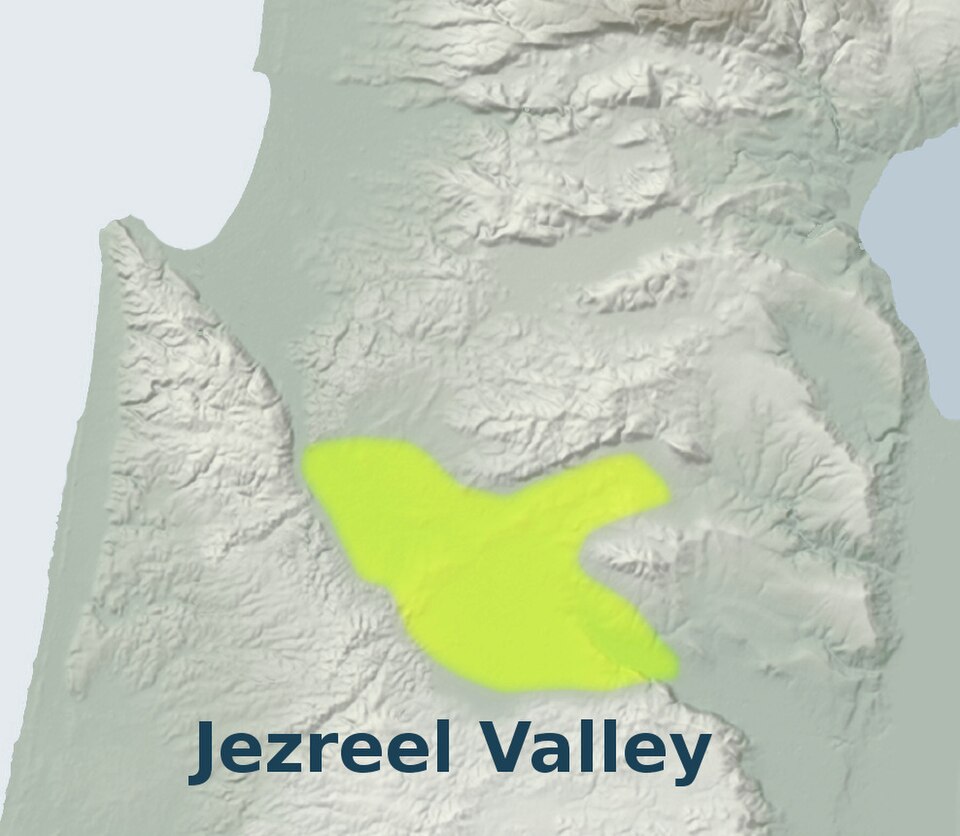 Source: Tamar Hayardeni, Jezreel Valley Map, CC BY-SA 4.0, via Wikimedia Commons.
The valley gives the child’s name a geographical weight. The broken bow is not an abstract defeat: the Lord confronts the military confidence of a kingdom rooted in real fields and roads. The place associated with judgment will return in the gathering promise of Hosea 2.
Unpitied: mercy is not military strength (Hosea 1:6-7)
- And she conceived again, and bore a daughter. And he said to him, Call her name, Unpitied: for I will no more have mercy on the house of Israel, but will surely set myself in array against them.
- But I will have mercy on the house of Juda, and will save them by the Lord their God, and will not save them with bow, nor with sword, nor by war, nor by horses, nor by horsemen.
The daughter’s name makes the warning more intimate. Israel has presumed on mercy while departing from the Lord; now mercy cannot be treated as an entitlement that makes repentance unnecessary. Brenton’s wording is active and severe: God will set Himself in array against the house of Israel. Religious belonging does not give wrongdoing immunity.
Yet the following verse speaks of mercy toward Juda. This is not a simple division between a permanently rejected people and a naturally deserving one. In the immediately preceding passage, Brenton has already named Juda in connection with judgment. Here the emphasis falls on the manner of salvation: it comes through the Lord their God, not through bow, sword, war, horses, or horsemen.
God does not merely offer His people a stronger version of the security they already trust. He calls them to recognize the source of deliverance. The verse does not forbid responsible protection or practical action. It overturns the fantasy that our instruments can guarantee life apart from Him.
Not my people: the covenant wound named (Hosea 1:8-9)
- And she weaned Unpitied; and she conceived again, and bore a son.
- And he said, Call his name, Not my people: for ye are not my people, and I am not your God.
The weaning of the daughter and birth of another son give the sign duration. This is not a single dramatic utterance that passes as quickly as it is heard. The names enter the family’s continuing life. The third name reaches the deepest loss: estrangement from the God to whom the people belong.
The two clauses of verse 9 answer one another. The people are no longer acknowledged as His people, and He refuses the relationship they presume to possess. The wound concerns communion, not simply the removal of benefits. We can want God’s protection while resisting His claim upon our worship and conduct; Hosea will not let those desires be mistaken for faithfulness.
Brenton’s next chapter answers this terrible name with a promise of restored sonship and belonging. St Paul draws on that reversal in Romans 9:25-26, applying Hosea’s language within God’s calling of Jews and Gentiles. The apostolic use does not turn Hosea into a verdict of contempt against Israel. It teaches the Church to marvel that mercy can call the estranged into communion. No one receives that mercy as a warrant to boast over another people.
Spiritual Fruit 🍇
Let the warning become personal without becoming a sentence of despair. In confession, name one way you have wanted God’s help while withholding a part of your life from Him. Speak about a real choice or habit rather than condemning your whole person as beyond mercy. Hosea’s sequence continues into restoration.
Notice your bow. When you feel unsafe or unimportant, what seems able to save you: control, money, influence, or the ability to win an argument? Use the practical means you need, but bring their limits before God. Ask Him to free you from demanding that another person carry the weight of being your savior.
Refuse names that make another person disposable. The children’s names are a unique prophetic sign, not a model for family speech. Do not use someone’s parentage, past sin, injury, or failure as his or her permanent identity. In Christ, repentance is possible and human dignity does not disappear when a painful truth is spoken.
Teaching Notes
A word within the divided kingdoms (Hosea 1:1)
- Ask: why does a word from God need to be distinguished from our own anger, even when that anger concerns a real wrong?
- Emphasize: Juda and Israel are distinct kingdoms named within the prophet’s historical setting.
A household becomes a sign (Hosea 1:2-3)
- Watch for: turning the sign into advice to endure abuse, assuming an unstated history for Gomer, or shaming children. Keep the reader-facing safety warning beside the sign.
- Ask: what does covenant language reveal about idolatry that the language of a mistaken opinion might miss?
Jezrael: bloodshed and the broken bow (Hosea 1:4-5)
- Emphasize: Brenton has Juda; the NKJV has Jehu. Do not teach Jehu’s dynastic history as though Brenton printed his name here.
- Ask: when do we mistake success for evidence that our conduct is right?
Unpitied: mercy is not military strength (Hosea 1:6-7)
- Ask: what changes when salvation is received from the Lord rather than credited to the means we control?
- Watch for: treating Juda as uniformly innocent or reading a ban on all practical means of protection into the verse.
Not my people: the covenant wound named (Hosea 1:8-9)
- Connect: explain that Brenton places the restoration promise at Hosea 2:1-2, corresponding to NKJV Hosea 1:10-11.
- Watch for: a conclusion of permanent rejection or anti-Jewish superiority; Romans applies the language of mercy to the calling of Jews and Gentiles.
Sources
Embedded Scripture is from Brenton’s English Septuagint (LXX).
Brenton, Osee 1, for the displayed text and chapter ending.
NKJV, Hosea 1-3, for the limited comparison of Juda and Jehu and the chapter-boundary difference.
Romans 9:25-26 study, on Hosea’s reversal of estrangement within the calling of Jews and Gentiles.
Footnotes
-
Saint Irenaeus, Against Heresies IV.20.12, primary text. The quoted fragment describes prophetic actions; the paragraph then names Hosea and interprets his household sign. ↩
-
Compare Brenton, Osee 1 with NKJV, Hosea 1-3. This identifies the difference between the displayed English readings; it does not establish how the difference arose. ↩