
Israel says that it knows God, yet its kings, silver, gold, altars, and fortresses tell a different story. Hosea 8 exposes the contradiction between the name on the lips and the trust governing the life. The warning reaches its sharpest point in a manufactured calf: a workman made it, and it is not God. What our own hands produce may be useful, beautiful, or powerful; none of it can become our Maker.
Historical and Scriptural Context
Samaria stands for the northern kingdom, while the closing verse also addresses Juda. Assyria is the foreign power to which Ephraim turns. Egypt names the threatened reversal of the freedom Israel received from God; the next chapter develops the prospect of exile and unclean food among the Assyrians (Hosea 9:3). The concern is larger than a mistaken political strategy: the people have treated covenant faithfulness as dispensable while multiplying substitutes for it.
A Claim to Know God (Hosea 8:1-3)
- He shall come into their midst as the land, as an eagle against the house of the Lord, because they have transgressed my covenant, and have sinned against my law.
- They shall soon cry out to me, saying, O God, we know thee.
- For Israel has turned away from good things; they have pursued an enemy.
Verse 1. Brenton’s difficult opening moves into the clear image of an eagle against the Lord’s house. The charge explaining the attack is explicit: covenant and law have been transgressed. Belonging to a holy house does not give immunity from the truth of the God whose house it is. The image confronts presumption, not the goodness of worship itself.
Verse 2. Their cry claims knowledge of God. Read against the accusation, the claim cannot be accepted merely because it is fervent or familiar. To know God is not to possess a password that secures His favor while His commands are treated as optional.
Verse 3. Israel has turned from good things and pursued an enemy. What promised protection has become a direction of flight away from the good. The prophet exposes a tragic exchange: covenant gifts are neglected while what will harm the nation receives its energy and loyalty.
The Workman and the Calf (Hosea 8:4-6)
- They have made kings for themselves, but not by me: they have ruled, but they did not make it known to me: of their silver and their gold they have made images to themselves, that they might be destroyed.
- Cast off thy calf, O Samaria; mine anger is kindled against them: how long will they be unable to purge themselves in Israel?
- Whereas the workman made it, and it is not God; wherefore thy calf, Samaria, was a deceiver:
Verse 4. The rulers have been established without reference to God, and precious metals have been turned into images. Political authority and wealth are not condemned simply for existing; they are judged in the uses to which the people have put them. A decision does not become faithful because it is efficient, popular, or expensive.
Verse 5. The calf must be cast off. The Lord’s anger is directed against a form of worship that keeps His people from purity. Repentance cannot be reduced to feeling ashamed of the idol while continuing to preserve its authority. Something that has become a rival to God may need to lose its place, even when relinquishing it is costly.
Verse 6. The distinction is exact: a workman made the calf, and it is not God. The object promises more than any created thing can give. This is not a rejection of every material object in Christian worship. Orthodox veneration does not identify an icon’s wood and paint with the divine nature; honor is directed to the person depicted. Hosea condemns the fabricated god that takes the Creator’s place, not the Incarnation’s sanctification of matter.
Gems from the Fathers 💎
Saint Gregory the Theologian brings Hosea’s criticism of rulers into his examination of spiritual authority. He warns of those who ruled for themselves rather than through God.1 His concern is not to supply a history of each northern king, but to place leaders under the word they teach. Read beside verse 4, it asks whether a position has become a possession to defend or a responsibility received for the good of others. Hosea 5 develops his warning about leaders who become a snare.
Blighted Seed and a Stolen Harvest (Hosea 8:7)
- for they sowed blighted seed, and their destruction shall await them, a sheaf of corn that avails not to make meal; and even if it should produce it, strangers shall devour it.
Verse 7. The seed is already blighted; the sheaf cannot produce meal; and even a surviving yield will be eaten by strangers. The verse closes every imagined route by which the present sowing might secure the people. The loss is not arbitrary. False worship and false trust cannot be cultivated as though they were seeds of covenant life.
Language insight: “blighted seed”
Brenton reads “for they sowed blighted seed,” as in the Scripture above. The familiar NKJV wording uses the different images of sowing wind and reaping whirlwind.2 Both readings connect what is sown with the ruin that follows, but they should not be blended into one quotation. Here the failed crop belongs directly to the chapter’s food imagery: there is a sheaf, but it cannot feed; there may be a yield, but it cannot be kept. The reader’s question is therefore not only what dramatic storm might follow a choice, but what sort of nourishment the choice can actually produce.
Swallowed Up Among the Nations (Hosea 8:8-10)
- Israel is swallowed up: now is he become among the nations as a worthless vessel.
- For they have gone up to the Assyrians: Ephraim has been strengthened against himself; they loved gifts.
- Therefore shall they be delivered to the nations: now I will receive them, and they shall cease a little to anoint a king and princes.
Verse 8. The people meant to retain their place among the nations, yet Israel is swallowed up and treated as a worthless vessel. The language describes national humiliation; it does not declare that exiles, foreigners, or displaced persons lack human worth. God’s judgment exposes the failure of the nation’s security, not a loss of the divine image in its members.
Verse 9. Ephraim has gone to Assyria and been strengthened against himself. An apparent increase of protection becomes self-injury. The gifts they love cannot create faithful love in the foreign power they approach. This is the chapter’s political form of idolatry: asking something dependent and interested to function as an unfailing refuge.
Verse 10. The Lord, rather than the diplomats, determines what follows. Brenton places being delivered to the nations beside God’s receiving them and the interruption of royal anointing. The compressed wording should not be stretched into a detailed timetable of restoration. Its sure force is that the political machinery in which the nation trusts will not remain in its control.
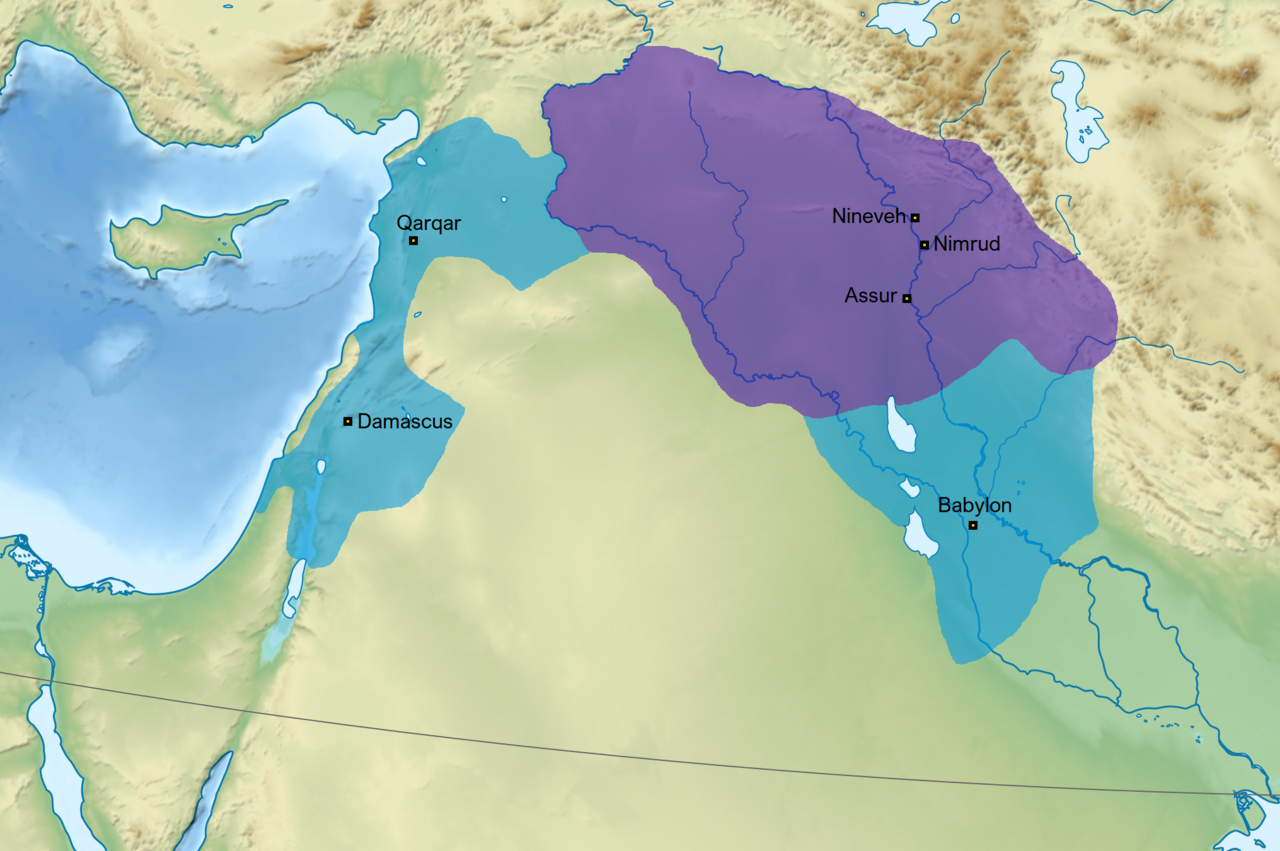 Source: Ichthyovenator, with Sémhur base map, Tiglath-Pileser map, CC BY-SA 4.0, via Wikimedia Commons.
The map sets Israel’s appeal for protection within Assyria’s expansion. An empire could receive tribute and provide temporary advantage without becoming the healer Israel needed. Hosea’s criticism concerns trust detached from covenant faithfulness, not the rejection of all diplomacy.
Many Altars, a Forgotten Maker (Hosea 8:11-14)
- Because Ephraim has multiplied altars, his beloved altars are become sins to him.
- I will write down a multitude of commands for him; but his statutes are accounted strange things, even the beloved altars.
- For if they should offer a sacrifice, and eat flesh, the Lord will not accept them: now will he remember their iniquities, and will take vengeance on their sins: they have returned to Egypt, and they shall eat unclean things among the Assyrians.
- And Israel has forgotten him that made him, and they have built fanes, and Juda has multiplied walled cities: but I will send fire on his cities, and it shall devour their foundations.
Verse 11. More altars have produced more sin. The equation between quantity and faithfulness has broken down: an increase of religious activity can deepen the very disorder it appears to remedy. The issue is not whether worship should be offered, but to whom, in what truth, and with what obedience.
Verse 12. God’s commands are counted as strange things. The people have made familiar what should have been rejected and foreign what should have formed their life. Scripture can suffer the same treatment when its words are heard every week but its correction is kept outside our decisions. Familiarity with sacred language is not yet hospitality to God’s will.
Verse 13. Sacrificial meat is eaten, but the Lord does not accept the offering. Participation in a meal cannot conceal unrepented iniquity. The movement toward Egypt and unclean food among Assyrians makes visible a loss of covenant freedom and worship. For Christians, this summons reverence and repentance before the Eucharist, not the false conclusion that the mysteries are merely symbols or that wounded people must make themselves sinless before seeking Christ.
Verse 14. Israel forgets its Maker while building fanes, meaning temples or shrines; Juda multiplies fortified cities. Religious and military construction stand together as visible achievements unable to replace fidelity. Fire reaches even their foundations. The chapter ends by asking what remains when the structures protecting our self-sufficiency are no longer able to hold.
Spiritual Fruit 🍇
Test what your activity can feed. A full calendar can resemble a sheaf that produces no meal. Choose one repeated activity and ask whether it nourishes prayer, honest work, mercy, and the people entrusted to you, or merely preserves the appearance of importance. Do not abandon a duty simply because it feels dry; seek to recover its truthful purpose in Christ.
Let God’s command become at home again. Read a short passage slowly enough to notice the sentence you would prefer to leave strange. Bring that resistance to confession or trusted pastoral counsel. The point is not to invent an impressive rule but to stop excluding the known will of God from an ordinary decision.
Receive rather than manufacture your refuge. Money, institutions, skilled work, and sensible protections have their proper place. Give thanks for them without asking them to guarantee your life. At prayer and in the Church’s mysteries, return to the Maker who knows you before you have anything to display. A created support becomes dangerous when losing it seems equivalent to losing God.
Teaching Notes
A Claim to Know God (Hosea 8:1-3)
- Ask: What can make a true religious phrase become a way of avoiding repentance?
- Watch for: Do not import another translation’s opening trumpet into Brenton’s displayed verse.
The Workman and the Calf (Hosea 8:4-6)
- Ask: What does the distinction between a workman and God expose?
- Watch for: Distinguish the worship of a manufactured god from Orthodox veneration of an icon.
Blighted Seed and a Stolen Harvest (Hosea 8:7)
- Ask: What does a sheaf that cannot make meal reveal about false trust?
- Watch for: Identify the wind and whirlwind as NKJV imagery, not Brenton’s wording.
Swallowed Up Among the Nations (Hosea 8:8-10)
- Ask: How can an apparent gain in strength become self-injury?
- Watch for: National humiliation does not diminish the dignity of displaced people.
Many Altars, a Forgotten Maker (Hosea 8:11-14)
- Ask: How can a command become strange in a religiously busy life?
- Watch for: The rebuke of unfaithful sacrifice is not a rejection of the Eucharist or an instruction to avoid pastoral help.
Sources
Embedded Scripture is from Brenton’s English Septuagint (LXX).
Footnotes
-
Saint Gregory the Theologian, Oration 2.57, primary text, applying Hosea’s condemnation of self-serving rule to priests and rulers. ↩
-
Hosea 8:7, Brenton and NKJV readings. The comparison identifies the differing images; it does not establish a particular manuscript history for them. ↩