


Joseph falls upon his father’s face, weeps, and kisses him. The man who once seemed lost now mourns the father who was restored to him. Genesis ends through this tender grief, the brothers’ renewed fear, Joseph’s promise to feed them, and a coffin left in Egypt awaiting God’s visitation. Its final chapter teaches mercy without pretending that evil was good, and hope without pretending that every promise has already been fulfilled.
Jacob’s blessing and burial charge stand immediately behind the chapter. Joseph’s authority makes a great funeral procession possible, but neither power nor long life can complete the promise to Abraham. The family will return to Egypt after burying Jacob. Before his own death, Joseph gives them words to remember when he can no longer provide for them: God will bring them up.
Joseph’s tears and Egypt’s mourning (Genesis 50:1-3)
1 And Joseph fell upon his father’s face, and wept on him, and kissed him. 2 And Joseph commanded his servants the embalmers to embalm his father; and the embalmers embalmed Israel. 3 And they fulfilled forty days for him, for so are the days of embalming numbered; and Egypt mourned for him seventy days.
Joseph’s first response to death is personal: his father’s face, his tears, his kiss. The preceding blessing does not spare him grief. Faith and sorrow occupy the same scene. A believer need not turn immediately from a loved one’s body to an explanation of why the loss happened. Love may first speak by weeping.
The embalming and the seventy days of Egyptian mourning show how deeply this family’s life has entered Egypt. Joseph uses the embalmers who serve him, and the land mourns Israel. At the end, Joseph too will have his corpse prepared and be placed in a coffin in Egypt. The practices surround a family whose hope remains governed by God’s promise.
For a Coptic Christian reader, Egypt is both a real homeland and a place within Scripture’s history of preservation. Here Egyptians honor Jacob, whose household found shelter among them. Later Pharaoh’s oppression will be real also. The story should not turn a whole people or country into a permanent symbol of evil. God’s mercy reaches persons within the lands where His people live, and the Church’s hope in resurrection accompanies the care she gives to bodies there.
An oath honored and a family returning (Genesis 50:4-14)
4 And when the days of mourning were past, Joseph spoke to the princes of Pharao, saying, If I have found favour in your sight, speak concerning me in the ears of Pharao, saying, 5 My father adjured me, saying, In the sepulchre which I dug for myself in the land of Chanaan, there thou shalt bury me; now then I will go up and bury my father, and return again. 6 And Pharao said to Joseph, Go up, bury thy father, as he constrained thee to swear. 7 So Joseph went up to bury his father; and all the servants of Pharao went up with him, and the elders of his house, and all the elders of the land of Egypt. 8 And all the household of Joseph, and his brethren, and all the house of his father, and his kindred; and they left behind the sheep and the oxen in the land of Gesem. 9 And there went up with him also chariots and horsemen; and there was a very great company. 10 And they came to the threshing-floor of Atad, which is beyond Jordan; and they bewailed him with a great and very sore lamentation; and he made a mourning for his father seven days. 11 And the inhabitants of the land of Chanaan saw the mourning at the floor of Atad, and said, This is a great mourning to the Egyptians; therefore he called its name, The mourning of Egypt, which is beyond Jordan. 12 And thus his sons did to him. 13 So his sons carried him up into the land of Chanaan, and buried him in the double cave, which cave Abraam bought for possession of a burying place, of Ephrom the Chettite, before Mambre. 14 And Joseph returned to Egypt, he and his brethren, and those that had gone up with him to bury his father.
When the mourning is past, Joseph asks Pharaoh’s princes to speak for him. His request rests on the oath to his father, not on a claim that his office places him above permission. Pharaoh grants it. The elders, servants, household, chariots, and horsemen make the procession public and weighty. Jacob leaves Egypt surrounded by the honor given to his son, yet the destination is the burial possession Abraham acquired.
The cave before Mamre links the funeral to Genesis 23 and Jacob’s final words in Genesis 49. Joseph’s obedience carries a remembered promise into an actual action. Covenant memory survives because sons undertake the journey and keep the charge they received. The sheep and oxen remain in Gesem, the place commonly called Goshen, and Joseph promises to return. Jacob’s burial is a journey toward the promised land, not yet the Exodus of Israel’s household.
At Atad the mourning is so great that the Canaanites identify it as “The mourning of Egypt.” Joseph observes seven days of lamentation there. The passage gives both family sorrow and public witness room to be seen. The sons then carry him to Canaan and lay him in the ancestral cave, completing the charge he gave them.
Then Joseph and his brothers go back. A grave in the promised land is now part of their history, while daily life continues elsewhere. That tension trains patience. Obedience may be complete in one task while the larger promise is still waiting. Christian hope permits us to honor a loved one, return to the duties before us, and entrust the future to God without treating ordinary work as a betrayal of grief.
Fear returns after the father’s death (Genesis 50:15-18)
15 And when the brethren of Joseph saw that their father was dead, they said, Let us take heed, lest at any time Joseph remember evil against us, and recompense to us all the evils which we have done against him. 16 And they came to Joseph, and said, Thy father adjured us before his death, saying, 17 Thus say ye to Joseph, Forgive them their injustice and their sin, forasmuch as they have done thee evil; and now pardon the injustice of the servants of the God of thy father. And Joseph wept while they spoke to him. 18 And they came to him and said, We, these persons, are thy servants.
The brothers fear that Joseph has been storing up revenge until Jacob’s death. Their own words name “all the evils” they have done. His forgiveness in Genesis 45 has not yet quieted their suspicion. Guilt can make mercy seem like a pause in punishment rather than a real change in the relationship. Here the father’s absence exposes what the brothers still imagine about Joseph.
They report a command from Jacob asking him to pardon them. The narrator records their report but does not independently show Jacob giving that instruction. We cannot decide from these verses whether the message is authentic or a plea shaped to secure safety. What is certain is their acknowledgment of injustice and sin. They appeal as servants of their father’s God, invoking a bond deeper than Joseph’s political authority.
Joseph weeps as they speak. The text leaves his tears unexplained, so they should not be made proof that he knows the message is false. Sorrow over the old wrong and pain at their continued fear are both possible within the scene. His answer, rather than our reconstruction of his motive, will disclose how he chooses to receive them.
The brothers offer themselves as his servants. This recalls the dreams in Genesis 37, when their sheaves bowed to Joseph’s: the men who sold Joseph into slavery now place themselves at his disposal. His response will turn their submission toward relief rather than exploitation.
“I am God’s”: providence becomes bread and peace (Genesis 50:19-21)
19 And Joseph said to them, Fear not, for I am God’s. 20 Ye took counsel against me for evil, but God took counsel for me for good, that the matter might be as it is to-day, and much people might be fed. 21 And he said to them, Fear not, I will maintain you, and your families: and he comforted them, and spoke kindly to them.
Joseph begins with belonging: “Fear not, for I am God’s.” His authority in Egypt does not make him self-owned. He belongs to the God whose goodness has preserved life, and that belonging governs what he will do with the power now in his hands. The NKJV’s Hebrew-based form is a question: “for am I in the place of God?”1 Both readings restrain vengeance, but Brenton’s positive confession deserves to be heard in its own right. Joseph can release the desire to repay because his life and judgment are entrusted to God.
The next sentence names two counsels and keeps them morally distinct. The brothers took counsel for evil; God took counsel for good. Joseph does not deny the wrong or call it necessary holiness. He looks at the life now preserved: “much people might be fed.” Providence is God’s wise and merciful governance of creation, including His freedom to bring saving good through circumstances disfigured by human sin. He remains good while their intent remains evil.
This confession belongs to Joseph, the wounded man who can now perceive a particular good. It must not be weaponized against grieving or wounded people. We have no right to announce that an assault, betrayal, or loss was good for its victim, or to demand gratitude for it. God’s power to redeem evil never becomes permission to commit it. Seeking safety, appropriate care, and justice is compatible with entrusting vengeance to Him; forgiveness does not require unsafe contact or immediate restoration of trust.
The Cross reveals the deepest fullness of this providential pattern. Acts 2:23 joins God’s determined purpose with the “lawless hands” that crucified Jesus; verse 24 announces God’s raising Him from death. Acts 4:27-28 names Herod, Pilate, Gentiles, and the people of Israel gathering against the Lord’s anointed servant, while confessing God’s saving purpose. The human act remains lawless. The divine purpose gives life through the death and Resurrection of the innocent Christ. Joseph’s preservation of many lives prepares us to recognize this saving mystery without making Joseph the Savior or reducing the Cross to successful human administration.
Christ’s prayer for His enemies in Luke 23:34 shows mercy from within suffering. Romans 8:28 assures those who love God that all things work together for good. That hope rests in God’s faithfulness, not in our ability to explain another person’s wound. Joseph fed many with grain. Christ gives His flesh for the life of the world (John 6:51), and at the Eucharist the crucified and risen Lord feeds His Church with His own life. Those who receive His mercy are sent to make their provision for others an act of peace.
Joseph makes his reassurance practical. He will maintain the brothers and their families. The man once sold for twenty pieces of gold in Brenton’s Genesis 37:28 now feeds those who sold him. Money once measured a brother as merchandise. Provision now honors people whose need Joseph could have used against them.
His words complete another reversal. Genesis 37:4 said that the brothers “could not speak anything peaceable to him.” Genesis 50:21 ends his reply with comfort and kindly speech. The hatred that first destroyed speech has been answered by words that make the frightened hearer safe. Forgiveness reaches the mouth and the table. Its truth can be heard in how he addresses them and seen in the bread their households receive.
Gems from the Fathers 💎: mercy when retaliation is possible
St. John Chrysostom, preaching on forgiveness and the parable of the unforgiving servant (Matthew 18:21-35) in Homily LXI, turns from God’s generosity toward human examples of enemy-love. He names Joseph, “who suffered countless things, and did good unto his brethren”.2 The homily’s closing appeal asks hearers to cast away anger and seek God’s forgiveness. Joseph illuminates that appeal because his mercy is active: he uses power to do good rather than merely postponing harm.
That is a searching distinction for ordinary life. When we can deny a favor, withhold food, damage a reputation, or speak contemptuously without immediate consequences, our freedom reveals what anger has made of us. Joseph’s belonging to God gives another possibility. We can ask Christ to make the next word or practical decision serve the person’s good, while retaining the boundaries needed to prevent further harm.
Bones awaiting visitation, promises awaiting fulfillment (Genesis 50:22-26)
22 And Joseph dwelt in Egypt, he and his brethren, and all the family of his father; and Joseph lived a hundred and ten years. 23 And Joseph saw the children of Ephraim to the third generation; and the sons of Machir the son of Manasse were borne on the sides of Joseph. 24 And Joseph spoke to his brethren, saying, I die, and God will surely visit you, and will bring you out of this land to the land concerning which God sware to our fathers, Abraam, Isaac, and Jacob. 25 And Joseph adjured the sons of Israel, saying, At the visitation with which God shall visit you, then ye shall carry up my bones hence with you. 26 And Joseph died, aged an hundred and ten years; and they prepared his corpse, and put him in a coffin in Egypt.
Joseph lives to see Ephraim’s descendants to the third generation and the sons of Machir “borne on the sides of Joseph.” The family is growing in Egypt. His long life and the children around him testify to preservation, yet he names death plainly: “I die.” He then places God’s action beside his own departure. His death will end his administration; it will not end the promise sworn to Abraham, Isaac, and Jacob.
“God will surely visit you” means that God will come to act for His people. Joseph does not give them a date or make their deliverance depend on his continued influence. He binds the sons of Israel by an oath to carry his bones when that visitation comes. The body left in Egypt becomes a reminder to the living that they must look beyond their present settlement.
Exodus 3:16 announces God’s attention to Israel’s affliction. Exodus 4:31 says that the people believed when they heard that God had visited them and seen their suffering. At the departure, Moses takes Joseph’s bones because of this oath (Exodus 13:19). Joshua 24:32 records their burial at Shechem, Brenton’s Sicima, in the portion Jacob bought and gave to Joseph. This closes the thread of land and inheritance carried through Genesis 33:19 and 48:22. The words spoken beside Joseph’s death become an obligation kept by generations he never met.
The Gospel gives visitation an even greater depth. Zechariah blesses the God who “has visited and redeemed His people” (Luke 1:68), joining that deliverance to the holy covenant and the oath to Abraham. Luke 1:78-79 speaks of the Dayspring visiting from on high to give light to those in death’s shadow and guide them into peace. Jesus’ warning in Luke 19:44 grieves over a city that failed to know the time of its visitation. God’s coming seeks a response of faith. In Christ, the promise reaches beyond leaving one country: the incarnate Son delivers His people from sin and death and leads them into communion with God.
Gems from the Fathers 💎: the oath trains the living to believe
St. John Chrysostom interprets Hebrews 11:22 in Homily XXVI. Joseph, he says, trusted the promise while living in a foreign land and gave the command about his bones so that Israel would keep the Exodus in mind. “He then not only believed himself, but led on the rest also to Faith”.3 The burial instruction teaches the people who must continue living after him.
Chrysostom then resists making this into anxiety over the right grave. He recalls that the earth belongs to the Lord and names righteous people buried away from their homeland. Joseph’s purpose is faith in the coming deliverance, not a belief that God’s care stops at a national border. This corrects an overreading of Jacob’s burial and Joseph’s bones: the places have covenant meaning in these particular histories, but a Christian’s resurrection does not depend on reaching a favored cemetery. We honor the body because the person belongs to God, wherever burial must take place.
Chrysostom also speaks more severely: “to mourn however, and lament, and bewail the departed, arises from littleness of mind.”3 That rebuke stands in tension with this chapter’s loving tears and public mourning. Joseph weeps on his father’s face, and the family keeps a solemn lamentation without the narrator condemning it. The pastoral lesson we draw from Scripture is that love may grieve while entrusting the departed to God. Bereaved people need prayer, patient companionship, and appropriate support; sorrow is not proof that their faith has failed. The oath and the tears belong to one believing life.
The Church’s Voice in Worship ⛪
On the Friday of the seventh week of Great Lent, the closing Friday of the Holy Forty Days before Lazarus Saturday, the Coptic Church hears Jacob’s death in Genesis 49:33 followed by all of Genesis 50 at Matins.4 On the same morning, Job 42:7-17 tells how Job prayed for the friends whose words about God had been wrong, and how his own household and acquaintances shared a meal and comforted him. Beside Joseph’s provision and kindly speech, the readings give the fasting faithful mercy to practice as prayer, nourishment, and consolation. His oath also directs their hearts toward the Lord who will conquer death.
Genesis 50:4-25 is also appointed in the funeral service for men during Holy Week in the cited Coptic service book.5 It is a particular service assignment, not the reading for every Coptic funeral. Beginning with Joseph’s request to bury Jacob and ending with the promise of visitation, it places mourning within remembered promise and active mercy. The Church can commend the departed to God while asking the living to forgive, provide, and wait for resurrection. The faithful body is treated with reverence because salvation concerns the whole person.
Genesis itself ends with a prepared corpse and a coffin in Egypt. The beginning of the book showed creation given life by God and human disobedience bringing death into the story. The struggle between the serpent and the woman’s seed in Genesis 3:15 remains unresolved at this coffin. The blessing pledged to Abraham for all the earth in Genesis 12:3 and 22:18 has not yet reached its fullness. The things stored up for Judah’s line, and the one who is “the expectation of nations” in Genesis 49:10, have not yet come. Yet the coffin is accompanied by a promise: God will visit.
The final chapter therefore gathers the whole book without closing off its future. Life has been preserved, brothers have been shown mercy, and descendants have multiplied. Death is still present, and the family is still away from the land. Christ will fulfill what these promises begin: the offspring who defeats the enemy, the blessing reaching the nations, and the king whose victory gives life. Christian hope does not deny the coffin. It confesses that the Lord’s last word will be greater than the one we can presently see.
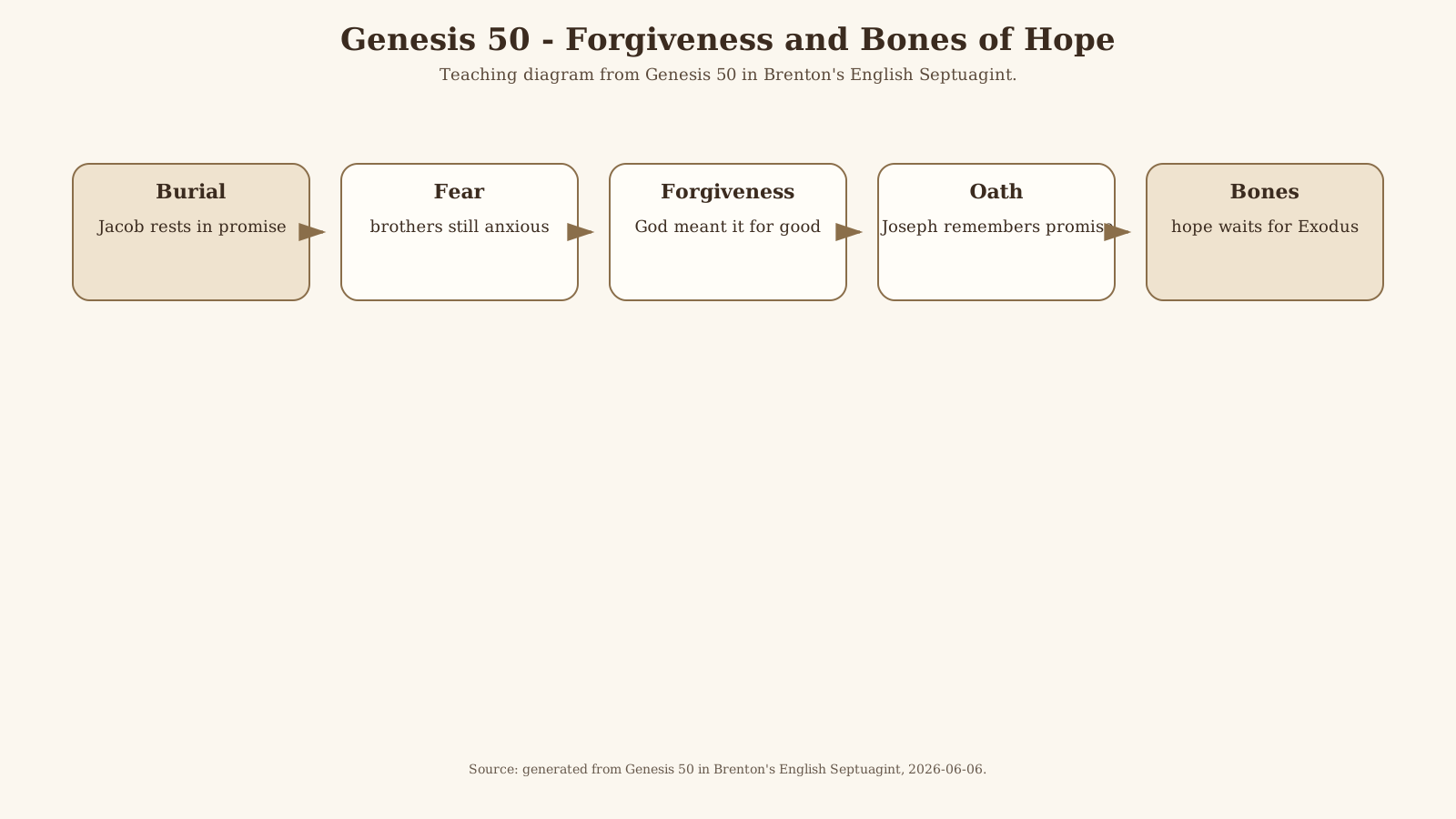 Genesis 50 narrative schematic based on Brenton’s English Septuagint.
Spiritual Fruit 🍇
Allow grief to remain personal before trying to explain it. Joseph weeps on his father’s face before arranging the funeral. When someone is bereaved, offer presence, a meal, help with a necessary task, or a quiet prayer. Avoid making a theory of providence the first thing you say. If you are grieving, receive the support you need without treating tears as a failure to believe in resurrection.
Let belonging to God govern the power now in your hands. Joseph’s “I am God’s” comes when his brothers fear repayment. Before making a decision that could disadvantage someone who hurt you, pray over that confession. Refuse revenge disguised as an ordinary use of authority. Ask what truth, safety, and mercy require in the specific case; wise boundaries can stand alongside the release of hatred.
Make peace audible and useful. The brothers once could not speak peaceably; Joseph now comforts them and feeds their households. Examine the next conversation with someone you resent. Remove contempt, threats, and rehearsed accusations. Speak truthfully and, when safe and appropriate, do one concrete good that meets a real need. A peaceful tone without honest conduct is too little; provision used to buy submission is not Joseph’s mercy.
Trust providence without claiming another person’s explanation. Joseph names evil as evil and recognizes God’s saving good in his own history. Thank God for a real mercy that you can identify without blessing the wrong that preceded it. Where a wound remains painful or unexplained, ask for healing and help. You need not make suffering intelligible before you may entrust it to Christ.
Leave those who remain a promise they can live by. Joseph’s oath keeps the Exodus before future generations. Speak with your household about practical responsibilities and wishes, but also give them the words of Scripture that have sustained you. Pray for the departed and remember the resurrection when caring for a grave. The final homeland is communion with God, not the privilege of being buried in a particular place.
Lord Jesus Christ, You have visited Your people and entered death to give us life. Receive our tears, free our speech from resentment, and teach us to use strength for mercy. Keep those we love in Your care, and grant us patience to trust the promise that outlives our sight. Amen.
Teaching Notes
Joseph’s tears and Egypt’s mourning (Genesis 50:1-3)
- Ask: What does Joseph do before any funeral arrangements begin?
- Watch for: Egyptian bodily care is described without requiring Egyptian religious beliefs; tears do not disprove resurrection faith.
An oath honored and a family returning (Genesis 50:4-14)
- Ask: How do the journey and the return to Egypt hold obedience and unfinished promise together?
- Watch for: Do not invent the route beyond the named places or confuse this funeral journey with the Exodus.
Fear returns after the father’s death (Genesis 50:15-18)
- Ask: What do the brothers’ words reveal about their guilt and their understanding of Joseph’s mercy?
- Watch for: Jacob’s message is reported, not independently confirmed; Joseph’s tears do not establish deceit. Brenton does not print the NKJV’s falling-down gesture here.
“I am God’s”: providence becomes bread and peace (Genesis 50:19-21)
- Ask: How do Joseph’s belonging, counsel, kindly speech, and provision form one answer to fear?
- Watch for: Do not weaponize providence against grieving or wounded people; Joseph’s words are holy, but they are not permission for casual speech over someone else’s suffering. Forgiveness does not demand unsafe reconciliation.
Bones awaiting visitation, promises awaiting fulfillment (Genesis 50:22-26)
- Ask: What do Joseph’s bones teach people who will live after his death, and how does this ending gather Genesis’s promises?
- Watch for: Chrysostom emphasizes faith in the Exodus, not a universally required burial location. The Holy Week funeral reading is a particular assignment, not a universal one.
Sources
Embedded Scripture is from Brenton’s English Septuagint (LXX). New Testament quotations are from NKJV.
Genesis 3:15; 12:3; 22:18; 23; 33:19; 37:4, 7-10, 28; 48:22; 49:10, 29-33; 50; Exodus 3:16, 4:31, 13:19; Joshua 24:32. Brenton Genesis 50 🔗; NKJV comparison 🔗.
Acts 2:23-24 and 4:27-28; Romans 8:28; Luke 1:68-79, 19:44, and 23:34; John 6:51; Hebrews 11:22, for providence, mercy, life-giving nourishment, and visitation fulfilled in Christ.
St. John Chrysostom, Homilies on Matthew LXI, concluding exhortation on enemy-love, and Homilies on Hebrews XXVI, section 2, on Joseph’s bones. The latter also challenges excessive concern over burial location and speaks severely against mourning. Exact citations follow below.
Coptic Katameros for Holy Lent, Friday of the seventh week, Matins, Genesis 49:33 and 50:1-26; date-resolved reading for 3 April 2026 🔗. The service text uses Hebrew-based English wording; the embedded chapter here retains Brenton.
Funeral Services for the Laity, “Funeral Services for Men during Passion Week,” pp. 55-56 🔗. The preceding section, “At the Burial Site” (p. 54), is separate from this Holy Week service.
The narrative schematic summarizes the chapter’s sequence. It is not a funeral-service diagram or an exact route map.
Footnotes
-
Brenton Genesis 50:19 🔗, compared with NKJV Genesis 50:19 🔗. Genesis 37:28 has “twenty pieces of gold” in Brenton 🔗, unlike the Hebrew-based silver. ↩
-
St. John Chrysostom, Homilies on Matthew LXI, closing exhortation 🔗, George Prevost translation revised by M. B. Riddle, Nicene and Post-Nicene Fathers, first series, vol. 10 (1888). ↩
-
St. John Chrysostom, Homilies on Hebrews XXVI, section 2 🔗, Nicene and Post-Nicene Fathers, first series, vol. 14 (1889). Printed as Homily XXVI (CCEL section v.xxx). The English version in this volume is the Oxford translation revised by Frederic Gardiner. The first quotation precedes his argument that the whole earth belongs to the Lord; his severe rebuke of mourning follows it. ↩ ↩2
-
Coptic Katameros for Holy Lent, Friday of the seventh week, Matins; Genesis 49:33-50:26, corroborated by the 3 April 2026 readings 🔗. The companion prophecies are Proverbs 11:27-12:22, Isaiah 66:10-24, and Job 42:7-17. ↩
-
Funeral Services for the Laity, pp. 55-56, “Funeral Services for Men during Passion Week,” Genesis 50:4-25 🔗. The rubric prescribes Genesis followed by the Trisagion, Gospel litany, Psalm and Gospel as previously given, then absolutions, blessing, and the Lord’s Prayer. ↩