


Jacob has obeyed the command to return, yet the road home brings him toward the brother he once deceived. God’s promise and Jacob’s fear occupy the same night. He prays for the mothers and children, sends gifts ahead, and finally stands alone before a stranger who wrestles with him until morning. The blessing he receives comes with a new name; the sunrise finds him still needing help in his body. Genesis 32 teaches us to bring our actual fear before God, to receive identity without disguise, and to seek the Lord whose nearness is a gift before it is anything we can endure or understand.
Behind Jacob lies the guarded parting from Laban in Genesis 31. Before him lies Esau’s embrace in Genesis 33. Between them, prayer names what careful planning cannot settle: whether he and his household will be received alive. Bethel’s promise accompanies him into this uncertainty. The man who once spoke another son’s name before Isaac will now answer with his own.
God’s camp before the frightening report (Genesis 32:1-3)
1 And Laban rose up in the morning, and kissed his sons and his daughters, and blessed them; and Laban having turned back, departed to his place. 2 And Jacob departed for his journey; and having looked up, he saw the host of God encamped; and the angels of God met him. 3 And Jacob said, when he saw them, This is the Camp of God; and he called the name of that place, Encampments.
Laban’s kiss and blessing close the encounter behind Jacob. The narrator then turns to Jacob’s journey and the angels who meet him. At Bethel, he had seen angels ascending and descending in a dream; here he looks up and sees God’s host encamped. Divine care accompanies the return as it accompanied the departure. Jacob receives this disclosure before he hears of Esau’s four hundred men. God’s presence is already a reality when the frightening report arrives.
Jacob names what he has been shown: “This is the Camp of God.” Soon he will divide his own people and animals into camps, hoping one may survive an attack. The repeated camp-language brings heavenly presence and human vulnerability into the same account. It gives his precautions a wider horizon. He may act responsibly while knowing that his household’s life exceeds the reach of his arrangements.
God’s camp does not promise that a believer will never suffer bodily harm. It shows that danger does not exhaust the truth about the road. When anxiety makes every possible loss vivid, remembrance of God restores another reality to our attention.
Language insight: “Encampments”
Brenton translates the place-name as “Encampments.” The Greek has Παρεμβολαί (parembolai), a plural for camps; the familiar Hebrew name “Mahanaim” has a dual form, commonly rendered “two camps.”1 The Greek plural and Jacob’s later division into two camps should be heard together, without making the name a precise diagram of one human camp and one heavenly camp. Scripture shows him the host of God; its presence gives courage for a journey whose practical uncertainties remain.
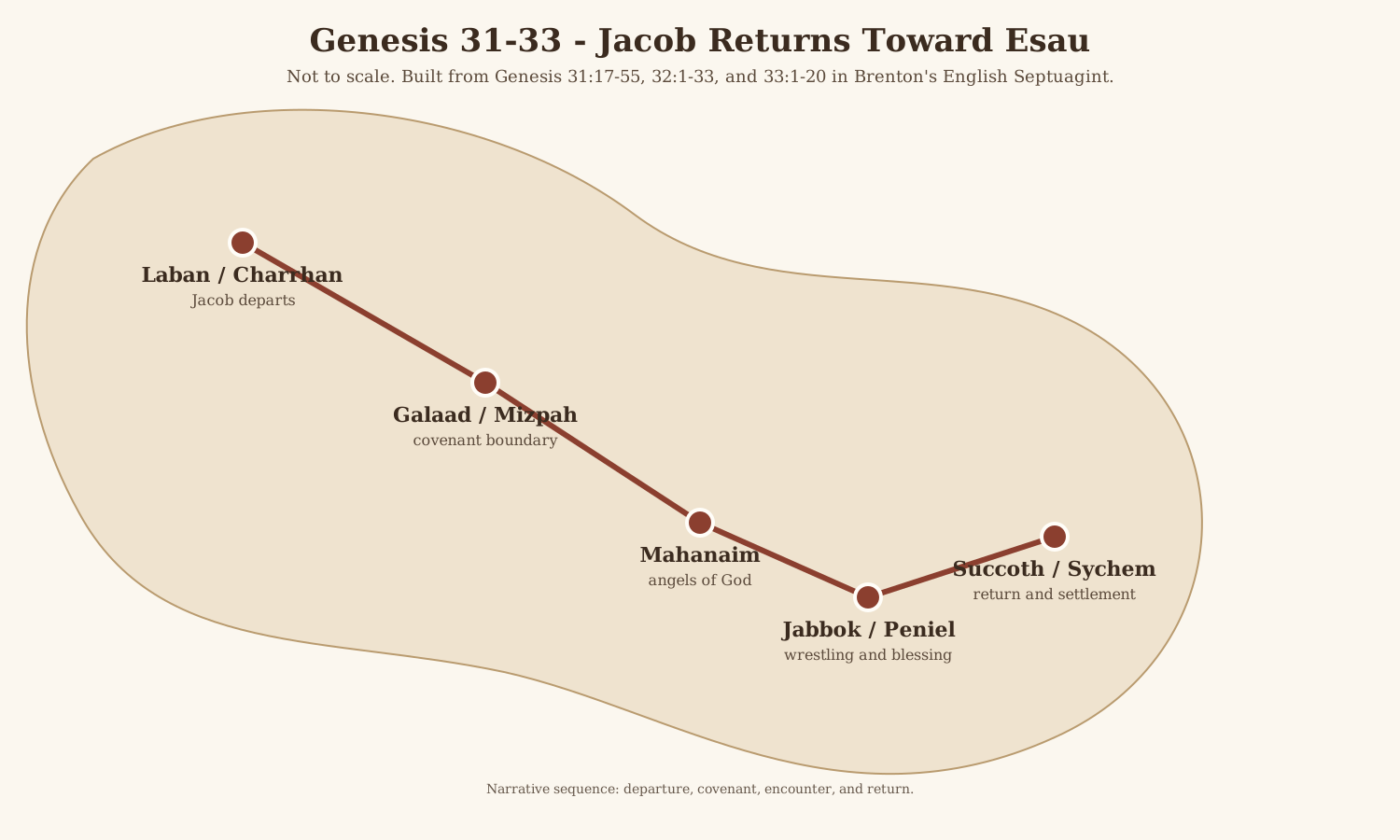 Source: Genesis 31–33 narrative schematic; not to scale.
A brother’s approach and a household’s fear (Genesis 32:4-9)
4 And Jacob sent messengers before him to Esau his brother to the land of Seir, to the country of Edom. 5 And he charged them, saying, Thus shall ye say to my lord Esau: Thus saith thy servant Jacob; I have sojourned with Laban and tarried until now. 6 And there were born to me oxen, and asses, and sheep, and men-servants and women-servants; and I sent to tell my lord Esau, that thy servant might find grace in thy sight. 7 And the messengers returned to Jacob, saying, We came to thy brother Esau, and lo! he comes to meet thee, and four hundred men with him. 8 And Jacob was greatly terrified, and was perplexed; and he divided the people that was with him, and the cows, and the camels, and the sheep, into two camps. 9 And Jacob said, If Esau should come to one camp, and smite it, the other camp shall be in safety.
Jacob sends words of deference: “my lord Esau,” “thy servant Jacob.” Isaac’s earlier blessing had spoken of Jacob being lord of his brother (Genesis 27:29). Now Jacob approaches without demanding that Esau enact that hierarchy. He reports his years away and the household he has acquired, asking to find grace. The brother who had once obtained an advantage through concealment now seeks an audience under his own name. These words make room for peace, even while fear is still shaping his preparations.
The messengers return with facts that Jacob finds terrifying: Esau is coming, and four hundred men accompany him. They report no speech threatening an attack. The earlier threat against Jacob’s life makes his fear intelligible. He imagines what may happen and divides the household. Verse 9 gives his conditional reasoning: if one camp is struck, the other may be safe. His plan tries to limit a possible loss; it cannot guarantee the future.
Memory may identify a real danger, but it can also make us hear intentions another person has not expressed. Jacob’s fear deserves serious attention; Esau’s eventual embrace deserves to be received as something fear had not predicted. God can work in the person we dread as well as in us.
Jacob is no longer the solitary traveler who lay down at Bethel. His decision concerns people who depend on him. He divides the camp, then turns to God. Christian trust can likewise accompany a safety plan, an honest conversation, or counsel sought before a difficult meeting.
The prayer that remembers a staff (Genesis 32:10-13)
10 And Jacob said, God of my father Abraam, and God of my father Isaac, O Lord, thou art he that said to me, Depart quickly to the land of thy birth, and I will do thee good. 11 Let there be to me a sufficiency of all the justice and all the truth which thou hast wrought with thy servant; for with this my staff I passed over this Jordan, and now I am become two camps. 12 Deliver me from the hand of my brother, from the hand of Esau, for I am afraid of him, lest haply he should come and smite me, and the mother upon the children. 13 But thou saidst, I will do thee good, and will make thy seed as the sand of the sea, which shall not be numbered for multitude.
Jacob’s prayer begins with the God of Abraham and Isaac, then addresses the Lord who has spoken to him personally. The family’s faith has become the ground of his own appeal. “Thou art he that said to me” locates his hope in a received word. In Genesis 31:3, God commanded his return and promised His presence. Jacob brings that command into the danger now facing him. Obedience has led him to a place where he needs the One who commanded it.
The remembered staff gives gratitude a concrete shape. He crossed the Jordan carrying it; now he has become two camps. The arrangement that expresses his fear also testifies to God’s provision. Gratitude allows distress to remain: the life now endangered has already been sustained by God.
The urgent center is verse 12. He asks to be delivered from his brother’s hand and says plainly, “I am afraid of him.” He names the possible destruction of mother and children along with himself. Those words are a responsible intercession for vulnerable lives. Fear spoken truthfully can become prayer; its admission is not automatically repentance, since fear itself is not necessarily a sin. Where Jacob has sinned, he must face that truth too. Here he asks for rescue without hiding behind the appearance of a fearless patriarch.
Verse 13 returns to God’s promise of innumerable descendants. The prayer begins and ends with what God has said, enclosing gratitude and fear within faithfulness. Jacob pleads for the household through which that promise is being carried. Christians learn the same shape of prayer when they let Scripture supply their hope and then name the actual need before them. God’s promises give confidence in His saving goodness; they do not authorize us to declare every desired outcome a debt He must pay.
Hebrews 4:16 gives this dependence its Christian boldness: “Let us therefore come boldly to the throne of grace, that we may obtain mercy and find grace to help in time of need.” Our access is through Christ, the merciful High Priest. Need is something to bring before Him, not a reason to withdraw until we can appear spiritually composed. The promise makes room for the frightened person to pray.
Language insight: “a sufficiency”, “justice”, and “truth”
Verse 11 in this Septuagint translation is a petition: “Let there be to me a sufficiency.” Brenton renders the Greek language of sufficiency as a petition; the Greek also names δικαιοσύνη (dikaiosynē), “justice” or “righteousness,” and ἀλήθεια (alētheia), “truth.”1 Jacob appeals to God’s righteous and truthful dealings already manifested toward His servant. His need is for that faithfulness to sustain him now.
Readers familiar with Hebrew-based translations may remember a declaration of unworthiness at this point, numbered Genesis 32:10 in those editions. That is a real translation-shape difference, not the literal sentence quoted here.2 Brenton’s wording emphasizes a request for sufficient divine faithfulness. Humility remains visible in Jacob’s position as servant and in his remembrance of the staff, but the explanation should follow the prayer he actually speaks. He asks to live from God’s goodness, rather than presenting his own achievements as sufficient.
The Church’s Voice in Worship ⛪
The Coptic lectionary assigns Genesis 32:1–30, verses 2–31 in this guide, among the Matins prophecies on Thursday of the fourth week of Great Lent.3 Jacob’s prayer and his refusal to let the stranger go without a blessing speak powerfully within a season of repentance. Fasting exposes how little control we possess over our desires; prayer turns that discovery toward the Lord who sustains His servants. We return to Him with the fear, gratitude, and unfinished obedience we actually have.
The Church’s repeated cry for mercy teaches us to remain before God in attention and dependence. Lenten labor responds to grace; it cannot compel a revelation. The reading reaches Jacob’s confession that he has seen God and lived, leading the worshiper toward grateful reception of divine nearness.
Gifts sent toward a brother’s face (Genesis 32:14-22)
14 And he slept there that night, and took of the gifts which he carried with him, and sent out to Esau his brother, 15 two hundred she-goats, twenty he-goats, two hundred sheep, twenty rams, 16 milch camels, and their foals, thirty, forty kine, ten bulls, twenty asses, and ten colts. 17 And he gave them to his servants each drove apart; and he said to his servants, Go on before me, and put a space between drove and drove. 18 And he charged the first, saying, If Esau my brother meet thee, and he ask thee, saying, Whose art thou? and whither wouldest thou go, and whose are these possessions advancing before thee? 19 Thou shalt say, Thy servant Jacob’s; he hath sent gifts to my lord Esau, and lo! he is behind us. 20 And he charged the first and the second and the third, and all that went before him after these flocks, saying, Thus shall ye speak to Esau when ye find him; 21 and ye shall say, Behold thy servant Jacob comes after us. For he said, I will propitiate his countenance with the gifts going before his presence, and afterwards I will behold his face, for peradventure he will accept me. 22 So the presents went on before him, but he himself lodged that night in the camp.
The separate droves make the approach deliberate. Each servant must identify the giver, honor the recipient, and announce Jacob’s arrival behind them. He is preparing a meeting, not merely dispatching property.
His purpose is stated with the uncertainty still intact: “peradventure he will accept me.” Generosity can prepare for reconciliation, but another person’s welcome cannot be purchased. It does show Jacob placing some of his abundance at his brother’s disposal while seeking grace. A person who has grasped for advantage must learn that possessions can serve a relationship instead of securing superiority within it.
The gifts also leave Jacob himself still to come. He cannot replace his presence with an impressive offering. When we have hurt someone, a generous act may be valuable, but truthful words and a willingness to listen remain necessary. The distinction becomes plain in the next chapter: Esau initially says he has enough and tells Jacob to keep his own. His embrace precedes his acceptance of the gift. Mercy will turn out to be greater than Jacob’s calculations.
Language insight: “countenance” and “face”
Verse 21 gathers the face-language that will shape the night and the reunion. Jacob hopes to “propitiate his countenance,” then behold his face and be accepted. The Greek repeats πρόσωπον (prosōpon), “face,” across appeasing Esau’s face, seeing his face, and hoping Esau will receive Jacob’s face.1 Brenton’s varied English conveys the actions, while the repeated Greek makes their personal character especially clear. Jacob seeks a changed encounter, not simply an end to movement on the road.
Before he sees Esau, he will confess, “I have seen God face to face.” The Greek of that confession repeats πρόσωπον, the word used in his hopes of meeting his brother. In Genesis 33:10, he will compare his brother’s welcome with seeing God’s face. Divine encounter and human reconciliation become linked without making Esau divine. The blessing at the river is granted personally and freely; no drove of animals is offered to the stranger who gives it.
Alone beside the crossing (Genesis 32:23-25)
23 And he rose up in that night, and took his two wives and his two servant-maids, and his eleven children, and crossed over the ford of Jaboch. 24 And he took them, and passed over the torrent, and brought over all his possessions. 25 And Jacob was left alone; and a man wrestled with him till the morning.
Jaboch is Brenton’s spelling of Jabbok, the river named in this crossing. The account follows Jacob taking his wives, servant-maids, and eleven children across, then bringing over his possessions. Finally it states that he is alone. The household he has prayed for is no longer surrounding him in the scene. Yet his solitude follows care for them. Seeking God personally belongs beside responsibility for others.
“A man wrestled with him till the morning.” The initiative belongs to the unexpected wrestler. Jacob has asked for deliverance from Esau, and now someone else confronts him. The narrator first describes the figure as a man, records the encounter’s duration, and only later lets Jacob confess that he has seen God. The chapter’s final verse explicitly calls the one who touched him “the angel.” These descriptions belong to the account’s unfolding disclosure. “Theophany” means a manifestation of God: the Lord makes Himself known in a form the recipient can encounter.
The bodily struggle retains its strangeness. Jacob will continue limping, and Israel will remember the event in a bodily custom. Prayer is illuminated by this encounter; it cannot be reduced to Jacob thinking intensely about his problems. The frightened man enters a personal relation with the One from whom he needs blessing.
Gems from the Fathers 💎: The One who makes God known
St. Justin Martyr treats this very wrestling in Dialogue with Trypho 58, placing it beside Jacob’s encounters at Bethel and his summons to leave Laban. He understands the divine figure as the Son who reveals the Father. After quoting the wrestling, Justin describes the One “who is both Angel and God and Lord, and who appeared as a man to Abraham, and who wrestled in human form with Jacob”.4 This is Justin’s interpretation of the patriarchal encounter, not an assertion that the Son belongs to the created angelic host.
Justin calls Him “minister to the Father of all things”: the title “Angel” names His service of revealing the Father. His second-century language precedes the later precision of the Nicene confession. The Church confesses the Son as truly God, of one essence with the Father, begotten and not made. Distinction of Father and Son does not divide God into competing powers or make the Son a lesser deity. John 1:18 gives the scriptural center: “No one has seen God at any time. The only begotten Son, who is in the bosom of the Father, He has declared Him.” Jacob’s encounter is received through the Son’s revelation of the unseen Father.
A patriarchal manifestation in human form anticipates, but is distinct from, the eternal Word’s truly becoming man. Jesus Christ is the one incarnate Word, fully divine and fully human; His divinity and humanity are united without confusion or alteration and never separated. Taking our human life as His own, He brings us into communion with the Father.
Blessing received under the true name (Genesis 32:26-30)
26 And he saw that he prevailed not against him; and he touched the broad part of his thigh, and the broad part of Jacob’s thigh was benumbed in his wrestling with him. 27 And he said to him, Let me go, for the day has dawned; but he said, I will not let thee go, except thou bless me. 28 And he said to him, What is thy name? and he answered, Jacob. 29 And he said to him, Thy name shall no longer be called Jacob, but Israel shall be thy name; for thou hast prevailed with God, and shalt be mighty with men. 30 And Jacob asked and said, Tell me thy name; and he said, Wherefore dost thou ask after my name? and he blessed him there.
The account holds together two startling facts. The wrestler does not prevail against Jacob, yet one touch leaves Jacob’s thigh benumbed. Human strength cannot explain the outcome. God’s condescension makes the sustained contest possible: He accommodates His action to His servant. Jacob’s perseverance is real, but it takes place within an encounter God permits. The blessing comes from the One he holds, not from an independently superior power he possesses.
Dawn brings the request to be released. Jacob answers by asking for blessing. Earlier he had obtained Isaac’s blessing through disguise; now he asks the stranger directly. His refusal to let go gives prayer a memorable bodily image. Perseverance means remaining in dependence on God through delay and uncertainty. Prayer keeps us dependent on the One whose goodness exceeds our demands. The One who grants the contest also grants its fruit.
“What is thy name?” opens the way to that fruit. In Genesis 27:19 Jacob answered his father, “I, Esau thy first-born.” Here he answers, “Jacob.” The contrast is powerful even though the verse does not give a detailed confession of all his sins. He stands under his own name, and blessing meets him there. The truthful answer does not yet supply his future; the divine word does. “Israel shall be thy name.” Grace receives the person he is and gives him a calling he could not confer on himself.
Israel’s name will pass to the people descended from Jacob. Their identity begins in divine address and received blessing. Christian baptism likewise gives a life we could not create: belonging to Christ and adoption by grace. The gift calls for truthful repentance and faithful love.
Language insight: “Israel” and the given victory
The explanation in verse 29 is the controlling meaning here: Jacob has “prevailed with God,” and “shalt be mighty with men.” The Greek connects strength with God to strength in relation to human beings. Brenton’s future wording turns us toward the meeting still ahead, instead of treating every conflict as already settled.1 The new name does not promise that Jacob will dominate Esau. The next chapter will show strength expressed in approaching his brother and receiving mercy.
Jacob asks for the stranger’s name in return, but the answer redirects him from possession of a name to reception of a blessing. The question remains unanswered; the relationship does not remain empty. “He blessed him there.” God can give Himself truly without becoming something we have comprehended or mastered. In worship, reverence and confidence belong together: we address the Lord who has made Himself known, while receiving more than our understanding can contain.
Preserved before God, walking into sunrise (Genesis 32:31-33)
31 And Jacob called the name of that place, the Face of God; for, said he, I have seen God face to face, and my life was preserved. 32 And the sun rose upon him, when he passed the Face of God; and he halted upon his thigh. 33 Therefore the children of Israel will by no means eat of the sinew which was benumbed, which is on the broad part of the thigh, until this day, because the angel touched the broad part of the thigh of Jacob—even the sinew which was benumbed.
Jacob names the place from the encounter: “the Face of God.” Peniel is the familiar name in Hebrew-based editions. His confession emphasizes both seeing and preservation. He has met God and remained alive. The greater wonder is that divine nearness has become life for the one who receives it. The unanswered question about the divine name has not prevented this knowledge.
The sun rises upon him as he passes the place. At Bethel, sunset had introduced the night of promise; now sunrise follows the night of wrestling. The correspondence belongs to Jacob’s return story: the Lord who met the departing traveler has accompanied him homeward. Yet the narrator adds his limp in the same sentence. Morning light does not erase the body’s need. Jacob’s injury is not a verdict on his worth; this night does not teach us to read every illness as punishment or to refuse care. Christ’s grace is fully present amid continuing bodily need. The account lets thanksgiving and impairment remain visible together.
Verse 33 carries the bodily event into Israel’s memory through abstention from the affected sinew. The preserved man becomes the father of a people who remember the touch.
Romans 8:23 gives enduring bodily need its Christian horizon: even those who have the Spirit’s firstfruits await “the redemption of our body.” Grace has begun its work, and the resurrection’s fullness is still awaited. Hebrews 11:21 later remembers Jacob worshiping while leaning on his staff. Faith can be present in a supported body. For now, Jacob must go forward to Esau. The new name equips him for a continuing life of faith and repentance.
Gems from the Fathers 💎: The Father revealed in the Son
St. Athanasius of Alexandria invokes this sunrise in On the Councils of Ariminum and Seleucia 52 while defending the Son’s unity of essence with the Father. Brenton’s place-name “the Face of God” renders Εἶδος θεοῦ, “Form” or “Appearance of God.” Athanasius reads the sunrise wording as “when the Form of God passed by,” interpreting that divine Form through light and radiance.1 His reading differs from Brenton’s account of Jacob passing the place, while both proclaim a life-preserving encounter with God. His point is that the Son reveals the Father because He shares the Father’s Godhead, not because a creature has been promoted to divine status. Athanasius says: “the Father’s godhead being in the Son, so that he that hath seen the Son hath seen the Father in Him”.5 The vision leads toward confession of the living God, not admiration for Jacob’s spiritual achievement.
St. Irenaeus, speaking more broadly about seeing God in Against Heresies IV.20.5, supplies a complementary principle: “For man does not see God by his own powers; but when He pleases He is seen by men, by whom He wills, and when He wills, and as He wills.”6 This is a thematic witness rather than direct commentary on the wrestling. In the same section he says, “those, therefore, who see God, do receive life.”6 God’s freedom makes revelation possible, and His goodness makes it life-giving. Irenaeus places this beside the warning that no one sees God and lives: the Father in His greatness is incomprehensible, yet in His love He grants a sight that gives life. Jacob’s “my life was preserved” receives that mercy.
Paul gives the Christian fullness of face-language in 2 Corinthians 4:6: “For it is the God who commanded light to shine out of darkness, who has shone in our hearts to give the light of the knowledge of the glory of God in the face of Jesus Christ.” Knowing God has its center in the incarnate Son. We seek Him through Scripture, prayer, and the Church’s sacramental life, receiving communion rather than trying to reproduce an extraordinary night. His light forms people capable of mercy toward the brother they must still meet.
Spiritual Fruit 🍇
Let fear become a specific prayer. Jacob asks for deliverance and names the mothers and children. When a meeting, diagnosis, or family conflict fills the mind with possibilities, give the fear words before Christ. Name the people for whom you are responsible, then ask for mercy, wisdom, and protection. This keeps prayer personal and prevents anxiety from reducing loved ones to the scenarios we rehearse. Seek the practical help their safety requires as part of that responsibility.
Remember the staff before measuring the danger. Jacob’s two camps are both a precaution and evidence of God’s past provision. Before repeating tomorrow’s worst possibilities, recall one concrete mercy that has sustained your household. Give thanks for it without demanding that tomorrow copy yesterday. Then return to God’s promises through the words of Scripture. Gratitude makes room for trust while allowing the urgent request to remain urgent.
Answer under your own name. Jacob’s truthful answer stands beside the false identity he once used before Isaac. In confession, speak of the action you actually committed, without borrowing another person’s blame or presenting an improved self. Christ already knows the sinner who comes to Him. His mercy makes truth possible, and truth allows a real beginning. Where another person was harmed, ask how that truth can become an apology, restitution where owed, or a changed habit.
Offer generosity without demanding acceptance. Jacob’s gifts move toward a face he hopes will welcome him. If you seek peace, give what serves the relationship and be ready to speak honestly when you arrive. Another person’s forgiveness remains free. Resist using a gift, a favor, or religious language to put the recipient under obligation. Esau’s embrace will show Jacob a welcome greater than the one he could arrange.
Receive grace in the body you have. The new name and the limp belong to the same morning. A limitation need not exclude a person from worship, service, or communion with Christ. Receive assistance without shame; give it to another person without treating dependence as moral failure. Pray for healing and use appropriate care while keeping hope in the redemption of the body. God’s blessing establishes dignity that pain cannot measure.
Lord Jesus Christ, You know the name beneath every disguise. Receive the fear I bring, and teach me to remember Your mercy. Keep those entrusted to me, and make my words truthful before the person I must meet. Let Your light lead me forward, receiving the help I need and giving the mercy I have received. Amen.
Teaching Notes
God’s camp before the frightening report (Genesis 32:1-3)
- Ask: What changes when we notice that Jacob sees God’s camp before hearing the report about Esau?
- Watch for: Angelic presence is not a guarantee that faithful people will never be physically harmed.
- Show: Use the return schematic to locate the parting from Laban, the crossing, and the meeting ahead; treat it as a narrative aid, not an exact surveyed route.
A brother’s approach and a household’s fear (Genesis 32:4-9)
- Ask: Which details are reported by the messengers, and which possible outcome is imagined by Jacob?
- Watch for: Do not label Esau’s four hundred men an attacking army when no attack is reported.
The prayer that remembers a staff (Genesis 32:10-13)
- Ask: How do promise, gratitude, fear, and intercession give this prayer its shape?
- Watch for: Brenton’s verse 11 is a petition for sufficiency; the unworthiness wording belongs to the Hebrew-based comparison.
Gifts sent toward a brother’s face (Genesis 32:14-22)
- Ask: What can Jacob’s generosity accomplish, and what must remain Esau’s free response?
- Watch for: The text does not establish a restitution tariff or make gifts a means of buying forgiveness.
Alone beside the crossing (Genesis 32:23-25)
- Ask: How do “man,” Jacob’s confession of seeing God, and the final mention of “the angel” together disclose the encounter?
- Watch for: Justin’s title “Angel” concerns the Son’s revealing ministry, not membership among created angels.
Blessing received under the true name (Genesis 32:26-30)
- Ask: What difference does the answer “Jacob” make beside his answer to Isaac in Genesis 27:19?
- Watch for: Prayer is dependence on God, not coercion; the limp is not a verdict on Jacob’s worth or a reason to refuse care.
Preserved before God, walking into sunrise (Genesis 32:31-33)
- Ask: How can the sunrise, the given name, and the continuing limp all be true of one blessed person?
- Watch for: The Lenten reading’s NKJV 32:1–30 corresponds to this guide’s 32:2–31; it does not include the sunrise and sinew custom.
Sources
Embedded Scripture is from Brenton’s English Septuagint (LXX). New Testament quotations are from NKJV. Verse numbers follow the chapter text printed here. Its opening farewell of Laban overlaps the closing verse preserved in the Genesis 31 study; Hebrew-based editions place that farewell at Genesis 31:55 and begin Genesis 32 with the angels. This study retains that chapter boundary and its thirty-three verses.
Brenton, The Septuagint Version of the Old Testament, Genesis 27–33; Genesis 32 comparison 🔗, whose online numbering begins with the angels.
H. B. Swete, The Old Testament in Greek according to the Septuagint, Genesis 32 🔗, for the prayer, camp, face, and naming language. That online display explicitly adjusts versification to modern English numbering.
St. Justin Martyr, Dialogue with Trypho 58, direct interpretation of Jacob’s wrestling; St. Athanasius, On the Councils of Ariminum and Seleucia 52, direct use of the sunrise; St. Irenaeus, Against Heresies IV.20.5, thematic teaching on divine vision. Direct citations and edition credits follow below.
Coptic lectionary reading for 12 March 2026 🔗, Matins prophecies, printed Genesis 32:1–30 in NKJV. Its text begins with the angels and ends with seeing God and being preserved: this guide’s 32:2–31.
Footnotes
-
For the dual place-name, see “Mahanaim” 🔗. Swete, Greek Genesis 32 🔗, displayed 32:2, 10, 20, 28–31, corresponding to this guide’s 32:3, 11, 21, 29–32. Brenton’s explicit “the angel” in the final verse is retained; the displayed Swete text there does not include that noun. ↩ ↩2 ↩3 ↩4 ↩5
-
Genesis 32:10 Hebrew interlinear 🔗, corresponding to this guide’s 32:11. Compare the NKJV wording in the verified Lenten reading. ↩
-
Coptic lectionary, Thursday of the fourth week of Great Lent, Matins prophecies; 12 March 2026 reading 🔗. The provider prints Genesis 32:1–30 with Hebrew-based chapter numbering. ↩
-
St. Justin Martyr, Dialogue with Trypho 58, direct chapter text 🔗. Translation by Marcus Dods and George Reith, Ante-Nicene Fathers, vol. 1, edited by Alexander Roberts and James Donaldson, American edition revised by A. Cleveland Coxe (1885). Justin’s biblical quotation has its own wording and is not substituted for Brenton’s chapter text. ↩
-
St. Athanasius, On the Councils of Ariminum and Seleucia 52, direct section 🔗, Nicene and Post-Nicene Fathers, second series, vol. 4 (1892). John Henry Newman’s translation revised and edited by Archibald Robertson. Athanasius cites the sunrise as LXX Genesis 32:31; it is verse 32 in this guide. ↩
-
St. Irenaeus, Against Heresies IV.20.5, direct chapter text 🔗. Ante-Nicene Fathers, vol. 1 (1885); Book IV translation grounded in W. H. Rambaut’s work, within the Roberts–Rambaut translation, edited by Roberts, Donaldson, and Coxe. New Advent revision edited by Kevin Knight. ↩ ↩2