


Genesis 3 begins with a question that makes God’s generosity sound like deprivation. The serpent attacks the command given in a garden full of food; the man and woman take what was withheld and soon hide from the One who gave them life. Yet God comes looking for them. Even the judgment contains a promise of enmity against the serpent, which the Church reads toward Christ’s victory, and God clothes the exiles before they leave the garden.
Why this passage matters
This chapter gives the Church her basic grammar for sin and salvation. It explains why human beings hide from God, why desire becomes disordered, why the ground itself feels resistant, and why death overshadows all earthly life. It also lays the foundation for the Orthodox reading of Christ as the New Adam, the Virgin Mary in obedient contrast to Eve, the Cross as the true tree of life, and the Church as the beginning of paradise restored.
Historical and Scriptural Context
Genesis 3 follows the goodness and harmony of Genesis 1-2. Humanity has been made in God’s image, placed in a garden of communion, and given a command that protects life rather than restricting joy. The fall therefore has to be read against the brightness of what is lost. The chapter is not merely an explanation for why life is hard. It is the revelation of how humanity turned from the living God toward self-rule and thus entered corruption and death.
In Orthodox theology, this chapter is central for understanding ancestral sin. Humanity inherits mortality, corruption, alienation, and a wounded will from Adam’s fall. The Church does not read Genesis 3 as if each child is born personally guilty of Adam’s act in a crude legal sense. Rather, we are born into a damaged condition that only Christ can heal.
The serpent begins by twisting God’s word (Genesis 3:1-5)
1 Now the serpent was the most crafty of all the brutes on the earth, which the Lord God made, and the serpent said to the woman, Wherefore has God said, Eat not of every tree of the garden? 2 And the woman said to the serpent, We may eat of the fruit of the trees of the garden, 3 but of the fruit of the tree which is in the midst of the garden, God said, Ye shall not eat of it, neither shall ye touch it, lest ye die. 4 And the serpent said to the woman, Ye shall not surely die. 5 For God knew that in whatever day ye should eat of it your eyes would be opened, and ye would be as gods, knowing good and evil.
The serpent does not begin with open denial but with insinuation. He reframes the command as deprivation: “Wherefore has God said, Eat not of every tree of the garden?” The enemy’s first tactic is not appetite but suspicion. He suggests that God is withholding fullness and that obedience is a form of diminishment.
The woman’s answer shows that the command is still known, but the conversation has already shifted from trust to negotiation. Then comes the direct contradiction: “Ye shall not surely die.” Sin starts when the creature accepts an alternative interpretation of reality over God’s word.
The fall is a shared human collapse (Genesis 3:6)
6 And the woman saw that the tree was good for food, and that it was pleasant to the eyes to look upon and beautiful to contemplate, and having taken of its fruit she ate, and she gave to her husband also with her, and they ate.
The verse is concise and devastating. The tree is seen as good for food, pleasant to the eyes, and beautiful to contemplate. The serpent had promised opened eyes and likeness to gods, yet the next verse reveals fear rather than divine life. The woman takes and eats, and Adam, “with her,” also eats. Neither may transfer responsibility to the other. Their shared dignity in Genesis 1 becomes shared accountability here.
The gaze is important. What had been received gratefully is now evaluated autonomously. The creature no longer receives life from God but reaches to define good and evil apart from Him.
So-called enlightenment becomes shame (Genesis 3:7-10)
7 And the eyes of both were opened, and they perceived that they were naked, and they sewed fig leaves together, and made themselves aprons to go round them. 8 And they heard the voice of the Lord God walking in the garden in the afternoon; and both Adam and his wife hid themselves from the face of the Lord God in the midst of the trees of the garden. 9 And the Lord God called Adam and said to him, Adam, where art thou? 10 And he said to him, I heard thy voice as thou walkedst in the garden, and I feared because I was naked and I hid myself.
Their eyes are opened, but not into glory. They discover nakedness, sew fig leaves, and hide among the trees. The promised elevation becomes fragmentation. Before the fall, nakedness was without shame; after the fall, self-consciousness becomes fear.
Then comes one of the most searching questions in Scripture: “Adam, where art thou?” God is not asking for information. He is summoning the sinner out of concealment. Every confession begins there. The Lord addresses the person who has hidden himself.
Sin fractures communion into blame (Genesis 3:11-13)
11 And God said to him, Who told thee that thou wast naked, unless thou hast eaten of the tree concerning which I charged thee of it alone not to eat? 12 And Adam said, The woman whom thou gavest to be with me—she gave me of the tree and I ate. 13 And the Lord God said to the woman, Why hast thou done this? And the woman said, The serpent deceived me and I ate.
Adam blames the woman and, indirectly, God: “The woman whom thou gavest to be with me.” Eve blames the serpent. Neither simply says, “I sinned.” The first human response after sin is not repentance but self-protection.
This is a major pastoral insight. Sin does not stay private. It immediately damages relationships, language, responsibility, and memory. The couple that was created for communion is now arranged around fear.
Judgment falls, but promise is spoken (Genesis 3:14-19)
14 And the Lord God said to the serpent, Because thou hast done this thou art cursed above all cattle and all the brutes of the earth, on thy breast and belly thou shalt go, and thou shalt eat earth all the days of thy life. 15 And I will put enmity between thee and the woman and between thy seed and her seed, he shall watch against thy head, and thou shalt watch against his heel. 16 And to the woman he said, I will greatly multiply thy pains and thy groanings; in pain thou shalt bring forth children, and thy submission shall be to thy husband, and he shall rule over thee. 17 And to Adam he said, Because thou hast hearkened to the voice of thy wife, and eaten of the tree concerning which I charged thee of it only not to eat—of that thou hast eaten, cursed is the ground in thy labours, in pain shalt thou eat of it all the days of thy life. 18 Thorns and thistles shall it bring forth to thee, and thou shalt eat the herb of the field. 19 In the sweat of thy face shalt thou eat thy bread until thou return to the earth out of which thou wast taken, for earth thou art and to earth thou shalt return.
The serpent is cursed, and the great word of hope is announced: enmity will exist between the serpent and the woman, between his seed and her seed. The Church has always cherished verse 15 as the first Gospel proclamation. The enemy will wound, but he will not finally triumph.
Brenton’s Septuagint renders verse 15, “he shall watch against thy head, and thou shalt watch against his heel.” The familiar language of crushing the serpent’s head belongs to other translation traditions and to Christian interpretation of the promised victory; it is not the wording printed above. Here God Himself establishes lasting opposition between the serpent and the woman’s offspring. Christians see the ultimate defeat of the deceiver in Christ, the woman’s Son, without pretending that this single verse narrates the Cross in detail.
The woman hears of pain in childbirth and of her husband’s rule; Adam hears of thorns, sweat, and return to dust. These are wounds of fallen life, not commands for a husband to dominate or for anyone to withhold care from a woman in pain. The text names what sin does to communion. Christ calls His people to heal rather than reenact that rupture.
Mercy appears even in exile (Genesis 3:20-24)
20 And Adam called the name of his wife Life, because she was the mother of all living. 21 And the Lord God made for Adam and his wife garments of skin, and clothed them.
22 And God said, Behold, Adam is become as one of us, to know good and evil, and now lest at any time he stretch forth his hand, and take of the tree of life and eat, and so he shall live for ever— 23 So the Lord God sent him forth out of the garden of Delight to cultivate the ground out of which he was taken. 24 And he cast out Adam and caused him to dwell over against the garden of Delight, and stationed the cherubs and the fiery sword that turns about to keep the way of the tree of life.
Adam names his wife Life in the shadow of death. There is already a strange hope in that naming. The man and woman had sewn fig leaves for themselves, but God now clothes them. Their self-covering could not restore the lost communion; nevertheless, they do not leave the garden uncared for. The garments testify first to God’s continuing care, without requiring every proposed allegorical detail about their material to be true.
The expulsion from Eden is severe, but it is also merciful. The tree of life is guarded so that man will not live forever in corruption. Paradise is closed for a time so that it may later be reopened in a better way through Christ.
💎 Gems from the Fathers
St. Irenaeus reads Genesis 3 through recapitulation. Humanity’s story is not discarded; it is retaken and healed in Christ. Adam’s disobedience is answered by the obedience of the incarnate Son, and the disobedience associated with Eve is answered by the obedience of the Virgin Mary. Irenaeus gives the contrast its famous shape: “And thus also it was that the knot of Eve’s disobedience was loosed by the obedience of Mary. For what the virgin Eve had bound fast through unbelief, this did the virgin Mary set free through faith.”1 Orthodox tradition treasures this parallel not as a literary curiosity but as a way of seeing how salvation enters history through real human cooperation with grace.
St. Athanasius, in On the Incarnation, describes humanity as turning away from communion with God and falling into corruption and death. That is exactly the world Genesis 3 introduces. Man was made for life in God, but by separating from Him he became subject to dissolution. Athanasius is blunt that “repentance cannot avert the execution of a law; still less can it remedy a fallen nature.”2 He also names the mercy hidden inside the whole argument: “our transgression called forth the loving-kindness of the Word, that the Lord should both make haste to help us and appear among men.”3 The Incarnation is therefore not a decorative addition to the story. It is the divine rescue of creation from corruption.
St. Ephrem the Syrian, in his commentary on Genesis, lingers over Eden with great tenderness. He reads the loss of paradise not simply as legal penalty but as tragedy, and he treats God’s actions even after the fall as marked by care. The guarded tree and the garments both witness that judgment is never separated from mercy.
Athanasius on the fall and the need for the Incarnation
St. Athanasius is essential here because he refuses to treat the fall as a small legal infraction that could be repaired by advice alone. In On the Incarnation §§3-5, he joins creation, the image of God, corruption, death, and the coming of the Word into one argument. Man was made from nothing by the Word and given the grace of the image so that he might live in communion with God. When man turned from God, he did not merely break a rule. He turned away from the only Source who could preserve him from corruption.
That is why Athanasius says that when we speak of the Saviour’s appearance, we must also speak of human origins. The Word comes because the creature made for incorruption has fallen into corruption. The cure must reach the depth of the wound.
Visual contemplation: exile and the guarded tree
The expulsion from Paradise should be shown with restraint. The image below is not an Orthodox icon in the strict liturgical sense; it is a medieval Christian mosaic scene from Monreale Cathedral. It is useful because it lets the reader feel the gravity of exile without losing the chapter’s mercy. Adam and Eve are driven away from the garden, yet the whole Christian reading refuses despair, because the guarded tree will be answered by the Cross and the tree of life will appear again in Revelation.
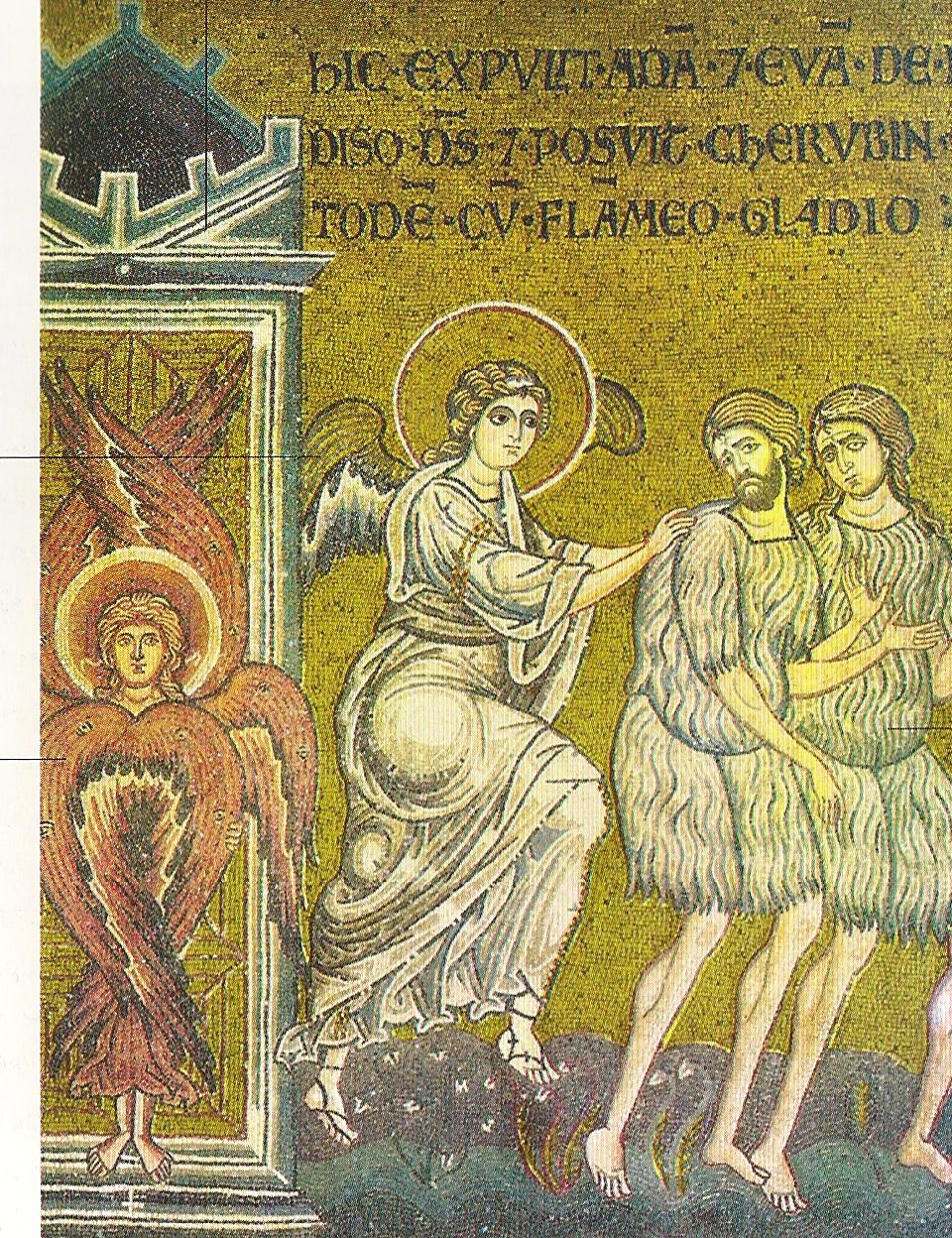 Source: Expulsion of Adam and Eve, Monreale Cathedral mosaic, Wikimedia Commons, public domain, https://commons.wikimedia.org/wiki/File:Vertreibung_aus_dem_Paradies-Cattedrale_di_Monreale.jpg
Spiritual Fruit 🍇
- Answer the serpent with the whole command. When a limit begins to feel like proof that God is withholding good, return to the abundance of Genesis 2:16 before deciding what the prohibition means. In prayer, name the gift as well as the boundary.
- Come out of hiding. “Where art thou?” is addressed to the person behind the fig leaves. Bring one defended sin into confession rather than waiting to feel worthy of God’s presence.
- Stop the chain of blame. Adam points to his wife and Eve points to the serpent. Speak honestly about your own choice without excusing deception or making another person’s vulnerability carry your fault.
- Do not mistake a wound for God’s ideal. The rule and pain named in verse 16 belong to the fallen condition. Let marriage, family, and parish life resist domination through patient, truthful love.
- Receive hope without rushing past exile. God clothes the pair, yet they must leave Eden. Christ’s victory does not make grief imaginary; it gives exiles a way to repent and walk toward life.
Teaching Notes
The serpent begins by twisting God’s word (Genesis 3:1-5)
- Ask: What does the serpent attack first: appetite, identity, or trust in God’s word?
- Emphasize: Sin begins by making God appear withholding and the commandment appear hostile.
- Watch for: Do not make Eve or Adam into caricatures. The chapter exposes the shared human wound.
- Connect: Every ascetical struggle in the Church includes learning again to trust God’s word over the passions’ suspicion.
- Show: Keep the visual focus on exile, shame, and guarded mercy rather than on curiosity about the tree.
The fall is a shared human collapse (Genesis 3:6)
- Ask: Who eats, and how does the next verse expose the serpent’s promise?
- Emphasize: Adam and Eve both act; neither bears the whole responsibility alone.
So-called enlightenment becomes shame (Genesis 3:7-10)
- Ask: What do their opened eyes actually perceive?
- Emphasize: God’s “where art thou?” summons the hiding person toward truthful encounter.
Sin fractures communion into blame (Genesis 3:11-13)
- Ask: How does Adam’s answer change the way he speaks about the woman and God?
- Emphasize: Confession names one’s own act without transferring guilt to another.
Judgment falls, but promise is spoken (Genesis 3:14-19)
- Ask: Why is Genesis 3:15 heard by Christians as the first promise rather than only as punishment?
- Emphasize: Brenton says “watch against,” not “crush”; distinguish the printed LXX wording from the Church’s fuller reading of Christ’s victory.
- Watch for: Do not skip the mercy of the garments and exile. They are severe, but not meaningless.
- Connect: Athanasius helps the reader see why the fall requires the Incarnation, not merely moral improvement.
- Show: Use the Monreale Expulsion image to help students feel both loss and mercy, not despair.
Mercy appears even in exile (Genesis 3:20-24)
- Ask: What does God do for the couple before they leave the garden?
- Emphasize: Clothing and guarded access reveal care amid real loss; avoid claiming the text explains every detail of the garments.
- Connect: Christ’s saving work opens the hope of life beyond the guarded tree.
Sources
Scripture and apostolic witnesses
Embedded Scripture is from Brenton’s English Septuagint (LXX).
- Public-domain Brenton edition: https://archive.org/details/septuagintversio00bren
- Romans 5:12-21; 1 Corinthians 15:21-22, 45-49; Revelation 2:7; Revelation 22:1-5.
Patristic and Orthodox sources
- St. Irenaeus, Against Heresies 3.22.4, for Adam-Christ recapitulation and the Eve-Mary contrast: https://www.ccel.org/ccel/schaff/anf01.ix.iv.xxiii.html#ix.iv.xxiii-p12
- St. Athanasius, On the Incarnation §§3-5, for creation through the Word, the fall into corruption, and the necessity of the Word’s saving coming: https://www.ccel.org/ccel/schaff/npnf204.vii.ii.iii.html and https://www.ccel.org/ccel/schaff/npnf204.vii.ii.iv.html
- St. Ephrem the Syrian, Commentary on Genesis, for Eden, exile, and mercy after the fall: https://archive.org/details/selectedprosewor0000ephr
Secondary academic sources
- Gordon J. Wenham, Genesis 1-15.
- Victor P. Hamilton, The Book of Genesis: Chapters 1-17.
- Kenneth A. Mathews, Genesis 1-11:26.
- Claus Westermann, Genesis 1-11.
Coptic Orthodox / pastoral sources
- The Orthodox Study Bible, notes on Genesis 3, Romans 5, and the New Adam theme.
- Fr. Tadros Yacoub Malaty, commentary on Genesis.
- Pope Shenouda III on repentance, humility, and the healing of the fallen person.
- Fr. Bishoy Kamel on repentance, grace, and restored communion in Christ.
Visual sources
Expulsion of Adam and Eve, Monreale Cathedral mosaic, Wikimedia Commons, public domain: https://commons.wikimedia.org/wiki/File:Vertreibung_aus_dem_Paradies-Cattedrale_di_Monreale.jpg
Footnotes
-
St. Irenaeus, Against Heresies 3.22.4, https://www.ccel.org/ccel/schaff/anf01.ix.iv.xxiii.html#ix.iv.xxiii-p12. ↩
-
St. Athanasius, On the Incarnation, §7, https://www.ccel.org/ccel/schaff/npnf204.vii.ii.iv.html. ↩
-
St. Athanasius, On the Incarnation, §4, https://www.ccel.org/ccel/schaff/npnf204.vii.ii.iv.html. ↩