
Bel is broken, and the king is not finished. In the same place there is a great dragon, and Babylon worships it because it lives, eats, and drinks. Daniel has already said he will not worship works of hands. Now he must say something harder. A thing can be alive and still not be God.
The first study left the king blessing Bel over an empty table. These verses finish his mouth. “The king is become a Jew” stands between the false doxology and the true one. Read them after the overview, which places the book in Greek Daniel and in Friday’s Matins prophecies of the fourth week of Great Lent.
The dragon that lives and is not God (Bel and the Dragon 23-27)
23 And in that same place there was a great dragon, which they of Babylon worshipped. 24 And the king said unto Daniel, Wilt thou also say that this is of brass? lo, he liveth, he eateth and drinketh; thou canst not say that he is no living god: therefore worship him.
25 Then said Daniel unto the king, I will worship the Lord my God: for he is the living God. 26 But give me leave, O king, and I shall slay this dragon without sword or staff. The king said, I give thee leave. 27 Then Daniel took pitch, and fat, and hair, and did seethe them together, and made lumps thereof: this he put in the dragon’s mouth, and so the dragon burst in sunder: and Daniel said, Lo, these are the gods ye worship.
The king’s argument has changed, and it is sharper. Bel could be dismissed as clay and brass. This creature breathes. It eats and drinks. Reality, the king thinks, has become divinity. Daniel does not deny that the dragon lives. He denies it worship. “I will worship the Lord my God: for he is the living God.” Life in a creature is still created life. Only the Lord is the living God.
That distinction is the adult form of discernment. The Church does not tell her children that power, desire, sickness, political pressure, or death are imaginary. She refuses to kneel to them. Fear becomes idolatry when it starts to command the obedience that belongs to God. A living threat is still a creature.
Daniel asks to slay the dragon without sword or staff. The detail belongs to this scene, not to a general claim that he never touches what is violent. In the previous verses he has already destroyed Bel and Bel’s temple, and the king has already put the priests and their households to death. Those acts are in the text. What verse 26 specifies is the manner of this unmasking. He does not meet the dragon as one more armed idol, sword against fang. He feeds it pitch, fat, and hair, and the worshiped mouth bursts. “Lo, these are the gods ye worship.” The creature dies of what it was willing to swallow. Appetite, again, is not proof of divinity. It can be the way a false god comes apart.
Scripture already knows a dragon that is not God. Brenton’s Psalm 73:13-14, Psalm 74 in the Hebrew numbering, says the Lord broke the heads of the dragons in the water, and the heads of the dragon. Genesis 3 speaks of a serpent in the garden. Revelation 12:9 names the great dragon, that ancient serpent. These are cross-references, so the ear hears one biblical line of hostile created power. They are not a claim that a Father in this study wrote a typology from Bel’s dragon to the Apocalypse. No such commentary is quoted here. The spiritual point that is in the text is enough: Babylon knelt to a living thing, and the living thing was not the Lord.
Gems from the Fathers 💎
St. Irenaeus quotes this second confession beside the first. In Against Heresies IV.5.2, after Daniel’s refusal of idols made with hands, he adds, “Again did he say, I will adore the Lord my God, because He is the living God.”1 Irenaeus is still on the God of the living. The dragon has given him the perfect contrast. Babylon can point to a creature that eats and say, “Therefore worship him.” Daniel points past the creature to the Lord, and Irenaeus hears in that sentence the God Christ will call the God of Abraham, Isaac, and Jacob, not the God of the dead. The Father’s “I will adore” is his wording of verse 25. Brenton says “I will worship.” The confession is the same act.
The den and the bread (Bel and the Dragon 28-42)
28 When they of Babylon heard that, they took great indignation, and conspired against the king, saying, The king is become a Jew, and he hath destroyed Bel, he hath slain the dragon, and put the priests to death. 29 So they came to the king, and said, Deliver us Daniel, or else we will destroy thee and thine house.
30 Now when the king saw that they pressed him sore, being constrained, he delivered Daniel unto them; 31 who cast him into the lions’ den: where he was six days. 32 And in the den there were seven lions, and they had given them every day two carcases, and two sheep: which then were not given to them, to the intent they might devour Daniel.
33 Now there was in Jewry a prophet, called Habbacuc, who had made pottage, and had broken bread in a bowl, and was going into the field, for to bring it to the reapers. 34 But the angel of the Lord said unto Habbacuc, Go, carry the dinner that thou hast into Babylon unto Daniel, who is in the lions’ den.
35 And Habbacuc said, Lord, I never saw Babylon; neither do I know where the den is. 36 Then the angel of the Lord took him by the crown, and bare him by the hair of his head, and through the vehemency of his spirit set him in Babylon over the den. 37 And Habbacuc cried, saying, O Daniel, Daniel, take the dinner which God hath sent thee.
38 And Daniel said, Thou hast remembered me, O God: neither hast thou forsaken them that seek thee and love thee. 39 So Daniel arose, and did eat: and the angel of the Lord set Habbacuc in his own place again immediately.
40 Upon the seventh day the king went to bewail Daniel: and when he came to the den, he looked in, and, behold, Daniel was sitting. 41 Then cried the king with a loud voice, saying, Great art thou, O Lord God of Daniel, and there is none other beside thee. 42 And he drew him out, and cast those that were the cause of his destruction into the den: and they were devoured in a moment before his face.
“The king is become a Jew” is the hinge of the book. The people mean it as treason. The narrative lets it stand as the truth of his conversion, still unfinished, still cowardly, and already real enough to enrage the city. He has destroyed Bel, slain the dragon, and put the priests to death. They list his acts as one betrayal. He is not yet brave. When they threaten his house, he is constrained, and he delivers Daniel. Conversion that has learned a new name for God can still hand the confessor over. The story does not flatter the king in order to reach his last sentence.
The den is not the den of Daniel 6, and it is not a sealed tomb. Daniel 6:17 sets a stone on the mouth of the den and seals it with the king’s signet. Bel and the Dragon never seals this pit. The king’s seal in this book was on the temple door, in verse 14, and it protected a lie. Here Daniel is simply cast in, for six days, among seven lions whose food has been withheld so that hunger will do the killing. The Church’s wisdom is to read the two dens on consecutive mornings, not to collapse them into one picture. Thursday of the fourth week of Great Lent reads Daniel 6:1-27. Friday reads this book. Prayer under a written law, then worship under an idol, and in both the Lord remembers His servant among lions. Daniel 6 is the other morning.
On the seventh day the king comes to bewail Daniel and finds him sitting. Grief arrives dressed for a funeral and meets a living man. That is as close as this chapter comes to the shape of Pascha, and it is read in Lent, not on Bright Saturday. Bel and the Dragon is not among the Bright Saturday Midnight Praises. Those praises do include Daniel 3:1-23, Daniel 3:25-51, Daniel 9:4-19, and Habakkuk 3:2-19. The Church sings Habakkuk’s prayer that night. She does not read this story there.
Habakkuk, the bowl, and the question of names
Brenton calls him Habbacuc. That is the prophet Habakkuk. A careful reader will ask how this can be, and the question deserves a straight answer.
The book of Habakkuk speaks before the exile has closed. Habakkuk 1 looks toward the Chaldeans as a terror still rising. This story is set after Astyages, when Cyrus has received the kingdom. The years do not line up as a simple report that the same man walked from his field into Babylon under Cyrus. The Old Greek does not hide the difficulty. It opens the book with a superscription naming Hambakoum son of Iesous, of the tribe of Levi, and it calls Daniel a priest. Theodotion, which Brenton follows at the start, names Cyrus and does not repeat that superscription. The Church has long linked the Habakkuk of this chapter with the prophet whose prayer she sings. The link is traditional, not a solved chronology. What the text itself shows is a prophet in Judea with ordinary food for reapers, sent by the angel of the Lord to a man he cannot reach by any road he knows.
That is already enough to love. He is not hunting a miracle. He has made pottage, broken bread into a bowl, and turned toward the field. God takes the dinner meant for workers and sets it down in Babylon. The Letter of Jeremiah had said the idol’s priests and their wives consume the offerings and give nothing to the poor. Habakkuk’s bowl moves the other way. Mercy begins as food in faithful hands and is redirected toward the person everyone has agreed to forget.
His own prayer is the one Bright Saturday sings, Habakkuk 3:2-19, a prophet rejoicing when the fig tree does not blossom and the flock is cut off. The Habakkuk study and Habakkuk 3 are the place to hear that prayer as his book gives it. Bashans 24 commemorates the Departure of Habakkuk the Prophet. That is the Church’s date. It is not a claim that the Synaxarium entry, unread here as a vita, retells this meal.
Daniel’s words in the pit are the chapter’s purest praise. “Thou hast remembered me, O God: neither hast thou forsaken them that seek thee and love thee.” He eats before he is drawn out. The lions are still there. Often this is how the Lord sustains His people. He does not always open the pit on the first day. He remembers, feeds, and strengthens, and then, on the day He chooses, He is found to have kept His servant alive.
St. John Chrysostom, in the homily already met beside Bel’s table, is preaching John 6 when he rebukes the crowd that followed Christ for loaves. He does not stop at the rebuke. In that same homily Christ says, “I am the bread of life; he that comes to Me shall never hunger, and he that believes in Me shall never thirst.” The dinner in the den is not the institution of the Eucharist, and it does not need to be. A Church that knows Who the Bread is cannot hear God send bread into a pit without remembering Him. False worship ate the worshipper. The living God feeds the one who seeks Him and loves Him.
Verse 42 must be read with the same honesty as the deaths in verse 22. The king draws Daniel out, and casts “those that were the cause of his destruction” into the den, and they are devoured before his face. The text reports the king’s judgment on the accusers. It does not present Daniel as the one who sentences them. Christians do not take the pit’s hunger as a pattern for revenge. They take Daniel’s sitting, and his praise, and the king’s new sentence: “Great art thou, O Lord God of Daniel, and there is none other beside thee.” The first cry blessed Bel and said there was no deceit in him. The last cry blesses the Lord and says there is none beside Him. That is the conversion the book was written to bring a king, and a reader, to finish.
The Church’s Voice in Worship ⛪
Friday of the fourth week of Great Lent reads this chapter with the temple story, in the Matins prophecies, as Daniel 14. Thursday has already read Daniel 6. The pair is one of the strongest liturgical gifts of the week: two dens, two mornings, one Lord who does not forget. The Friday prophecies also include Deuteronomy’s warning against other gods and Isaiah’s grief over lip worship, so the dragon is not an isolated wonder. It is the morning’s last test of what the people will adore.
Bel is not read on Bright Saturday. Habakkuk 3:2-19 is. The Church can love the traditional link between the prophet and this chapter without pretending the chronology is simple, and without moving this story onto a night where she has not appointed it.
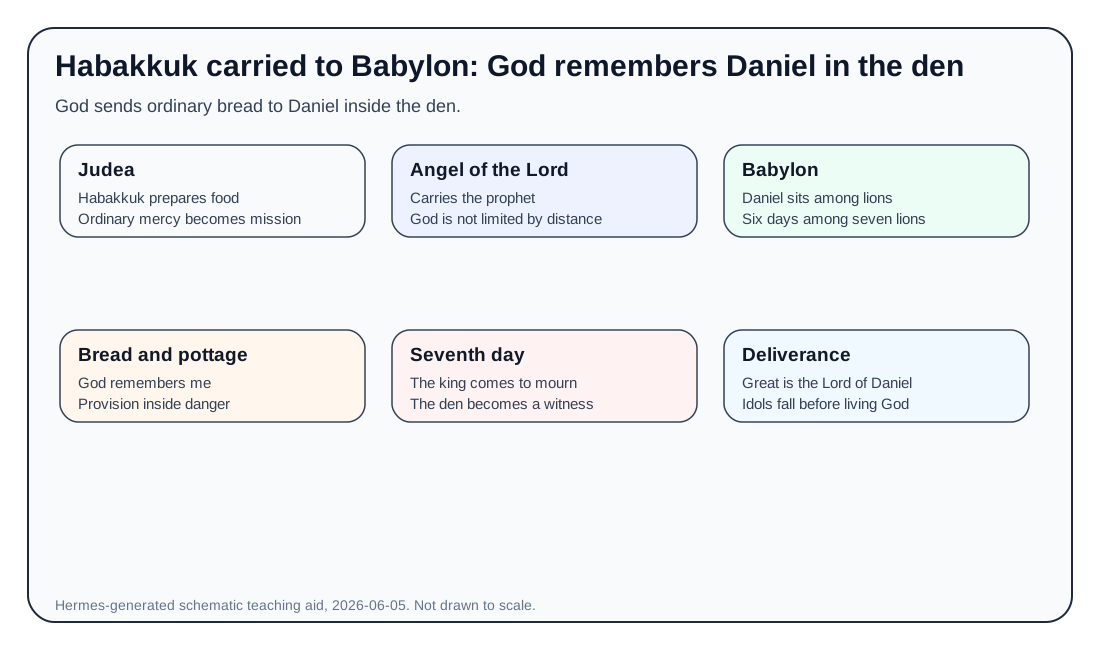 Source: Generated schematic teaching aid for this project, 2026-06-05. The den label was corrected in 2026-10-19: this pit is not sealed.
Spiritual Fruit 🍇
Some false gods are dead systems kept alive by fraud. Others are real: a fear that breathes, a desire that eats, a pressure that can destroy a house. Christian faith does not call the dragon imaginary. It calls the dragon a creature. Only the Lord is the living God. The practice is specific. When a real threat starts to receive the obedience, the silence, or the praise that belong to God, name it as a creature again, and return the worship.
The king’s weakness is also ours. He has begun to know the truth and still hands Daniel over when his house is threatened. Conversion is not finished when the sentence changes. It is tested when love of safety asks for the confessor. Pray for the courage that does not trade a brother or sister for peace in the house.
If you are in a den, hear verse 38 before you demand verse 41. God may feed you inside the danger before He draws you out. A visit, a prayer, a meal, a word that you have not been forsaken: these are not small because the lions remain. Habakkuk thought he was feeding reapers. God made the bowl travel farther than the prophet knew the road. Ordinary mercy in your hands may be someone else’s dinner in a pit. Do not wait to be impressive. Carry the food you already have.
And do not baptize verse 42. The accusers fall, and the text tells us so. Our part is not to hurry anyone into the mouth of judgment. Our part is the king’s last cry, learned slowly, and Daniel’s quieter one: Thou hast remembered me.
Teaching Notes
General guidance
- Ask: How does “The king is become a Jew” sit between the two cries of praise?
- Emphasize: This half of the book completes a conversion. It is not only a second miracle.
- Watch for: Do not say the den is sealed. The seal is in Daniel 6:17, and on Bel’s temple door in verse 14. This pit is open enough for the king to look in.
- Connect: Thursday’s Daniel 6 and Friday’s Daniel 14. Then Bright Saturday’s Habakkuk 3, without moving Bel onto that night.
- Show: The Habakkuk diagram is a schematic of Judea, the angel, and Babylon, not a claimed route and not an icon.
The dragon that lives and is not God (Bel and the Dragon 23-27)
- Ask: What is the difference between saying a thing is real and saying it is God?
- Emphasize: “Without sword or staff” describes this act, not a denial of verse 22 or of the king’s executions.
- Watch for: Pitch, fat, and hair are an unmasking by appetite. Do not turn the scene into a lesson that violence is holy, or into a lesson that Daniel never destroys an idol.
- Connect: Irenaeus hears verse 25 as praise of the living God, the God of the living.
The den and the bread (Bel and the Dragon 28-42)
- Ask: Why does God feed Daniel before He draws him out?
- Emphasize: Remembrance is often provision in the pit. Do not promise that every den ends on our schedule.
- Watch for: Verse 42. The king casts the accusers to the lions. Report it. Do not preach it as Christian revenge. Habakkuk’s name: Brenton’s Habbacuc is Habakkuk; the chronology with the prophetic book is not simple; say so.
- Connect: Chrysostom’s Homily 45 reaches “I am the bread of life.” One sentence is enough. This meal is not a Eucharistic institution text.
- Show: Set the diagram beside verses 33-38. Mention Bashans 24 as Habakkuk’s commemoration, without inventing a vita.
Sources
Embedded Scripture is from Brenton’s English Septuagint (LXX).
Book, canon, and Friday lectionary details are in the overview.
St. Irenaeus, Against Heresies IV.5.2, New Advent.
St. John Chrysostom, Homily 45 on the Gospel of John, section 1, New Advent.
The Old Greek superscription naming Hambakoum son of Iesous of the tribe of Levi is from the NETS “To the Reader” for Bel and the Dragon, NETS.
Psalm 73:13-14 Brenton corresponds to Psalm 74:13-14 in the Hebrew numbering. Revelation 12:9 is a cross-reference, not a patristic typology claimed in this study.
Bright Saturday Midnight Praises, in
@andraws/lectionary-data1.3.3: Daniel 3:1-23, Daniel 3:25-51, Daniel 9:4-19, Habakkuk 3:2-19. Bel is absent from that cluster.Bashans 24 in the packaged Synaxarium: the Departure of Habakkuk the Prophet. Title only.
Footnotes
-
St. Irenaeus, Against Heresies IV.5.2, New Advent. ↩