


Habakkuk 1 is the chapter of the hard question. The prophet does not simply ask why people suffer. He asks how the Holy God can answer Judah’s injustice by raising up a more violent nation. The chapter forces us to distinguish God’s sovereignty from moral approval of evil.
The prophet bears the burden (Habakkuk 1:1-4)
The burden which the prophet Ambacum saw.
How long, O Lord, shall I cry out, and thou wilt not hearken? how long shall I cry out to thee being injured, and thou wilt not save?
Wherefore hast thou shewn me troubles and griefs to look upon, misery and ungodliness? judgment is before me, and the judge receives a reward.
Therefore the law is frustrated, and judgment proceeds not effectually, for the ungodly man prevails over the just; therefore perverse judgment will proceed.
The first word is important: this is a burden. Prophecy is not merely information handed to a messenger. Habakkuk must carry what he sees before he understands what God will do.
His prayer is blunt. He sees injury, bribed judgment, ungodliness, and a law that seems paralyzed. This is not unbelief. It is faithful lament. He does not escape the scandal of injustice by becoming cynical. He brings the scandal directly into prayer.
The hard pastoral question
Habakkuk is not asking for a religious phrase to cover pain. He is asking why God appears silent while the wicked overpower the just. The chapter teaches that the faithful may ask God real questions, but they must ask them in the posture of relationship. Habakkuk cries, “O Lord,” because he has not stopped believing that the Lord hears.
The Chaldeans are coming (Habakkuk 1:5-11)
Behold, ye despisers, and look, and wonder marvellously, and vanish: for I work a work in your days, which ye will in no wise believe, though a man declare it to you.
Wherefore, behold, I stir up the Chaldeans, the bitter and hasty nation, that walks upon the breadth of the earth, to inherit tabernacles not his own.
He is terrible and famous; his judgment shall proceed of himself, and his dignity shall come out of himself.
And his horses shall bound more swiftly than leopards, and they are fiercer than the wolves of Arabia: and his horsemen shall ride forth, and shall rush from far; and they shall fly as an eagle hasting to eat.
Destruction shall come upon ungodly men, resisting with their adverse front, and he shall gather the captivity as the sand.
And he shall be at his ease with kings, and princes are his toys, and he shall mock at every strong-hold, and shall cast a mound, and take possession of it.
Then shall he change his spirit, and he shall pass through, and make an atonement, saying, This strength belongs to my god.
God’s answer is not comforting at first. He announces that the Chaldeans, the Babylonians, are coming. They are bitter, swift, violent, and self-exalting. They laugh at kings and strongholds. Their strength becomes their god. Brenton’s difficult phrase “make an atonement” is followed by the conqueror crediting his strength to his own god. It is not Christ’s saving atonement or a declaration that Babylon’s violence is holy.
This is the central theodicy of the chapter: God can use Babylon without approving Babylon. Divine sovereignty is not moral endorsement. Babylon can be an instrument of judgment and still be guilty for its pride, bloodshed, and idolatry. Habakkuk 2 will make that clear.
The answer also exposes a danger inside all human power. When strength becomes a god, victory becomes worship of the self. Babylon is not only a political threat. It is a spiritual picture of power without repentance.
Paul takes up Habakkuk’s warning in Acts 13:38-41 after proclaiming forgiveness and justification through Christ. The warning now confronts hearers who might refuse the announced salvation. This does not erase its first setting: in Habakkuk, the unbelievable work is the raising of the Chaldeans.
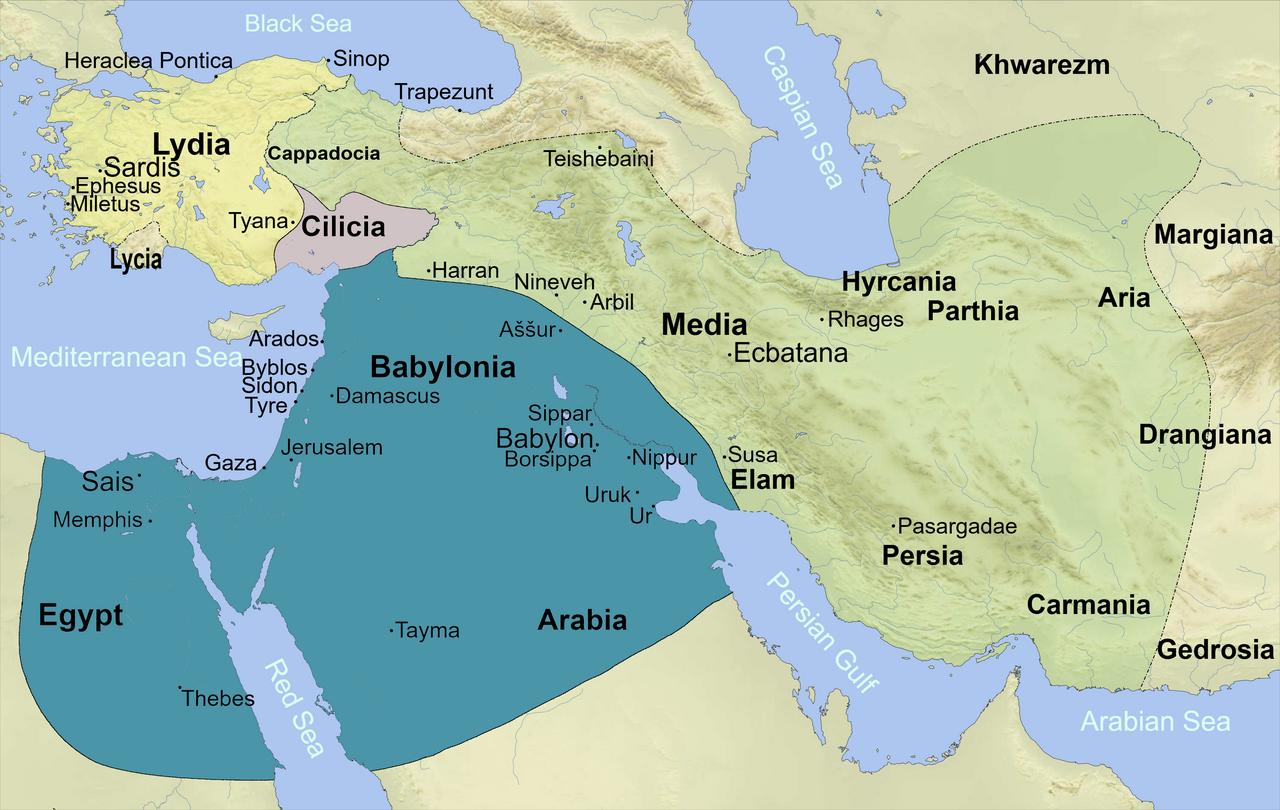 Source: Wikimedia Commons, BlueHypercane761, Neo-Babylonian Empire with neighboring powers, CC0. This is an orientation map for the Neo-Babylonian world, not an exact map of the first moment of Habakkuk’s ministry.
The Holy One is questioned again (Habakkuk 1:12-17)
Art not thou from the beginning, O Lord God, my Holy One? and surely we shall not die. O Lord, thou hast established it for judgment, and he has formed me to chasten with his correction.
His eye is too pure to behold evil doings, and to look upon grievous afflictions: wherefore dost thou look upon despisers? wilt thou be silent when the ungodly swallows up the just?
And wilt thou make men as the fishes of the sea, and as the reptiles which have no guide?
He has brought up destruction with a hook, and drawn one with a casting net, and caught another in his drags: therefore shall his heart rejoice and be glad.
Therefore will he sacrifice to his drag, and burn incense to his casting-net, because by them he has made his portion fat, and his meats choice.
Therefore will he cast his net, and will not spare to slay the nations continually.
Habakkuk answers God’s answer with another prayer. He begins with theology: “Art not thou from the beginning, O Lord God, my Holy One?” He anchors his question in who God is. “We shall not die” confesses hope that his people will not be wiped out, not that judgment will leave them unhurt. His question grows out of trust in the Holy One, not indifference to Him.
The net imagery is devastating. Babylon treats nations like fish, pulling them up by hook and dragnet. Then it worships the net. Empire becomes idolatrous when it sacrifices to its own tools: armies, strategies, wealth, technology, reputation, and fear.
Habakkuk does not solve this in chapter 1. The chapter ends with the question still open. That is spiritually honest. Some prayers do not end with immediate relief. They end by putting the wound in God’s presence and waiting for His word.
Spiritual Fruit 🍇
This chapter teaches us to pray without pretending. A faithful person may grieve injustice, name corruption, and ask why God seems silent. But faithful lament refuses two temptations: it refuses despair, and it refuses to justify evil just because God can overrule it.
Here God announces a historical judgment on Judah; this is not a diagnosis of the reader’s illness, injury, or abuse. God does not become the author of sin, and the violent remain accountable for their violence. Habakkuk helps us stand in the painful middle: honest enough to cry out, humble enough to wait.
Teaching Notes
The prophet bears the burden
- Ask: What makes Habakkuk’s complaint faithful rather than cynical?
- Emphasize: The prophet brings injustice into prayer instead of walking away from God.
- Watch for: Do not shame honest lament. Scripture gives us language for it.
- Connect: Christ Himself cries from the Cross, showing that lament can remain obedient prayer.
The Chaldeans are coming
- Ask: Why is God’s answer harder than Habakkuk’s original question?
- Emphasize: God can use Babylon without approving Babylon.
- Watch for: Avoid implying that violent power becomes righteous because God overrules it.
- Connect: The Cross also shows God defeating evil through what evil intended, without making evil good.
- Show: Use the map to locate Judah between larger imperial powers.
The Holy One is questioned again
- Ask: What does Babylon’s worship of its net look like in modern life?
- Emphasize: Tools of success become idols when they receive the trust owed to God.
- Watch for: Do not rush the chapter to a neat answer. The unresolved ending is part of the lesson.
- Connect: Waiting for God’s answer leads directly into the watchtower of Habakkuk 2.
Sources
- Embedded Scripture is from Brenton’s English Septuagint (LXX). Brief New Testament references are cited by reference.
- Historical background: 2 Kings 23-25; Jeremiah 1 and 25; Daniel 1.
- New Testament reception: Acts 13:38-41, where Paul takes up Habakkuk 1:5 after proclaiming salvation through Christ.
- The Bright Saturday service-order index (
@andraws/lectionary-data1.3.5) lists Habakkuk 3:2-19 as the Prayer of Habakkuk in Midnight Praises; this is a local service-order witness. Its Paschal resonance is developed in the chapter 3 study.