


Habakkuk 2 is the chapter of the watchtower. The prophet does not receive an easy answer, but he is taught how the righteous live while the proud still appear to be winning: with watchful, patient, covenantal faith.
The watchtower and the delayed vision (Habakkuk 2:1-3)
I will stand upon my watch, and mount upon the rock, and watch to see what he will say by me, and what I shall answer when I am reproved.
And the Lord answered me and said, Write the vision, and that plainly on a tablet, that he that reads it may run.
For the vision is yet for a time, and it shall shoot forth at the end, and not in vain: though he should tarry, wait for him; for he will surely come, and will not tarry.
Habakkuk does not abandon prayer after the painful answer of chapter 1. He stands on the watch. This is a spiritual posture: he is attentive, corrected, and ready to receive the Lord’s word even if that word rebukes him.
The vision is delayed, but not empty. The command is not, “Pretend the crisis is not real.” The command is, “Wait for him.” Biblical waiting is not passivity. It is faithful endurance before the God whose word will arrive at the appointed time.
Eusebius reads the line “he will surely come, and will not tarry” in light of Hebrews 10 and the coming of Christ. That is one early Christian witness to the way the Church hears Habakkuk: waiting is ultimately directed toward the Coming One, not merely toward a change in circumstances.1
The proud soul and the just by faith (Habakkuk 2:4-5)
If he should draw back, my soul has no pleasure in him: but the just shall live by my faith.
But the arrogant man and the scorner, the boastful man, shall not finish anything; who has enlarged his desire as the grave, and like death he is never satisfied, and he will gather to himself all the nations, and will receive to himself all the peoples.
The contrast is sharp. Pride is crooked, swollen, and hungry like death. Faith is life. The proud person expands desire until nothing is enough. The righteous person receives life by steadfast trust in God.
Language insight: “by my faith” and “by faith”
The Hebrew noun ʾemunah carries faithfulness and reliability; in Habakkuk, trust is lived as steadfast fidelity.2 Brenton’s Septuagint rendering says, “the just shall live by my faith,” while Romans 1:17 and Galatians 3:11 say, “the just shall live by faith.” Hebrews 10:37-39 joins this life of faith to waiting for the Coming One and refusing to draw back. The different forms of the quotation should be heard in their own settings, not treated as Paul correcting the Septuagint.
This should not be reduced to a slogan for passive belief. In Habakkuk, faith is the way the righteous live while proud empire seems successful: watchful, patient, obedient, and anchored in God’s coming judgment.
Gems from the Fathers 💎
St John Chrysostom connects Habakkuk’s word to the Gospel proclamation in Romans. He says that what God gives “transcends reasoning entirely,” so we need faith, and that righteousness is not achieved by our own toil but received “by a gift from above,” with faith as the one thing we bring.3
Chrysostom hears this promise reaching beyond present survival to life in the age to come. Faith is not spiritual laziness. It is the humble reception of God’s righteousness, the refusal to make our own reasoning or achievements into a savior.
Woes against greed, shame, blood, and idols (Habakkuk 2:6-19)
Shall not all these take up a parable against him? and a proverb to tell against him? and they shall say, Woe to him that multiplies to himself the possessions which are not his! how long? and who heavily loads his yoke.
For suddenly there shall arise up those that bite him, and they that plot against thee shall awake, and thou shalt be a plunder to them.
Because thou hast spoiled many nations, all the nations that are left shall spoil thee, because of the blood of men, and the sins of the land and city, and of all that dwell in it.
Woe to him that covets an evil covetousness to his house, that he may set his nest on high, that he may be delivered from the power of evils.
Thou hast devised shame to thy house, thou hast utterly destroyed many nations, and thy soul has sinned.
For the stone shall cry out of the wall, and the beetle out of the timber shall speak.
Woe to him that builds a city with blood, and establishes a city by unrighteousness.
Are not these things of the Lord Almighty? surely many people have been exhausted in the fire, and many nations have fainted.
For the earth shall be filled with the knowledge of the glory of the Lord; it shall cover them as water.
Woe to him that gives his neighbour to drink the thick lees of wine, and intoxicates him, that he may look upon their secret parts.
Drink thou also thy fill of disgrace instead of glory: shake, O heart, and quake, the cup of the right hand of the Lord has come round upon thee, and dishonour has gathered upon thy glory.
For the ungodliness of Libanus shall cover thee, and distress because of wild beasts shall dismay thee, because of the blood of men, and the sins of the land and city, and of all that dwell in it.
What profits it the graven image, that they have graven it? one has made it a molten work, a false image; for the maker has trusted in his work, to make dumb idols.
Woe to him that says to the wood, Awake, arise; and to the stone, Be thou exalted! whereas it is an image, and this is a casting of gold and silver, and there is no breath in it.
The woes are not random punishments. They are a diagnosis of empire’s soul. Greed multiplies possessions that are not its own. False security builds a nest on high. Cities are built with blood. People are degraded through drunkenness, exposure, and shame. Idols promise life but have no breath.
God’s judgment answers each sin with truth. The plunderer becomes plunder. The house built for security becomes shame. The stones cry out from the wall. What was hidden in the structure of violence becomes witness against it.
Yet a promise interrupts the woes: the earth will be filled with the knowledge of the Lord’s glory. Babylon fills the world with its appetite; God will fill it with the knowledge of Himself, preparing us for the whole earth’s reverence before Him in verse 20.
Pastoral safeguard
Habakkuk 2:15-16 should be read plainly and carefully. The prophet condemns domination that uses intoxication, exposure, and humiliation. Sin does not only kill people. It degrades them first. God sees that hidden exploitation and turns the shame back upon the violent.
This matters for parish teaching. The passage should not be made lurid, but it should not be sanitized. God defends the shamed, the manipulated, and the exploited.
Icon and idol distinction
Habakkuk condemns idols because people trust dead wood and stone as gods. An idol receives worship and becomes a false source of power. An Orthodox icon is different: it is honored as a window that directs love and reverence toward the living God and His saints. Habakkuk 2 is not an argument against Christian icon veneration. It is a warning against trusting any created thing as if it had life in itself.
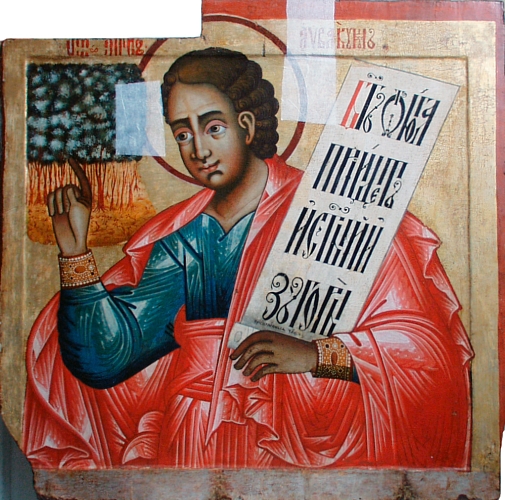 Source: Wikimedia Commons, public-domain Russian icon of Prophet Habakkuk, first quarter of the 18th century.
The Lord in His holy temple (Habakkuk 2:20)
But the Lord is in his holy temple: let all the earth fear before him.
The chapter ends in silence. After the noise of empire, the boasts of the proud, the cries of the victims, and the lifeless speech of idols, the true answer is reverent stillness before the living God.
This silence is not emptiness. It is worship. The righteous wait because the Lord is not absent. He is in His holy temple, and the whole earth belongs before Him in fear, humility, and hope.
Spiritual Fruit 🍇
Habakkuk 2 teaches the difference between waiting and drifting. The faithful wait on the Lord’s word. The proud drift into appetite, violence, exploitation, and self-worship.
The just live by faith because faith keeps the soul upright when sight is dark. Before God, consider one place where you are seeking security at another person’s expense. Faithfulness may mean returning what is not yours, refusing a humiliating joke, or telling the truth when a profitable silence would protect you. Such obedience does not purchase God’s righteousness; it gives the trust we profess a shape in daily life. Then keep watch in prayer, without demanding that God work to your timetable.
Teaching Notes
The watchtower and the delayed vision
- Ask: What does it mean to stand watch spiritually?
- Emphasize: Waiting for God is active attention, not passivity.
- Watch for: Do not present delay as abandonment. The vision has an appointed time.
- Connect: Hebrews receives this waiting as waiting for the Coming One.
The proud soul and the just by faith
- Ask: How is faithfulness different from a momentary feeling of belief?
- Emphasize: Habakkuk 2:4 is covenantal endurance under pressure.
- Watch for: Do not reduce the verse to a narrow slogan. Let Habakkuk, Romans, Galatians, and Hebrews all speak.
- Connect: In Christ, faith receives God’s righteousness as gift and learns patient endurance.
Woes against greed, shame, blood, and idols
- Ask: Which woe feels most recognizable in modern life?
- Emphasize: God’s judgment exposes hidden structures of exploitation.
- Watch for: Handle verses 15-16 with moral clarity and pastoral care.
- Connect: The Cross reveals both the violence of the world and God’s victory over it.
- Show: Use the icon/idol distinction to prevent confusion between dead idols and Orthodox icons.
The Lord in His holy temple
- Ask: Why does the chapter end with silence?
- Emphasize: Reverent fear is the right answer to the noise of pride.
- Watch for: Silence before God is not denial. It is worshipful trust.
- Connect: The Church learns this silence especially before the mystery of Christ’s Passion and Resurrection.
Sources
- Embedded Scripture is from Brenton’s English Septuagint (LXX). Brief New Testament references are cited by reference.
- New Testament reception: Romans 1:17; Galatians 3:11; Hebrews 10:37-39.
- Patristic source used: St John Chrysostom, Homilies on Romans; Eusebius of Caesarea, Proof of the Gospel, Book VI, chapter 14.
- Visual asset: Wikimedia Commons public-domain icon of Prophet Habakkuk.
Footnotes
-
Eusebius of Caesarea, Proof of the Gospel, Book VI, chapter 14: https://www.tertullian.org/fathers/eusebius_de_08_book6.htm#p19 ↩
-
NET Bible, Habakkuk 2:4, translation note on ʾemunah: https://www.biblegateway.com/passage/?search=Habakkuk%202%3A4&version=NET; Brown-Driver-Briggs, ʾemunah, sense 3a: https://biblehub.com/hebrew/530.htm ↩
-
St John Chrysostom, Homilies on Romans, Homily II on Romans 1:17, at CCEL: https://www.ccel.org/ccel/schaff/npnf111.vii.iv.html#vii.iv-p39 ↩