


This narration is from a previous version of the study and may include a combined recording of multiple chapters.
Daniel begins with holy vessels carried into a foreign treasury. It ends with a promise that the dead will rise. Between those two scenes, kings command, courtiers accuse, the faithful pray, and heaven reveals the limit of earthly power. The book does not ask the Church to panic before empire, imitate its cruelty, or make its threats the center of her imagination. It teaches a harder freedom: to serve faithfully without worshipping what we serve.
The stories are familiar enough to become too familiar. A vegetable meal can shrink into advice about healthy eating; the furnace into an exciting rescue; the visions into puzzles for the curious. Read slowly, and a different question holds the book together: who may claim the worship of a human being? Babylon can change an exile’s address, education, employment, and public name. It cannot become his God.
The stories and the visions
Chapters 1–6 follow Daniel and his companions through foreign courts. Food, images, royal pride, sacred vessels, and a prohibition of prayer become tests of allegiance. Chapters 7–12 disclose the same conflict on a wider horizon: kingdoms grow beastly, worship is attacked, the faithful suffer, and God gives an enduring kingdom to one like a Son of Man and to His saints. The visions do not abandon the stories. They show what the stories have been teaching all along: visible power is not ultimate authority.
The order is literary as well as historical. Daniel 7 and 8 return to the reign of Baltasar, known as Belshazzar in many English Bibles, before the reign of Darius described in chapter 6. A reader should not try to make each new chapter begin later than the preceding one.
The Hebrew and Aramaic text also crosses the book’s two halves. Daniel 2:4b–7:28 is Aramaic; the surrounding material is Hebrew. Brenton introduces the transition at 2:4 with the courtiers speaking “in the Syrian language,” the older English designation used there for Aramaic. The language division does not coincide with the division between court narratives and visions.1
The traditional reading locates Daniel’s prophetic ministry in the sixth-century exile and receives the book under his name. Much modern scholarship dates the book’s final composition to the second-century persecution under Antiochus IV, while recognizing older narrative material; the ancient dispute is already visible in Jerome’s answer to Porphyry, though that dispute should not be mistaken for the whole range of modern historical arguments.2 These studies keep the narrative’s setting, questions of composition, and the Church’s reception distinct, rather than making a disputed historical reconstruction the measure of Christian hope.
Greek Daniel and the Orthodox canon
Daniel stands among the Prophets in the Orthodox Old Testament. Its Greek textual history is unusually rich: the Old Greek and the version conventionally called Theodotion are distinguishable witnesses, not interchangeable names for every Greek reading. Brenton’s familiar Daniel translation follows the Theodotionic tradition. Here, “Brenton LXX” identifies the English edition being read; it does not mean that every surviving Greek manuscript has identical wording or numbering.1
The Church’s Daniel includes Susanna, the Prayer of Azariah and Song of the Three Holy Children within chapter 3, and Bel and the Dragon. They are not optional curiosities for an Orthodox reader. They give the Church prayer from inside the fire, praise that summons creation, the vindication of the falsely accused, and the exposure of idols that consume their servants.
In the Theodotionic ordering, Susanna precedes chapter 1; other arrangements place her after chapter 12, commonly as chapter 13. Reading her before Daniel 1 can help readers meet the young Daniel as a defender of an innocent woman before encountering the prophet at the imperial court. The companion studies retain their separate reading paths. Bel’s temple and the footprints are treated in Bel and the Dragon 1–22; the dragon, the den, and Habakkuk’s provision follow in 23–42.
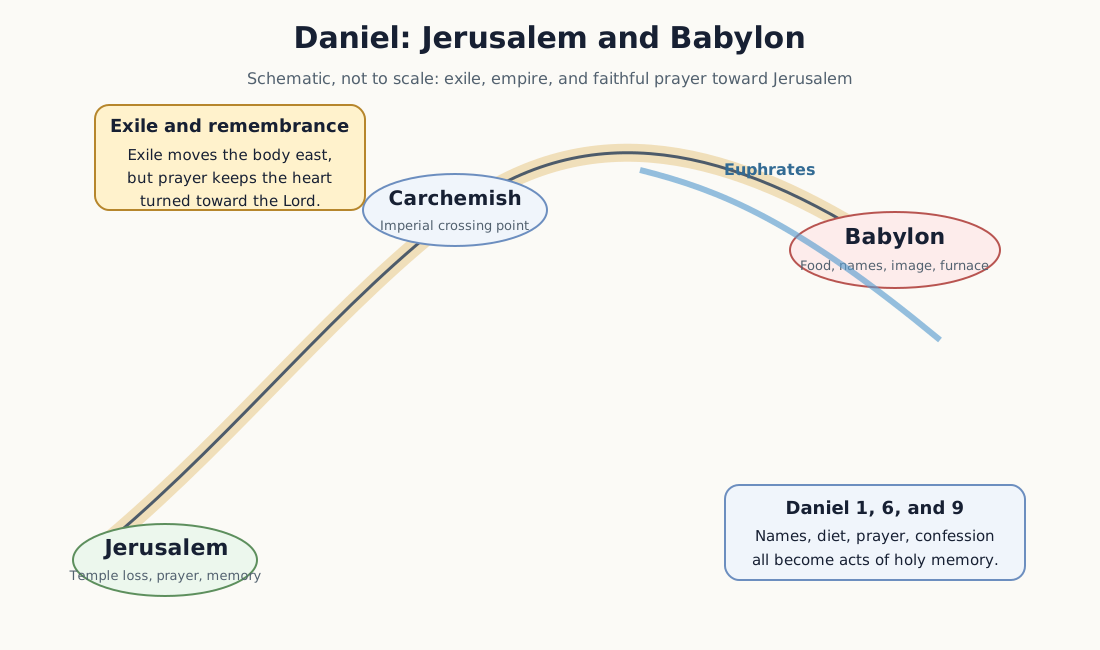 Source: Hermes, schematic of exile geography; not a reconstructed itinerary.
Reading toward Christ
Christ names Daniel when warning His disciples about desolation (Matthew 24:15), and His answer before the high priest brings the Son of Man coming with the clouds into the heart of the Passion (Matthew 26:64; Daniel 7:13). The Christian center of Daniel is therefore not an identification of today’s most frightening ruler. It is Jesus Christ, whose dominion is unlike the dominion of beasts and whose victory does not require His people to become beastly.
Jerome, introducing his commentary, says that “none of the prophets has so clearly spoken concerning Christ as has this prophet Daniel.”3 This is a Christian exegete’s reading of the book, not permission to ignore its historical grief or turn every detail into a separate prediction. The stone, the Son of Man, the promise of atonement, and the resurrection hope lead the reader toward Christ through the particular passages in which they occur.
Hippolytus’s Commentary on Daniel, written in the early third century, is commonly described as the oldest surviving Christian commentary on a biblical book.4 That early engagement is a reminder that Christian reading of Daniel did not begin with modern end-times schemes. In On Christ and Antichrist, Hippolytus gives a better center of attention: “For He is our expectation.”5 The One we await matters more than our ability to arrange every event before His coming.
Typology must remain truthful. Daniel’s deliverance from the den can illuminate the tomb, but Daniel is not Christ, and rescue from danger is not itself resurrection from the dead. The Three Youths’ fidelity prepares Christian courage, but it does not promise that every faithful sufferer will be spared bodily harm. Hebrews 11 holds deliverance and martyrdom together. Hope rests in the Lord who raises the dead, not in a contract exempting believers from suffering.
The Church’s Voice in Worship ⛪
The Coptic Church hears Daniel in more than one kind of service. These placements have different kinds of evidence and should not be collapsed into one general claim about the annual Katameros.
| Passage | Liturgical setting |
|---|---|
| Daniel 6:1–27 in the familiar Hebrew-based numbering, corresponding to Brenton 6:2–28 | Thursday of the fourth week of Great Lent, Matins prophecy; a current reading. Brenton includes Darius’s accession as 6:1. |
| Daniel 3:1–23, 3:25–51, and 3:91–97; Daniel 9:4–19; Susanna 1:1–64 | Listed in the Bright Saturday service-order witness for Midnight Praises, in the Praises of the Prophets; these are not assignments to the Bright Saturday Liturgy.6 |
| Daniel 9:20–27 | Listed in the Myron preparation readings attributed to Coptic Reader, within the consecration of the Church’s chrism. The prophecy of anointing has a fitting resonance here; that connection is interpretation, not a rubric explaining the choice of passage.7 |
| Daniel 7:9–15 | Printed in the St. Mary Ottawa Holy Pascha Katameros for Tuesday, Ninth Hour; a printed-book witness rather than an unqualified assertion of current universal practice. |
| Bel and the Dragon, Daniel 14:2–42 | Listed in the Midlands printed Lent Katameros for Friday of the fourth week; a printed witness, not a separately confirmed current daily reading.8 |
The Synaxarium commemorates the departure of the Prophet Daniel on Baramhat 23 and the departure of the Three Holy Young Men on Bashans 10. A commemoration is not by itself an appointment of a chapter as a reading. The angelic commemorations considered in the later chapters are likewise resonances with Daniel’s visions, not evidence that those visions are read at those feasts.
Bright Saturday gives these passages an especially moving home. The Church prays Daniel’s confession in desolation, hears refusal before the image, and receives Azariah’s contrition from within the furnace. Beside the tomb, praise does not wait until every sign of deliverance is visible. This is a theological reading of the service’s juxtaposition: the Lord has entered death, and the Church waits in His promise.
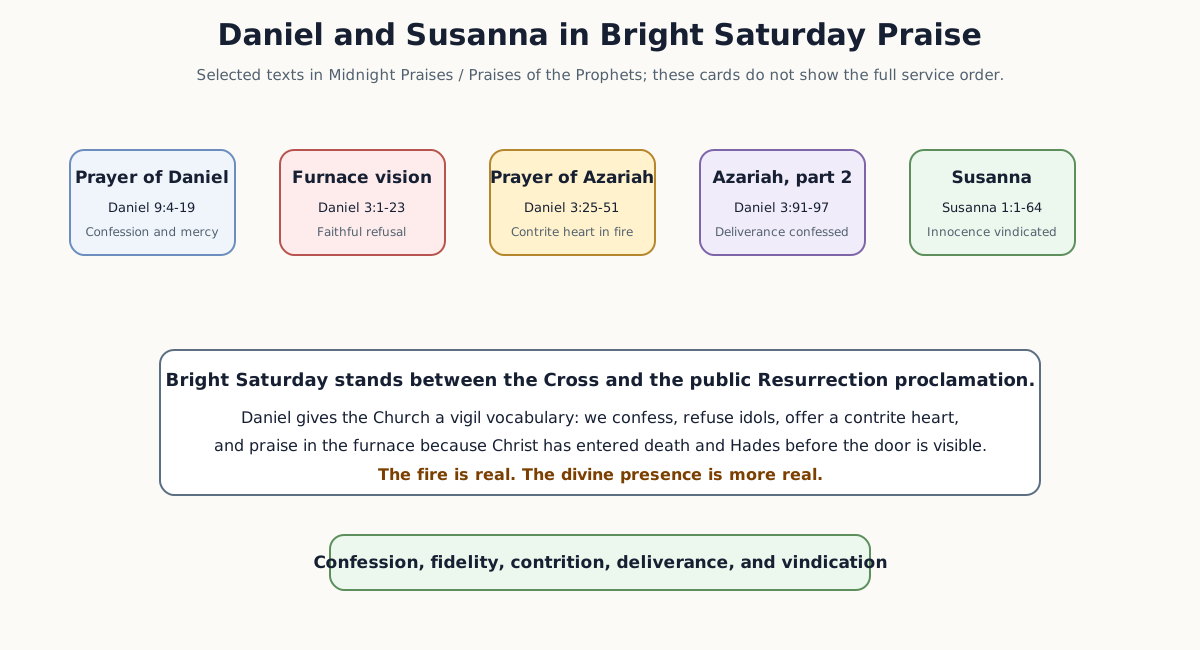 Source: Hermes, schematic of selected Bright Saturday prophetic praises; not the complete service order.
How to receive the book
Begin with the prayer before reaching for the calculation. Notice who speaks, what the rulers demand, what God gives, and how the faithful answer. The visions contain real historical detail and real promises about judgment and resurrection. Restraint means explaining those things carefully, not refusing to explain them.
Let each chapter leave one practice behind: a particular refusal of compromise, a settled hour of prayer, reverence before the Holy Mysteries, confession spoken with “we,” or endurance through an unanswered week. Fasting and courage are received in grace and lived within the Church; they are not ways to purchase God’s protection. A person who is ill, bereaved, or frightened has not thereby failed Daniel’s test.
The faithful in Daniel do not escape Babylon by geography. They escape its claim upon them by worship. They pray, fast, refuse idols, confess sin, and await the Kingdom that cannot be destroyed. Their deliverances point beyond themselves to Christ’s saving death and Resurrection. The soul that clings to Him can live in exile without becoming exiled from God.
Sources
UK Midlands Coptic Orthodox Diocese, Katameros Lent, Friday of the fourth week, pp. 355–358: Daniel 14:2–42.
St. Mary Ottawa, Holy Pascha Katameros, Lent 1734 A.M./2018, Tuesday Ninth Hour: Daniel 7:9–15.
Coptic Bright Saturday service order, Midnight Praises / Praises of the Prophets, and the Coptic Synaxarium commemoration catalog: source-qualified appointments and event titles, as distinguished in the table above.
Coptic Reader, Great Lent week 4 Thursday Matins prophecies, and Special / Consecrations / Oil / Myron / Preparation, Daniel 9:20–27.
Lancelot C. L. Brenton, The Septuagint Version of the Old Testament: the English edition used in the chapter studies. Embedded Scripture is from Brenton’s English Septuagint (LXX).
Jerome, Commentary on Daniel, Prologue, translated by Gleason L. Archer: ancient Christian reception and the answer to Porphyry.
Hippolytus, On Christ and Antichrist, especially §9.
Francis X. Gumerlock, notice of T. C. Schmidt’s English translation of Hippolytus’s Commentary on Daniel: bibliographic orientation, not a substitute for the commentary’s text.
Amanda M. Davis Bledsoe, “The Relationship of the Different Editions of Daniel: A History of Scholarship”, Currents in Biblical Research 13.2 (2015), pp. 175–190, especially pp. 176–179.
Encyclopaedia Britannica, “The Book of Daniel”: a concise account of the modern composition view, not the theological authority for these studies.
Footnotes
-
Amanda M. Davis Bledsoe, “The Relationship of the Different Editions of Daniel”, pp. 176–179, on the Hebrew/Aramaic divisions and the Old Greek and Theodotionic editions. ↩ ↩2
-
Jerome, Commentary on Daniel, Prologue; compare Encyclopaedia Britannica, “The Book of Daniel”, for the modern critical dating view. ↩
-
Jerome, Commentary on Daniel, Prologue, translated by Gleason L. Archer. ↩
-
Francis X. Gumerlock, “Commentary on Daniel by Hippolytus Now in English Translation”, identifying the commentary and its early-third-century date. ↩
-
Hippolytus, On Christ and Antichrist, §9, translated by J. H. MacMahon. ↩
-
Coptic Bright Saturday service order, Midnight Praises / Praises of the Prophets: Daniel 3:1–23, 3:25–51, 3:91–97, 9:4–19 and Susanna 1:1–64. ↩
-
Coptic Reader, Special / Consecrations / Oil / Myron / Preparation, Daniel 9:20–27. ↩
-
UK Midlands Coptic Orthodox Diocese, Katameros Lent, Friday of the fourth week, printed pp. 355–358. ↩