Illuminated Coptic sanctuary banner
Audio narration

Core thesis

This passage teaches the Church how to pray inside the furnace. Azariah begins with repentance: God is righteous, we have sinned, and we have no temple sacrifice to offer. Then the angel of the Lord makes the furnace like a cool wind. Then the three youths answer with cosmic praise: not only angels and saints, but fire, heat, frost, snow, whales, birds, priests, servants, and all creation are summoned to bless the Lord.

For the Coptic Orthodox Church, this is not a forgotten appendix to Daniel. It is prayed and sung in the heart of worship: the Third Hoos of Midnight Psalmody, the Psali for the Three Saintly Children, and the Bright Saturday / Apocalypse Night sequence.

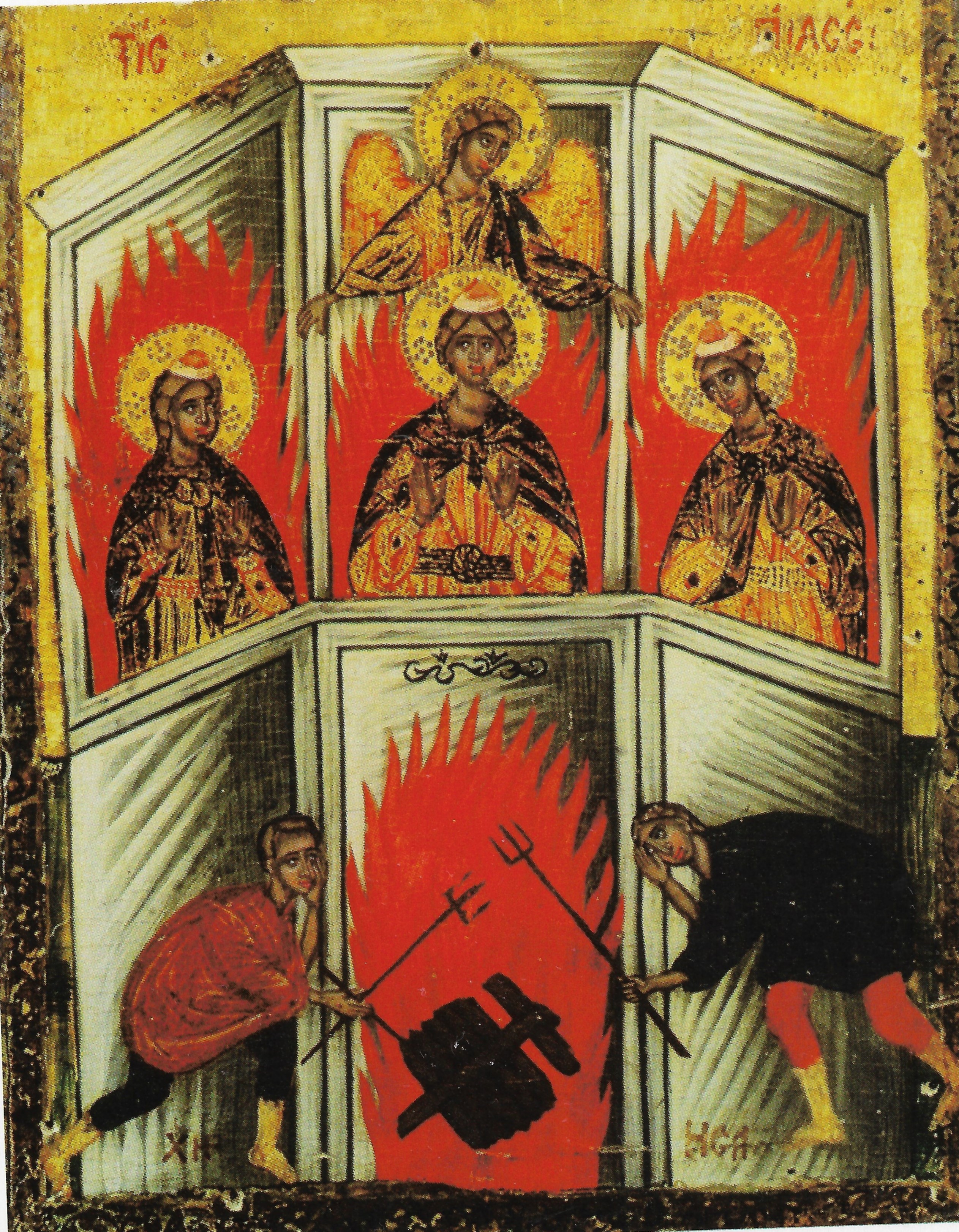
Public domain Levantine icon of the Three Holy Children in the furnace

Visual note: Public-domain Levantine icon of Shadrach, Meshach, and Abednego / the Three Holy Children in the fiery furnace, preserved through Wikimedia Commons. The icon shows the youths unharmed in the furnace under angelic protection.

Gustave Doré engraving of Shadrach, Meshach and Abednego in the Furnace (1866)

Source: Gustave Doré, Shadrach, Meshach and Abednego in the Furnace, from Doré’s Bible Illustrations (public domain), via Wikimedia Commons: https://commons.wikimedia.org/wiki/File:129.Shadrach,_Meshach_and_Abednego_in_the_Furnace.jpg

Iconography of the Three Holy Children

In Orthodox iconography, the Three Holy Children (Ananias, Azarias, and Misael) are almost always shown together in the fiery furnace. Several elements carry deep spiritual meaning:

  • The Angel / Christ in the furnace: The figure standing with the youths is not merely an angel in the modern sense. In Orthodox tradition, this is understood as a pre-incarnate appearance of Christ (the Logos, sometimes called the “Angel of Great Counsel” from Isaiah 9:6 in the Septuagint). The angel is frequently depicted with a cross-nimbus (halo containing a cross), indicating that He is the divine Son, not a created being. This makes the icon a Christophany — a revelation of Christ before His Incarnation.

  • The youths’ posture: They are usually shown standing upright with hands raised in prayer, not cowering or burned. Their bodies are intact, their garments untouched, and often their hands are open in the ancient orans (prayer) position. This expresses that true faithfulness transforms suffering into worship.

  • The “Jewish cap” or round hat: In many icons the youths wear a distinctive round or pointed cap. This identifies them as faithful Jews in a foreign land and visually distinguishes them from the Babylonian courtiers.

  • The furnace itself: The flames are often painted in stylized, almost decorative patterns rather than realistic destruction. This artistic choice emphasizes that the fire has lost its power to harm those who belong to God.

  • Nebuchadnezzar and the officials: When included, they are usually shown outside the furnace, astonished or pointing, symbolizing the Gentile world witnessing the power of the God of Israel.

Spiritually, the icon proclaims several truths at once:

  • Christ is present with His faithful in the midst of trial.
  • The fire of persecution cannot ultimately destroy those who refuse to worship idols.
  • Suffering can become the place where the Church learns to praise “as out of one mouth.”
  • The scene is a type of the Resurrection and the harrowing of Hades — Christ enters the place of death and brings life.

This is why the Three Holy Children appear so frequently in Orthodox hymnography and on Bright Saturday: the icon and the readings together teach that the Lord does not merely rescue His servants from the fire — He enters the fire with them.

The Prayer of Azariah and Song of the Three Holy Children is the Greek Daniel expansion placed after Daniel 3:23. It is usually treated as one of the Additions to Daniel, along with Susanna and Bel and the Dragon.

The passage has four movements:

  1. The youths walk in the flame, praising God - Daniel 3:24.
  2. Azariah prays from the furnace - Daniel 3:25-45.
    • He blesses God.
    • He confesses Israel’s sin.
    • He accepts God’s judgment as true.
    • He pleads the covenant with Abraham, Isaac, and Israel.
    • He offers a contrite heart and humble spirit in place of sacrifices.
  3. The angel of the Lord cools the furnace - Daniel 3:46-51.
    • The fire consumes the Chaldeans outside the furnace.
    • Inside, the flame becomes like a moist, whistling wind.
    • The three praise God “as out of one mouth.”
  4. The Song summons all creation to praise - Daniel 3:52-90.
    • Heaven, angels, waters, sun, moon, stars, fire, heat, frost, snow, mountains, seas, animals, Israel, priests, servants, and the humble in heart all bless the Lord.

Why it is in the LXX but not in modern Protestant translations like NKJV

Short answer: this is a canon and textual-tradition difference, not simply a “missing verse” issue.

1. The Hebrew/Aramaic Daniel is shorter

The Masoretic Text of Daniel, the Hebrew/Aramaic textual tradition used as the base Old Testament text for most Protestant translations, does not include this expansion after Daniel 3:23. That is why standard Protestant Bibles move from the youths falling into the furnace to Nebuchadnezzar seeing the men walking in the fire, without Azariah’s prayer or the creation hymn.

2. Greek Daniel includes it

The Greek Daniel tradition includes the Prayer of Azariah and the Song of the Three Holy Children. In broad English shorthand people say “it is in the Septuagint,” but the textual history is slightly more precise: Christian Greek Daniel was often transmitted in Theodotion’s Greek form rather than only the older Old Greek form. Either way, the Church’s Greek Daniel tradition contains this passage, and it was received in ancient Christian worship.

The International Standard Bible Encyclopedia notes that the Song follows Daniel 3:23 and is integral to chapter 3 in the Septuagint, Theodotion, Syriac, Old Latin, and Vulgate traditions. OrthodoxWiki likewise identifies it as part of Septuagint Daniel.

3. The Orthodox Church receives the Old Testament through the Septuagintal worshipping tradition

The Orthodox Church does not treat the Old Testament as only the later Jewish Masoretic collection. The Church inherited and prayed the Greek Old Testament in its liturgical life. That is why Greek Daniel, including the Prayer of Azariah, the Song of the Three Holy Children, Susanna, and Bel and the Dragon, belongs naturally inside Orthodox Scripture and worship.

For a Coptic Orthodox audience, this point matters: the passage was not “added to make services longer.” The Coptic Church sings it because it received Daniel through the Church’s biblical and liturgical inheritance.

4. NKJV normally follows the Protestant Old Testament canon

The standard NKJV is a Protestant Bible: 39 Old Testament books plus 27 New Testament books. It follows the Protestant Old Testament canon and generally translates Daniel from the Hebrew/Aramaic textual base, so this passage is not printed inside Daniel 3. That does not mean every modern Bible omits it. Catholic, Orthodox, and some ecumenical editions include the Deuterocanonical books or Apocrypha. The Orthodox Study Bible includes the Greek Daniel tradition; NRSV/RSV editions with Apocrypha or Catholic/Orthodox contents also include it.

How to explain this without becoming combative

A good parish-level explanation is:

Protestant Bibles like the NKJV usually follow the shorter Hebrew/Aramaic Daniel and Protestant Old Testament canon. The Orthodox Church receives Daniel through the Greek Septuagintal tradition used in the worshipping Church, where the Prayer of Azariah and Song of the Three Holy Children stand inside Daniel 3. That is why we sing it in the Third Hoos and on Bright Saturday.

Why this passage matters spiritually

1. It gives words to faithful suffering

The youths are not delivered before the furnace. They pray and sing inside it. The passage does not teach denial, optimism, or religious theatrics. It teaches sober prayer under pressure:

“For we have sinned and committed iniquity, departing from thee.” - Daniel 3:29, Brenton LXX

Azariah does not blame Babylon first. He confesses Israel’s sin first. That does not excuse Babylon’s idolatry or violence, but it keeps the faithful soul from becoming spiritually proud under persecution.

2. It teaches repentance when normal religious supports are gone

Azariah says:

“Neither is there at this time prince, or prophet, or leader, or burnt offering, or sacrifice, or oblation, or incense, or place to sacrifice before thee, and to find mercy. Nevertheless in a contrite heart and an humble spirit let us be accepted.” - Daniel 3:38-39, Brenton LXX

This is one of the deepest lines in the passage. The temple is not available. Sacrifice is not available. The people are in exile. Yet the heart can still become an altar.

This does not replace the sacramental life of the Church. It shows what repentance looks like when the faithful person has nothing left to offer except humility, fear of God, and the desire to return.

3. It turns the furnace into a liturgy

The fire is not merely endured. It becomes the place where the Church learns to bless the Lord. The enemy builds an oven; God turns it into a sanctuary.

This is why the passage belongs so naturally in Psalmody. The Church is not simply remembering a miracle. She is practicing the same spiritual movement:

  • from bondage to praise,
  • from fear to confession,
  • from isolation to one mouth,
  • from creation as threat to creation as choir.

4. It reveals Christ in the furnace

The Greek Daniel passage says the angel of the Lord came down into the furnace and made it cool. Immediately afterward, Nebuchadnezzar sees a fourth figure with the three youths. Orthodox interpretation reads this as divine presence and as a type or manifestation of Christ: the Lord enters the fire with His servants.

On Bright Saturday, this becomes Paschal. Christ enters death, Hades, and the place of fear, not as a victim trapped there, but as the Lord who transforms it from within.

5. It teaches creation to praise

The Song does not only call rational beings to bless God. It calls waters, stars, winds, fire, frost, snow, mountains, seas, whales, birds, and beasts. The human voice becomes priestly: mankind gathers creation into praise.

This is especially important in an Orthodox worldview. Salvation is not escape from creation. It is creation restored into doxology.

Unique place in the Coptic Midnight Psalmody

The Third Hoos of the Coptic Midnight Psalmody comes from Daniel 3 and the Song of the Three Holy Children. In the fixed order of the Midnight Praise, it follows:

  1. Midnight Psalms from the Agpeya.
  2. Ten Theno - “Let us rise, O children of the light.”
  3. First Hoos - Exodus 15, the Song of Moses after crossing the Red Sea.
  4. Second Hoos - Psalm 135/136, the refrain of mercy.
  5. Third Hoos - Daniel 3, the praise of the Three Holy Youths.
  6. Psali for the Three Saintly Children.
  7. Commemoration of the saints, doxologies, Fourth Hoos, Psali, Theotokia, Creed, and conclusion.

Tasbeha.org’s Third Hoos text gives the familiar refrain:

“praise Him and exalt Him above all forever”

The Coptic-English transliteration appears as:

Hos erof ari-ho-oo chasf sha ni-eneh.

This means that the Prayer of Azariah and the Song of the Three Holy Children are not rare liturgical material in the Coptic Church. They sit near the center of regular praise. In the Coptic experience, the furnace is visited again and again, because praise is learned under trial.

The Psali for the Three Saintly Children makes the Paschal connection explicit:

“O sing unto Him who was crucified, buried and resurrected for us, who trampled and abolished death, praise Him and exalt Him above all.”

That line is the key Coptic instinct: the furnace is read through the Cross and Resurrection.

Unique place on Bright Saturday / Apocalypse Night

Bright Saturday, also called Apocalypse Night or Saturday of Light, places the Prayer of Azariah and the Three Youths in a unique Paschal frame.

Checked Bright Saturday service-order material preserves this sequence in the Midnight Praises / prophetic section:

  • Prayer of Daniel - Daniel 9:4-19.
  • Vision of Daniel / Three Youth in the Fiery Furnace - Daniel 3:1-23.
  • Prayer of Azariah, Part 1 - Daniel 3:25-51.
  • The booklet sequence also names the Praise of the three young men and the Greek/Coptic Psali Watos for the three young men.

This is the night when the Church stands between Good Friday and the Resurrection proclamation. Christ has died in the flesh. The Church waits at the tomb. Revelation will be read. The saints of the Old Covenant are remembered. Hades is being harrowed by the Lord of glory.

In that setting, Daniel 3 becomes more than a miracle story:

  • The furnace becomes an image of death and Hades.
  • The angelic presence becomes the Lord’s saving presence among the bound.
  • The cool wind in the fire becomes an image of resurrection life breaking into the place of destruction.
  • The youths’ praise becomes the voice of the righteous awaiting deliverance.
  • The cosmic hymn anticipates the whole creation blessing the risen Christ.

Bright Saturday therefore makes explicit what the Third Hoos trains us to know every week: the Church blesses the Lord from inside the fire because Christ has entered the fire first. The youths’ deliverance from “hell” and “the hand of death” becomes a type of the harrowing of Hades that the Church proclaims on this night before the Resurrection Gospel.

Early Christian catacomb image of the Three Hebrews in the fiery furnace

Visual note: Public-domain early Christian image from the Catacombs of Priscilla, Rome, late 3rd / early 4th century. The three figures stand in prayer amid the flames, showing how ancient Christians saw this scene as a sign of tribulation and redemption.

Brenton Septuagint text for study

Translation note: This project uses Brenton’s English Septuagint for embedded Old Testament Scripture. In the Brenton text used here, Daniel 3 moves from verse 66 to verse 71 and combines several invocations in verse 72. The textual flow is still continuous.

24. and walked in the midst of the flame, singing praise to God, and blessing the Lord. 25. Then Azarias stood up, and prayed on this manner; and opening his mouth in the midst of the fire said, 26. Blessed art thou, O Lord God of our fathers: thy name is worthy to be praised and glorified for evermore: 27. for thou art righteous in all the things that thou hast done to us: yea, true are all thy works, thy ways are right, and all thy judgments truth. 28. In all the things that thou hast brought upon us, and upon the holy city of our fathers, even Jerusalem, thou hast executed true judgment: for according to truth and judgment didst thou bring all these things upon us because of our sins. 29. For we have sinned and committed iniquity, departing from thee. In all things have we trespassed, and not obeyed thy commandments, 30. nor kept them, neither done as thou hast commanded us, that it might go well with us. 31. Wherefore all that thou hast brought upon us, and every thing that thou hast done to us, thou hast done in true judgment. 32. And thou didst deliver us into the hands of lawless enemies, most hateful forsakers of God, and to an unjust king, and the most wicked in all the world. 33. And now we cannot open our mouths, we are become a shame and reproach to thy servants, and to them that worship thee. 34. Yet deliver us not up wholly, for thy name’s sake, neither disannul thou thy covenant: 35. and cause not thy mercy to depart from us, for thy beloved Abraham’s sake, for thy servant Isaac’s sake, and for thy holy Israel’s sake; 36. to whom thou hast spoken and promised, that thou wouldest multiply their seed as the stars of heaven, and as the sand that lieth upon the seashore. 37. For we, O Lord, are become less than any nation, and be kept under this day in all the world because of our sins. 38. Neither is there at this time prince, or prophet, or leader, or burnt offering, or sacrifice, or oblation, or incense, or place to sacrifice before thee, and to find mercy. 39. Nevertheless in a contrite heart and an humble spirit let us be accepted. Like as in the burnt offerings of rams and bullocks, and like as in ten thousands of fat lambs: 40. so let our sacrifice be in thy sight this day, and grant that we may wholly go after thee: for they shall not be confounded that put their trust in thee. 41. And now we follow thee with all our heart, we fear thee, and seek thy face. Put us not to shame: 42. but deal with us after thy lovingkindness, and according to the multitude of thy mercies. 43. Deliver us also according to thy marvellous works, and give glory to thy name, O Lord: 44. and let all them that do thy servants hurt be ashamed; and let them be confounded in all their power and might, and let their strength be broken; 45. and let them know that thou art Lord, the only God, and glorious over the whole world. 46. And the king’s servants, that put them in, ceased not to make the oven hot with rosin, pitch, tow, and small wood; 47. so that the flame streamed forth above the furnace forty and nine cubits. 48. And it passed through, and burned those Chaldeans it found about the furnace. 49. But the angel of the Lord came down into the oven together with Azarias and his fellows, and smote the flame of the fire out of the oven; 50. and made the midst of the furnace as it had been a moist whistling wind, so that the fire touched them not at all, neither hurt nor troubled them. 51. Then the three, as out of one mouth, praised, glorified, and blessed, God in the furnace, saying, 52. Blessed art thou, O Lord God of our fathers: and to be praised and exalted above all for ever. And blessed is thy glorious and holy name: and to be praised and exalted above all for ever. 53. Blessed art thou in the temple of thy holy glory: and to be praised and glorified above all for ever. 54. Blessed art thou that beholdest the depths, and sittest upon the cherubim: and to be praised and exalted above all for ever. 55. Blessed art thou on the glorious throne of thy kingdom: and to be praised and glorified above all for ever. 56. Blessed art thou in the firmament of heaven: and above all to be praised and glorified for ever. 57. O all ye works of the Lord, bless ye the Lord: praise and exalt him above all for ever. 58. O ye heavens, bless ye the Lord: praise and exalt him above all for ever. 59. O ye angels of the Lord, bless ye the Lord: praise and exalt him above all for ever. 60. O all ye waters that be above the heaven, bless ye the Lord: praise and exalt him above all for ever. 61. O all ye powers of the Lord, bless ye the Lord: praise and exalt him above all for ever. 62. O ye sun and moon, bless ye the Lord: praise and exalt him above all for ever. 63. O ye stars of heaven, bless ye the Lord: praise and exalt him above all for ever. 64. O every shower and dew, bless ye the Lord: praise and exalt him above all for ever. 65. O all ye winds, bless ye the Lord: praise and exalt him above all for ever. 66. O ye fire and heat, bless ye the Lord: praise and exalt him above all for ever. 71. O ye nights and days, bless ye the Lord: praise and exalt him above all for ever. 72. O ye light and darkness, bless ye the Lord: praise and exalt him above all for ever. O ye frost and heat, bless ye the Lord: praise and exalt him above all for ever. O ye frost and snow, bless ye the Lord: praise and exalt him above all for ever. 73. O ye lightnings and clouds, bless ye the Lord: praise and exalt him above all for ever. 74. O let the earth bless the Lord: praise and exalt him above all for ever. 75. O ye mountains and little hills, bless ye the Lord: praise and exalt him above all for ever. 76. O all ye things that grow on the earth, bless ye the Lord: praise and exalt him above all for ever. 77. O ye seas and rivers, bless ye the Lord: praise and exalt him above all for ever. 78. O ye fountains, bless ye the Lord: praise and exalt him above all for ever. 79. O ye whales, and all that move in the waters, bless ye the Lord: praise and exalt him above all for ever. 80. O all ye fowls of the air, bless ye the Lord: praise and exalt him above all for ever. 81. O all ye beasts and cattle, bless ye the Lord: praise and exalt him above all for ever. 82. O ye children of men, bless ye the Lord: praise and exalt him above all for ever. 83. O Israel, bless ye the Lord: praise and exalt him above all for ever. 84. O ye priests of the Lord, bless ye the Lord: praise and exalt him above all for ever. 85. O ye servants of the Lord, bless ye the Lord: praise and exalt him above all for ever. 86. O ye spirits and souls of the righteous, bless ye the Lord: praise and exalt him above all for ever. 87. O ye holy and humble men of heart, bless ye the Lord: praise and exalt him above all for ever. 88. O Ananias, Azarias, and Misael, bless ye the Lord; praise and exalt him above all for ever: for he hath delivered us from hell, and saved us from the hand of death, and delivered us out of the midst of the furnace and burning flame: even out of the midst of the fire hath he delivered us. 89. O give thanks unto the Lord, because he is gracious: for his mercy endureth for ever. 90. O all ye that worship the Lord, bless the God of gods, praise him and give him thanks: for his mercy endureth for ever.

Scriptural insights by movement

Daniel 3:24-25 - Praise starts before the explanation

The text says the youths walked in the flame “singing praise to God, and blessing the Lord” before Azariah’s prayer is recorded. This matters spiritually. They do not wait to understand the miracle before worshipping. Praise begins while the furnace is still a furnace.

Daniel 3:26-31 - God’s judgment is true

Azariah’s first doctrinal claim is not “we are innocent.” He says God is righteous and His judgments are true. The faithful suffer unjustly under Babylon, but they still confess the people’s sin before God.

This is a mature Orthodox instinct: repentance does not require that every circumstance be my fault. It means that in every circumstance, my first movement toward God is humility.

Daniel 3:34-36 - Covenant memory

Azariah prays for God’s name’s sake and for the sake of Abraham, Isaac, and Israel. He does not bargain from merit. He appeals to God’s covenant mercy.

This is the Old Testament root of how the Church prays with the saints: God remembers His promises, His servants, and His covenant love. The Orthodox instinct is not to stand before God on the strength of private merit, but to approach Him through His covenant faithfulness and with the prayers of the righteous.

Daniel 3:38-40 - The heart becomes an altar

The absence of temple sacrifice is not treated casually. It is a tragedy. But Azariah asks that a contrite heart and humble spirit be accepted like burnt offerings.

This becomes a crucial spiritual lesson for anyone who feels spiritually displaced: when the outer supports are stripped away, the heart can still bow.

Daniel 3:49-50 - The angel makes the furnace cool

The miracle is not only that the youths survive. The nature of the furnace is transformed for them. The same fire that destroys the Chaldeans becomes harmless to the faithful.

This is why the Fathers love the passage. The fire remains fire, but God restrains its operation. Trial remains trial, but grace changes what it can do to the faithful soul.

Daniel 3:51 - “As out of one mouth”

The three praise “as out of one mouth.” Suffering can isolate people. Worship makes them one. In the Church, common praise heals the loneliness of the furnace. This also prepares the Coptic Psali that follows the Third Hoos, where the faithful join the youths’ refrain and become one choir with them.

Daniel 3:57-90 - Creation becomes choir

The Song is a priestly act. Humanity calls all creation to bless the Creator. Even fire and heat are told to bless the Lord.

This is not poetic decoration. It is a worldview: every created thing is meant to return as praise to God. Man stands as microcosm and liturgical priest of creation, gathering the groaning creation of Romans 8 into the praise of every creature before the Lamb in Revelation 5.

Daniel 3:88 - Delivered from Hades and death

The verse says God “delivered us from hell, and saved us from the hand of death.” In a Paschal setting, this line becomes luminous. The Church hears the harrowing of Hades before the Gospel of the empty tomb is proclaimed.

Patristic and Orthodox witnesses

St. John Chrysostom

In Homily 4 on the Statues, St. John Chrysostom says of the three youths:

“For the three youths were cast into the furnace, and did not even for this forget their piety; neither did the flames affright them, but more earnestly than men sitting in a chamber, and suffering nothing to alarm them, did they, while encircled by the fire, send up to heaven those sacred prayers - therefore the fire became a wall unto them, and the flame a robe; and the furnace was a fountain; and whereas it received them bound, it restored them free.”

He then explains that their piety did not destroy the nature of fire, but “stayed the operation” of it. This is a careful theological point: God does not need to pretend the fire is not real. He reveals His lordship over it.

St. Hippolytus of Rome

In his Commentary on Daniel, Hippolytus treats the fourth figure in the furnace as a revelation of the Son of God and reads Nebuchadnezzar’s recognition as a foreshadowing of the Gentiles recognizing Christ. The striking point is that the Gentile king recognizes a divine figure identified with the Son of God in the furnace, anticipating the nations who will recognize Christ incarnate. This is an early Christian witness that Daniel 3 was not read merely as moral courage, but as a Christophany and a prophecy of the nations coming to know the Lord.

Coptic Orthodox pastoral reading

The Coptic Orthodox Diocese of Los Angeles article on the Three Holy Youth connects their steadfastness directly to the power of Christ’s Resurrection. It notes the meaning of their Hebrew names:

  • Hananiah - the Lord is kind.
  • Mishael - who is like God?
  • Azariah - God is my help.

Their Babylonian names represent an imperial attempt to rename and absorb them. Their worship shows that Babylon can rename the body, but not the heart.

Teacher cautions

  • Do not present this as “Catholics and Orthodox added books; Protestants removed them” in a simplistic way. Explain the difference between the Hebrew/Aramaic textual tradition and the Greek Daniel tradition, then explain the Church’s liturgical reception.
  • Do not flatten the passage into moral courage only. The text is about repentance, covenant mercy, divine presence, creation’s praise, and Pascha.
  • Do not imply suffering is automatically good. Babylon’s idolatry and coercion are evil. God is good because He enters and transforms the furnace.
  • Do not overstate exact Bright Saturday verse usage beyond the verified available lectionary references. The local service-order note explicitly lists Daniel 3:1-23 and Daniel 3:25-51; the booklet sequence also names the Praise of the three young men and the Greek/Coptic Psali Watos.

Closing meditation

The furnace is the place Babylon builds to make worship impossible. But God turns it into a church.

Azariah prays because the faithful still have a heart to offer. The angel descends because the Lord does not abandon His servants in the fire. The three youths sing because deliverance has already begun before the door opens. Then creation itself joins them, because salvation is never private. The same Lord who cools the furnace will descend into death, break its gates, and teach the righteous to sing on Bright Saturday: praise Him and exalt Him above all forever.

Sources used in this overview

Coptic Psalmody and Third Hoos sources

  • Coptic Orthodox Diocese of Los Angeles, “The Life of Praise and Psalmody”
    • https://www.lacopts.org/story/the-life-of-praise-and-psalmody/
    • Used for the structure and spiritual meaning of the four canticles, especially the Third Canticle / Three Holy Youth.
    • Notes that the Third Canticle is sung by Hananiah, Azariah, and Mishael in the furnace and that Christ appears, loosens their chains, and makes the fire like dew.
  • HCOC / Coptic Heritage, “The Spirituality of the Holy Psalmody”
  • Tasbeha.org, “Praises Explained”
  • Tasbeha.org Hymn Library, “The Third Hoos”
  • Tasbeha.org Hymn Library, “The Third Hoos” - St. Antony Monastery English translation
  • Tasbeha.org Hymn Library, “Psali for the Three Saintly Children”

Bright Saturday / Three Youths sources

Canon, Septuagint, and modern translation sources

Patristic and Orthodox interpretive sources

Reading statusLoading your browser-local progress
Saved only in this browser

Created: | Updated:

Page Connections

Backlinks