


This narration is from a previous version of the study and may include a combined recording of multiple chapters.
The youths begin praising before the furnace door opens. That is the doorway into this companion study. The Daniel 3 study follows the full narrative, including the image, the refusal to bow, Azariah’s prayer, the Song, and the king’s astonishment. Here we follow the passage into Coptic prayer: how the Church receives it, remembers these saints, and learns to bless God while deliverance is still hidden.
The received passage and the Church’s memory
The Prayer of Azariah and Song of the Three Holy Children belongs after Daniel 3:23 in Greek Daniel. The shorter Hebrew and Aramaic form passes from the youths falling into the fire to the king’s astonishment. The Greek forms let us hear what happens inside: repentance, the Lord’s saving intervention, and a hymn that summons creation.
The Old Greek and Theodotion’s Greek Daniel both contain the furnace prayer and Song. Theodotion’s form became the usual Daniel of Greek Christian biblical transmission. Calling the passage part of the Septuagint is therefore useful Church shorthand, provided we remember that Greek Daniel has more than one textual form. The Overview explains the manuscript and numbering distinctions.
Standard NKJV editions translate Daniel from the shorter Hebrew and Aramaic tradition and follow the Protestant Old Testament canon. They therefore do not print this prayer and Song inside the chapter. That difference need not become an accusation against another Christian. For the Orthodox reader, the more fruitful question is what this received passage gives us to pray.
The Church’s memory is not an argument built only from tables of contents. The Third Hoos keeps the youths’ praise in the mouths of the faithful. Bright Saturday gives their deliverance a Paschal setting. Their yearly commemoration remembers them as persons, not merely as examples of courage.
Bound bodies and an unbound voice (Daniel 3:19-25)
Numbering note: The verse labels here follow the continuous Greek Daniel numbering used in the Daniel 3 study. Brenton prints the clause about walking and singing at the end of Daniel 3:23; it is displayed here as Greek Daniel 3:24. His separate Prayer of Azarias begins with the words displayed here as 3:25. The next session gives the complete prayer.
19 Then Nabuchodonosor was filled with wrath, and the form of his countenance was changed toward Sedrach, Misach, and Abdenago: and he gave orders to heat the furnace seven times more than usual, until it should burn to the uttermost. 20 And he commanded mighty men to bind Sedrach, Misach, and Abdenago, and to cast them into the burning fiery furnace. 21 Then those men were bound with their coats, and caps, and hose, and were cast into the midst of the burning fiery furnace, 22 forasmuch as the king’s word prevailed; and the furnace was made exceeding hot. 23 Then these three men, Sedrach, Misach, and Abdenago, fell bound into the midst of the burning furnace, 24 and walked in the midst of the flame, singing praise to God, and blessing the Lord. 25 Then Azarias stood up, and prayed on this manner; and opening his mouth in the midst of the fire said,
The king’s anger intensifies the furnace and binds the youths’ bodies. Yet his command cannot determine the direction of their prayer. They fall bound, then walk blessing God. The story does not first take them into a safe room and then teach them to give thanks. Praise is heard in the place intended to silence them.
Azariah stands and opens his mouth. He is not inventing an escape through positive thinking. He is addressing the God of his fathers while the threat remains real. The movement from falling to standing, from bondage to blessing, is the hinge between the narrative and the Church’s prayer.
For Daniel 3:1-18, the image, the accusation, and the youths’ refusal without bargaining, read the full narrative study. Their refusal remains essential: the voice that now blesses God is the voice that would not worship an idol. This companion does not replace that story. It lingers over the worship born within it.
The miracle does not promise that every faithful person will escape bodily harm. Hebrews 11:34-38 remembers both deliverance from fire and faithful suffering through death. Nor does the account require a person to remain in danger or endure abuse without help. Seeking safety is compatible with entrusting oneself to God. Praise may be quiet, broken by tears, or carried by others when a suffering person has no words.
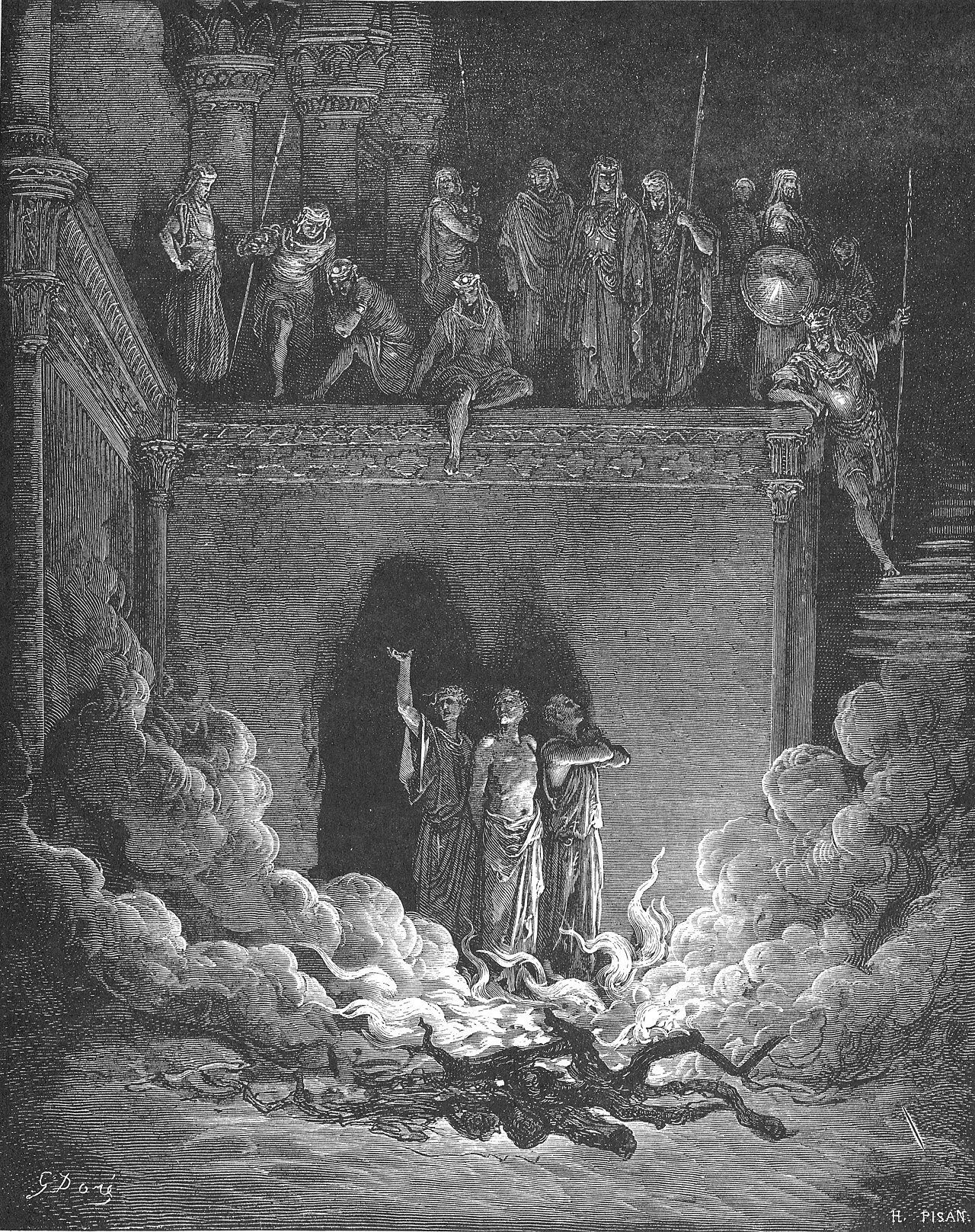 Source: Gustave Doré, Shadrach, Meshach and Abednego in the Furnace, from Doré’s Bible Illustrations (public domain), via Wikimedia Commons: https://commons.wikimedia.org/wiki/File:129.Shadrach,_Meshach_and_Abednego_in_the_Furnace.jpg
Doré’s engraving keeps the furnace before our eyes. It is a Western biblical illustration, not an Orthodox icon or an eyewitness record. Its usefulness here is the contrast between the intended destruction and the living company within the fire. The Overview keeps the icon, and Session 2 keeps the early Christian catacomb painting.
Gems from the Fathers 💎
Saint John Chrysostom uses the Three Children while preaching on the trials surrounding Paul’s arrival at Malta. His point is not that persecution is good. The very attempt to extinguish faithful life becomes, through God’s action, an occasion for its light to be seen. This helps us read the youths’ praise as witness rather than performance. Their enemies do not get to decide what the furnace will mean. Chrysostom writes: “The Three Children were thrown into the furnace, and through this they became more illustrious: Daniel was cast into the pit, and thence was he made more renowned.”1
This witness belongs to Homily 54 on Acts, on Acts 28:1. The prayer’s offering of the contrite heart receives a different, passage-specific treatment in Session 2; the fire’s restrained power and the fourth figure belong to Session 3.
The Church’s Voice in Worship ⛪
The Third Hoos is the third biblical canticle of Coptic Midnight Psalmody. It draws the Church into the Song’s repeated call to bless the Lord. The Psali for the Three Saintly Children then names Christ’s saving Passion and Resurrection. Session 4 follows the complete Song and that Paschal line, rather than repeating them here.
Coptic Reader’s Bright Saturday furnace readings place the youths beside the prayers of Daniel and other biblical witnesses.2 Session 5 follows this larger chain. The point is more than remembering that three men once escaped death. The Church learns a language for hope where death appears to have the final word.
On Bashans 10, commonly May 18, the Coptic Synaxarium commemorates the Departure of the Three Holy Young Men Hananiah, Azariah and Mishael. This is a Synaxarium commemoration, not a claim that Daniel 3 is appointed in that day’s readings. The day’s readings follow the Holy Fifty Days. The yearly memory gives names and faces to the refrain we sing: these are God’s servants whom the Church continues to remember, not interchangeable figures in an inspiring story.3
Their names also keep the Church’s memory personal. Court names identify them in the king’s command, while the hymn calls Ananias, Azarias, and Misael to bless the Lord. The empire’s account of who they are does not exhaust their life before God.
Spiritual Fruit 🍇
Receive this passage with gratitude rather than superiority. A fuller knowledge of the Church’s Bible should make our prayer more truthful, not our conversation more combative. Knowing why the prayer is present matters because it helps us hear what we might otherwise pass over.
Begin with the freedom that is already possible. The youths cannot open the furnace door, but they can refuse the idol and address God. In a trial we cannot immediately change, there may still be a faithful act within reach: telling the truth, asking for help, resisting resentment, or speaking a brief blessing. None of these buys a miracle. They are ways of belonging to God now.
Remember the saints by name. On Bashans 10, or when their names sound in the Third Hoos, let the Church’s remembrance interrupt the feeling that suffering makes us anonymous. The God whom they blessed has not forgotten His servants. When our own voice is weak, their song can help carry it.
Teaching Notes
Teaching Notes
Explain the textual difference calmly and exactly. Do not portray all Christians who use the NKJV as deliberately rejecting a prayer they may never have encountered. Keep the full Daniel narrative in its own study and use this session as the hinge into prayer.
Bound bodies and an unbound voice (Daniel 3:19-25)
- Ask: What becomes possible inside the furnace before the door opens?
- Watch for: Making visible rescue a test of faith, or telling a suffering person to remain unsafe until God acts.
- Show: Use Doré’s engraving to contrast royal violence with the living company in the furnace. Identify it as Western biblical art.
The received passage and the yearly memory
- Ask: How does remembering Hananiah, Azariah, and Mishael by name change the way we sing the Third Hoos?
- Watch for: Confusing Bashans 10’s Synaxarium commemoration with a Daniel reading appointment. The day’s readings follow the Holy Fifty Days.
Sources
Embedded Scripture is from Brenton’s English Septuagint (LXX).
Brenton, Daniel 3, https://www.ccel.org/b/brenton/lxx/htm/16.iii.htm, and separate Prayer of Azarias, https://ebible.org/eng-Brenton/S3Y01.htm. The Overview explains the continuous Greek frame and manuscript distinctions.
Tasbeha.org, The Third Hoos, https://tasbeha.org/hymn_library/view/1241; Psali for the Three Saintly Children, https://tasbeha.org/hymn_library/view/1242. The full Song and the quoted Psali line have their home in Session 4.
Doré engraving, public domain: https://commons.wikimedia.org/wiki/File:129.Shadrach,_Meshach_and_Abednego_in_the_Furnace.jpg.
Footnotes
-
Saint John Chrysostom, Homily 54 on Acts, on Acts 28:1, concluding exhortation, paragraph beginning “Cain slew his brother,” NPNF1 11, p. 322: https://www.newadvent.org/fathers/210154.htm. ↩
-
Coptic Reader, Diocese of the Southern United States, Special / Pascha / Saturday, Praises (Midnight Praises), Matins, Revelation, and Liturgy of the Word, Joyous Saturday edition: https://copticreader.org/app/. The app is stateful; select the named service rather than treating the opening screen as the reading. ↩
-
Coptic Synaxarium, Bashans (Bashons) 10, entry 1, “The Departure of the Three Hebrew Young Men Hananiah, Azariah and Mishael”: https://www.copticchurch.net/synaxarium/9_10.html. ↩