


This narration is from a previous version of the study and may include a combined recording of multiple chapters.
Azariah’s prayer teaches the soul how to repent in the fire without collapsing into self-pity. He does not pretend Babylon is righteous, and he does not pretend Israel is innocent. He blesses God, confesses sin, remembers the covenant, offers a contrite heart when temple sacrifice is unavailable, and asks for deliverance so that God’s name may be glorified. This is confession without despair: the prayer begins in judgment, but it moves toward mercy, whole-hearted return, and hope.
Overview: repentance inside the furnace
This session covers Greek Daniel 3:25-45, the Prayer of Azariah proper. Session 1 showed why the Church receives this passage inside Daniel 3 and why Coptic worship keeps it in the Church’s mouth. Here the focus narrows to Azariah’s prayer: a penitential unit spoken from inside the furnace before the angel cools the fire and before the whole creation hymn begins.
The setting matters. The Three Holy Children suffer unjustly under Babylon’s idolatrous coercion. They are not in the furnace because they worshiped the idol. Yet Azariah’s prayer does not become a speech about victimhood, rage, or self-defense. He prays as a member of God’s covenant people. He can name Babylon’s injustice and still confess Israel’s sin. He can say God has judged truly and still ask God not to abandon His mercy. This is spiritual maturity: repentance under unjust suffering.
Coptic Reader’s Bright Saturday Midnight Praises includes the Prayer of Azarias, Daniel 3:25-51, which this study calls Part 1.1 This gives the prayer a Paschal frame. The Church stands between the Cross and the Resurrection and hears a righteous sufferer confess sin, offer the heart, and ask God to act for His name. The session therefore reads Azariah not as generic repentance, but as the voice of the faithful heart learning to become an altar in the fire.
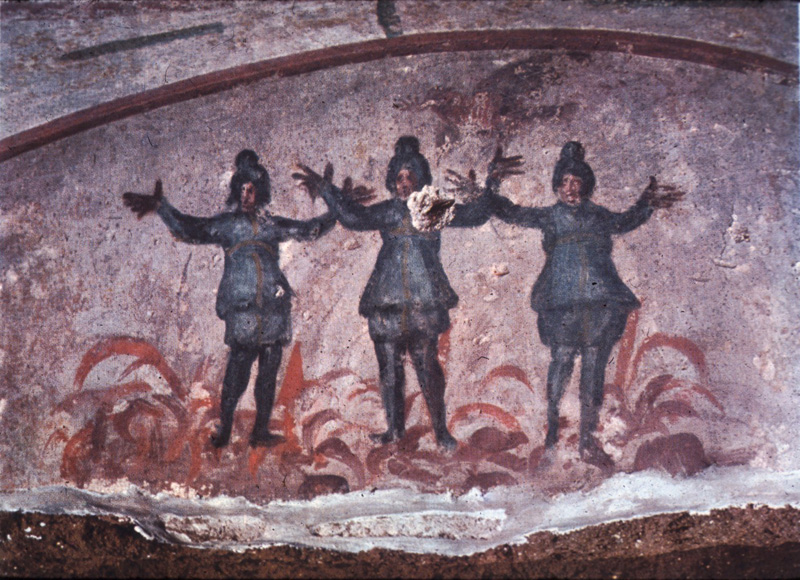 Source: Wikimedia Commons, public-domain early Christian image from the Catacombs of Priscilla, Rome, late 3rd or early 4th century: https://commons.wikimedia.org/wiki/File:Fiery_furnace_01.jpg
The catacomb image shows the three figures standing in prayer amid stylized flames. That is the spiritual posture of this session. The fire is real, but the faithful body is lifted toward God.
Azariah stands and blesses God in the fire (Greek Daniel 3:25-27)
Numbering note: These verses use the continuous Greek Daniel frame, 3:25-45. Brenton prints the prayer as Prayer of Azarias 1-21 within a separate 67-verse book. The Overview explains the distinct printed and integrated forms.
25 Then Azarias stood up, and prayed on this manner; and opening his mouth in the midst of the fire said,
26 Blessed art thou, O Lord God of our fathers: thy name is worthy to be praised and glorified for evermore: 27 for thou art righteous in all the things that thou hast done to us: yea, true are all thy works, thy ways are right, and all thy judgments truth.
Azariah stands up inside the fire. This is not a small detail. Babylon has thrown the youths down bound, but the prayer begins with a man standing before God. His body is in the furnace, yet his prayer is not crouched in panic. The posture of his heart is worship.
His first word is blessing. He does not begin by explaining himself, accusing Babylon, or measuring the heat. He begins with God: “Blessed art thou, O Lord God of our fathers.” Pain may fill our attention, and grief is not a failure of faith. Azariah opens a way to address God without pretending that the wound is small.
He calls God “the God of our fathers.” This phrase already prepares the covenant appeal that will come later. Azariah is not praying as a religious individual inventing private comfort. He prays as a son of Abraham, Isaac, and Israel, as a member of the people whose life rests on God’s promise. The furnace cannot cut him off from that memory.
Then he confesses God’s righteousness. “True are all thy works, thy ways are right, and all thy judgments truth.” This is not denial. Babylon’s violence remains evil. The king remains unjust. But Azariah refuses to let Babylon’s sin become an excuse for his own people to stop confessing God rightly.
This is one of the deep lessons of the prayer. Repentance is not the same as blaming ourselves for everything that hurts us. The youths are suffering because they refused idolatry. Yet repentance is still possible in that suffering because the heart always stands before God. A faithful person may say, “This wrong done to me is evil,” and also say, “Lord, cleanse me, have mercy on Your people, and let Your judgments be true.”
The Gospel resonance is the publican in Luke 18. He does not build a case for himself. He stands before God with a plea for mercy. Azariah’s prayer has the same publican-like humility, but spoken from the furnace and from within Israel’s covenant story. The soul is healed when it stops making itself the judge of God and begins again by blessing Him.
Truthful judgment and Israel’s sin (Greek Daniel 3:28-33)
28 In all the things that thou hast brought upon us, and upon the holy city of our fathers, even Jerusalem, thou hast executed true judgment: for according to truth and judgment didst thou bring all these things upon us because of our sins. 29 For we have sinned and committed iniquity, departing from thee. In all things have we trespassed, and not obeyed thy commandments, 30 nor kept them, neither done as thou hast commanded us, that it might go well with us. 31 Wherefore all that thou hast brought upon us, and every thing that thou hast done to us, thou hast done in true judgment.
32 And thou didst deliver us into the hands of lawless enemies, most hateful forsakers of God, and to an unjust king, and the most wicked in all the world. 33 And now we cannot open our mouths, we are become a shame and reproach to thy servants, and to them that worship thee.
Azariah now names Jerusalem. The furnace in Babylon is connected to the holy city of the fathers. His prayer is not only about the three youths’ immediate danger. It is about exile, covenant-breaking, and the humiliation of God’s people. The personal furnace is set inside the larger tragedy of Israel’s sin.
The confession is direct: “we have sinned and committed iniquity, departing from thee.” He does not say, “Our circumstances are unfortunate.” He does not say, “Mistakes were made.” He says the people departed from God, trespassed, and did not obey the commandments. That precision matters. Confession heals because it tells the truth.
At the same time, Azariah carefully names the enemies as lawless, hateful forsakers of God, and servants of an unjust king. This keeps the prayer from becoming false guilt. Repentance does not require calling evil good. The Babylonians are not justified because Israel has sinned. The king is not righteous because God has allowed judgment. Azariah holds both truths together: God has judged truly, and Babylon remains wicked.
This protects the wounded soul from two opposite dangers. One danger is allowing resentment to close the heart to every call to repentance. The other danger is despairing self-condemnation, where every wound becomes proof that God has rejected me. Azariah chooses neither. He confesses sin before God and still names injustice as injustice.
The line “we cannot open our mouths” is especially piercing because Azariah is opening his mouth in prayer. Before men, Israel has become shame and reproach. Before God, the mouth can still open in confession. Shame closes the mouth when it turns inward. Repentance opens the mouth because it turns toward God.
Psalm 51 (LXX 50) resonates here. David’s penitential psalm also confesses sin before the righteous Judge and asks God to cleanse the heart. The point is not that Azariah is quoting that Psalm as commentary. The spiritual resonance is that true repentance speaks plainly because it trusts mercy. A soul that believes God is only angry hides. A soul that knows God’s judgment is true and His mercy is real can speak.
Covenant memory and mercy for the fathers’ sake (Greek Daniel 3:34-37)
34 Yet deliver us not up wholly, for thy name’s sake, neither disannul thou thy covenant: 35 and cause not thy mercy to depart from us, for thy beloved Abraham’s sake, for thy servant Isaac’s sake, and for thy holy Israel’s sake; 36 to whom thou hast spoken and promised, that thou wouldest multiply their seed as the stars of heaven, and as the sand that lieth upon the seashore. 37 For we, O Lord, are become less than any nation, and be kept under this day in all the world because of our sins.
The prayer turns from confession to covenant appeal. Azariah does not ask God to deliver them because their suffering has earned a claim on Him. He asks God to act for His own name and covenant. “Deliver us not up wholly, for thy name’s sake.” The deepest ground of hope is not the quality of our repentance. It is God’s faithfulness to Himself.
This is confession without despair. Azariah has just said Israel has sinned. Now he asks God not to disannul the covenant. Sin is real, shame is real, exile is real, and yet covenant mercy is also real. The faithful person does not deny judgment. He pleads the mercy that God Himself has promised.
The appeal to Abraham, Isaac, and Israel is not a sentimental memory of heroic ancestors. It is covenant memory. God spoke to them. God promised to multiply their seed. Azariah’s prayer asks God to remember what God has said. This is one root of the Church’s prayer with the saints: we do not come before God as isolated spiritual consumers. We come inside God’s covenant dealings with His servants, asking Him to remember mercy.
The names are also spiritually ordered. Abraham is beloved, Isaac is servant, Israel is holy. Azariah stands in a furnace, humiliated under a pagan king, and his mind returns to the promises given before Egypt, Sinai, the monarchy, the temple, and the exile. Faith remembers farther back than pain. Pain says, “This moment is everything.” Covenant memory says, “God was faithful before this moment, and His name has not changed.”
Verse 37 is honest. “We are become less than any nation.” Azariah does not pretend the promise is visibly triumphant at that moment. The descendants compared to stars and sand now seem diminished and humiliated. That tension is the prayer’s anguish. The covenant promise and the present shame stand side by side. Prayer lives in that space, not by denying either side, but by carrying both into God’s presence.
Jonah 2 resonates with this movement and is also its liturgical neighbor: Coptic Reader places the Prayer of Jonah in the same Bright Saturday prophetic-prayer sequence.1 Jonah prays from the depths, from a place that feels like death, and remembers the Lord’s holy temple. Azariah prays from the fire and remembers the covenant. Both prayers teach that the faithful memory of God can survive when the body is enclosed, threatened, and unable to deliver itself.
The heart as altar when sacrifice is unavailable (Greek Daniel 3:38-40)
38 Neither is there at this time prince, or prophet, or leader, or burnt offering, or sacrifice, or oblation, or incense, or place to sacrifice before thee, and to find mercy.
39 Nevertheless in a contrite heart and an humble spirit let us be accepted. Like as in the burnt offerings of rams and bullocks, and like as in ten thousands of fat lambs: 40 so let our sacrifice be in thy sight this day, and grant that we may wholly go after thee: for they shall not be confounded that put their trust in thee.
This is the deepest wound in the prayer. Azariah is not only saying, “I am in trouble.” He is saying that the visible supports of covenant life have collapsed. There is no prince, prophet, leader, burnt offering, sacrifice, oblation, incense, or place to sacrifice before God and find mercy. Exile has stripped Israel of temple, altar, and ordered public worship.
Azariah does not treat the loss of sacrifice as a minor inconvenience. He does not say, “We never needed temple worship anyway.” He laments the absence because Israel’s worship mattered. The temple was not a disposable religious stage. Sacrifice, incense, and the appointed place were part of God’s gift to His people.
Then comes the word “nevertheless.” This is one of the great turns of the prayer. “Nevertheless in a contrite heart and an humble spirit let us be accepted.” When the visible altar is unavailable, the heart can still be offered. The heart becomes an altar, not by replacing God’s appointed worship, but by becoming inwardly true before God.
Azariah’s prayer does not abolish sacramental worship, priesthood, liturgy, Eucharist, confession, or the Church’s visible altar. It teaches what the faithful heart must do when ordinary supports are taken away or when a person stands exposed before God with nothing to offer but humility. In the Church, outward worship is not opposed to the heart. The altar trains the heart, and the heart must not be absent from the altar.
The phrase “contrite heart and humble spirit” resonates with Psalm 51 (LXX 50), where the broken and humbled heart is not despised by God. It also looks forward to Hebrews 13:15, where the Church offers the sacrifice of praise through Christ. These are resonances, not replacements for Azariah’s own meaning. The prayer remains an exile prayer from inside Daniel 3, but the Church hears in it the shape of every true offering: humility, trust, and whole-hearted return.
The prayer asks, “grant that we may wholly go after thee.” Contrition is not a mood. It is a turn of the whole person. Azariah does not ask only to feel forgiven. He asks that the people’s life may be reoriented toward God. True confession always moves toward obedience.
Gems from the Fathers 💎
Saint John Chrysostom makes this very prayer an explanation of the living sacrifice in Romans 12:1. In Homily 20 on Romans, he asks how the body becomes a sacrifice: the eye refuses evil, the tongue refuses filthy speech, and the hand refuses lawlessness. But restraint alone is not enough. The hand must also give alms, the mouth bless those who oppose us, and the ear make time for Scripture. He then quotes the Three Children’s loss of prince, prophet, and offering and their plea to be received with a contrite heart. “This was the sacrifice that God sought of old.”2
The connection deepens the heart-as-altar image. The heart is not a private sanctuary in which conduct no longer matters. An offered heart gives direction to eyes, hands, speech, and hearing. Azariah’s next petition, to go wholly after God, is therefore part of the offering itself. We cannot separate inward repentance from the neighbor whom our hands can help or our tongue can wound.
Chrysostom also hears the prayer as intercession. In Homily 14 on Romans, after discussing Romans 8:26-27, he observes that the youths pray for their people, not simply for private relief: “And the three Children too, when in the furnace, and so fierce a fire, put up a supplication for them.”3 Their own deliverance does not make them forget Israel. The heart that has received mercy learns to carry others before God.
Whole-hearted return and deliverance for God’s name (Greek Daniel 3:41-45)
41 And now we follow thee with all our heart, we fear thee, and seek thy face. Put us not to shame: 42 but deal with us after thy lovingkindness, and according to the multitude of thy mercies.
43 Deliver us also according to thy marvellous works, and give glory to thy name, O Lord: 44 and let all them that do thy servants hurt be ashamed; and let them be confounded in all their power and might, and let their strength be broken; 45 and let them know that thou art Lord, the only God, and glorious over the whole world.
The final movement of the prayer is not vague sorrow. It is return. “Now we follow thee with all our heart, we fear thee, and seek thy face.” The language is total: all our heart. Azariah has moved from blessing, to confession, to covenant appeal, to the heart as sacrifice, and now to whole-hearted pursuit of God.
This sequence matters for repentance. We often want deliverance before surrender. Azariah asks for deliverance after surrender. He does not offer the contrite heart as a technique to make God act. He offers it because the heart belongs to God. Deliverance is sought inside restored relationship.
The prayer asks God to deal with them according to lovingkindness and the multitude of mercies. Confession has not made Azariah afraid to ask boldly. That is confession without despair. The more truthfully the soul confesses, the more clearly it can ask for mercy. False humility says, “I am too sinful to seek God’s face.” True humility says, “I am sinful, therefore I must seek His face.”
The plea for the enemies’ shame must also be read carefully. Azariah does not ask for revenge so he can feel superior. He asks that those who hurt God’s servants may be confounded in their power, that their strength may be broken, and that they may know the Lord as the only God, glorious over the whole world. The goal is God’s name, not Azariah’s vindication.
This is why deliverance in the prayer is missional and doxological. If God acts, His name will be glorified. If the power of the wicked is broken, the nations may know that the Lord is God. The Three Children are not merely asking to survive the furnace. They are asking that the furnace become a revelation.
Christ fulfills this pattern in the deepest way. He is the sinless One who enters suffering, not to confess His own sin, but to bear ours and glorify the Father’s name. In Him, the righteous sufferer and the merciful intercessor meet. On Bright Saturday, the Church hears Azariah’s prayer near the tomb because Christ has entered the place of death and turned judgment into salvation for those who return with the whole heart.
Spiritual Fruit 🍇
Azariah teaches us to begin with blessing when pain wants to become the center. This does not mean pretending the fire is harmless. It means refusing to let the fire become god. A Christian can name the wound and still begin, “Blessed are You, O Lord.”
He teaches confession without despair. The prayer names sin directly, but every confession is spoken toward mercy. If confession makes us hopeless, we have stopped before reaching the God to whom confession is addressed. The publican in Luke 18, David in Psalm 51 (LXX 50), Jonah from the depths, and Azariah from the furnace all show that truth before God is the doorway to mercy.
He teaches repentance without self-pity. The youths are suffering unjustly, yet Azariah does not use injustice as permission for spiritual pride. When we are hurt, misunderstood, or treated unfairly, the heart can still ask, “Lord, what in me must return to You?” This is not self-blame for another person’s sin. It is vigilance over the heart before God.
He teaches the heart as altar. When normal supports are absent, when a person is far from comfort, when prayer feels bare, the soul can still offer a contrite heart and humble spirit. This should make us love the Church’s sacraments more, not less, because every outward offering calls the heart to become true.
He teaches whole-hearted return. Repentance is not only regret over the past. It is the movement of the whole person toward God’s face. The prayer ends by asking that God’s name be glorified over the whole world. The healed heart does not merely want relief. It wants God to be known.
Teaching Notes
Teaching Notes
Allow the loss of prince, prophet, offering, and place of sacrifice to register as grief before moving to “Nevertheless.” Explain the heart as altar carefully: inward repentance is not a substitute for the Church’s sacramental life.
Azariah stands and blesses God in the fire (Greek Daniel 3:25-27)
- Ask: Why does Azariah begin with blessing and God’s righteousness instead of beginning with Babylon’s cruelty?
- Emphasize: Blessing God in the fire is not denial of suffering. It is the soul refusing to let suffering become the center.
- Watch for: Suggesting that victims should ignore injustice. Azariah will name the king as unjust, but he still begins with God.
- Connect: The publican in Luke 18 shows the same humility before God without self-defense.
- Show: Use the catacomb image at the beginning to show prayerful bodies inside real fire.
Truthful judgment and Israel’s sin (Greek Daniel 3:28-33)
- Ask: How can Azariah confess Israel’s sin while also naming Babylon’s king as unjust?
- Emphasize: Repentance does not require false guilt. It requires truth before God.
- Watch for: Turning the passage into a claim that every suffering is directly caused by the sufferer’s personal sin.
- Connect: Psalm 51 (LXX 50) helps students recognize confession as truth spoken toward mercy.
- Show: Write the two truths side by side: God judges truly; Babylon remains wicked.
Covenant memory and mercy for the fathers’ sake (Greek Daniel 3:34-37)
- Ask: What does Azariah ask God to remember, and why does that protect him from despair?
- Emphasize: Hope rests on God’s name, covenant, promise, and mercy, not on the emotional strength of the penitent.
- Watch for: Treating Abraham, Isaac, and Israel as mere historical decoration. They are covenant witnesses.
- Connect: The Church’s prayer with the saints grows from the same instinct of covenant memory and God’s faithfulness to His servants.
- Show: Link the promise of stars and sand to the present humiliation of exile so the class feels the tension of the prayer.
The heart as altar when sacrifice is unavailable (Greek Daniel 3:38-40)
- Ask: What is lost when Azariah says there is no sacrifice, incense, or place to sacrifice, and what remains possible?
- Emphasize: The contrite heart does not replace sacramental worship. It is the heart that must accompany every true offering.
- Watch for: Making repentance merely emotional. Azariah asks to wholly go after God.
- Connect: Hebrews 13:15 resonates with the sacrifice of praise through Christ, while Azariah remains an exile prayer inside Daniel 3.
- Emphasize: Allow the list of lost supports to register as grief before moving to “Nevertheless.” Explain the heart as altar carefully, without setting inward repentance against sacramental worship.
Whole-hearted return and deliverance for God’s name (Greek Daniel 3:41-45)
- Ask: How does the prayer move from sorrow to seeking God’s face?
- Emphasize: True repentance asks for deliverance so that God’s name may be glorified, not merely so that the penitent can feel relieved.
- Watch for: Reading the prayer against enemies as private revenge. Azariah asks that the wicked be humbled so they may know the Lord.
- Connect: Jonah 2 and Bright Saturday both show prayer from a place that feels like death, answered by God’s saving revelation.
- Show: End the session by having the class name one place where they need to seek God’s face with the whole heart rather than only asking for the fire to stop.
Glossary
- Azariah: The Hebrew name of one of the Three Holy Children. It means “the Lord has helped” or “God is my help.” In this passage he speaks the penitential prayer from inside the furnace.
- Contrite heart: A heart crushed open before God, not by despair, but by truthful repentance and humility. In Azariah’s prayer it becomes the offering presented when temple sacrifice is unavailable.
- Covenant appeal: Prayer that asks God to act according to His own promises, name, mercy, and faithfulness rather than according to human merit.
- Greek Daniel: The Greek form of Daniel received in ancient Christian transmission, including the Prayer of Azariah and Song of the Three Holy Children within Daniel 3.
- Heart as altar: The inward offering of humility, fear of God, and whole-hearted return. This does not replace sacramental worship, but shows the heart that must accompany all true worship.
- Oblation: An offering presented to God. In Azariah’s list, oblation belongs to the temple worship that exile has made unavailable.
- Psalm 51 (LXX 50): The great penitential Psalm of David. It resonates with Azariah’s contrite-heart language and with confession that trusts mercy.
- The Three Holy Children: Hananiah, Azariah, and Mishael, known in Babylonian court names as Shadrach, Meshach, and Abednego or Sedrach, Misach, and Abdenago in Brenton’s Daniel.
- Whole-hearted return: Repentance that seeks God with the whole person, not merely regret, fear, or a temporary wish for relief.
Sources
Embedded Scripture is from Brenton’s English Septuagint (LXX).
The prayer is displayed in the continuous Greek Daniel frame, 3:25-45. Brenton’s separate Prayer of Azarias 1-21 gives the corresponding prayer within its own divisions: https://ebible.org/eng-Brenton/S3Y01.htm. The Overview explains why the numbering differs.
Saint John Chrysostom directly cites the contrite-heart prayer while explaining Romans 12:1. This is an application of this passage, not a continuous Daniel commentary. His separate intercession reading is in Homily 14, not Romans chapter 14.
Coptic Reader, Bright Saturday Midnight Praises, supplies the special-service setting and Jonah’s neighboring prayer. The Third Hoos is the Song studied in Session 4, not the entirety of this session’s penitential verses.
Image: early Christian painting from the Catacombs of Priscilla, public domain, https://commons.wikimedia.org/wiki/File:Fiery_furnace_01.jpg.
Footnotes
-
Coptic Reader, Diocese of the Southern United States, Special / Pascha / Saturday, Praises (Midnight Praises), Matins, Revelation, and Liturgy of the Word, Joyous Saturday edition: https://copticreader.org/app/. The app is stateful; select the named service rather than treating the opening screen as the reading. ↩ ↩2
-
Saint John Chrysostom, Homily 20 on Romans, on Romans 12:1-3, especially the exposition of 12:1, NPNF1 11, pp. 496-497: https://www.newadvent.org/fathers/210220.htm. The prayer cited corresponds to Greek Daniel 3:38-39; its separate-addition verse labels differ between editions. ↩
-
Saint John Chrysostom, Homily 14 on Romans, on Romans 8:12-27, concluding exhortation after 8:26-27, NPNF1 11, p. 448: https://www.newadvent.org/fathers/210214.htm. ↩