


This narration is from a previous version of the study and may include a combined recording of multiple chapters.
Jonah prays while he is still enclosed in the whale. He has been preserved from drowning, but dry land is not yet in sight. His thanksgiving begins there, before the visible completion of his rescue. Christ Himself makes Jonah’s three days a sign of His burial and Resurrection, while the prayer teaches us to call on God when we cannot bring ourselves out of the depths.
The Great Whale and the Prayer Begins (Jonah 2:1-2)
1 Now the Lord had commanded a great whale to swallow up Jonas: and Jonas was in the belly of the whale three days and three nights.
2 And Jonas prayed to the Lord his God out of the belly of the whale,
Brenton begins chapter 2 with the great whale, the verse numbered Jonah 1:17 in the NKJV. The prayer and the return to land are therefore numbered one verse higher here than in the NKJV.
The Lord commands the whale just as He ruled the storm. Jonah’s prison is also God’s preservation. What looks like a final enclosure becomes the place where the fugitive can pray. The whale is not stronger than God, and Jonah’s failure has not put him beyond God’s hearing.
The three days and three nights are the hinge of the Christian reading. In Matthew 12:39-41, the Lord Jesus makes Jonah’s time in the whale the sign of the Son of Man’s time in the heart of the earth. In Matthew 16:4, He names the sign again. Luke 11:29-32 also brings the response into view: Nineveh heard Jonah, and Christ, who is greater than Jonah, must be heard.
How Jonah prefigures Christ in the tomb
A type is an earlier person or event that points forward to Christ without being identical to Him. Jonah descends because of disobedience; Christ descends willingly in obedience and love. Jonah is kept alive in the belly of the whale; Christ truly dies, is buried, and conquers death. Jonah comes out alone; Christ rises as the firstfruits of those who have died, the beginning and pledge of the resurrection to come (1 Corinthians 15:20-23). Jonah’s return makes way for preaching to Nineveh; Christ’s Resurrection sends the Gospel to every nation.
Romans 6:3-4 does not cite Jonah, but it explains how we share in Christ’s death and Resurrection through baptism: buried with Him, we are called to walk in newness of life. This is not permission to continue in sin, as Romans 6:1-2 makes clear. Nor does the sign promise salvation apart from our response to Christ. In 1 Corinthians 15:3-4, Paul gives the apostolic center: Christ died, was buried, and rose on the third day according to the Scriptures.
Gems from the Fathers 💎
St. Athanasius uses Jonah to show that a scriptural comparison need not mean identity or equality. The whale was not Hades, the realm of the dead, and Jonah did not rescue others from it. Of Jonah he says, “but he alone came forth, when the whale was bidden.”1 In his argument against the Arians, the point guards the distinction between Christ and those compared with Him. Here it helps us honor the sign without reducing Christ to a rescued prophet.
St. John Chrysostom, commenting on Matthew, explains that the heart of the earth means Christ’s actual sepulchre. Jonah’s real enclosure cannot be the sign of an unreal death: “For surely the type is not in truth, and the truth in mere appearance.”2 He connects this confession of Christ’s death with the mysteries and baptism. Our sacramental life rests on what Christ truly suffered and overcame, not on a seeming death.
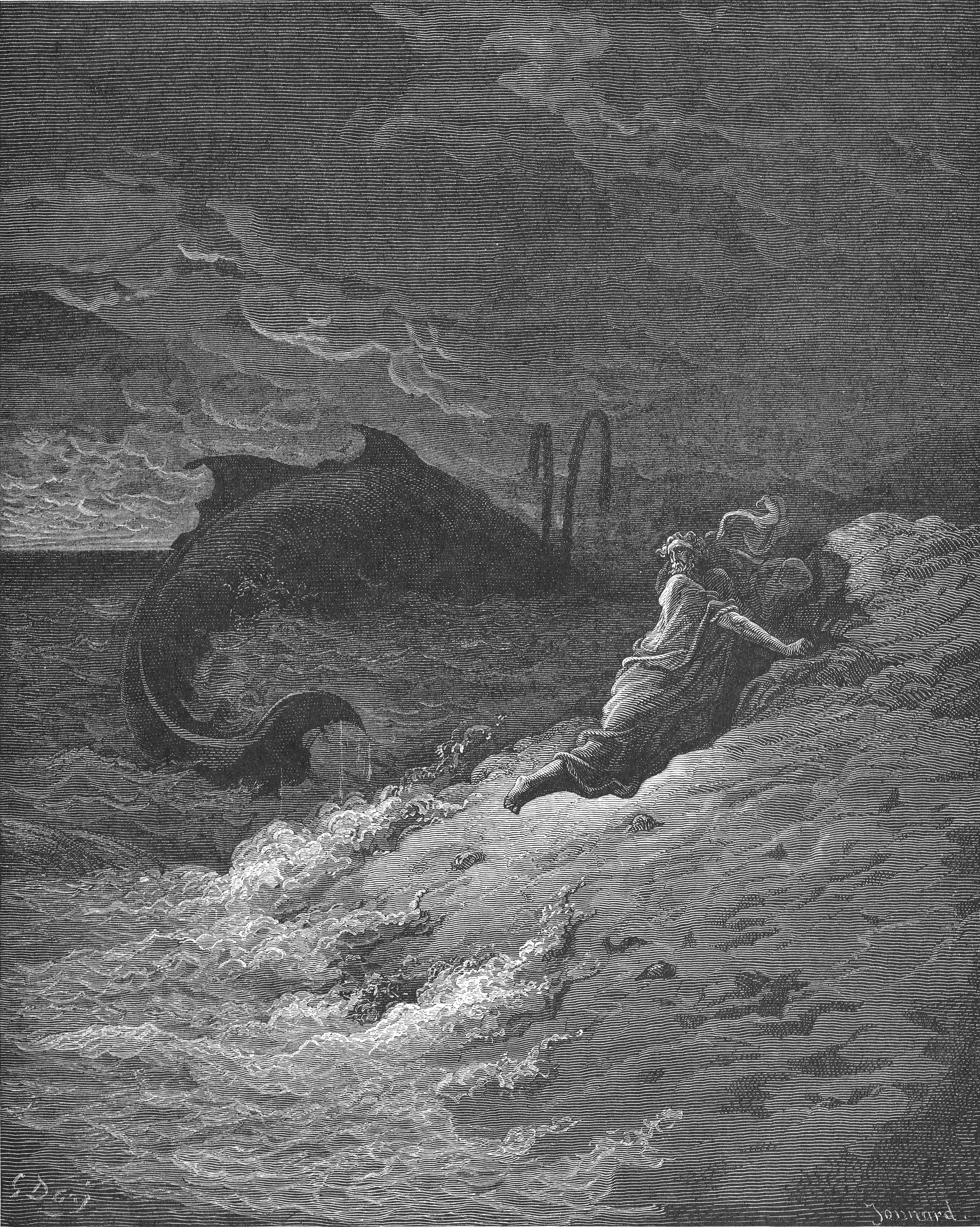 Source: Wikimedia Commons, Gustave Dore, public domain, https://commons.wikimedia.org/wiki/File:137.Jonah_Is_Spewed_Forth_by_the_Whale.jpg
Prayer from the Belly of Hell (Jonah 2:3-7)
3 and said, I cried in my affliction to the Lord my God, and he hearkened to me, even to my cry out of the belly of hell: thou heardest my voice.
4 Thou didst cast me into the depths of the heart of the sea, and the floods compassed me: all thy billows and thy waves have passed upon me. 5 And I said, I am cast out of thy presence: shall I indeed look again toward thy holy temple? 6 Water was poured around me to the soul: the lowest deep compassed me, my head went down 7 to the clefts of the mountains; I went down into the earth, whose bars are the everlasting barriers: yet, O Lord my God, let my ruined life be restored.
Brenton’s phrase “belly of hell” names the depth of Jonah’s peril in the language of the realm of death. It is not proof that Jonah has died or been eternally condemned. A living man prays from what seems a sealed grave. His cry confesses both helplessness and hope: he cannot climb out by discipline, intelligence, or prophetic standing, yet he can call on the Lord his God.
The movement is downward: depths, heart of the sea, lowest deep, clefts of the mountains, the earth with bars. But Jonah addresses God even when he feels cast out of His presence. Earlier he fled from that presence; now his anguish is the fear of losing it. Brenton leaves his longing for the holy temple as a question. Faith here does not require him to pretend that the darkness has already lifted.
In verse 4 Jonah acknowledges God’s rule over the waves, though the sailors threw him into the sea. His own story of disobedience has brought him here; it does not authorize us to diagnose every sufferer’s distress as punishment for a hidden sin. The prayer gives the afflicted words to use, not a reason to accuse them.
“Let my ruined life be restored” is a request, not a report of self-repair. Jonah brings God the life he cannot restore. Before he can offer renewed service, he must receive mercy. We too may pray without disguising what is broken.
Remembering the Lord and Returning to Dry Land (Jonah 2:8-11)
8 When my soul was failing me, I remembered the Lord; and may my prayer come to thee into thy holy temple. 9 They that observe vanities and lies have forsaken their own mercy. 10 But I will sacrifice to thee with the voice of praise and thanksgiving: all that I have vowed I will pay to thee, the Lord of my salvation.
11 And the whale was commanded by the Lord, and it cast up Jonas on the dry land.
Jonah remembers the Lord when his soul is failing. The prayer turns from drowning to worship: temple, sacrifice, praise, thanksgiving, vows, salvation. He promises thanksgiving before the whale casts him out. He has already received preservation, and he entrusts the unfinished rescue to the One who has heard him. His vow does not purchase a passage to shore.
Verse 9 warns against the vanities and lies that draw people away from the mercy they need. Its contrast with Jonah’s praise can be heard as a rejection of idols. Yet Jonah cannot safely aim the warning only at others. The sailors have already turned to the Lord, while the Lord’s prophet has fled from Him. For us, the verse also exposes the lie that life away from God’s will will be freer than life within His mercy.
The chapter does not pretend Jonah is fully healed. He has learned to pray from distress, but Jonah 4 will show that his compassion still needs conversion. The mercy he thanks God for must become mercy he can desire for others.
The whale obeys the Lord and returns Jonah to dry land. His rescue opens into the renewed call of Jonah 3. He has been brought up not only to survive, but to bear God’s word to the city he avoided.
The Church’s Voice in Worship ⛪
On Jonah’s Feast, the Liturgy’s Psalm gives the distressed prophet a companion voice: “I called on the Lord out of affliction” (Psalm 118:5; LXX Psalm 117:5).3 Jonah longs for the holy temple; the Gospel, John 2:12-25, reveals Christ’s body as the temple He will raise after three days. The Catholic Epistle, 1 Peter 3:17-22, joins Christ’s suffering and proclamation to the spirits in prison with baptism through His Resurrection.4 Jonah is rescued, while Christ brings us to God. In the Midnight Praises of Bright Saturday, the Church reads Jonah’s prayer itself, giving worshippers words for hope when deliverance is not yet visible.5
Spiritual Fruit 🍇
Pray before you feel worthy to pray. When your soul is failing, remember the Lord; you need not first make your distress presentable. Jonah’s prayer does not promise that every illness, grief, or danger will end as we ask. It gives us words to address the Lord from within them.
Give thanks for the mercy already received, even while much remains unresolved. Then let gratitude reach the person you would rather leave outside it. Jonah can praise his own rescue and still need healing in his love for Nineveh. We can receive real grace and still need to repent of the limits we set on mercy.
Christ is more than a companion in darkness. He truly enters death and rises victorious. In baptism He calls us to share His new life, a life that learns obedience and compassion rather than presuming that rescue has left nothing more to heal.
Teaching Notes
The Great Whale and the Prayer Begins (Jonah 2:1-2)
- Ask: What does Christ fulfill in Jonah’s three days, and where does He surpass Jonah?
- Watch for: Confusing Jonah’s preservation alive with Christ’s real death, or treating baptism as permission to continue in sin.
- Show: Use Dore’s image above as Western biblical illustration, not as an Orthodox icon.
Prayer from the Belly of Hell (Jonah 2:3-7)
- Ask: How does Jonah address God while fearing that he is cast out of His presence?
- Watch for: Reading “hell” as proof of Jonah’s damnation, or using his story to blame every sufferer for their distress.
Remembering the Lord and Returning to Dry Land (Jonah 2:8-11)
- Ask: What can Jonah thank God for before he reaches dry land, and what still needs healing in him?
- Watch for: Making thanksgiving a bargain for deliverance or mistaking rescue for completed repentance.
Sources
Embedded Scripture is from Brenton’s English Septuagint (LXX).
Primary biblical anchors: Jonah 2; Matthew 12:39-41; Matthew 16:4; Luke 11:29-32; Romans 6:1-4; 1 Corinthians 15:3-4, 20-23; Jonah 3:1-2; Jonah 4:1-2.
Footnotes
-
St. Athanasius of Alexandria, Against the Arians, Discourse III, chapter XXV, §23 (III.23), NPNF2 4: https://www.ccel.org/ccel/schaff/npnf204.xxi.ii.iv.iii.html#xxi.ii.iv.iii-p107. ↩
-
St. John Chrysostom, Homilies on Matthew 43.2, NPNF1 10: https://www.ccel.org/ccel/schaff/npnf110.iii.XLIII.html#iii.XLIII-p22. ↩
-
Coptic lectionary, Jonah’s Feast, Liturgy, Psalm 118:5, 18; the quoted wording follows Brenton, Psalm 117:5. ↩
-
Coptic lectionary, Jonah’s Feast, Liturgy: Romans 10:4-18; 1 Peter 3:17-22; Acts 3:22-26; Psalm 118:5, 18; John 2:12-25, as recorded for 2026-2028 in the CopticChurch.net daily readings. ↩
-
Bright Saturday service order, Midnight Praises, Praises of the Prophets: Prayer of Jonah. The service lists Jonah 2:2-10 in English numbering. ↩