


This narration is from a previous version of the study and may include a combined recording of multiple chapters.
Jonah 1 begins with a prophet fleeing the work God gives him. The chapter is not mainly about a storm at sea; it is about the Lord pursuing His servant and teaching Gentile sailors reverence. Jonah cannot escape the God he confesses, but neither does God abandon him.
Jonah Receives the Word and Flees (Jonah 1:1-3)
1 Now the word of the Lord came to Jonas the son of Amathi, saying, 2 Rise, and go to Nineve, the great city, and preach in it; for the cry of its wickedness is come up to me. 3 But Jonas rose up to flee to Tharsis from the presence of the Lord. And he went down to Joppa, and found a ship going to Tharsis: and he paid his fare, and went up into it, to sail with them to Tharsis from the presence of the Lord.
The first command is simple: rise and go. Jonah rises, but not toward obedience. He moves toward Tharsis, away from Nineveh, and the text repeats that he is fleeing “from the presence of the Lord.” His fare buys passage, not freedom from the One who sends him. Chapter 4:2 will connect his flight with his knowledge of God’s mercy; chapter 1 does not yet tell us the whole struggle within him.
Brenton does not describe every movement as downward. Jonah goes down to Joppa, then up into the ship. Later he goes down into its hold (1:5); in his prayer he will speak of going down into the earth (2:7). Sin often begins with movement that looks practical: pay the fare, board the ship, leave the problem behind. But changing his location cannot release him from God’s call.
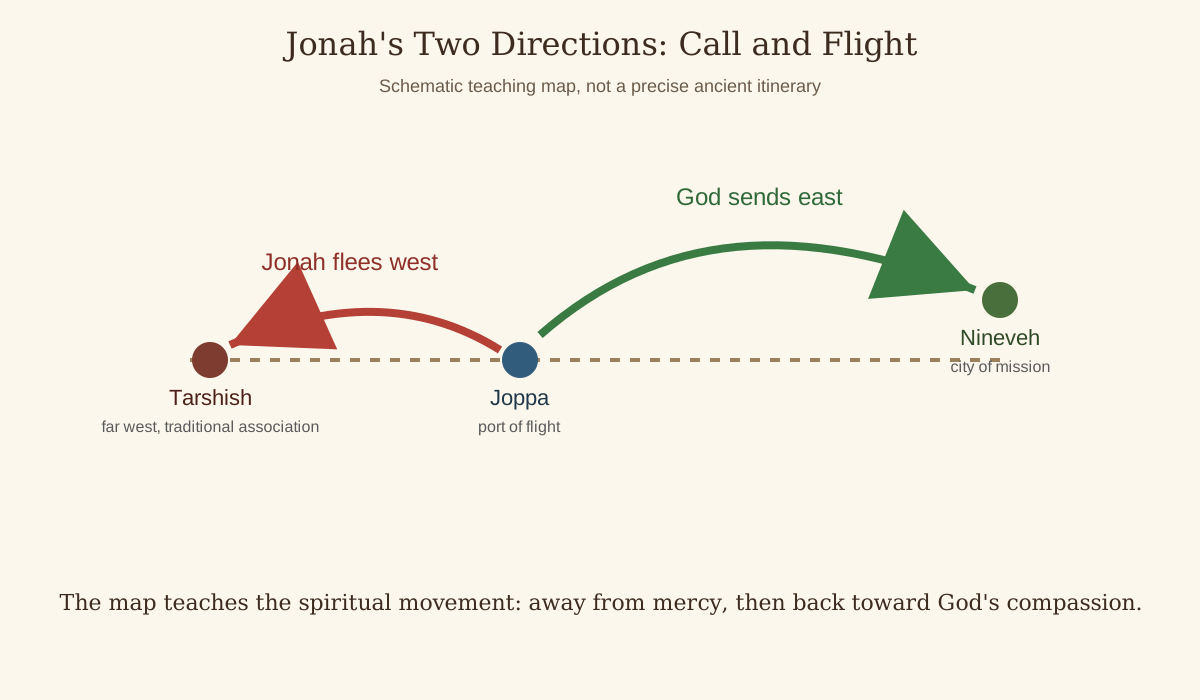 Teaching schematic by OrthodoxBibleStudy.com.
St. Gregory the Theologian urges a more searching reading of Jonah’s motive. After considering concern for the credibility of prophecy, he commends an interpretation centered on Jonah’s sorrow over Israel and the extension of prophetic grace to the Gentiles. This is Gregory’s interpretation, not an explanation supplied in chapter 1. It cautions us against reducing Jonah to a man whose every motive we know. We can recognize his disobedience without despising the servant God continues to teach.1
The Storm Exposes the Sleeping Prophet (Jonah 1:4-10)
4 And the Lord raised up a wind on the sea; and there was a great storm on the sea, and the ship was in danger of being broken. 5 And the sailors were alarmed, and cried every one to his god, and cast out the wares that were in the ship into the sea, that it might be lightened of them. But Jonas was gone down into the hold of the ship, and was asleep, and snored.
6 And the shipmaster came to him, and said to him, Why snorest thou? arise, and call upon thy God, that God may save us, and we perish not. 7 And each man said to his neighbour, Come, let us cast lots, and find out for whose sake this mischief is upon us. So they cast lots, and the lot fell upon Jonas.
8 And they said to him, Tell us what is thine occupation, and whence comest thou, and of what country and what people art thou? 9 And he said to them, I am a servant of the Lord; and I worship the Lord God of heaven, who made the sea, and the dry land. 10 Then the men feared exceedingly, and said to him, What is this that thou hast done? for the men knew that he was fleeing from the face of the Lord, because he had told them.
The storm is judgment, but it is also mercy: the Lord interrupts Jonah’s flight. The sailors throw cargo into the sea while Jonah sleeps below. They cry to their gods; the shipmaster must summon the prophet to prayer. The narrative records no prayer from Jonah here. This particular storm is explicitly linked to his disobedience. It does not teach us to treat every illness, loss, or disaster as evidence of someone’s hidden guilt.
The shipmaster repeats the command to arise, this time with the lives of his companions at stake. The outsider calls the servant of God back to the responsibility he has left behind. Jonah has something these sailors need, yet he must also receive correction from them.
Jonah’s confession is true: he worships the Lord God of heaven, who made the sea and the dry land. Yet his life contradicts his creed. He confesses the Maker of the sea while using the sea as an escape route. Correct words do not heal a divided heart unless confession becomes obedience. The sailors’ question, “What is this that thou hast done?”, makes the contradiction audible.
LXX / Brenton insight
At 1:9 Brenton reads “I am a servant of the Lord”; a Hebrew-based translation such as the King James Version reads “I am an Hebrew.” The difference matters here: Jonah names himself the Lord’s servant while fleeing the Lord’s command. The question is not only whom he belongs to, but whether he will live as that servant.2
Jonah Is Cast into the Sea and the Sailors Fear the Lord (Jonah 1:11-16)
11 And they said to him, What shall we do to thee, that the sea may be calm to us? for the sea rose, and lifted its wave exceedingly. 12 And Jonas said to them, Take me up, and cast me into the sea, and the sea shall be calm to you: for I know that for my sake this great tempest is upon you.
13 And the men tried hard to return to the land, and were not able: for the sea rose and grew more and more tempestuous against them. 14 And they cried to the Lord, and said, Forbid it, Lord: let us not perish for the sake of this man’s life, and bring not righteous blood upon us: for thou, Lord, hast done as thou wouldest. 15 So they took Jonas, and cast him out into the sea: and the sea ceased from its raging. 16 And the men feared the Lord very greatly, and offered a sacrifice to the Lord, and vowed vows.
In Brenton the verse about the great whale opens chapter 2 (2:1); the King James Version and many other English Bibles number it 1:17.
Jonah acknowledges that the tempest is upon them for his sake, but the sailors do not hurry to throw him away. They first try hard to return to land. When they cannot, they pray against bringing “righteous blood” upon themselves. This is the sailors’ plea against bloodguilt, not a declaration that Jonah’s flight was righteous. They fear doing wrong even while their own lives are threatened.
Their reluctance matters. This extraordinary rescue is not permission to find a scapegoat, expel a vulnerable person, or harm yourself so that others may be safe. Jonah’s story continues because the Lord preserves him, not because his life is disposable.
The sea becomes calm after Jonah is cast out. The chapter ends with Gentiles fearing the Lord, offering sacrifice, and making vows. Jonah has not reached Nineveh, yet God is already drawing Gentiles to Himself. The mercy Jonah tried to evade is already spreading through his failure.
Gems from the Fathers 💎
St. Cyril of Jerusalem places the sleeping Jonah beside Christ asleep in the storm-tossed boat. The sailors tell Jonah to call upon his God; the disciples ask Christ Himself to save them. Jonah is cast into the sea, but Christ commands it: Cyril says He “Himself rebuked the winds and the sea”3. The resemblance reveals the difference. Jonah is endangered through disobedience; Christ, without sin, is Lord of the storm and enters death willingly for our salvation. The fuller sign of His death and Resurrection belongs to the study of Jonah 2.
Spiritual Fruit 🍇
Jonah 1 asks whether our confession and our direction match. We can say that God is Lord of heaven, sea, and dry land while choosing routes that protect resentment. If you recognize a command you have been avoiding, you need not wait for a crisis to turn back. Name one act of obedience before God and ask for the grace to begin it.
The sailors also teach humility. Sometimes those with less religious knowledge respond to God with more reverence than those who have been near holy things for years. The chapter calls the Church to repent without superiority. Listen when another person’s honest question exposes a gap between what you profess and how you live.
Lord of sea and dry land, wake me to prayer. Keep me from harming others, and turn my confession into obedience.
For the book’s place in the Fast of Nineveh, see the introduction’s worship discussion.
Teaching Notes
Jonah Receives the Word and Flees (Jonah 1:1-3)
- Ask: What does Jonah’s direction reveal before the book explains his motive?
- Watch for: Forcing a downward movement into every phrase or treating an inferred motive as the whole story.
- Show: Use the route schematic above to contrast Jonah’s flight with God’s command.
The Storm Exposes the Sleeping Prophet (Jonah 1:4-10)
- Ask: What makes “I am a servant of the Lord” so searching in this scene?
- Watch for: Treating every sufferer’s distress as proof of disobedience.
Jonah Is Cast into the Sea and the Sailors Fear the Lord (Jonah 1:11-16)
- Ask: What do the sailors’ efforts to save Jonah reveal about their growing reverence?
- Watch for: Making the casting out a model for scapegoating or self-harm, or identifying Jonah’s disobedience with Christ’s sinless sacrifice.
Sources
Embedded Scripture is from Brenton’s English Septuagint (LXX).
Brenton, Jonah 1 and Jonah 2, especially 1:3, 1:5, 1:9, 1:14 and the chapter boundary at 2:1.
Biblical connections: Jonah 4:2; Matthew 8:23-27; Matthew 12:39-41.
Footnotes
-
St. Gregory the Theologian, Oration 2, §§106-109, especially §§107-109 for the interpretation he commends. Primary text. ↩
-
Compare Brenton, Jonah 1:9 with King James Version, Jonah 1:9. This comparison does not explain the textual origin of the difference. ↩
-
St. Cyril of Jerusalem, Catechetical Lecture 14, §17, on Jonah and Christ in the storm. Primary text. ↩