


This narration is from a previous version of the study and may include a combined recording of multiple chapters.
The roads to Sion are still there, but no one comes to the feast. That is the kind of loss Lamentations asks us to face: the familiar places remain, while the life that filled them has been shattered. Jerusalem has fallen, the temple is ruined, and the people must learn to speak to God from a world they can no longer repair. Scripture gives them neither a quick explanation nor permission to disappear into silence. It gives them a lament.
Jerusalem’s grief and Jeremiah’s witness
The poems look back on the Babylonian destruction of Jerusalem in 586 BC. Hunger, deportation, a violated sanctuary, failed leaders, and the humiliation of the Davidic monarchy belong to the book’s history. Its grief has particular faces: elders seated on the ground, children asking for bread, a mother city stretching out her hands with no one to comfort her.
The Septuagint preface names Jeremiah sitting in tears over the desolate city. This is the Church’s received Greek framing of the book, not simply a later association based on the prophet’s reputation for sorrow. The preface is absent from the Hebrew text underlying the NKJV. Saint John Chrysostom also names Jeremiah as the composer of Lamentations in Homilies on Romans, Homily 14, where the prophet’s grief illustrates loving intercession for an afflicted people.1
Jeremiah had warned Jerusalem, yet the book offers no satisfaction in being proved right. Prophetic truth becomes a responsibility to remain with the people when the warning comes to pass. The voice that names sin also weeps. That union of truth and compassion governs Christian reading: repentance must become more truthful, and love must become more attentive.
Five poems, five chapter studies
The poems have a deliberate order, even when the sorrow they contain feels unmanageable. In Hebrew, chapters 1, 2, and 4 have twenty-two alphabetic stanzas; chapter 3 expands the pattern into sixty-six verses, three for each letter. Chapter 5 keeps twenty-two verses without following an alphabetic sequence. Grief is given a form in which to pray, though form never makes the grief small.
The Hebrew alphabet runs in a different order in chapters 2, 3, and 4, with pe before ayin. Greek copies mark the acrostic through Hebrew-letter names, and Brenton’s labels follow the usual alphabetic order rather than reproducing all the Hebrew poem’s features. These headings preserve a memory of the form; they do not make the English words into an acrostic.2
| Study | What the poem brings before God |
|---|---|
| Lamentations 1: Lonely Jerusalem | The city without a comforter learns to confess and asks the passer-by to turn and see. |
| Lamentations 2: The Lord’s judgment and tears | Sacred institutions fall; tears for the children become a call to pour out the heart before the Lord. |
| Lamentations 3: Mercy in the middle of affliction | The afflicted man remembers mercy, bears reproach, examines his ways, and calls from the pit. |
| Lamentations 4: Tarnished gold and the anointed Lord | Human dignity is treated as broken pottery, leaders fail, and royal hope is taken captive. |
| Lamentations 5: Turn us, O Lord | The whole people ask God to remember their wounds and grant the return they cannot accomplish without Him. |
The central confession of mercy does not cancel the poems on either side. Chapter 4 returns to hunger after chapter 3 has spoken of hope. A person may truly trust God and still wake the next morning inside the same sorrow. Lamentations teaches a hope strong enough to pray there.
The ending is equally honest. The plea to be turned and renewed comes in 5:21; the final verse, 5:22, returns to the anguish of rejection. The book leaves that wound open. Its last confession of God’s enduring throne and its plea for renewal remain prayers, not reports that restoration has already arrived.
Reading the Septuagint alongside the NKJV
The Scripture passages are Brenton’s English translation of the Septuagint, the ancient Greek Old Testament received in the Church. Chapter and verse references follow the NKJV so readers can find the corresponding passage in a familiar Bible. Where wording or numbering differs, a short explanation precedes the affected reading.
The best-known difficulty concerns Lamentations 3:22-24. Brenton’s printed edition numbers the mercy confession 22, 23, and 24; some electronic editions label these lines 21a, 21b, and 21c. Their place in the earliest Greek translation has been disputed. Rahlfs and Ziegler exclude them from their reconstructed original text, while Peter J. Gentry’s NETS introduction accepts Albert Pietersma’s argument that they belonged to the original translation and were lost during Greek copying. Similar endings in verses 21 and 24 could have caused a copyist’s eye to skip the intervening lines. The chapter study retains the familiar numbers and Brenton’s words. Verse 29 has weaker Greek support and is absent from Brenton’s English reading; it is explained rather than supplied from another translation.2
Some differences matter for interpretation as well as for finding a verse. In 2:19 Brenton calls Zion to rejoice in the night while pouring out her heart. In 4:20 his wording, “our anointed Lord,” helps us understand the early Christian reading of the captured ruler in the light of Christ. Such differences deserve attention because the Church has prayed and interpreted these words, not because textual detail should interrupt every page.
The Church’s Voice in Worship ⛪
Coptic Reader appoints Lamentations 3:1-66 at Great Friday (The Twelfth Hour), beside the psalmody of the lowest pit and the Gospel accounts of the Lord’s burial. The afflicted man’s pit, stone, and overwhelming waters are heard as the Church contemplates Christ entering death. Jerusalem’s sorrow remains real; in the innocent suffering and saving descent of Christ, the Church hears how far divine mercy will go to reach her.3
Bright Saturday’s Midnight Praises include Lamentations 5:16-22 under Coptic Reader’s title Praise of the Prophet Jeremiah. Among the praises of the prophets and saints, the Church takes the book’s plea for return upon her own lips. While the Lord’s body lies in the tomb, the faithful ask for the renewal they await from Him. The unresolved ending becomes a prayer held open toward the Resurrection.3
Coptic Reader also appoints Lamentations 1:1-4 at Hosanna Sunday (The Ninth Hour), the daytime hour whose Gospel is Matthew 21:10-17. Christ enters the temple, heals, and receives the children’s praise; the prophecy speaks of roads empty of worshippers. The King who receives praise is the One His people need for their healing. St. Mary Ottawa’s 2018 Holy Pascha book independently attests the same appointment.3
Christ enters the sorrow of His people
The poems first speak of Jerusalem, covenant unfaithfulness, and the real people who suffered in the catastrophe. Christian reading does not turn them into a code in which every detail loses its first meaning. It follows the path Scripture opens: the city asks to be seen, the afflicted man offers his cheek, the anointed ruler is caught, and the people plead for a return that God must grant.
Christ enters this sorrow without sharing its sin. He is mocked by passers-by, bears reproach, and is laid behind a stone. Yet He is never merely another defeated king. The Lord who descends into death is the One who breaks its dominion. In Him, the cry for God to draw near receives an answer deeper than the restoration of walls: God has come among His people to give them life.
The book also changes how the Church sees those who grieve. The repeated absence of a comforter becomes a summons to stay near. A meal carried to a bereaved household, patient attention to someone whose sorrow has outlasted everyone else’s interest, and truthful intercession for a wounded community belong to the obedience these poems teach.
Iconography Connection 🖼️
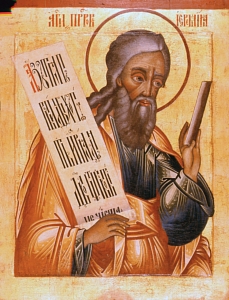 Source: Prophet Jeremiah, early eighteenth-century Russian icon from the Kizhi iconostasis; Wikimedia Commons, public domain.
The prophet holds a scroll. His grief belongs to the word entrusted to him and to the people for whom he speaks before God.
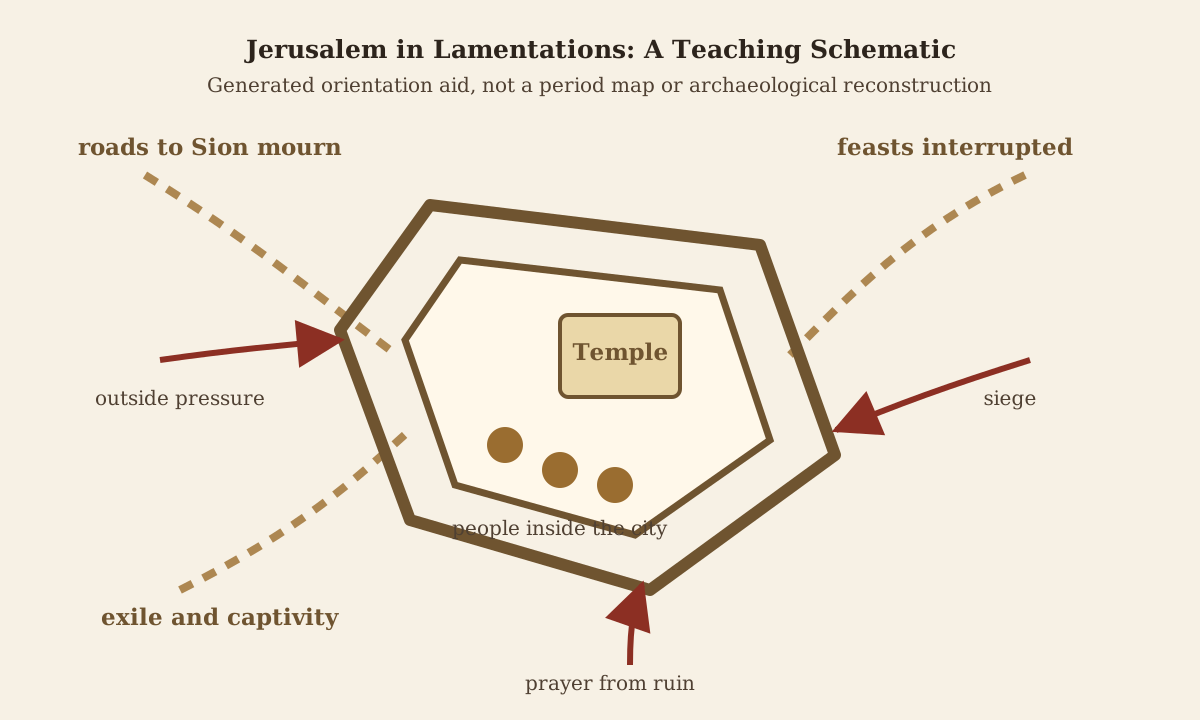 Source: Generated orientation aid for this study, 2026-06-20; not a period map or archaeological reconstruction.
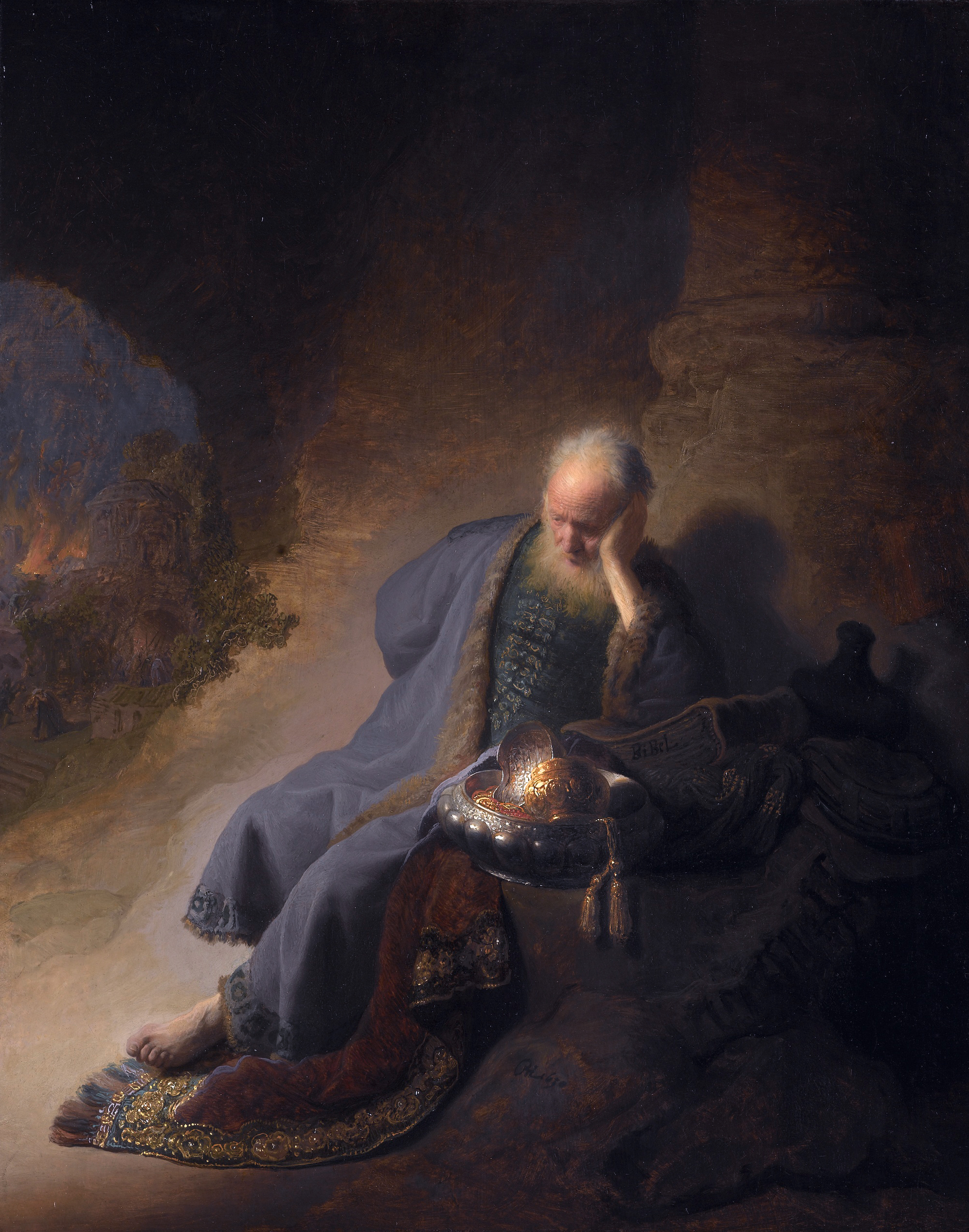 Source: Rembrandt van Rijn, Jeremiah Lamenting the Destruction of Jerusalem, 1630, Rijksmuseum; Wikimedia Commons, public domain. Western biblical art, not an Orthodox icon.
Spiritual Fruit 🍇
Give sorrow truthful words. Begin with what has actually happened, as the poems do. In prayer, name the person you miss, the damage you caused, or the fear you cannot quiet. Bring the wound before God before trying to make it sound resolved.
Let confession make you more merciful. Jerusalem’s acknowledgment of sin does not make her children’s hunger easier to bear. When repentance is genuine, the suffering of others becomes harder to overlook. Ask forgiveness for your own part in a broken relationship, then consider what practical care the other person needs, even where the whole history cannot be put right at once.
Receive return as grace and answer it with obedience. The plea of 5:21 is a prayer for God to turn His people toward Himself. Pray it before confession, before approaching a difficult reconciliation, or when a habit has made another beginning seem impossible. Then take the next faithful step: speak the truth, seek help, make restitution, or resume the prayer you abandoned. Hope has become real when it helps the heart turn.
The roads to Sion mourn, but mourning has become an address to God. The city without a comforter has been given words the Church will keep praying. Stand with her long enough to hear them. Then carry one of those words into the place where you need the Lord to draw near.
Teaching Notes
Whole-book orientation
- Ask: How does the return to sorrow in chapter 4 change the way we hear chapter 3’s confession of mercy?
- Watch for: Jerusalem’s covenant judgment is not a licence to diagnose another person’s suffering as punishment. Keep historical judgment, personal responsibility, and innocent suffering distinct.
The shape and ending of the poems
- Ask: What can ordered prayer give a person whose circumstances remain disordered?
- Watch for: The prayer for return is 5:21; the book’s final verse is 5:22. Allow the open ending to retain its weight.
Scripture and worship
- Ask: How do the psalm of the lowest pit and the burial Gospels deepen our hearing of chapter 3?
- Watch for: Coptic Reader confirms the three appointments described above. Its Hosanna reading belongs to Sunday Day, not Monday Eve; its Twelfth Hour does not include Ottawa’s additional Jonah reading. Keep those source distinctions separate from spiritual resonances, and explain Greek-text differences without turning them into a competition between Bibles.
Visual witness
- Show: Begin with Jeremiah as a prophet. Use the siege schematic here to orient the roads, sanctuary, and people; it is not an ancient map. The royal relationship chart accompanies chapter 4, where the captured anointed ruler is discussed. Rembrandt’s painting may help readers attend to grief, but it has no liturgical or iconographic authority.
- Watch for: Preserve Jerusalem’s history before developing Christological connections. An image should clarify the passage, not supply details the text does not give.
Sources
Embedded Scripture is from Brenton’s English Septuagint (LXX). The reading follows the 1879 printed edition, Lamentations, pp. 972-979. This introduction surveys the book; the chapter studies contain the Scripture readings.
Sir Lancelot C. L. Brenton, The Septuagint Version of the Old Testament, Lamentations, including its prefatory notice.
Peter J. Gentry, “Lamentations,” introduction and translation in A New English Translation of the Septuagint (NETS), especially the discussion of Albert Pietersma’s research and the acrostic headings.2
Coptic Reader, Coptic Orthodox Metropolis of the Southern United States: the Holy Pascha and Joyous Saturday services.3
Footnotes
-
Saint John Chrysostom, Homilies on Romans, Homily 14, exposition of Romans 8:26-27, New Advent. ↩
-
Peter J. Gentry, “Lamentations,” “To the Reader,” pp. 932-935, A New English Translation of the Septuagint, official NETS text. Gentry discusses Albert Pietersma, “The Acrostic Poems of Lamentations in Greek Translation,” especially pp. 195-199 for the mercy strophe. ↩ ↩2 ↩3
-
Coptic Reader, Special > Pascha: Sunday > Sunday Day > 9th Hour, “Hosanna Sunday (The Ninth Hour),” April 5, 2026; Friday > 12th Hour, “Great Friday (The Twelfth Hour),” April 10, 2026; Saturday > Praises, “Midnight Praises,” “Praise of the Prophet Jeremiah (Lamentations 5:16-22),” Joyous Saturday, April 11, 2026. St. Mary Ottawa, The Katameros of the Holy Pascha, Lent 1734 A.M./2018 A.D., p. 57 and pp. 638-644, attests the Sunday and Friday readings and adds Jonah 1:10-2:7 at the Friday hour. ↩ ↩2 ↩3 ↩4