


This narration is from a previous version of the study and may include a combined recording of multiple chapters.
Jonah is short, but it is spiritually sharp. It does not only ask whether pagans can repent; it asks whether the people who know God can bear the wideness of His mercy. In the Coptic Orthodox imagination, Jonah belongs to repentance, fasting, and the Resurrection because Christ Himself names Jonah as His sign.
Why Jonah matters
Jonah tells a prophet’s story with searching irony. The sailors pray while the prophet sleeps. A city notorious for wickedness believes God’s warning, while His servant struggles to welcome its deliverance. The book ends not with a monument to Jonah’s success, but with God’s question about the people Jonah has not learned to pity. We begin by watching a runaway prophet; we finish being questioned ourselves.
The book is therefore not simply about Nineveh being forgiven. It is also about the healing of the servant who resents forgiveness. Jonah knows that God is merciful, compassionate, long-suffering, and abundant in kindness. His problem is not ignorance of mercy; his problem is that he wants mercy controlled.
Reading Jonah in the Septuagint
These studies quote Brenton’s English Septuagint, the ancient Greek Old Testament in English translation. The great whale appears at Jonah 2:1, where Hebrew-based English Bibles have Jonah 1:17, so the prayer’s verse numbers are one higher here. At Jonah 3:4 Brenton reads “Yet three days”, rather than the forty days familiar from those Bibles. Brenton also gives “I am a servant of the Lord” at Jonah 1:9 and describes Jonah as “grieved” in chapter 4. The chapter studies explain these differences where they affect the reading. Brenton’s “Jonas”, “Nineve”, and “Tharsis” are the same Jonah, Nineveh, and Tarshish named in the commentary.
Geographical Significance ⛰️
Jonah is sent eastward toward Nineveh, the great city associated with Assyria, but he flees westward from Joppa toward Tarshish. The geography preaches before Jonah does: his body travels in the opposite direction from God’s compassion.
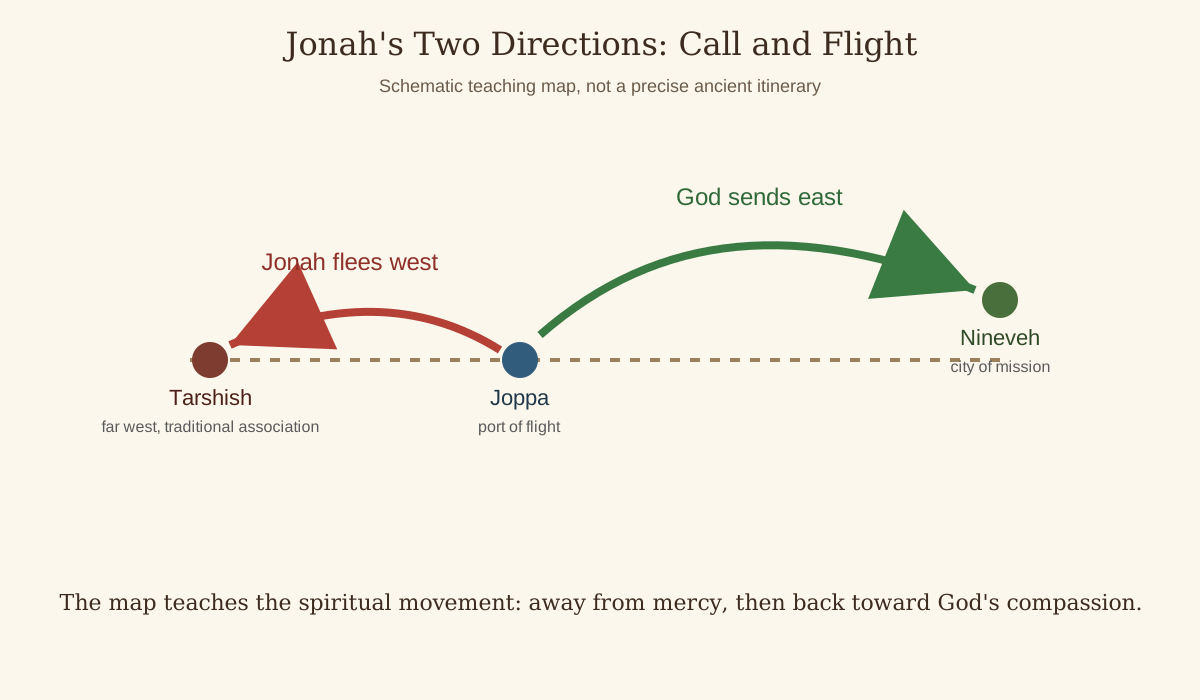 Teaching schematic by OrthodoxBibleStudy.com.
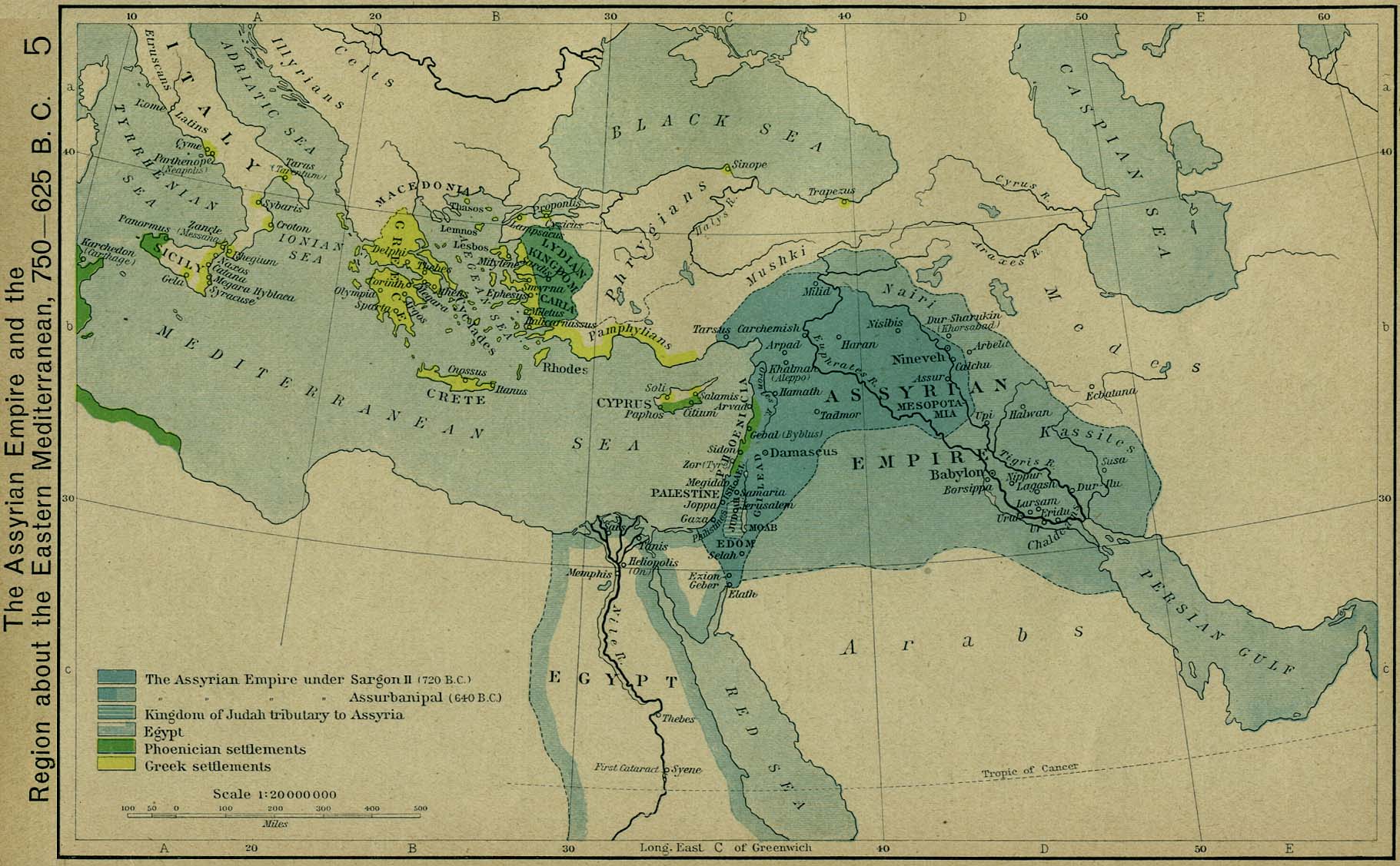 Source: Wikimedia Commons, Map of the Assyrian Empire, public domain, https://commons.wikimedia.org/wiki/File:Assyrian_empire_750_625.jpg
Tarshish should be treated cautiously. It is traditionally associated with the far west, often Tartessos or Spain, but the teaching point does not depend on absolute identification. Jonah tries to go as far as possible from the place where God’s mercy is being sent.
The Characters 👥
- The Lord: Patiently pursues both Nineveh and Jonah. The wind, great whale, gourd, and worm all serve His purpose. He does not abandon the disobedient servant when He spares the wicked city.
- Jonah son of Amittai: A prophet from Israel’s memory, named in 2 Kings 14:25. Scripture gives his father and historical placement, but not a full genealogy.
- The sailors: Gentiles who move from fear of the storm to fear of the Lord. Their reverence exposes Jonah’s resistance.
- The people and king of Nineveh: A violent Gentile city that responds to warning with fasting, sackcloth, and turning from evil.
- The gourd, worm, and east wind: Created things through which God exposes Jonah’s selective compassion.
Teaching schematic by OrthodoxBibleStudy.com, based on Jonah 1:1 and 2 Kings 14:25.
This places the prophet within Israel’s history; it does not settle when the book received its written form.
The Sign of Jonah in the New Testament
Christ names Jonah as His sign: Matthew 12:39-41 points to His burial, while Luke 11:29-32 presses the summons to repentance before One greater than Jonah. A biblical type is a real person or event that prepares us to recognize Christ, not an identity between every detail of two stories. The Jonah 2 study develops this sign, its limits, and its connection with our baptism into Christ’s death and Resurrection.
Iconography and Visual Teaching 🖼️
The icons present Jonah as a prophet within the Church’s memory, not merely as the subject of an adventure at sea. They invite us to receive the witness God gives through a servant whose weakness Scripture does not conceal. The Western biblical illustrations in the chapter studies serve a different purpose: they help us follow the narrative, but are not Orthodox icons.
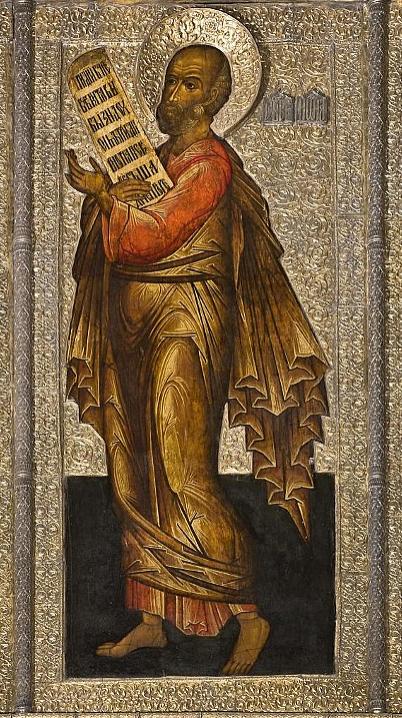 Source: Wikimedia Commons, Icon of Prophet Jonah from a prophetical tier, public domain, https://commons.wikimedia.org/wiki/File:II_ProphetJonah.jpg
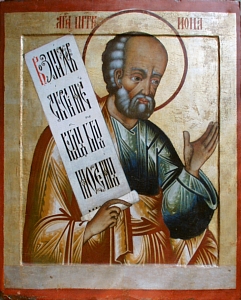 Source: Wikimedia Commons, Russian Orthodox icon of the Prophet Jonah, public domain, https://commons.wikimedia.org/wiki/File:Jonah.jpg
Chapter movement
| Chapter | Movement | Spiritual burden |
|---|---|---|
| Jonah 1 | Flight, storm, and descent | God pursues the prophet who flees mercy. |
| Jonah 2 | Prayer from the depths | The tomb-like place becomes a place of prayer and deliverance. |
| Jonah 3 | Nineveh repents | Fasting bears fruit in turning from evil. |
| Jonah 4 | Grief, the gourd, and God’s compassion | The Lord questions the servant who resents compassion. |
The Church’s Voice in Worship ⛪
The Coptic Orthodox Church keeps the Fast of Nineveh for three days, Monday to Wednesday, beginning two weeks before Great Lent; Jonah’s Feast follows on Thursday. The Liturgy Gospels on Tuesday and Wednesday bring us to Christ’s sign of Jonah (Luke 11:29-36; Matthew 15:32-16:4), and the feast’s Gospel turns to His body as the temple raised after three days (John 2:12-25).1 Repentance and Resurrection belong together here: the fast prepares us not merely to admire Nineveh’s change, but to turn toward the Lord who gives life. Jonah’s prayer is also read in the Midnight Praises of Bright Saturday.2
Spiritual Fruit 🍇
Jonah teaches repentance as more than regret. Repentance means turning toward the mercy of God, but it also means wanting that mercy for others. The book exposes a frightening possibility: a person can know doctrine, pray true words, and obey a command, yet still resist the love of God when it reaches an enemy.
The Fast of Nineveh is therefore not only a small Lent before Great Lent. It is a school for receiving the mercy we cannot control. The Church fasts with Nineveh so that Jonah’s heart will not remain in us.
Pope Shenouda III calls Jonah the “prelude of the forty days of Lent”.3 He asks us to receive this story as preparation for approaching the Lord with a clean heart, not simply to admire the Ninevites from a distance.
Before beginning the chapters, bring one person you find difficult to pray for before Christ. Do not pretend that injury is harmless or that trust can be restored without truth. Simply ask that the mercy which has kept you alive may also lead that person to repentance. Jonah’s story gives us time to learn a prayer we may not yet want to pray.
Teaching Notes
Book orientation
- Ask: What might it cost to rejoice when God gives an enemy time to repent?
- Watch for: Standing above Jonah as though religious knowledge made us immune to his struggle. The book also questions its readers.
- Show: Use the route schematic to explain the opposed directions of God’s call and Jonah’s flight; its locations are schematic, not an exact itinerary.
Sources
Embedded Scripture in the chapter guides is from Brenton’s English Septuagint (LXX).
Primary biblical anchors: Jonah 1-4; 2 Kings 14:25; Matthew 12:39-41; Luke 11:29-32.
Footnotes
-
Coptic lectionary, Tuesday and Wednesday of the Fast of Nineveh, Liturgy; Jonah’s Feast, Liturgy. The readings described here are recorded for 2026-2028 in the CopticChurch.net daily readings. ↩
-
Bright Saturday service order, Midnight Praises, Praises of the Prophets: Prayer of Jonah. The service lists Jonah 2:2-10 in English numbering. ↩
-
Pope Shenouda III, Contemplations on the Book of Jonah the Prophet, Introduction, text at OrthodoxEbooks; book page at Coptic Treasures. ↩