


This narration is from a previous version of the study and may include a combined recording of multiple chapters.
Ezra 3 begins with a people who are home, but not yet secure. They have returned to their cities, yet the temple is not rebuilt and the surrounding peoples are frightening. Their first act of restoration is not strategy, decoration, or public confidence. It is the altar.
This chapter teaches that worship precedes visible wholeness. The people gather as one, rebuild the altar, keep the feasts, order the work, lay the foundation, and answer God with praise. Yet the sound at the foundation is mixed: joy from the many, weeping from the elders who remember the former house. Ezra does not flatten that moment into triumph or despair. True restoration can carry thanksgiving and grief at the same time.
This mixed sound is spiritually mature. The young may see a beginning; the old may remember what was lost. Both need one another. Joy without memory becomes shallow, and grief without hope becomes paralyzing. In the Church, God receives the tears and the praise together when they are offered in truth.
This is a word for every season of partial restoration. A family, parish, ministry, or soul may still feel like ruins, but the altar must not wait for perfect conditions. Begin with prayer, repentance, thanksgiving, and the offering God has commanded. Worship is not the reward for a completed life; it is the way a wounded life is reordered toward God.
For Orthodox Christians, Ezra 3 is a sober lesson in beginning again. The Church does not wait for every ruin to be repaired before she prays, offers, fasts, sings, and returns to the altar. In Christ, the altar, sacrifice, temple, and priesthood are fulfilled, yet the spiritual order remains: restoration begins before God.
Historical and Scriptural Context
Ezra 1-2 told how the Lord stirred Cyrus, restored the temple vessels, and gathered the first return from exile by families, priests, Levites, singers, gatekeepers, servants, and households. Ezra 3 now asks what the returned people will do first. They are in the land, but they are not yet visibly restored. Jerusalem’s temple still lies unfinished, the surrounding peoples cause fear, and the community has to decide whether worship will wait for security or begin in obedience.
The seventh month gives the chapter its liturgical weight. In the Law, this season included holy convocations, the Day of Atonement, and the Feast of Tabernacles (Leviticus 23). The returned people do not invent a new religion for a new circumstance. They restore worship “according to the things that were written in the law of Moses the man of God.” Their recovery is scriptural, priestly, sacrificial, and communal.
Ezra 3 also stands before the opposition of Ezra 4. The altar and foundation are not sentimental scenes placed before a smooth success story. They prepare the people to endure resistance. Worship is not escape from conflict. It is the way the people stand before God while conflict is already gathering.
Geographical Significance ⛰️
The chapter begins with the children of Israel in their cities and then gathering “as one man at Jerusalem.” The movement matters. They are not merely scattered families trying to survive after exile. They assemble around the place where the Lord had caused His name to dwell. Jerusalem is still wounded, but it is again the center of worship.
The supply route also matters. Cedar comes from Libanus, meaning Lebanon, through Sidonian and Tyrian labor, to the sea of Joppa. This recalls Solomon’s temple materials and shows that the second temple stands in continuity with the first, even though the community is smaller and poorer. It also shows the practical side of holy work: money, skilled labor, food, drink, oil, transport, and foreign craftsmen are all drawn into a work ordered toward the house of God.
Joppa later appears as the port from which Jonah flees and the place where Peter receives the vision that prepares him to welcome Gentiles (Jonah 1:3; Acts 10). Here it serves an obedient rebuilding. A port can carry someone away from God’s command or supply the work God has commanded.
The Characters 👥
- The children of Israel: The returned covenant people. They are in their cities, but they become visibly one when they assemble at Jerusalem.
- Jesus son of Josedec: Brenton’s form of Jeshua or Joshua son of Jehozadak, the high-priestly leader. “Jesus” is the same Greek name as our Lord’s, but this man is the historical high priest Joshua, not Jesus Christ.
- Zerubbabel son of Shealtiel: Named Zorobabel son of Salathiel in Brenton, the Davidic-line governor associated with the first return and temple rebuilding.
- The priests: They stand with Jesus son of Josedec and restore the altar and offerings according to the Law.
- The Levites: They are appointed over the workmen, and the sons of Asaph lead praise with cymbals when the foundation is laid.
- The elders who saw the former house: They remember Solomon’s temple and weep when they see the new foundation. Their grief is not dismissed.
- The people of the lands: The surrounding peoples whose presence brings fear. Their pressure becomes open opposition in Ezra 4.
- The Sidonians and Tyrians: Skilled workers involved in bringing cedar from Lebanon to Joppa.
- Cyrus king of the Persians: The imperial ruler whose grant makes the rebuilding legally possible, though Ezra always sees the deeper cause as the Lord’s faithfulness.
Ezra 3 moves in four natural scenes. First the people gather and restore the altar amid fear. Then they keep feasts and offerings before the foundation is laid. Then they gather materials and appoint Levites for the work. Finally, the foundation is laid with Davidic praise, public joy, and the tears of memory.
The Altar Rebuilt Amid Fear (Ezra 3:1-3)
1 And the seventh month came on, and the children of Israel were in their cities, and the people assembled as one man at Jerusalem. 2 Then stood up Jesus the son of Josedec, and his brethren the priests, and Zorobabel the son of Salathiel, and his brethren, and they built the altar of the God of Israel, to offer upon it whole-burnt-offerings, according to the things that were written in the law of Moses the man of God.
3 And they set up the altar on its place, for there was a terror upon them because of the people of the lands: and the whole-burnt-offering was offered up upon it to the Lord morning and evening.
Light from the Word 🕯️
The people assemble “as one man” at Jerusalem. This is not only an administrative gathering. Ezra is showing the first visible sign of restored identity. The returned exiles are not merely individuals who have survived Babylon. They are again a worshiping people before God. Their gathering “as one man” anticipates the unity of the apostolic assembly in Acts 2:1, although the gift of the Spirit at Pentecost brings that communion to a new fullness.
The leaders are priestly and Davidic: Joshua son of Jehozadak, named “Jesus the son of Josedec” in Brenton, with the priests, and Zerubbabel son of Shealtiel with his brethren. They stand together at the altar. Zechariah 3 shows Joshua cleansed of filthy garments; Zechariah 6:11-13 places crowns upon him and speaks of the Branch who builds the Lord’s house. Zechariah 4:14 calls the two standing before the Lord “anointed ones.” Read together, these passages prepare a priestly and royal hope fulfilled in Christ, who unites kingship and priesthood in His one Person. The altar is built before the temple structure is complete because the heart of restoration is worship. The text is careful to say that the offerings are made according to the Law of Moses. The people do not rebuild by religious creativity, but by obedience to the revealed order God had given.
Verse 3 gives the chapter its courage. They set the altar on its place “for there was a terror upon them because of the people of the lands.” Fear is real, and Ezra does not mock it. But fear becomes the circumstance in which obedience begins, not the excuse by which obedience is delayed. The morning and evening offering resumes in the presence of danger.
Apostolic reading
Hebrews 13:10-16 speaks of the Christian altar, of going to Christ outside the camp, and of offering the sacrifice of praise to God. Romans 12:1 calls the faithful to present their bodies as a living sacrifice. These passages lead from Ezra’s altar to Christ’s willing self-offering, the Eucharistic life of the Church, and the faithful’s offering of their whole life.
Gems from the Fathers 💎: The Table and the cleansing High Priest
St. John Chrysostom, in Homily 8 on Romans, turns Eucharistic reverence into a demand for charity. He cries, “Reverence now, oh reverence, this Table whereof we all are partakers!” Then he names “Christ, Who was slain for us, the Victim that is placed thereon!”1 His warning is against sharing the holy Table while wounding one another with the tongue. A rebuilt altar cannot excuse an unreconciled heart.
St. Justin Martyr reads Joshua’s vision in Zechariah 3 as a promise of Christ’s high priesthood and of our cleansing through Him. He calls Christ “the High Priest, namely this crucified One” and says that believers have been stripped of their former wickedness by His grace.2 Joshua’s dirty garments become a summons to repentance, not a suggestion of sin in the sinless Christ. The One who willingly offers Himself also cleanses those who come to Him.
Spiritual application
The soul often wants to wait until fear is gone before it returns to prayer. Ezra 3 says otherwise. Rebuild the altar while the ruins are still visible. Resume the morning and evening offering while anxieties still surround you. Begin with what God has commanded, not with what your mood permits.
For a parish or family, this means worship cannot be postponed until every ministry, relationship, budget, and schedule feels stable. The altar comes first. The prayer rule comes first. The return to confession, liturgy, thanksgiving, fasting, and repentance comes first. Fear may still be present, but fear is not lord.
Feasts and Offerings Before the Foundation (Ezra 3:4-6)
4 And they kept the feast of tabernacles, according to that which was written, and offered whole-burnt-offerings daily in number according to the ordinance, the exact daily rate. 5 And after this the perpetual whole-burnt-offering, and offering for the season of new moon, and for all the hallowed feasts to the Lord, and for every one that offered a free-will-offering to the Lord. 6 On the first day of the seventh month they began to offer whole-burnt-offerings to the Lord: but the foundation of the house of the Lord was not laid.
Light from the Word 🕯️
The restoration of worship is not vague enthusiasm. Ezra names the Feast of Tabernacles, the daily offerings, the perpetual whole-burnt-offering, the new moon offerings, the hallowed feasts, and free-will offerings. The repeated phrase “according to” matters. The people are being re-formed by the rhythm of God’s commandments.
The Feast of Tabernacles is especially fitting after exile. Israel had once dwelt in booths to remember the Lord’s care in the wilderness. Now the returned exiles celebrate a feast of pilgrimage, fragility, and divine provision while they are themselves fragile in the land. They are home, yet still living in the tension between promise and incompletion.
Verse 6 is the key: “but the foundation of the house of the Lord was not laid.” Worship begins before the building is visible. This does not make the building unimportant, since the rest of the chapter moves toward the foundation. It means the people understand the order of restoration. The house is built for worship, so worship cannot be treated as the final accessory after the house is done.
Apostolic and spiritual reading
The Church reads this order through Christ’s words in John 4:23-24: the Father seeks worshipers who worship in spirit and truth. Ezra’s people obey the written command in the place God appointed; Christ brings worship to its fullness by giving the Spirit and revealing Himself as the truth toward whom the Law was always moving.
Romans 12:1 deepens the same pattern. The worshiping life is not reduced to a service attended or a rite performed. The faithful present their bodies as a living sacrifice. Hebrews 13:15 speaks of the sacrifice of praise, the fruit of lips confessing His name. Ezra’s repeated offerings train the reader to see worship as rhythm, obedience, thanksgiving, and self-offering.
This is why Orthodox worship is not an interruption of life. It is the form by which life is healed. The calendar, feasts, fasting, hymns, litanies, prostrations, and Eucharistic offering are not decoration. They teach the heart how to belong to God again.
Spiritual application
When life is under repair, the holy calendar becomes a mercy. A person in grief, exhaustion, or repentance may not feel spiritually strong enough to invent devotion. The Church gives a rhythm: come to the liturgy, pray the hours, keep the fast, confess, receive counsel, offer thanksgiving, give alms, return tomorrow.
Ezra 3 warns against saying, “I will worship when I am rebuilt.” The better prayer is, “Lord, rebuild me as I worship.” The foundation may not yet be laid in every part of the life, but the offering can begin.
Materials, Workers, and Levites Appointed for the Work (Ezra 3:7-9)
7 And they gave money to the stone-hewers and carpenters, and meat and drink, and oil, to the Sidonians, and Tyrians, to bring cedar trees from Libanus to the sea of Joppa, according to the grant of Cyrus king of the Persians to them.
8 And in the second year of their coming to the house of God in Jerusalem, in the second month, began Zorobabel the son of Salathiel, and Jesus the son of Josedec, and the rest of their brethren the priests and the Levites, and all who came from the captivity to Jerusalem, and they appointed the Levites, from twenty years old and upward, over the workmen in the house of the Lord. 9 And Jesus and his sons and his brethren stood, Cadmiel and his sons the sons of Juda, over them that wrought the works in the house of God: the sons of Enadad, their sons and their brethren the Levites.
Light from the Word 🕯️
The chapter moves from sacrifice to practical labor. Money is given. Stone-hewers and carpenters are paid. Food, drink, and oil are supplied. Cedar is brought from Lebanon through Sidonian and Tyrian workers to Joppa. The holy work requires real materials and real administration.
This matters because Scripture refuses a false division between worship and work. The same restored community that offers morning and evening sacrifice must also handle wages, supplies, craftsmen, timber, and oversight. The Lord’s house is not rebuilt by pious language alone.
The passage also connects the second temple to the memory of Solomon’s temple. Cedar from Lebanon and coastal transport through Phoenician expertise echo the first temple’s construction. Yet the community is no longer Solomon’s kingdom at its height. They work under the grant of Cyrus. Their restoration is smaller, humbler, and politically dependent, but it is still holy.
The work begins in the second month, the same month in which Solomon began the first temple (1 Kings 6:1; 2 Chronicles 3:2). The renewal inherits Israel’s sacred calendar as well as its materials. The Levites are appointed over the workmen. The point is not control for its own sake. The work belongs to the house of the Lord, so it needs order, accountability, and spiritual oversight.
Apostolic reading
First Peter 2:4-5 calls believers living stones built upon Christ into a spiritual house and holy priesthood. The stones and cedar of Ezra remain real building materials; the apostolic text reveals the greater dwelling God prepares through His Son. Bodies, skills, wages, time, and patient cooperation can serve that dwelling. They become offerings when charity gives the visible work its purpose.
Spiritual application
Ministry needs both prayer and competence. A servant should not despise budgets, schedules, training, stewardship, sound systems, cleaning, building repairs, lesson planning, and team order as if these were beneath spiritual people. Ezra 3 places all of that under the heading of rebuilding the house of God.
At the same time, practical skill must remain under spiritual purpose. The Levites are appointed because the work belongs to the Lord. In parish life, administration without prayer becomes management. Prayer without faithful labor can become evasion. Ezra holds them together.
Foundation, Praise, Joy, and Weeping (Ezra 3:10-13)
10 And they laid a foundation for building the house of the Lord: and the priests in their robes stood with trumpets and the Levites the sons of Asaph with cymbals, to praise the Lord, according to the order of David king of Israel. 11 And they answered each other with praise and thanksgiving to the Lord, saying, For it is good, for his mercy to Israel endures for ever. And all the people shouted with a loud voice to praise the Lord at the laying the foundation of the house of the Lord. 12 But many of the priests and the Levites, and the elder men, heads of families, who had seen the former house on its foundation, and who saw this house with their eyes, wept with a loud voice: but the multitude shouted with joy to raise a song. 13 And the people did not distinguish the voice of the glad shout from the voice of the weeping of the people: for the people shouted with a loud voice, and the voice was heard even from afar off.
Light from the Word 🕯️
The parallel account in 1 Esdras 5:47-65 preserves the same broad scene with distinctive wording. Here Ezra anchors praise in the Lord’s enduring mercy.
The foundation is laid with ordered worship. Priests stand in robes with trumpets. Levites from the sons of Asaph stand with cymbals. Praise follows “the order of David king of Israel.” The restoration is not only architectural. It restores the liturgical memory of Israel.
Their song is simple and ancient: “For it is good, for his mercy to Israel endures for ever.” The people do not praise the size of the foundation, the cleverness of the plan, or the strength of their morale. They praise the mercy of the Lord. The temple foundation becomes a public confession that God has not abandoned Israel. The refrain belongs with Psalm 136 (LXX Psalm 135), the praise of mercy that accompanies creation, deliverance, and the remembrance of His people.
The foundation also points toward Isaiah 28:16. Brenton calls the promised foundation “a costly stone, a choice, a corner-stone, a precious stone,” and says that the one who believes on Him will not be ashamed. St. Paul identifies the final foundation as Jesus Christ (1 Corinthians 3:11); Psalm 118:22 (LXX Psalm 117:22) names the rejected stone made the cornerstone. Christian confidence rests in Him, not in the dimensions or prestige of a house.
Then Ezra gives one of the most human scenes in the book. Some shout with joy. Others weep loudly because they remember the former house. The text does not rebuke the elders for weeping, and it does not rebuke the multitude for joy. The sound is mixed until no one can distinguish gladness from sorrow.
Haggai 2:3-9 later asks who remembers the former glory and promises a greater latter glory. Zechariah 4:10 challenges contempt for the day of small things. These words do not belittle grief; they open it toward a promise larger than the first sight of the foundation.
This is restoration as Scripture actually portrays it. New beginnings can awaken old grief. Hope can stand beside memory. The people are not asked to pretend the destruction never happened. They are asked to praise the Lord in the midst of a mercy that still carries scars.
Apostolic and spiritual reading
John 2:19-21 gives the Christian center of temple interpretation. When Christ says, “Destroy this temple, and in three days I will raise it up,” the Gospel explains that He spoke of the temple of His Body. Ezra’s foundation is real and holy within Israel’s history, but the unshakable temple is Christ Himself, crucified and risen.
First Peter 2:4-5 also belongs here. The foundation of the Lord’s house points beyond stone to the people built on Christ. Their praise and tears find fulfillment in the Church, where living stones are joined to the living Stone. Hebrews 13:15 names the sacrifice that continues from the altar into the life of the Church: praise that confesses His name.
The mixed sound of joy and weeping is also deeply ecclesial. The Divine Liturgy gathers penitents and joyful believers, the wounded and the grateful, those returning after long absence and those who have served for years. The Church does not demand one emotional tone from all. She gives one Lord, one altar, one praise, and one mercy.
Gems from the Fathers 💎: The glory of living stones
St. Augustine, in City of God 18.48, reads Haggai’s greater glory through the Church built by Christ. The new house is more glorious because “the living stones, even believing, renewed men, of which it is constructed are better.”3 He understands the rebuilt temple as a figure of that renewed dwelling. The elders remember a beauty they can no longer recover; Christ promises a glory that is more than recovered stone. A person made new in Him is part of the house God is building.
Spiritual application
Do not despise the tears that come with restoration. Some people weep because they remember what was lost, what was wasted, what sin destroyed, or what former beauty cannot be recovered exactly. Others rejoice because a new beginning has finally appeared. Both may be standing before God honestly.
The danger is nostalgia that refuses mercy, or shallow joy that refuses memory. Ezra teaches a better way. Let the elders weep. Let the multitude rejoice. Let the whole sound rise before God. Mercy is not proven by the absence of tears. Sometimes mercy is the reason tears can finally be offered without despair.
The Church’s Voice in Worship ⛪
No reading from Ezra is appointed in the Coptic lectionary. The Church nevertheless hears its altar and foundation through specific prophetic and apostolic readings.
Isaiah 28:16-29 is read at the Eleventh Hour on Wednesday of Holy Pascha, and Isaiah 28:14-22 at Matins on Thursday of the fourth week of Great Lent.4 The precious cornerstone leads the hearer toward Christ as Passion draws near. First Corinthians 3:4-23, containing the confession that Christ is the only foundation, is the Pauline reading on Amshir 3.5
Hebrews 13:7-16 is read on Friday of the fourth week of Great Lent; Hebrews 13:10-21 on Friday of the first week of the Holy Fifty Days. Romans 12:1-21 is read on Saturday of the first week of Great Lent.5 Their altar, sacrifice of praise, charity, and living sacrifice show what a worshipping life becomes in Christ.
Psalm 136 (LXX Psalm 135) is the basis of the Second Hoos, the second canticle of the Midnight Praise. Its opening gives thanks for the Lord’s goodness, and its recurring response is “His mercy endures forever.”6 Verses from this psalm also appear on the fifth Sunday and sixth Saturday of the Holy Fifty Days.5 The praise at Ezra’s foundation belongs to a mercy the Church continues to sing.
Iconography and Visual Teaching 🖼️
The later temple model gives historical context for Jerusalem’s temple-centered life; it does not depict the early foundation scene itself.
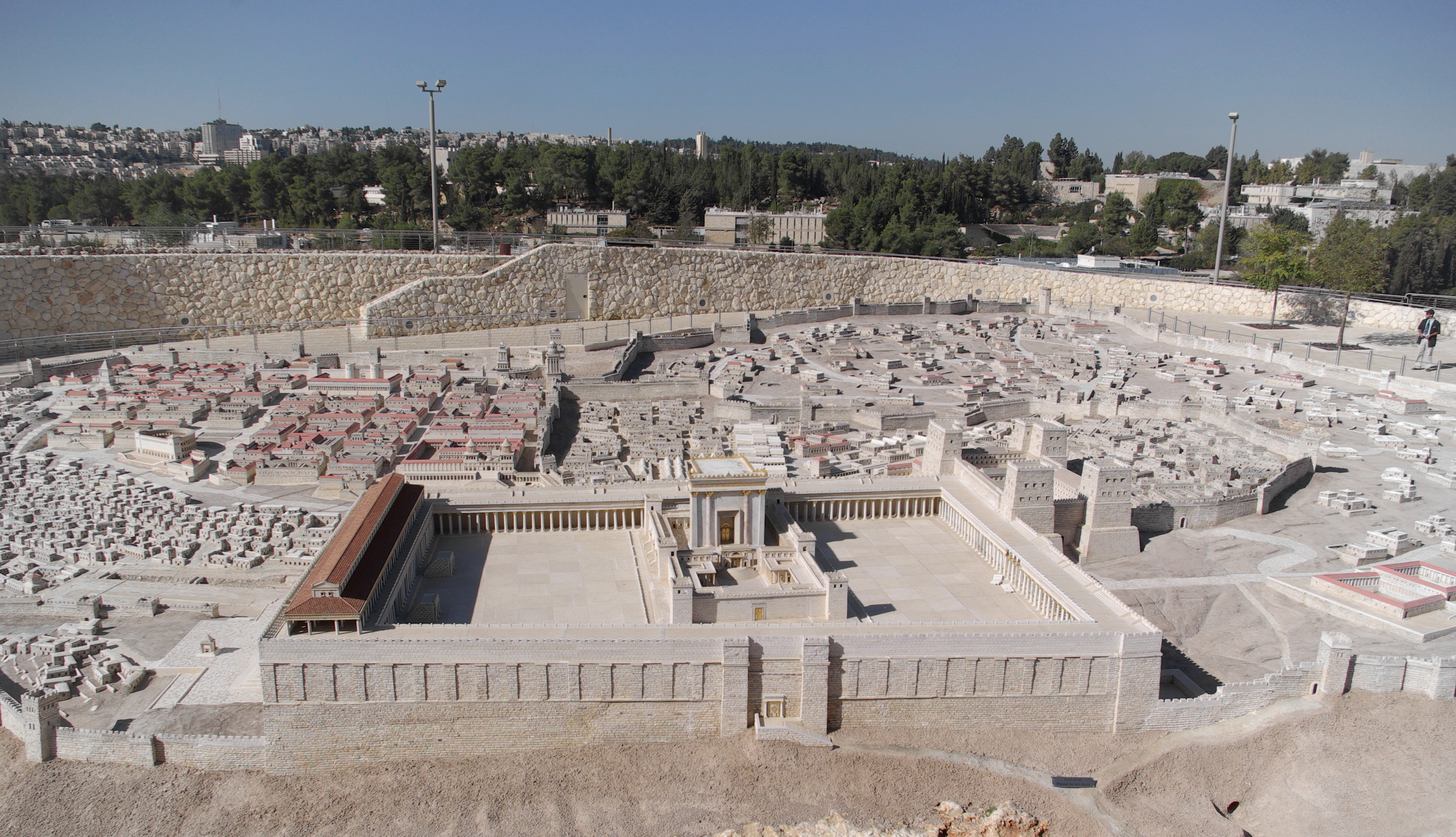 Source: Berthold Werner, Holyland Model of Jerusalem, public domain via Wikimedia Commons. Later Second Temple context, not an exact reconstruction of Zerubbabel’s temple.
Ezra’s beginning is humbler than this later model: an altar and foundation before visible completion.
The strongest image in the chapter remains the altar before the finished building: worship offered amid ruins.
Glossary
- Altar: The place of sacrifice restored before the temple building is complete. In Christian fulfillment, altar language is received through Christ’s sacrifice and the Eucharistic life of the Church.
- Whole-burnt-offering: Brenton’s rendering for the burnt offering, an offering wholly given to God.
- Seventh month: A dense liturgical season in Israel’s calendar, including holy convocations and the Feast of Tabernacles.
- Feast of Tabernacles: A feast remembering God’s care for Israel in the wilderness. In Ezra 3 it is kept by a returned people still living with fragility.
- Jesus son of Josedec: Brenton’s form of Jeshua or Joshua son of Jehozadak, the high-priestly leader in the return.
- Zerubbabel: Named Zorobabel in Brenton, the Davidic-line leader involved in the temple rebuilding.
- Libanus: Lebanon, source of cedar timber associated with temple building.
- Joppa: Coastal port used for bringing timber toward Judah.
- Sons of Asaph: Levitical singers associated with temple praise.
- People of the lands: Surrounding peoples whose presence brings fear and later opposition.
Spiritual Fruit 🍇
- Begin with the altar. Do not wait for your whole life to feel rebuilt before returning to prayer, confession, liturgy, thanksgiving, and obedience. Worship is the beginning of restoration, not the reward after restoration.
- Obey while afraid. Ezra 3 does not deny terror. It shows a people offering morning and evening sacrifice while fear is still present. Ask God for faithful obedience, not only emotional calm.
- Let the Church’s rhythm carry you. Feasts, fasts, daily prayer, and repeated offerings are not empty cycles. They are medicine for a heart that cannot rebuild itself by willpower.
- Offer practical service as holy labor. Money, carpentry, stonework, transport, supervision, and scheduling can all become offerings when they serve the house of God with humility.
- Make room for joy and tears together. Some restorations come with grief because they reveal how much was lost. Do not shame tears, and do not despise joy. Bring both to the Lord whose mercy endures forever.
Stand before the unfinished house with both its sounds in your heart. You need not hide the tears, and you need not postpone thanksgiving until they stop. Christ is the foundation that grief cannot remove. Offer Him the next act of obedience while His mercy carries what you cannot yet repair.
Teaching Notes
- Where to linger: Ezra 3:3 and Ezra 3:12-13. These verses carry the deepest pastoral weight: worship amid fear, and restoration with mixed joy and grief.
- Where to compress: The timber and labor details in verses 7-9 can be summarized quickly if time is short, but do not skip their spiritual point. Holy work requires practical faithfulness.
- Key phrase to repeat: “The altar comes before the finished building.”
- Pastoral caution: Do not use the elders’ tears to romanticize the past or to attack younger hope. Do not use the people’s joy to silence the grief of those who remember loss.
The Altar Rebuilt Amid Fear (Ezra 3:1-3)
- Ask: What fears most often make us delay returning to prayer, liturgy, confession, or obedience?
- Emphasize: The people do not wait for the temple to be finished before worship begins.
- Watch for: Turning the altar into a lucky charm against danger. Ezra presents obedience, not magic.
- Connect: Hebrews 13 and Romans 12 show the altar fulfilled in Christ and in the living sacrifice of His people.
Feasts and Offerings Before the Foundation (Ezra 3:4-6)
- Ask: Why might God give His people feasts and daily offerings instead of leaving worship to personal inspiration?
- Emphasize: Worship before the foundation means God forms the people while restoration is still unfinished.
- Watch for: Treating liturgical rhythm as empty repetition. In Ezra 3, repeated worship is how the returned people learn fidelity.
- Connect: John 4, Romans 12, and Hebrews 13 show that true worship is fulfilled in Christ and lived by the whole person.
Materials, Workers, and Levites Appointed for the Work (Ezra 3:7-9)
- Ask: What ordinary tasks in parish or family life become holy when they are offered to God with obedience?
- Emphasize: Holy work requires money, material, skilled labor, and accountable oversight.
- Watch for: Pitting practical service against spiritual service. Ezra 3 refuses that division.
- Connect: First Peter 2 shows the Church as God’s spiritual house, built in Christ with living stones.
Foundation, Praise, Joy, and Weeping (Ezra 3:10-13)
- Ask: Why do new beginnings often awaken grief as well as joy?
- Emphasize: The foundation is praised because the Lord’s mercy endures, not because restoration already looks complete.
- Watch for: Mocking older grief as negativity, or using memory to crush younger joy.
- Connect: John 2 points from the temple foundation to Christ’s crucified and risen Body, the true Temple.
Sources
Embedded Scripture is from Brenton’s English Septuagint (LXX).
Brenton, The Septuagint Version of the Old Testament, Ezra 3; Isaiah 28:16; Haggai 2:3-9; Zechariah 3:3-5; Zechariah 4:10, 14; Zechariah 6:11-13.
Exodus 29:38-46; Leviticus 23; 1 Kings 6:1; 2 Chronicles 3:2; Psalm 118:22 (LXX Psalm 117:22); Psalm 136 (LXX Psalm 135); Acts 2:1; Romans 12:1; Hebrews 13:10-16; 1 Peter 2:4-5; 1 Corinthians 3:11.
Return-from-exile map and Israel Museum Second Temple model.
Further reading: H. G. M. Williamson, Ezra, Nehemiah, Word Biblical Commentary; Lester L. Grabbe, A History of the Jews and Judaism in the Second Temple Period.
Footnotes
-
St. John Chrysostom, Homilies on Romans, Homily 8 (Romans 4:1-2), concluding moral exhortation, paragraph beginning “Reverence now,” text. ↩
-
St. Justin Martyr, Dialogue with Trypho 115-116, especially chapter 116’s opening explanation of Christ’s high priesthood and believers’ cleansing, text. ↩
-
Coptic Holy Pascha, Wednesday, Eleventh Hour, Isaiah 28:16-29; Coptic Katameros, Thursday of the fourth week of Great Lent, Matins, Isaiah 28:14-22. ↩
-
Coptic Katameros, Amshir 3, Pauline Epistle, 1 Corinthians 3:4-23; Friday of the fourth week of Great Lent, Hebrews 13:7-16; Friday of the first week of the Holy Fifty Days, Hebrews 13:10-21; Saturday of the first week of Great Lent, Romans 12:1-21; fifth Sunday and sixth Saturday of the Holy Fifty Days, verses from Psalm 136 (LXX Psalm 135). ↩ ↩2 ↩3
-
Fr. Jacob Nadian, Psalmody of Annual Sundays, St. Bishoy Coptic Orthodox Church of Toronto, “The Second Hoos (Canticle),” pages 16-18, Psalmody text. ↩