


Zechariah 3 is one of the book’s clearest priestly and Christological visions. The high priest stands accused, clothed in filthy garments, and the Lord answers not by minimizing sin but by removing it. Grace restores the priest for service and points beyond Joshua to the Branch.
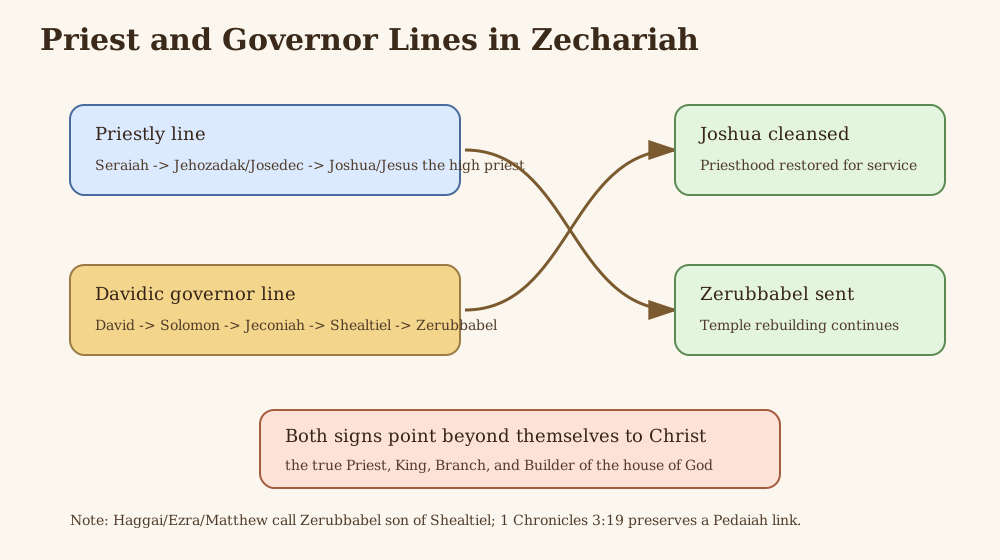 Source: Generated schematic for this guide. It is a teaching aid for Joshua the high priest and Zerubbabel the governor.
Placement in the Book and Grouping Rationale
After the city is measured and promised divine presence, the priesthood itself must be cleansed. A rebuilt temple with an uncleansed priesthood would not be true restoration. This chapter therefore moves from place to person, from city to priest, from outward rebuilding to purification.
Satan Accuses, the Lord Rebukes, and the Priest Is Clothed (Zechariah 3:1-5)
1 And the Lord shewed me Jesus the high priest standing before the angel of the Lord, and the Devil stood on his right hand to resist him. And the Lord said to the Devil,
2 The Lord rebuke thee, O Devil, even the Lord that has chosen Jerusalem rebuke thee: behold! is not this as a brand plucked from the fire?
3 Now Jesus was clothed in filthy raiment, and stood before the angel. 4 And the Lord answered and spoke to those who stood before him, saying, Take away the filthy raiment from him: and he said to him, Behold, I have taken away thine iniquities: and clothe ye him with a long robe, 5 and place a pure mitre upon his head. So they placed a pure mitre upon his head, and clothed him with garments: and the angel of the Lord stood by.
Joshua stands before the angel of the Lord, and the accuser stands ready. The vision does not deny the filth of the garments. The priest really needs cleansing. Yet the decisive word belongs to the Lord: “The Lord rebuke thee, O Devil.”
The change of garments is grace made visible. The high priest does not cleanse himself and then come near. He is cleansed because the Lord chooses Jerusalem and plucks the brand from the fire. This is a strong medicine against despair: accusation may be loud, but it is not lord.
LXX / Translation Insight
Brenton uses “Jesus the high priest,” the Greek form of Joshua. This is not saying Joshua son of Josedec is Christ. It does, however, make the typology unavoidable for Christian readers: the priest who needs cleansing points forward to Jesus Christ, the sinless High Priest who bears our uncleanness and clothes us in righteousness.
The Branch and the Removal of Iniquity in One Day (Zechariah 3:6-10)
6 And the angel of the Lord testified to Jesus, saying, 7 Thus saith the Lord Almighty; If thou wilt walk in my ways, and take heed to my charges, then shalt thou judge my house: and if thou wilt diligently keep my court, then will I give thee men to walk in the midst of these that stand here.
8 Hear now, Jesus the high priest, thou, and thy neighbours that are sitting before thee: for they are diviners, for, behold, I bring forth my servant The Branch. 9 For as for the stone which I have set before the face of Jesus, on the one stone are seven eyes: behold, I am digging a trench, saith the Lord Almighty, and I will search out all the iniquity of that land in one day. 10 In that day, saith the Lord Almighty, ye shall call together every man his neighbour under the vine and under the fig-tree.
Joshua is restored for obedient service, not private honor. The promise then widens: the Lord will bring forth His servant, the Branch, and remove the iniquity of the land in one day.
The one-day cleansing reaches its fullness at the Cross. The filthy garments of humanity are not merely covered by optimism. They are removed by the work of Christ. The stone, the eyes, the Branch, and the peace under the vine and fig tree all press toward a restored creation where priestly service and neighborly peace belong together.
LXX / Translation Insight
The Branch language is joined elsewhere in Zechariah with priest-king hope. In Christian reading this belongs with the rising light of Luke 1:78 and with Christ as the One in whom priesthood, kingship, and temple are fulfilled. Keep the movement disciplined: Joshua is a sign, Christ is the fulfillment.
The Church’s Voice in Worship ⛪
No Coptic lectionary reading surfaced for Zechariah 3 in the checked lectionary references. The chapter still gives the Church priestly language for repentance: worship is not made pure by human confidence, but by the Lord who removes filthy garments.
Spiritual Fruit 🍇
The accuser wants sin to become identity. God makes sin the place where mercy is revealed and service is restored. A Christian reading of this chapter should lead to confession, not shame; to grateful obedience, not self-protection.
Teaching Notes
Satan Accuses, the Lord Rebukes, and the Priest Is Clothed (Zechariah 3:1-5)
- Ask: Where do accusation and repentance differ in this passage?
- Emphasize: The Lord rebukes the accuser and removes the filthy garments.
- Watch for: Do not minimize sin, but do not let sin become identity.
- Connect: Connect to confession, baptismal clothing, and Christ our High Priest.
- Show: Show the priest-king schematic to identify Joshua/Josedec and distinguish type from fulfillment.
The Branch and the Removal of Iniquity in One Day (Zechariah 3:6-10)
Ask: Why does cleansing lead to obedient service?
Emphasize: Grace restores the priest so that worship can be true.
Watch for: Avoid treating the Branch as a vague symbol. It is a messianic promise that crowns the vision.
Connect: Connect the one-day removal of iniquity to the Cross and to the peace Christ gives.
Sources
- Embedded Scripture is from Brenton’s English Septuagint (LXX).
- Brief New Testament references are cited by reference.
- Coptic Orthodox lectionary references are from the project’s lectionary reference tables and Holy Pascha reference tables.