


Zechariah 14 is a final vision of crisis, divine kingship, living waters, and holiness filling the ordinary. It should not be turned into speculative charts. Its spiritual center is worship: the Lord is King over all the earth, and even common vessels become holy to Him.
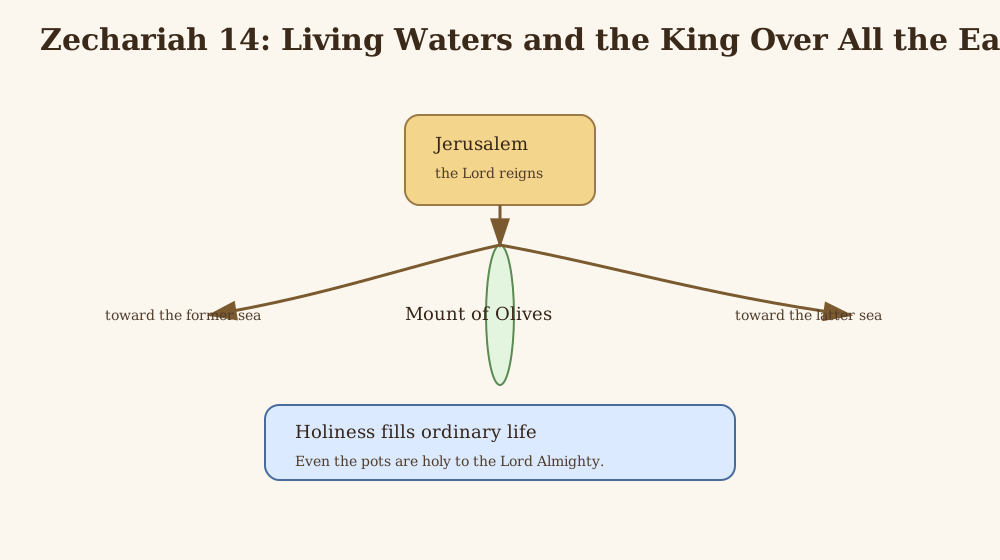 Source: Generated schematic for this guide.
Placement in the Book and Grouping Rationale
This chapter stands as the book’s conclusion. The mourning of chapter 12, fountain of chapter 13, and final kingship of chapter 14 belong together, but each has its own weight. Zechariah ends not with private consolation, but with the Lord reigning and worship transfiguring the world.
The Day of the Lord and the Mount of Olives (Zechariah 14:1-5)
1 Behold, the days of the Lord come, and thy spoils shall be divided in thee. 2 And I will gather all the Gentiles to Jerusalem to war, and the city shall be taken, and the houses plundered, and the women ravished; and half of the city shall go forth into captivity, but the rest of my people shall not be utterly cut off from the city.
3 And the Lord shall go forth, and fight with those Gentiles as when he fought in the day of war. 4 And his feet shall stand in that day on the mount of Olives, which is before Jerusalem on the east, and the mount of Olives shall cleave asunder, half of it toward the east and the west, a very great division; and half the mountain shall lean to the north, and half of it to the south. 5 And the valley of my mountains shall be closed up, and the valley of the mountains shall be joined on to Jasod, and shall be blocked up as it was blocked up in the days of the earthquake, in the days of Ozias king of Juda; and the Lord my God shall come, and all the saints with him.
The chapter opens with severe imagery: plunder, attack, divine intervention, and the Mount of Olives. The point is not curiosity about timelines. The Lord Himself comes forth.
The Mount of Olives matters for Christian reading because Christ prays, teaches, ascends, and is associated with final hope there. But Zechariah’s emphasis remains worshipful: the Lord enters the crisis that His people cannot solve.
Living Waters and the King Over All the Earth (Zechariah 14:6-11)
6 And it shall come to pass in that day that there shall be no light, 7 and there shall be for one day cold and frost, and that day shall be known to the Lord, and it shall not be day nor night: but towards evening it shall be light.
8 And in that day living water shall come forth out of Jerusalem; half of it toward the former sea, and half of it toward the latter sea: and so shall it be in summer and spring. 9 And the Lord shall be king over all the earth: in that day there shall be one Lord, and his name one, 10 compassing all the earth, and the wilderness from Gabe unto Remmon south of Jerusalem. And Rama shall remain in its place. From the gate of Benjamin to the place of the first gate, to the gate of the corners, and to the tower of Anameel, as far as the king’s wine-presses, 11 they shall dwell in the city; and there shall be no more any curse, and Jerusalem shall dwell securely.
Light, evening, living waters, and the Lord’s universal kingship fill this passage. The waters flow outward, and the Lord is confessed as one King over all the earth.
Good Friday Ninth Hour hears Zechariah 14:5-11 / 14:6-11 because the Cross is not defeat. From the crucified Lord flows life for the world. The living waters belong with the pierced side, the opened fountain, and the final reign of God.
Gems from the Fathers 💎
Eusebius reads Zechariah 14 with Christ, the Mount of Olives, the nations, and universal worship in view.1 His apologetic tone should be used carefully, but the core insight is valuable: Zechariah’s end is not local politics only. It opens toward the nations worshiping the Lord.
Holiness on the Bells and Pots (Zechariah 14:12-21)
12 And this shall be the overthrow with which the Lord will smite all the nations, as many as have fought against Jerusalem; their flesh shall consume away while they are standing upon their feet, and their eyes shall melt out of their holes, and their tongue shall consume away in their mouth. 13 And there shall be in that day a great panic from the Lord upon them; and they shall lay hold every man of the hand of his neighbour, and his hand shall be clasped with the hand of his neighbour. 14 Juda also shall fight in Jerusalem; and God shall gather the strength of all the nations round about, gold, and silver, and apparel, in great abundance. 15 And this shall be the overthrow of the horses, and mules, and camels, and asses, and all the beasts that are in those camps, according to this overthrow.
16 And it shall come to pass, that whosoever shall be left of all the nations that came against Jerusalem, shall even come up every year to worship the king, the Lord Almighty, and to keep the feast of tabernacles. 17 And it shall come to pass, that whosoever of all the families of the earth shall not come up to Jerusalem to worship the king, the Lord Almighty, even these shall be added to the others. 18 And if the family of Egypt shall not go up, nor come; then upon them shall be the overthrow with which the Lord shall smite all the nations, whichever of them shall not come up to keep the feast of tabernacles. 19 This shall be the sin of Egypt, and the sin of all the nations, whosoever shall not come up to keep the feast of tabernacles.
20 In that day there shall be upon the bridle of every horse Holiness to the Lord Almighty; and the caldrons in the house of the Lord shall be as bowls before the altar. 21 And every pot in Jerusalem and in Juda shall be holy to the Lord Almighty: and all that sacrifice shall come and take of them, and shall seethe meat in them: and in that day there shall be no more the Chananite in the house of the Lord Almighty.
The final scene is holiness everywhere. Even the bells, pots, and ordinary vessels are holy to the Lord Almighty. The book that began with “Return to me” ends with ordinary life consecrated.
This is the goal of restoration. Not religious performance on holy days only, but life made holy. Not temple worship sealed off from daily conduct, but cooking pots, streets, vessels, and worship all belonging to God. Brenton says that in that day there shall be no more the Chananite in the house of the Lord. The house is wholly holy. John 2 does not quote this verse, but the cleansing of merchandise from the Father’s house is one Gospel image of that hope. See The True Temple and the Cleansing of Worship. The chapter’s own climax remains larger than one scene: ordinary pots become as holy as altar bowls.
Pastoral Guardrail
Do not teach this chapter as end-times speculation or modern political mapping. Zechariah’s burden is the Lord’s kingship, living waters, purified worship, and the sanctification of ordinary life.
The Church’s Voice in Worship ⛪
Zechariah 14 appears repeatedly in Holy Pascha: Great Thursday Eleventh Hour includes 14:1-4 and 14:6-9 within the larger Zechariah 12-14 movement, and Good Friday Ninth Hour includes 14:5-11 / 14:6-11. The Church hears living waters and universal kingship while standing before the Cross.
Spiritual Fruit 🍇
The end of Zechariah is not escape from the world, but the world made holy to the Lord. The Christian hope is not merely that crisis ends, but that God reigns, living water flows, and common life becomes worship.
Teaching Notes
The Day of the Lord and the Mount of Olives (Zechariah 14:1-5)
- Ask: Why should we avoid turning this passage into speculation?
- Emphasize: The Lord enters the crisis and stands with sovereign authority.
- Watch for: Do not make the Mount of Olives a modern prediction chart. Keep the focus on divine kingship.
- Connect: Connect to Christ’s Passion, Ascension, and promised coming.
- Show: Show the living-waters schematic for orientation.
Living Waters and the King Over All the Earth (Zechariah 14:6-11)
- Ask: How do living waters change the tone of the final chapter?
- Emphasize: The Lord’s reign gives life outward from Jerusalem.
- Watch for: Avoid triumphalist readings. The King gives life and gathers worship.
- Connect: Connect to John 19, Baptism, Eucharist, and Good Friday Ninth Hour.
- Show: Show the Passion lectionary-flow schematic if teaching Holy Week sequence.
Holiness on the Bells and Pots (Zechariah 14:12-21)
Ask: What ordinary parts of life need to become holy to the Lord?
Emphasize: The book ends with ordinary vessels consecrated.
Watch for: Do not reduce holiness to church-only activity.
Connect: Connect to Romans 12 and offering daily life as worship. Use John 2:13-25 for the house made holy, without letting that scene swallow the ordinary-pots ending.
Sources
Embedded Scripture is from Brenton’s English Septuagint (LXX).
Brief New Testament references are cited by reference.
Coptic Orthodox lectionary references are from the project’s lectionary reference tables and Holy Pascha reference tables.
Footnotes
-
Eusebius of Caesarea, Proof of the Gospel, Book 2, chapter 4, citing Zechariah 12 and 14 in relation to Christ, the nations, and universal worship (🔗). ↩