


This narration is from a previous version of the study and may include a combined recording of multiple chapters.
Malachi is a small book with a searching voice. The temple has been rebuilt, the people are back in the land, and religious life continues, yet love has cooled into argument, worship has become careless, and covenant faithfulness has thinned. The Lord answers this weariness not by abandoning His people, but by exposing the wound and pointing forward to the messenger, the Lord who comes to His temple, and the Sun of Righteousness with healing in His wings.
Who speaks, when, and why?
The Hebrew name “Malachi” means “my messenger.” Whether it was the prophet’s personal name or a description of his calling is uncertain; the Septuagint presents the opening message as coming “by the hand of his messenger” rather than using Malachi as a proper name in that sentence. We know little of his biography. We know the world his prophecy addresses: Persian-period Yehud, the restored province of Judah, probably in the fifth century before Christ, around the time of Ezra and Nehemiah. The date is approximate, not supplied by the book. The rebuilt temple and the governor of Malachi 1:8 locate its concerns after the exile; its rebukes of neglected offerings and broken marriage covenants resemble those in Nehemiah 13.1
Malachi is the last of the Twelve Prophets. “Minor” describes the length of these prophetic books, not the importance of their message. His position makes him a fitting threshold to the Gospel, although the order of Old Testament books differs among biblical traditions. He speaks because return to the land has not yet become a wholehearted return to God. The problem is no longer that worship is impossible, but that possible worship has become cheap.
 Source: William Robert Shepherd, Map of the Achaemenid Empire, Wikimedia Commons, public domain.
Jerusalem is a holy city inside a vast empire, no longer the capital of an independent kingdom. Reduced circumstances do not excuse reduced reverence. The Lord’s name is still great among the nations.
The messenger thread: a word to receive, a life to carry it
One Greek word runs through the book: ἄγγελος, “messenger.” In Malachi 1:1 the Lord speaks through “his messenger.” In Malachi 2:7 the priest is “the messenger of the Lord Almighty,” whose lips must preserve knowledge. In Malachi 3:1 the Lord sends “my messenger,” and the coming Lord is called “the angel of the covenant.” The thread leads from the prophetic word, through the responsibility of those who teach it, to the Lord who comes to fulfill it. A messenger is judged not by the attention he attracts but by his fidelity to the One who sends him.
St Cyril of Alexandria makes this connection in the preface to his Commentary on Malachi. He rejects the idea that Malachi was a heavenly angel disguised as a man: the prophet bears God’s message, just as priests are called messengers in Malachi 2:7. Cyril then distinguishes these human servants from the Son, who is God by nature. The title “messenger” describes a mission; it does not reduce Christ to the nature of a created angel.2
The opening appeal in Brenton, “Lay it, I pray you, to heart,” tells us how to read the whole book. Its opposite appears when the priests will not “lay it to heart” in Malachi 2:2. The first failure is not lack of religious information. God’s word has reached the ear without being welcomed deeply enough to change a life. Cyril’s exposition of the opening appeal presses this very distinction between merely hearing and receiving the divine word inwardly.3
The prophet’s spiritual diagnosis
God speaks, and the people answer with defensive questions:
- “Wherein hast thou loved us?” (Malachi 1:2)
- “Wherein have we despised thy name?” (Malachi 1:6)
- “Wherein have ye polluted it?” (Malachi 1:7)
- “Wherefore?” (Malachi 2:14)
- “Wherein have we provoked him?” (Malachi 2:17)
- “Wherein shall we return?” (Malachi 3:7)
- “Wherein have we insulted thee?” (Malachi 3:8)
- “Wherein have we spoken against thee?” (Malachi 3:13)
These repeated questions reveal the book’s spiritual psychology. The danger is not simply the denial of God, but religious numbness. The people still have sacrifices, priests, altar, temple, marriage, tithes, and religious speech, but they have lost the ability to see how their worship and life answer God’s love.
Not every question is faithless. A wounded person may ask where God’s love is and still be praying. Malachi exposes a different habit: using questions to fend off every answer that might require repentance. The difference becomes visible in what we do when the Lord names a concrete wrong. Do we seek healing, or merely a better defense?
Covenant love before correction
Malachi begins with “I have loved you” (Malachi 1:2). The mention of Jacob and Esau is not permission for ethnic pride. It recalls a calling received by mercy, and warns Israel not to make ancestry a substitute for faithfulness. The judgment upon Edom is sobering; it is not a map of individuals predestined to damnation. The first chapter explores this difficult language in its covenant setting and alongside Romans 9.
flowchart LR
  Abraham --> Isaac
  Isaac --> Jacob["Jacob / Israel"]
  Isaac --> Esau["Esau / Edom"]
  Jacob --> Israel["Israel: covenant mercy and vocation"]
  Esau --> Edom["Edom: judgment upon wickedness"]
The chosen people must not despise the God who loved them first. Fr Tadros Malaty emphasizes that the rebuke begins in God’s desire to heal His people, and that the book’s horizon opens toward the nations rather than closing around inherited privilege.4
Altar, lips, and household
Malachi does not attack worship from the outside. He speaks to the altar, to the priests, and to the people who bring offerings. Priests are meant to guard knowledge, teach truth, and turn many from unrighteousness. When leaders become careless, the people are wounded. The authority to speak for God brings greater accountability, not immunity from correction.
This explains why Malachi moves from altar to marriage, and from offerings to withheld wages. Worship, teaching, and household fidelity are not separate rooms in the spiritual life. A person cannot cover the altar with tears while treating another person as disposable. Nor can the Church’s gathering become an excuse to neglect the neighbor. The Didache, an early Christian teaching text, receives Malachi’s pure offering in precisely this searching way: the Lord’s Day Eucharistic assembly includes confession and reconciliation, not thanksgiving detached from the life of the worshipers.5
The Gospel threshold
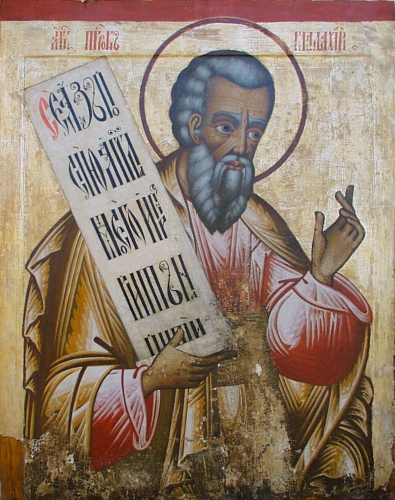 Source: Prophet Malachi icon from the Kizhi iconostasis, Wikimedia Commons, public domain.
Malachi bears the word of the Lord, not a program for religious self-improvement. His prophecy moves toward a coming that no human effort can manufacture. The messenger prepares; the Lord enters His temple; worshipers are refined; those who fear His name are remembered; the Sun of Righteousness rises with healing. John the Baptist prepares the way of Christ, and Moses and Elijah direct our attention toward the One in whom the Law and the Prophets find their fulfillment.
| Study | The movement to follow |
|---|---|
| Malachi 1 | Love received or resisted; polluted offerings and the pure offering among the nations. |
| Malachi 2 | The priest as messenger; truth in the mouth and fidelity in the household. |
| Malachi 3:1-18 | The coming Lord, purification, concrete return, and the book of remembrance. |
| Malachi 3:19-24 | Judgment and healing, Elijah’s restoration, and Moses remembered; Malachi 4:1-6 in four-chapter English Bibles, with a different order for the final three verses. |
The Church’s Voice in Worship ⛪
In the Coptic Church, Malachi 1:1-9 is read in the night hours of Holy Pascha Week, at the Third Hour. The reading begins with God’s love and reaches the rebuke of offerings that even a human ruler would refuse. As the Church follows Christ toward His saving Passion, these words search the offering of our own hearts. The One who gives Himself wholly for us is not asking for the remains of our attention. This is the Paschal resonance of the passage, not a claim that the entire book is appointed there.
Spiritual Fruit 🍇
Receive love before preparing your defense. Begin a reading of Malachi by pausing over “I have loved you.” Name one mercy that has become so familiar you no longer notice it. Give thanks for it before examining what needs to change. Repentance is a response to love, not a way of persuading an unwilling God to love us.
Let one sentence reach the heart. After reading a passage, keep one sentence for prayer instead of rushing to collect more information. Ask what accepting it would change today. If the answer is an apology, an honest word, or an act of mercy, let the reading continue in that action.
Bring the altar and the household together. Before the next Liturgy, examine one relationship or responsibility you have kept outside your prayers. Take a safe, truthful step toward repair: repay what is owed, keep a neglected promise, or ask for help where harm must be addressed. Reconciliation does not require returning to danger or concealing abuse.
Prepare for a Person, not merely a better routine. Malachi’s hope is the coming Lord. Bring Him one place where you want comfort but resist purification. Ask for the grace to receive both. He does not refine His people to make them less human, but to free them to worship, love, and rejoice.
Teaching Notes
Whole-book orientation
- Ask: Which defensive question in Malachi is easiest to recognize in ourselves?
- Emphasize: The book begins with God’s love and moves toward His coming. Correction serves return to communion.
- Watch for: Do not present the prophecy as contempt for the Jewish people, or the messenger title as proof that Christ is a created angel.
- Connect: Trace the messenger through Malachi 1:1, Malachi 2:7, and Malachi 3:1. The prophet and priest serve the word; Christ fulfills the covenant.
- Show: Use the empire map for the Persian setting, the Jacob/Esau chart for covenant history, and the Malachi icon for prophetic witness. These are orientation aids, not proofs of an interpretation.
Reading the book in the Church
- Ask: What changes when we hear “I have loved you” while following Christ toward His Passion?
- Emphasize: The Holy Pascha reading is Malachi 1:1-9, not the whole chapter or the book’s closing promises.
- Watch for: Distinguish a liturgical appointment from a thematic connection. Different chapter divisions do not mean different prophecies are missing.
- Connect: Confession, reverence, mercy, and faithful relationships belong to one Eucharistic life.
Sources
Embedded Scripture is from Brenton’s English Septuagint (LXX). The chapter studies present the complete text of Malachi.
Patristic reading: St Cyril of Alexandria on the prophet’s calling and attentive hearing; the Didache on the Eucharistic assembly. Specific locations are given in the footnotes.
Coptic Orthodox pastoral reading: Fr Tadros Y. Malaty’s The Book of Malachi, Introduction and chapter 1.
Worship: Coptic Holy Pascha order, night hours, Third Hour, first Old Testament reading, Malachi 1:1-9.
Visuals: Shepherd’s historical empire map and the Kizhi icon of Malachi, public-domain works reproduced through Wikimedia Commons.
Footnotes
-
Fr Tadros Y. Malaty, The Book of Malachi (2006), translated by Dr George Botros, Introduction, “History of Its Writing.” Commentary. ↩
-
St Cyril of Alexandria, Commentary on the Twelve Prophets, vol. 3, Preface to Malachi, pp. 283-285, translated by Robert C. Hill, Fathers of the Church 124 (2012). Paraphrased. Text. ↩
-
St Cyril of Alexandria, Commentary on the Twelve Prophets, vol. 3, on Malachi 1:1-2, pp. 286-287, translated by Robert C. Hill (2012). Paraphrased. Text. ↩
-
Fr Tadros Y. Malaty, The Book of Malachi, “The Shining of the Sun of Righteousness on All the Nations,” and chapter 1, section 1, “The Need for God’s Work.” Paraphrased. Commentary. ↩
-
Didache 14, “Christian Assembly on the Lord’s Day,” translated by M. B. Riddle, Ante-Nicene Fathers 7, as revised for New Advent. Paraphrased. Text. ↩