


This narration was recorded before the latest revision. The text on this page is current.
“We will not forsake the house of our God” was the promise at the end of Nehemiah 10 (10:39, NKJV). Now Nehemiah asks, “Wherefore has the house of God been abandoned?” (13:11). The last chapter holds the covenant up to the people’s life, vow by vow. Temple support and the Levites’ portions have failed (10:32-39; 13:10-14). Sabbath trade has resumed (10:31; 13:15-22). Households have again broken the marriage commitment (10:30; 13:23-27). Even the wood offering promised in 10:34 must be restored in the book’s last verse. The wall is complete, but the people’s faithfulness is not.
Malachi is the prophetic companion to this painful ending. Malachi 2 exposes a corrupted priesthood, a broken covenant of Levi, and faithless marriages. Malachi 3 names the withheld tithes as robbery of God. Together, prophet and governor uncover the same wound: people who have returned to Jerusalem can still turn away from the Lord. Yet Malachi also speaks of a book of remembrance for those who fear Him (Malachi 3:16-17). Nehemiah’s repeated “Remember me” belongs within that hope: he entrusts unfinished labor to the mercy of God.
Nehemiah has returned from the royal court to find disorder in the community he helped restore. The book refuses to conceal the relapse behind the joy of the dedication. Scripture, tears, promises, and celebration were real; so is the need to repent again.
The prose uses familiar NKJV names; Brenton’s forms remain in the Scripture below.
| Name in this study | Brenton form |
|---|---|
| Nehemiah | Neemias, the form used elsewhere in Brenton |
| Artaxerxes | Arthasastha |
| Eliashib | Eliasib; Elisub |
| Joiada | Joada |
| Tobiah | Tobias |
| Sanballat the Horonite | Sanaballat the Uranite |
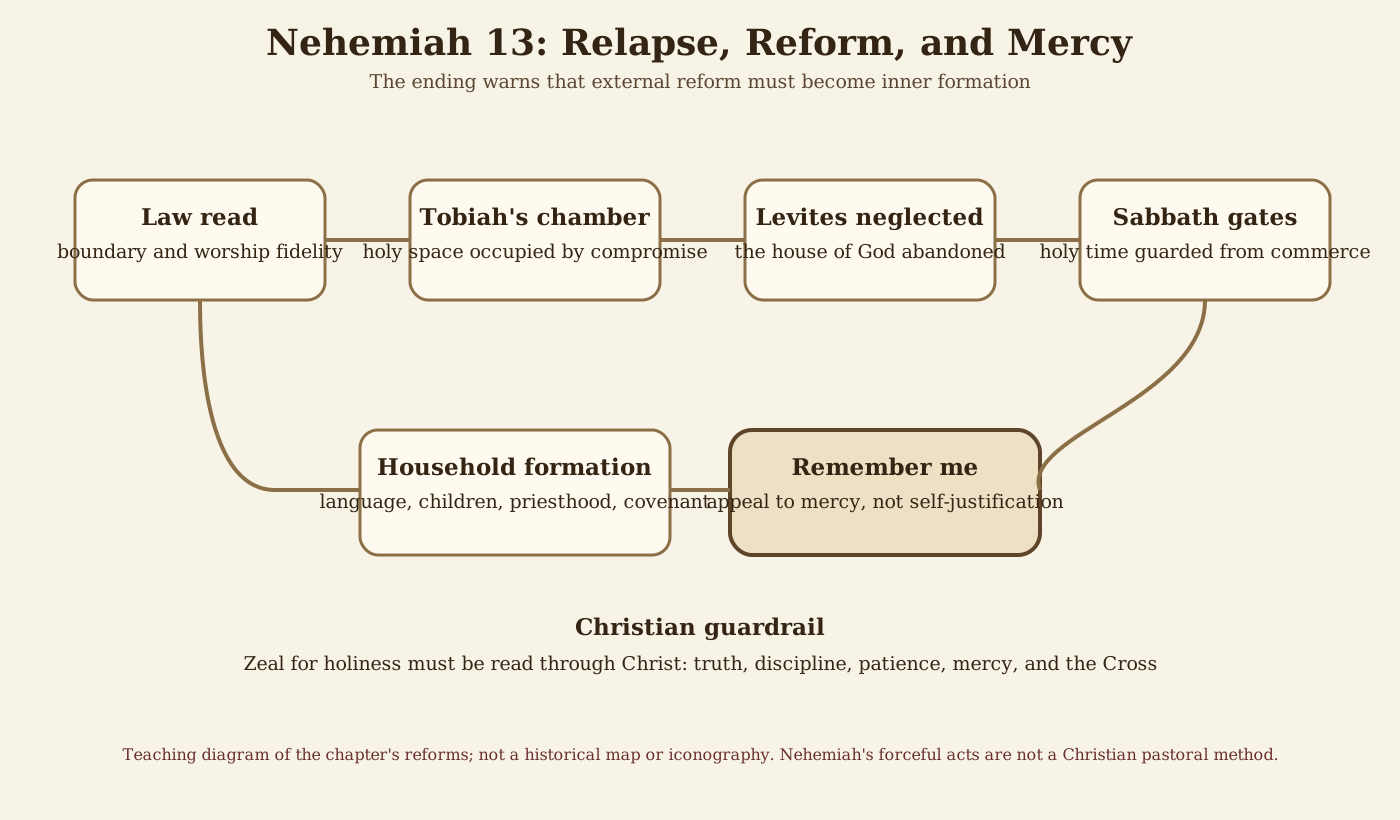 Teaching diagram of the chapter’s relapse and reforms; not a historical map.
The Law read and the curse turned to blessing (Nehemiah 13:1-3)
A note on numbering. Nehemiah 13 is 2 Esdras 23 in the Septuagint. Ezra and Nehemiah form one book there, 2 Esdras; this study follows the familiar Nehemiah chapter and verse numbers.
1 In that day they read in the book of Moses in the ears of the people; and it was found written in it, that the Ammonites and Moabites should not enter into the congregation of God for ever; 2 because they met not the children of Israel with bread and water, but hired Balaam against them to curse them: but our God turned the curse into a blessing. 3 And it came to pass, when they heard the law, that they were separated, even every alien in Israel.
The chapter begins with Moses being read “in the ears of the people.” Their response rests on the written Law, not simply on a governor’s anger. Deuteronomy 23:3-6 recalls a particular history of hostility: bread and water were withheld, and Balaam was hired to curse Israel. The people must take seriously the danger of an allegiance that opposes the God who delivered them.
But the same sentence that recalls the curse remembers God’s victory over it: “our God turned the curse into a blessing.” Balaam’s intended curse could not bind the Lord. Among the blessings God put into his mouth was the promise of the star from Jacob (Numbers 24:17). This remembered deliverance reaches beyond survival in the wilderness toward the coming of Christ.
The separation in verse 3 is a hard boundary, and it must be read alongside the whole witness of Scripture. Ruth the Moabitess clings to Israel’s God and becomes part of the ancestry of the Savior (Ruth 1:16; Matthew 1:5). Her faithfulness prevents us from turning the passage into a claim that ancestry alone makes a person incapable of belonging to God. The chapter’s concern is covenant allegiance and worship; it gives Christians no permission for ethnic contempt.
Isaiah 56:3-7 speaks directly to the foreigner who joins himself to the Lord, keeps the Sabbath, and holds fast His covenant. Such a person is welcomed into God’s house of prayer for all nations. Foreigners and Sabbath, two pressing concerns in Nehemiah 13, are held together in Isaiah’s promise. Christ takes that promise upon His lips as He cleanses the temple (Mark 11:17). Holiness and the gathering of the nations belong together in Him. The Church calls every nation to baptism and communion with the true God, rejecting both idolatry and contempt for persons.
Gems from the Fathers 💎: Ruth belongs to the promise
Thematic witness. St Jerome reads Ruth within the prophetic promise of the Messiah. His brief remark, “Ruth the Moabitess fulfils the prophecy of Isaiah,” points toward the promised ruler, not toward a rejection of Ruth because of her people.1 He is not commenting directly on Nehemiah’s ban. His reading nevertheless helps us keep Ruth’s place in the saving purpose of God before our eyes: the Moabite woman who cleaves to the Lord belongs to the line from which Christ comes.
Gems from the Fathers 💎: The blessing that foretold a star
Typological witness. Origen connects Balaam’s prophecy, “There shall arise a star out of Jacob,” with the star at Christ’s birth.2 The words intended to serve hostility became a witness to the Savior. Read in this light, Nehemiah’s remembrance of the curse turned into blessing contains a promise greater than Israel’s immediate rescue. God was preparing the coming of the One before whom the Magi, themselves from the nations, would bow.
Tobiah in the temple treasury (Nehemiah 13:4-9)
4 And before this time Eliasib the priest dwelt in the treasury of the house of our God, connected with Tobias; 5 and he made himself a great treasury, and there they were formerly in the habit of bestowing the offerings, and the frankincense, and the vessels, and the tithe of the corn, and the wine, and the oil, the ordered portion of the Levites, and singers, and porters; and the first-fruits of the priests. 6 But in all this time I was not in Jerusalem; for in the thirty-second year of Arthasastha king of Babylon I came to the king, and after a certain time I made my request of the king; 7 and I came to Jerusalem, and I understood the mischief which Eliasib had done in the case of Tobias, in making for him a treasury in the court of the house of God. 8 And it appeared very evil to me: so I cast forth all the furniture of the house of Tobias from the treasury. 9 And I gave orders, and they purified the treasuries: and I restored thither the vessels of the house of God, and the offerings, and the frankincense.
Verse 6 explains Nehemiah’s absence: he had returned to Artaxerxes in the thirty-second year of the king’s reign. “King of Babylon” does not make Artaxerxes a different ruler; the Persian king held Babylon. When Nehemiah receives leave and returns to Jerusalem, he finds that Tobiah, an opponent of the restoration, has been given a room in the temple courts.
The inventory in verse 5 makes the offense plain. Offerings, frankincense, holy vessels, grain, wine, oil, and the portions of those serving in the temple had belonged there. A room ordered toward worship has been occupied by Tobiah’s household furniture. Eliashib’s personal connection has displaced a holy trust.
Eliashib’s history makes the betrayal sharper. He helped sanctify the Sheep Gate at the beginning of the rebuilding (Nehemiah 3:1), appears in the high-priestly line (12:10), and now opens a temple chamber to Tobiah. At the end of this chapter, his family is tied to Sanballat through marriage (13:28). Consecration at the beginning did not spare the priesthood from divided loyalty later. Past service cannot excuse a present compromise.
Nehemiah casts out the furniture, orders the chambers purified, and restores the vessels, offerings, and frankincense. Repentance has all three acts: removal, cleansing, and restoration. An empty room is not the goal. The room must once more receive what belongs to God.
Christ’s cleansing of the temple brings this zeal to its fulfillment (John 2:13-17; Matthew 21:12-13). John recalls Psalm 69:9 (LXX Psalm 68): zeal for God’s house consumes Him. Yet Christ acts as the Son in His Father’s house, with His own divine authority. His cleansing does not authorize a Christian to turn anger into violence against people. The hard actions later in this chapter must be judged in the light of the Lord who restores His people through truth, repentance, mercy, and His own self-offering.
The heart can become like this treasury. Prayer and attention are crowded out by a grievance we keep rehearsing, an ambition we protect, or a secret habit we refuse to confess. The room may still carry God’s name while serving another occupant. Repentance begins by naming what has taken possession, bringing it to confession, and making room again for prayer and obedience. Christ cleanses in order to dwell with us.
Gems from the Fathers 💎: Zeal for the Father’s house
Thematic witness. St John Chrysostom explains that Christ’s rebuke of “a house of merchandise” shows His devotion to the Father.3 The One who risks opposition to restore the house’s good order is no enemy of the Lord worshipped there. This helps us read Nehemiah’s grief over the treasury as grief for worship betrayed, while remembering that Christ’s authority is His own. The cleansing serves communion with God; it cannot be borrowed as an excuse for our passions.
The abandoned Levites and faithful stewardship (Nehemiah 13:10-14)
10 And I understood that the portion of the Levites had not been given: and they had fled every one to his field, the Levites and the singers doing the work. 11 And I strove with the commanders, and said, Wherefore has the house of God been abandoned? and I assembled them, and set them in their place. 12 And all Juda brought a tithe of the wheat and the wine and the oil into the treasuries, 13 to the charge of Selemia the priest, and Sadoc the scribe, and Phadaea of the Levites: and next to them was Anan the son of Zacchur, son of Matthanias; for they were accounted faithful: it was their office to distribute to their brethren. 14 Remember me, O God, in this, and let not my kindness be forgotten which I have wrought in regard to the house of the Lord God.
The neglected portions have an immediate human cost. Levites and singers have left their work for their fields. Numbers 18:21-24 appoints the tithes to sustain the Levites’ service. When the people withhold them, those who should be serving must find food elsewhere. The house can remain standing while its service is being emptied out.
“Wherefore has the house of God been abandoned?” exposes the broken promise of 10:39. The people could not keep that promise while neglecting the people appointed to serve there. Malachi names the same failure as robbing God and calls for the tithes to be brought into the storehouse (Malachi 3:8-10). Nehemiah makes the restoration concrete: he gathers the workers, sets them in their places, receives the grain, wine, and oil, and appoints men to distribute them.
The administrators are chosen because “they were accounted faithful.” Giving and trustworthy distribution belong together. A parish needs offerings that sustain its worship and care for those who serve; it also needs stewardship that deserves the people’s trust. Generosity must not become a cover for careless administration, and suspicion must not become an excuse for withholding all help.
Nehemiah then places his labor before God: “Remember me, O God.” He names kindness done for the house without turning it into a claim that he can save himself. Verse 22 will make the prayer’s dependence on mercy explicit. The servant whose work is overlooked may pray this way without bitterness, entrusting the offering to God rather than demanding that everyone notice it.
Sabbath gates and the plea for mercy (Nehemiah 13:15-22)
15 In those days I saw in Juda men treading wine-presses on the sabbath, and carrying sheaves, and loading asses with both wine, and grapes, and figs, and every kind of burden, and bringing them into Jerusalem on the sabbath-day: 16 and I testified in the day of their sale. Also their dwelt in it men bringing fish, and selling every kind of merchandise to the children of Juda and in Jerusalem on the sabbath. 17 And I strove with the free children of Juda, and said to them, What is this evil thing which ye do, and profane the sabbath-day? 18 Did not your fathers thus, and our God brought upon them and upon us and upon this city all these evils? and do ye bring additional wrath upon Israel by profaning the sabbath? 19 And it came to pass, when the gates were set up in Jerusalem, before the sabbath, that I spoke, and they shut the gates; and I gave orders that they should not be opened till after the sabbath: and I set some of my servants at the gates, that none should bring in burdens on the sabbath-day. 20 So all the merchants lodged, and carried on traffic without Jerusalem once or twice. 21 Then I testified against them, and said to them, Why do ye lodge in front of the wall? if ye do so again, I will stretch out my hand upon you. From that time they came not on the sabbath. 22 and I told the Levites who were purifying themselves, and came and kept the gates, that they should sanctify the sabbath-day. Remember me, O God, for these things, and spare me according to the abundance of thy mercy.
Wine-presses, sheaves, loaded animals, fruit, fish, and merchandise fill the day set apart for God. The gates once restored for the city’s protection now admit a trade that profanes its holy time. Nehemiah closes them and posts guards. His threat in verse 21 belongs to his exercise of civil authority; it is not a method for a parish to use against unwilling people.
The scene recalls Jeremiah’s Sabbath sermon at Jerusalem’s gates (Jeremiah 17:21-27). Jeremiah forbids carrying burdens through those gates on the Sabbath and warns that refusal to listen will bring fire upon the city. Nehemiah likewise recalls the fathers’ disobedience and Jerusalem’s ruin. He sees a people repeating the sin from which they have so recently been restored.
Deuteronomy 5:15 gives the Sabbath its liberating memory: Israel had been enslaved in Egypt, and the Lord brought the people out. Rest proclaims that they no longer belong to a master who demands unending production. It extends to servants and households as well as to the prosperous. Nehemiah’s shutting of the gates protects a freedom that buying and selling are beginning to swallow.
Christ declares that the Sabbath was made for man and that He is Lord of the Sabbath (Mark 2:27-28). He fulfills its gift without surrendering people to either endless labor or loveless rule-keeping. Hebrews 4:9-10 speaks of the Sabbath rest that remains for God’s people, a rest received in God rather than produced by our own achievement. Christian worship and rest look toward that promised communion. Protecting time for the Sunday Eucharist, prayer, and needed rest is one concrete way to refuse the claim that every hour must earn, purchase, or perform. The care of others remains an act of love, not a violation of holy time.
The purified Levites now guard the gates “that they should sanctify the sabbath-day.” The reform returns the day to God. Nehemiah’s final words in this section return the reformer himself to mercy: “spare me according to the abundance of thy mercy.” Psalm 51:1 (LXX Psalm 50) gives the same ground for the penitent’s plea. His zeal has not made him sinless. He can ask God to remember his work only while asking God to spare him.
Household formation, hard actions, and final mercy (Nehemiah 13:23-31)
23 And in those days I saw the Jews who had married women of Ashdod, of Ammon, and of Moab: 24 and their children spoke half in the language of Ashdod, and did not know how to speak in the Jewish language. 25 And I strove with them and cursed them; and I smote some of them, and plucked off their hair, and made them swear by God, saying,Ye shall not give your daughters to their sons, and ye shall not take of their daughters to your sons. 26 Did not Solomon king of Israel sin thus? though there was no king like him among many nations, and he was beloved of God, and God made him king over all Israel; yet strange women turned him aside. 27 So we will not hearken to you to do all this evil, to break covenant with our God, to marry strange wives. 28 and Elisub the high priest, one of the sons of Joada, being son-in-law of Sanaballat the Uranite, I chased him away from me. 29 Remember them, O God, for their false connection with the priesthood, and the breaking the covenant of the priesthood, and for defiling the Levites. 30 So I purged them from all foreign connection, and established courses for the priests and the Levites, every man according to his work. 31 And the offering of the wood-bearers was at certain set times, and in the times of the first-fruits. Remember me, O our God, for good.
Verse 25 records actions that must remain difficult for a Christian reader. Nehemiah curses, strikes some of the men, and plucks off their hair. The Church does not commend Nehemiah striking people. This physical force is not a Christian pastoral model. Ezra 9:3 sets another response beside it: facing the same kind of covenant unfaithfulness, Ezra tears his own hair and sits appalled before praying. One reformer tears his own hair; the other tears the hair of those he rebukes. Scripture’s honest record of severity is not a command to imitate violence. Christ calls His shepherds to truth, patient correction, discipline, tears, and mercy.
That guardrail does not make the household’s sin small. The children in verse 24 cannot speak the Jewish language. The passage exposes a failure to hand on the life and memory of the covenant community. Language matters here because it carries Scripture, prayer, and the words by which a child learns whom to worship.
Pentecost answers the confusion of Babel by enabling people from many nations to hear the mighty works of God in their own tongues (Genesis 11:1-9; Acts 2:1-11). Unity in the Holy Spirit gathers many languages; it does not abolish them. The question for a Coptic family is therefore deeper than whether a child knows an ancestral language. Is the child being taught to pray, understand Scripture, and enter the Church’s hymns with the mind and heart? Learning Coptic can serve that gift, alongside the language a child understands. A hymn’s meaning explained, a short prayer prayed together, and Scripture heard at home form a child more faithfully than pride in an identity that remains unknown in worship. No language or ethnic origin places a believer closer to Christ by itself.
Nehemiah points to Solomon as a warning against spiritual confidence founded on gifts or status. This king had been “beloved of God,” yet he fell.4 The memory of Solomon’s greatness makes the warning more searching: being loved by God is never permission to treat temptation lightly. Disordered allegiance in his marriages drew his heart toward other gods (1 Kings 11:1-8). Nehemiah names the present offense in verse 27 as breaking covenant with God. Ruth has already shown why the question cannot be reduced to foreign ancestry.
The priesthood shares in the failure. The NKJV makes the family relationship in verse 28 clearer: one of the sons of Joiada, himself the son of Eliashib the high priest, had become Sanballat’s son-in-law.5 A high-priestly grandson was bound to the household of a man who had opposed the restoration. Nehemiah’s prayer in verse 29 concerns the defilement of the priesthood and its covenant. Numbers 25:12-13 names a covenant of priesthood, and Malachi 2:4-7 recalls the covenant of Levi and the priest’s responsibility to preserve knowledge of God. Holy office makes unfaithfulness more grievous; it never makes a household immune from it.
Christ leads worship beyond rivalry between holy places: the Father seeks those who worship in spirit and truth (John 4:21-24). This fulfillment neither excuses the corruption of worship nor makes one people the enemy of God. The Lord gathers true worshippers to Himself.
The final repairs are humble and necessary. Priests and Levites are set in their courses, each according to his work. The wood offering returns at its appointed times, and so do the first-fruits. Wood had been promised in 10:34; it is named again in 13:31, the book’s last verse. Faithfulness must reach the ordinary provision without which the altar’s service cannot continue.
Then the book ends with a prayer, not a victory speech: “Remember me, O our God, for good.” Six brief petitions have carried this word through Nehemiah: 5:19 and 6:14, then 13:14, 13:22, 13:29, and 13:31. Four ask God to remember Nehemiah’s service for good; two entrust the wrongdoers to God’s remembrance. The final plea asks for favor from the God whose abundant mercy Nehemiah has already confessed. Human reform cannot supply its own last word.
At the Cross, the penitent thief prays, “Lord, remember me when You come into Your kingdom” (Luke 23:42, NKJV). Christ answers with the promise of being with Him in Paradise (Luke 23:43). The book’s last prayer is answered at the Cross. Nehemiah’s unfinished restoration points us beyond the strength of any governor to the Savior who gives communion with Himself to the repentant. The community’s relapse is not softened; the Lord’s mercy is greater than what reform alone can accomplish.
The Church’s Voice in Worship ⛪
Nehemiah is not among the Scripture readings in the Coptic lectionary this site follows (Coptic Reader).
The Church nevertheless hears this chapter’s concerns through the Gospel. John 2:12-25, the cleansing of the temple, is the Liturgy Gospel of Jonah’s Feast and of Wednesday of the first week of the Holy Fifty Days. Matthew 21:1-17 and Luke 19:29-48 are among the Palm Sunday Liturgy Gospels. The King entering Jerusalem restores the house of prayer; His arrival exposes what has occupied the place of worship.
Ruth’s place in the promise is heard within Matthew 1:1-17, the Vespers Gospel of the Christmas Paramoun. John 4:1-42 is the Liturgy Gospel on the fourth Sunday of Great Lent and the third Sunday of the Holy Fifty Days. The Lord receives the Samaritan woman and teaches worship in spirit and truth. These readings keep covenant faithfulness and the gathering of outsiders together in Christ.
Acts 2:1-21 is the Acts reading of Pentecost. Many tongues proclaim one saving work of God, a fitting answer to the anxiety over children losing the words of faith. Psalm 51:1 (LXX Psalm 50) is the Vespers psalm on the second Sunday of Great Lent. Nehemiah’s plea to be spared according to abundant mercy finds its home in that penitential prayer: the person who guards worship still needs cleansing from God.
The thief’s prayer in Luke 23:42 belongs here as Scripture. It gives the Christian reader words with which to receive the book’s ending: remembrance is sought from Christ, and its fulfillment is life with Him.
Spiritual Fruit 🍇
Repentance after success. Nehemiah 13 will not let the joy of yesterday conceal today’s neglect. A good confession, a fruitful season of service, or a parish project completed with thanksgiving does not remove the need for watchfulness. Return to a promise you have made before God and examine one concrete part of it: neglected prayer, holy time surrendered to unnecessary work, or support for worship postponed until nothing is left. Begin again at that point rather than defending the sincerity of the original promise.
The heart restored to its purpose. The treasury needed more than Tobiah’s departure; offerings and frankincense had to return. Bring the habit or grievance occupying prayer’s place to confession, then restore a small, steady rule of prayer. The gain is communion with Christ, not simply the satisfaction of having cleared away a bad habit.
Holy time and faithful formation. Protect a realistic time for worship and rest, including rest for those whose work serves your household. Teach a child one prayer or one hymn with its meaning, and pray or sing it together. The gift being handed on is the knowledge and love of God. Language serves that gift; it must never become a test of ethnic worth.
Zeal that still asks for mercy. Concern for a family or a parish can become anger toward the very people we hope to help. Ezra’s grief and Nehemiah’s plea to be spared call us to repentance before correction. Speak truth without humiliation, seek proper pastoral help where discipline is needed, and refuse violence. A necessary rebuke does not free the person giving it from the need to confess his own sins.
The book closes with wood for the offering and a prayer for remembrance. We can bring the small service entrusted to us without pretending it will make everything complete. Christ receives the penitent who has no finished work to present. Before Him we can lay down both our labor and our failure and pray with the thief: “Lord, remember me.”
Teaching Notes
The Law read and the curse turned to blessing (Nehemiah 13:1-3)
- Ask: How does Ruth’s place in Christ’s genealogy protect us from a false reading of the separation in verse 3?
- Emphasize: Begin with 10:39 and trace the broken promises through temple support, Sabbath trade, marriage, and the wood offering. The opening reading of Moses also remembers God turning a curse into blessing.
- Watch for: Reject ethnic contempt without making covenant allegiance unimportant. Jerome’s Isaiah reference concerns the promised ruler; do not present it as his commentary on Isaiah 56 or Nehemiah 13.
- Connect: Deuteronomy 23:3-6; Ruth 1:16; Matthew 1:5; Isaiah 56:3-7; Numbers 24:17 and Origen’s typological reading of the star at Christ’s birth.
- Show: Use the relapse and reform flow diagram to follow the chapter’s concerns, not as a historical map or an endorsement of every action recorded.
Tobiah in the temple treasury (Nehemiah 13:4-9)
- Ask: What did Tobiah’s furniture displace, and why must the vessels and offerings return after it is removed?
- Emphasize: Explain the Persian king’s possession of Babylon in verse 6 and Eliashib’s arc from the Sheep Gate to the compromised chamber.
- Watch for: Personal dislike is not the reason for the reform. Christ’s own authority in His Father’s house cannot be appropriated to justify violence against people.
- Connect: John 2:13-17; Matthew 21:12-13; Mark 11:17; Psalm 69:9 (LXX Psalm 68); Chrysostom, Homily 23.2 on John.
The abandoned Levites and faithful stewardship (Nehemiah 13:10-14)
- Ask: How does withholding the portions break the promise not to forsake the house of God?
- Emphasize: Levites and singers have gone to their fields because support was withheld. Restoration includes faithful distribution as well as giving.
- Watch for: Do not use Malachi’s tithing language to promise financial returns or excuse poor administration. “Remember me” entrusts service to God rather than demanding public praise.
- Connect: Nehemiah 10:32-39; Numbers 18:21-24; Malachi 3:8-10 and Malachi 3:16-17.
Sabbath gates and the plea for mercy (Nehemiah 13:15-22)
- Ask: Why does Deuteronomy connect Sabbath rest with freedom from slavery?
- Emphasize: Jeremiah and Nehemiah both confront Sabbath burdens at Jerusalem’s gates and warn from the city’s disobedience. The reformer himself still needs abundant mercy.
- Watch for: Jeremiah 17:21-27 is cited as Scripture, not a verified Coptic lectionary appointment. Nehemiah’s civil threat is not a parish method of correction. Do not impose the ancient gate regulation as the Church’s exact Sunday rule.
- Connect: Deuteronomy 5:15; Mark 2:27-28; Hebrews 4:9-10; Psalm 51:1 (LXX Psalm 50), the Vespers psalm on the second Sunday of Great Lent.
Household formation, hard actions, and final mercy (Nehemiah 13:23-31)
- Ask: What does it mean to hand on the language of prayer and hymns rather than merely an inherited identity?
- Emphasize: Set Ezra 9:3 beside verse 25. Solomon was beloved and still fell. The priestly household also failed. The ending names the restored wood offering, then asks God to remember the servant for good.
- Watch for: State plainly that the Church does not commend Nehemiah striking people. Keep catechesis about understanding and entering worship, not ethnicity. Luke 23:42 is a Scripture connection; Luke 23:26-44 is not established here as a confirmed Good Friday lectionary reading.
- Connect: Acts 2:1-11 and the Pentecost Acts reading; 2 Samuel 12:25; Numbers 25:12-13; Malachi 2:4-7; John 4:21-24; Luke 23:42-43. Trace all six “Remember” prayers without treating them as identical requests.
- Watch for: Before naming a Good Friday “Remember me” hymn or assigning it an hour, confirm both in the Holy Week service book. Do not state that placement as fact from this study.
Sources
Embedded Scripture is from Brenton’s English Septuagint (LXX).
Nehemiah 10 and Nehemiah 13; Deuteronomy 23:3-6; Ruth 1:16; Isaiah 56:3-7; Numbers 24:17; Matthew 1:5. The NKJV is used for the brief comparisons noted in the prose and footnotes. Nehemiah 13 corresponds to 2 Esdras 23 in Rahlfs’ Septuagint.
John 2:13-17; Matthew 21:12-13; Mark 11:17; Psalm 69:9 (LXX Psalm 68); Numbers 18:21-24; Malachi 2:1-16 and Malachi 3:8-17.
Jeremiah 17:21-27; Deuteronomy 5:15; Mark 2:27-28; Hebrews 4:9-10; Psalm 51:1 (LXX Psalm 50); Ezra 9:3; Genesis 11:1-9; Acts 2:1-21; 1 Kings 11:1-8; 2 Samuel 12:25; Numbers 25:12-13; John 4:21-24; Luke 23:42-43. These biblical connections do not imply lectionary appointments.
St Jerome, Letter 53 to Paulinus, section 8; Origen, Against Celsus, book 1, chapter 59; St John Chrysostom, Homilies on John, Homily 23, section 2. Editions and direct links are in the footnotes below.
Coptic lectionary appointments for the Gospel, Acts, and psalm connections in the worship section: Katameros and Coptic daily-reading witnesses represented in
@andraws/lectionary-data1.3.3. These support the named appointments; the unconfirmed Good Friday material is not used to establish a placement.Teaching diagram: “Nehemiah 13 relapse and reform flow,” shown above.
Footnotes
-
St Jerome, Letter 53 to Paulinus, section 8, Nicene and Post-Nicene Fathers, second series, volume 6. Thematic witness on Ruth, not direct commentary on Nehemiah 13. Text. ↩
-
Origen, Against Celsus, book 1, chapter 59, Ante-Nicene Fathers, volume 4. Typological connection between Balaam’s star and the star at Christ’s birth. Text. ↩
-
St John Chrysostom, Homilies on John, Homily 23, section 2, Nicene and Post-Nicene Fathers, first series, volume 14. Thematic witness on Christ’s zeal for His Father’s house. Text. ↩
-
Nehemiah 13:26 reads “beloved of God” in Brenton and “beloved of his God” in the NKJV. This recalls Solomon’s name Jedidiah, “Beloved of the LORD,” given through Nathan in 2 Samuel 12:25 (NKJV). The warning is that even the beloved king fell. ↩
-
Brenton’s wording in Nehemiah 13:28 is compressed and can obscure the relationship. The NKJV identifies the man as one of the sons of Joiada, the son of Eliashib the high priest. He is therefore Eliashib’s grandson, not Eliashib himself. The NKJV distinguishes the high priest from the relative whose marriage is described. ↩