


This narration was recorded before the latest revision. The text on this page is current.
The breaches are beginning to close, and the builders’ enemies are angry. What they had dismissed as a ruined city is becoming a place where families can live again. In Nehemiah 4, ridicule gives way to plans for violence, while the rubble itself threatens to overwhelm the people doing the work. Nehemiah carries their reproach to God, sets watchmen, and calls the frightened people to remember the Lord. Their prayer takes shape in guarded places, shared burdens, and a trumpet that calls scattered workers together.
The chapter follows the ordered rebuilding described in Nehemiah 3. Jerusalem’s broken wall leaves the workers exposed and far apart. Sanballat and Tobiah, called Sanaballat and Tobias or Tobia in Brenton, first mock the work; then the surrounding opponents assemble against the city. Nehemiah, Brenton’s Neemias, must address both the threat outside and the discouragement within. Prayer and vigilance belong together because the people who depend on God still have neighbors to protect and work to do.
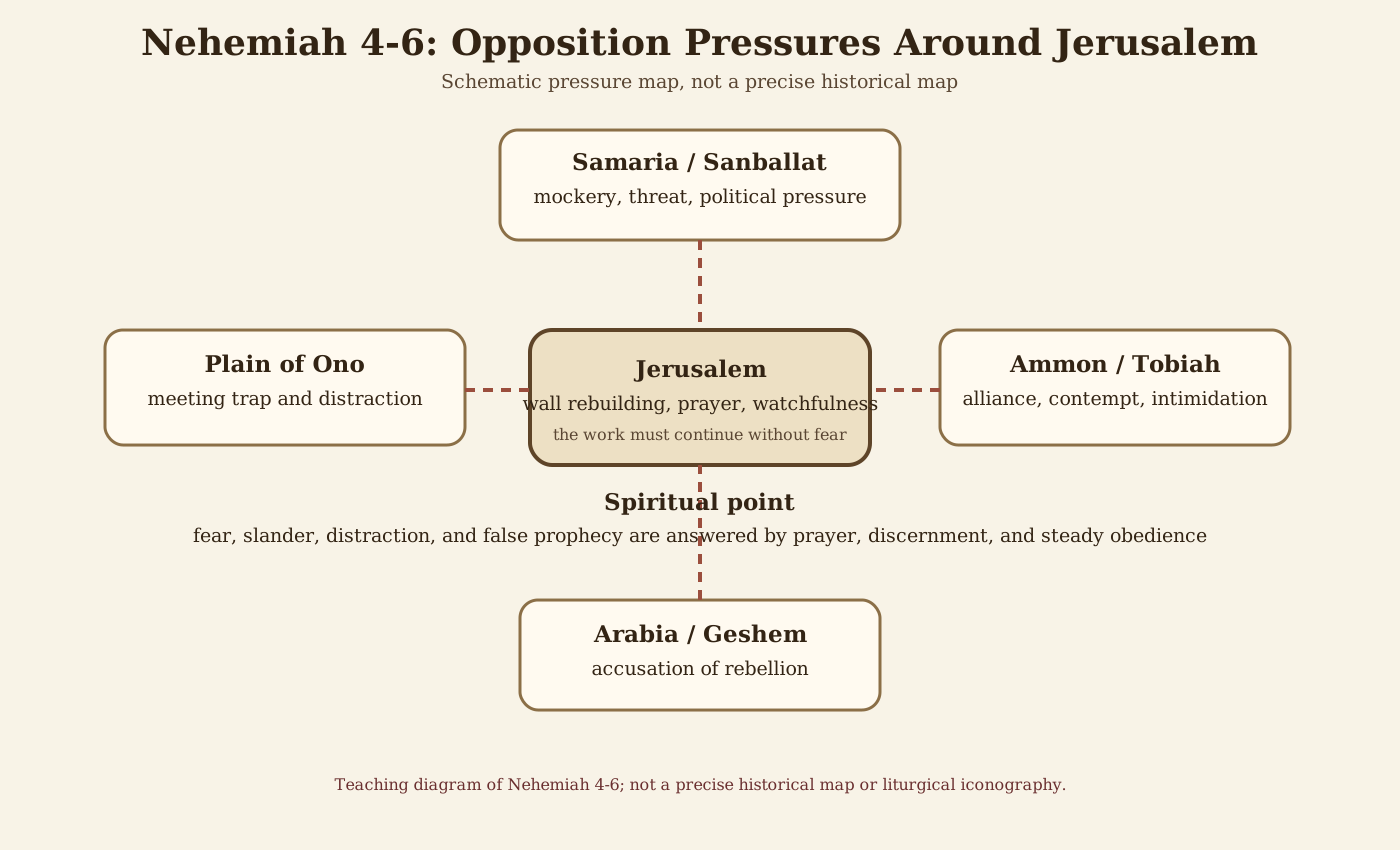 Teaching diagram of the pressures surrounding Jerusalem in Nehemiah 4-6; not a precise historical map.
Mockery answered by prayer (Nehemiah 4:1-5; Greek 3:33-37)
A note on numbering. In the Septuagint, Ezra and Nehemiah form one book, 2 Esdras. Nehemiah 4’s Greek chapter is 2 Esdras 14, but the opening verses, NKJV 4:1-5, belong to Hebrew and Greek 3:33-37, or 2 Esdras 13:33-37. NKJV 4:6 is Hebrew 3:38 and is absent from both Rahlfs’ Greek text and Brenton’s translation. It recounts the wall being joined to half its height because the people had a mind to work: the wall rose because their heart was in the work. NKJV 4:7-23 corresponds to Hebrew and Greek 4:1-17, or 2 Esdras 14:1-17. Brenton retains the familiar English verse labels and therefore jumps from verse 5 to verse 7 below. These differences concern both chapter divisions and a shorter Greek reading, not simply a missing English number.1
1 Now it came to pass, when Sanaballat heard that we were building the wall, that it was grievous to him, and he was very angry, and railed against the Jews. 2 And he said before his brethren (that is the army of the Samaritans) Is it true that these Jews are building their city? do they indeed offer sacrifices? will they prevail? and will they this day restore the stones, after they have been burnt and made a heap of rubbish? 3 And Tobias the Ammanite came near to him, and said to them, Do they sacrifice or eat in their place? shall not a fox go up and pull down their wall of stones? 4 Hear, O our God, for we have become a scorn; and return thou their reproach upon their head, and make them a scorn in a land of captivity, 5 and do not cover their iniquity.
The first attack is meant to make the builders ashamed. Sanballat turns the ruined stones into an argument against hope: can burnt rubble become a city again? Tobiah makes their labor sound so flimsy that a fox could undo it. Contempt works by making obedience seem foolish before it has time to bear fruit. A person who could endure hard labor may still be tempted to abandon it when others laugh.
Sanballat also mentions sacrifice. His mockery touches the people’s life before God as well as the strength of their masonry. Jerusalem’s recovery would mean that exile had not extinguished the covenant people. The builders are handling damaged stones, but the question beneath the ridicule is whether restoration is possible.
Nehemiah answers by bringing the insult before God: “Hear, O our God, for we have become a scorn.” The prayer is severe. He asks that the reproach return upon the opponents and that their iniquity remain uncovered. Its severity must be heard honestly, without making it a model for wishing personal enemies harm. Romans 12:19 places vengeance in God’s hands; Matthew 5:44 commands love for enemies and prayer for persecutors. The Christian can ask God to stop injustice, expose evil, and defend the vulnerable while also asking for the wrongdoer’s repentance.
An insult often tempts us to spend more strength defending our importance than fulfilling our duty. Nehemiah takes the wound into prayer. For us, that may mean refusing to repeat the contempt we have received, asking Christ to purify our anger, and returning to a good task that has become humiliating. Entrusting judgment to God frees the hands for service.
Gems from the Fathers 💎
Thematic witness. St Augustine considers how the prophets’ severe prayers can be read alongside Christ’s command to love enemies. In Our Lord’s Sermon on the Mount, he explains that prophetic imprecations, prayers expressed as curses or appeals for punishment, can announce coming judgment rather than express a malicious wish. The prophet speaks “in the spirit of one who saw it beforehand.”2 Augustine is discussing other biblical texts, not commenting directly on Nehemiah 4. His distinction helps us take divine judgment seriously without confusing it with our desire to retaliate. Before using a severe prayer against someone else, we must submit our own heart to the Lord who commands us to pray for that person.
Threat answered by prayer and watchfulness (Nehemiah 4:7-14; Greek 4:1-8)
7 But it came to pass, when Sanaballat and Tobia, and the Arabians, and the Ammanites, heard that the building of the walls of Jerusalem was advancing, and that the breaches began to be stopped, that it appeared very grievous to them. 8 And all of them assembled together, to come to fight against Jerusalem, and to destroy it utterly. 9 So we prayed to our God and set watchmen against them day and night, because of them. 10 And Juda said, The strength of the enemies is broken, yet there is much rubbish, and we shall not be able to build the wall. 11 And they that afflicted us said, They shall not know, and they shall not see, until we come into the midst of them, and slay them, and cause the work to cease. 12 And it came to pass, when the Jews who lived near them came, that they said to us, They are coming up against us from every quarter. 13 So I set men in the lowest part of the place behind the wall in the lurking-places, I even set the people according to their families, with their swords, their spears, and their bows. 14 And I looked, and arose, and said to the nobles, and to the captains, and to the rest of the people, Be not afraid of them: remember our great and terrible God, and fight for your brethren, your sons, your daughters, your wives, and your houses.
The closing breaches provoke a plan to attack. The opponents want to enter unexpectedly, kill the workers, and make the building cease. Nehemiah’s answer holds dependence and responsibility in a single sentence: “So we prayed to our God and set watchmen against them day and night.” Prayer gives the watch its true foundation; setting the watch gives their concern for others a practical form.
Psalm 127:1 (LXX Psalm 126) joins the same truths: a watchman keeps vigil in vain unless the Lord guards the city. The psalm exposes anxious self-reliance, not the watchman’s duty. A parent who prays for a child must still attend to the child’s dangers. A servant who entrusts a parish to God must still take a warning seriously. The confession that God guards us makes responsible attention possible without pretending that everything rests upon us.
Language insight: “The strength of the enemies is broken”
Judah’s words in verse 10 differ sharply between the two readings. The Greek, followed by Brenton, says that the enemies’ strength is broken, yet much rubbish remains and the people believe they cannot build. The NKJV, following the Hebrew, speaks instead of the laborers’ strength failing under the rubbish.3 In the Hebrew reading, weary workers confess that their strength is giving out. In the Greek reading displayed here, discouragement persists even when the enemy’s strength is broken. The rubble alone seems enough to defeat hope.
Both readings deserve to be heard, but they must not be made to say the same thing. Brenton directs our attention to the debris of an earlier ruin. Sometimes the heaviest obstacle is what remains after the blow: a damaged trust, an unpaid obligation, a neglected habit of prayer. Even when an immediate danger has weakened, the patient clearing of its consequences may feel impossible. The Greek reading does not promise that rubble will vanish when the enemy is checked. It prepares us to receive God’s help for the unfinished work still before us.
The Jews who live near the opponents warn that danger is coming from every quarter. Brenton does not say that they warned “ten times”; that detail belongs to the Hebrew and NKJV reading.3 Nehemiah responds to the warning by stationing people at the exposed places, arranged by families. He names the people whose lives are at stake: brothers, children, wives, and households. Courage here is the willingness to protect someone else while afraid.
His command to remember “our great and terrible God” brings the language of his private prayer in Nehemiah 1:5 into the hearing of the whole people. The God before whom he wept in secret is the God he now bids them remember. “Terrible” here names the Lord’s awe-inspiring greatness. The threatened families are not being told to regard Him as another terror closing in upon them. Remembering who He is loosens the grip of those who threaten them.
The weapons belong to the defense of Jerusalem in this historical account. They authorize no Christian hatred or aggression against people. Ephesians 6:12 locates the Church’s struggle against spiritual powers rather than flesh and blood. Our vigilance must therefore include a watch against the resentment that can grow while we are trying to defend something good. A guarded parish whose members learn to despise outsiders has allowed another breach to open within.
The hand that works and the hand that guards (Nehemiah 4:15-18; Greek 4:9-12)
15 And it came to pass, when our enemies heard that it was made known to us, and God had frustrated their counsel, that we all returned to the wall, every man to his work. 16 And it came to pass from that day that half of them that had been driven forth, wrought the work, and half of them kept guard; and there were spears, and shields, and bows, and breast-plates, and rulers behind the whole house of Juda, 17 even of them that were building the wall: and those who carried the burdens were under arms: each with one hand wrought his work, and with the other held his dart. 18 And the builders wrought each man having his sword girt upon his loins, and so they built: and the trumpeter with his trumpet next to him.
God frustrates the opponents’ counsel, and the people return to their own portions of the wall. They acknowledge deliverance while changing the way they work. Some build and some guard; burden-bearers are armed, and builders have swords at their sides. The discovery of danger has brought an ordered response rather than permanent paralysis.
The hand at work and the hand holding a weapon give a searching image of service. A visible task can absorb so much attention that the heart goes unguarded. A person may organize a lesson, care for a relative, or serve at church while feeding a private resentment that slowly poisons the gift. Watchfulness means noticing what is happening in the heart while continuing the duty love requires. It also means accepting the help of those assigned to guard, instead of believing that one person must carry every burden.
Ephesians 6:17 gives the Christian weapon its proper character: the sword of the Spirit is the word of God. This is a spiritual comparison, not a claim that Nehemiah’s builders carried symbolic swords. Scripture arms us by exposing falsehood and teaching obedience. A verse remembered in temptation can interrupt the thought that revenge is necessary or that a hidden sin does not matter. To wield the word faithfully is first to let it judge and heal us, rather than turn it against another person’s dignity.
The builders keep building. Vigilance serves their calling; it does not become their entire life. In a parish, endless scrutiny can consume the strength needed for mercy, teaching, and prayer. The chapter holds together the quiet examination of the heart and the outward work of love. Both belong to a life offered to God.
Gather at the trumpet and continue the work (Nehemiah 4:19-23; Greek 4:13-17)
19 And I said to the nobles, and to the rulers, and to the rest of the people, The work is great and abundant, and we are dispersed upon the wall, each at a great distance from his brother. 20 In whatsoever place ye shall hear the sound of the cornet, thither gather yourselves together to us; and our God shall fight for us. 21 So we continued labouring at the work: and half of them held the spears from the rising of the morning until the stars appeared. 22 And at that time I said to the people, Lodge ye every man with his servant in the midst of Jerusalem, and let the night be a watch-time to you, and the day a work-time. 23 And I was there, and the watchmen behind me, and there was not a man of us that put off his garments.
Nehemiah names the weakness created by distance: each person is far from his brother. The trumpet makes that distance answerable. Its sound tells the scattered workers where to gather, so that a threatened section will not be left alone. The trumpeter stationed nearby in verse 18 belongs to this shared defense. Readiness includes knowing how to call for help and how to answer when another person calls.
St Paul uses the military trumpet in 1 Corinthians 14:8 to explain why speech in the assembly must be intelligible. An uncertain sound leaves people unprepared. Nehemiah’s signal has a clear meaning and requires a common response. In our shared service, vague appeals and concealed needs can leave a struggling person alone. Truth spoken plainly, and heard with a willingness to act, helps turn many separate workers into a people who bear one another’s burdens.
“Our God shall fight for us” echoes Moses’ assurance at the sea in Exodus 14:14 and the promise of God’s presence with Israel in Deuteronomy 20:4. The people are to gather, but their gathering does not make them their own savior. They look to the God who delivered His people when they could not deliver themselves. For the Christian, confidence in God’s victory is received through Christ’s Cross and Resurrection, never as a guarantee that our own plans or quarrels have divine approval.
The account ends with long days, night watches, and garments kept on. Nehemiah shares the strain rather than simply commanding others to endure it. This is a season of exceptional readiness under threat, not a rule that holy people should always be exhausted. A parish that requires endless emergency from its servants has misunderstood the shared watch. Relief, help, and ordinary rest protect people entrusted to our care. The trust that God fights for us should make it possible to receive help without shame.
The Church’s Voice in Worship ⛪
Nehemiah is not among the Scripture readings in the Coptic lectionary this site follows (Coptic Reader).
On Pascha Wednesday, the Sixth Hour prophecy includes Exodus 14:13-15:1, the passage in which Moses assures Israel that the Lord will fight for them.4 Hearing this promise during Holy Pascha draws our attention to the Lord’s saving action when His people have no power to rescue themselves. Nehemiah’s assurance at the trumpet shares that trust: the people take their places in obedience while looking to God for deliverance. In the light of Christ’s willing suffering and victory, watchfulness becomes a response to His mercy rather than an attempt to secure ourselves apart from Him.
Spiritual Fruit 🍇
Carry the wound into prayer before carrying it to another person. The mockery of verses 1-5 can become a cycle of retelling an insult until resentment feels righteous. Bring the actual hurt to Christ, ask Him to defend what is good, and pray for the person who caused it. Forgiveness does not require hiding wrongdoing or abandoning those who need protection. It requires surrendering the desire to make another person suffer for our satisfaction.
Pair a prayer with a faithful action. Verse 9 joins prayer to the setting of watchmen. Where a danger is clear, name it honestly before God and take the next responsible step: seek counsel, address a harmful pattern, ask for help, or protect someone vulnerable. Where there is rubble rather than a fresh attack, choose one manageable piece of repair. A neglected relationship may need an apology; a disordered day may need a return to a small, steady rule of prayer.
Remember God before measuring the threat again. Nehemiah strengthens the people with the same confession that shaped his private prayer. Returning to the words of Scripture helps keep fear from becoming our only account of reality. The God who heard us in secret remains present when duty becomes public and costly. The sword of the Spirit is received through hearing and obeying His word, not through rehearsing our anxieties.
Answer the trumpet, and allow others to answer yours. Distance from a brother becomes dangerous when pride makes it permanent. Ask for help before exhaustion turns into bitterness. When someone else’s need becomes known, offer a concrete share of the burden. Shared vigilance should make room for faithful rest, not admiration for those who can conceal their weariness longest.
The builders are far apart, yet the trumpet can bring them together. The rubbish remains, yet their hands return to the wall. Before the work, within it, and when fear rises again, they turn to the God who guards them. In Christ, we learn to watch and pray with open eyes, a heart kept from hatred, and a place beside our brother.
Teaching Notes
Mockery answered by prayer (Nehemiah 4:1-5; Greek 3:33-37)
- Ask: What does contempt try to make the builders believe about their work and their future?
- Emphasize: Read the numbering note before the first block. NKJV 4:6 is absent from Rahlfs and Brenton; its account of wholehearted work must be identified as a Hebrew/NKJV comparison.
- Watch for: Augustine’s witness is thematic, not direct commentary on Nehemiah. His distinction between prophecy and malice does not authorize treating our anger as prophecy or wishing personal enemies harm.
- Connect: Set the severe prayer beside Romans 12:19 and Matthew 5:44. Entrusting judgment to God and praying for an enemy’s repentance belong together.
Threat answered by prayer and watchfulness (Nehemiah 4:7-14; Greek 4:1-8)
- Ask: How does the discouragement in Brenton’s verse 10 differ from the discouragement in the NKJV reading?
- Emphasize: Brenton says the enemies’ strength is broken, yet the rubbish remains overwhelming. The NKJV speaks of the laborers’ failing strength. Explain both without replacing the displayed reading.
- Watch for: Brenton’s verse 12 has no “ten times.” Do not describe repeated warnings without identifying the Hebrew/NKJV detail. Keep the historical weapons distinct from the Christian struggle against spiritual evil.
- Connect: Join verse 9 to Psalm 127:1 (LXX Psalm 126), and verse 14 to Nehemiah 1:5: the prayer of the first chapter becomes the people’s courage here.
- Show: Use the opposition pressure schematic to orient the threats surrounding Jerusalem. Explain that it covers chapters 4-6 and is a teaching diagram, not an archaeological reconstruction.
The hand that works and the hand that guards (Nehemiah 4:15-18; Greek 4:9-12)
- Ask: How can outward service continue while resentment or distraction is quietly gaining ground within?
- Emphasize: The people return to work after God frustrates the plot. Their changed arrangements keep vigilance in the service of building.
- Watch for: Neither careless activism nor suspicion of everyone fulfills this passage. Scripture must never become a weapon against another person’s dignity.
- Connect: Ephesians 6:17 identifies the Christian’s sword as the word of God. Ask for a concrete example of Scripture correcting a thought before it becomes an action.
Gather at the trumpet and continue the work (Nehemiah 4:19-23; Greek 4:13-17)
- Ask: What makes it difficult to ask for help, or to answer someone else’s clear need?
- Emphasize: The trumpet calls the scattered people together; their assurance is that God fights for them. Shared responsibility should relieve isolation.
- Watch for: Do not glorify burnout or turn emergency readiness into a permanent spiritual ideal. Do not cite the Gethsemane Gospel assignments as verified Holy Week placements.
- Connect: Read verse 20 beside Exodus 14:14 and Deuteronomy 20:4; use 1 Corinthians 14:8 to explain a clear signal and shared response. The Exodus reading is appointed at Pascha Wednesday’s Sixth Hour; that connection does not make Nehemiah itself an appointed reading.
Sources
Embedded Scripture is from Brenton’s English Septuagint (LXX).
Sir Lancelot C. L. Brenton, The Septuagint Version of the Old Testament, Nehemiah 4, within 2 Esdras; English Septuagint text.
Alfred Rahlfs, Septuaginta, 2 Esdras 13:33-37 and 14:1-17; CCAT Greek text, 19.2Esdras. The Greek numbering and shorter reading are distinguished from Brenton’s English verse labels.
The Holy Bible, New King James Version, Nehemiah 4:6, 4:10, and 4:12, for comparison with the Hebrew-based reading.
St Augustine, Our Lord’s Sermon on the Mount, Book 1, chapter 21, section 72, Nicene and Post-Nicene Fathers, First Series, volume 6; Book 1.
Coptic Reader, Holy Pascha, Wednesday, Sixth Hour prophecy: Exodus 14:13-15:1. Reading assignment preserved in Coptic Orthodox Lectionary Data, version 1.3.3.
Teaching diagram of the opposition pressures around Jerusalem in Nehemiah 4-6; schematic rather than a precise historical map.
Footnotes
-
The NKJV follows the Hebrew chapter division at Nehemiah 4:1; the Hebrew and Rahlfs’ Greek place this material at 3:33-37. Hebrew 3:38, NKJV 4:6, recounts the joined wall reaching half its height because of the people’s willingness to work. Rahlfs’ Greek and Brenton lack this sentence. Brenton follows Codex Vaticanus, but this omission is not unique to Brenton’s English edition. The compared texts establish the difference; they do not by themselves establish how it arose. ↩
-
St Augustine, Our Lord’s Sermon on the Mount, Book 1, chapter 21, section 72, translated by William Findlay, Nicene and Post-Nicene Fathers, First Series, volume 6, edited by Philip Schaff (1888), Book 1, chapter 21. This is a thematic witness on prophetic imprecations, not direct commentary on Nehemiah 4:4-5. ↩
-
Nehemiah 4:10: Brenton and Rahlfs’ Greek speak of the enemies’ broken strength, while the Hebrew and NKJV speak of the laborers’ failing strength. Nehemiah 4:12: the Hebrew and NKJV include the warning being given “ten times”; the Greek reading followed by Brenton has no such phrase. These are differences of reading, not interchangeable English descriptions of the same wording. ↩ ↩2
-
Coptic Reader, Holy Pascha Wednesday, Sixth Hour prophecy, Exodus 14:13-15:1. Coptic Orthodox Lectionary Data, version 1.3.3, preserves this assignment as confirmed against Coptic Reader. The reading is cited for its promise of God’s deliverance, not as a direct lectionary use of Nehemiah. ↩