


This narration is from a previous version of the study and may include a combined recording of multiple chapters.
Esther begins with a people preparing to die and ends with that people keeping a feast. Between the cry and the gladness stand a dream, a murderous decree, prayers offered in helplessness, and courage that enters the king’s presence trembling. The Greek book joins these scenes together so that deliverance can finally be named: “These things have been done of God.”
The story takes place far from Jerusalem, among Jews living under Persian rule. Its royal wealth is dazzling; its protection is uncertain. Esther’s crown cannot by itself save her people, and Mordecai’s watchfulness cannot master the future. Yet the God to whom they cry is already at work. Prayer does not remove their responsibility. It prepares them to bear it.
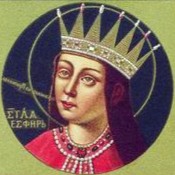 Source: Righteous Esther, public domain, Wikimedia Commons. This is Russian Orthodox visual tradition, not a Coptic-specific icon.
Historical and Scriptural Context
The narrative belongs to the world of the Jewish dispersion after the Babylonian captivity. Its setting is Susa, a Persian royal city, rather than the restored temple in Jerusalem. Beside the accounts of return and rebuilding in Ezra and Nehemiah, Esther attends to those who remain scattered. Covenant faithfulness has to be lived in a court whose commands can suddenly make an entire people unsafe.
Brenton calls the king Artaxerxes (Ahasuerus in the Hebrew text and NKJV). These are the names readers will meet in their Bibles; they should not be silently exchanged for a confidently reconstructed royal biography. The book’s pressure is plain without one: a king who can command a vast empire can still be governed by wounded pride, flattering counsel, and forgetfulness.
The Greek text and the history of its reception
The Hebrew form of Esther does not name God and does not contain the six large passages conventionally called Additions A to F. Greek Esther differs both through these passages and through shorter readings inside the shared narrative. Its theological voice therefore cannot be confined to six removable blocks. The dream and its interpretation frame a story in which Esther fears God, Mordecai urges prayer, and the Lord acts at the decisive sleepless night.
Ancient Christian reception also has a history. In his thirty-ninth Festal Letter, written in AD 367, Saint Athanasius, Pope of Alexandria, lists twenty-two Old Testament books in section 4. Esther appears instead in section 7 among books “not indeed included in the Canon, but appointed by the Fathers to be read by those who newly join us, and who wish for instruction in the word of godliness.”1 His distinction deserves to be reported in its own terms, alongside the ancient Christian use of Esther in teaching and prayer.
Jerome translated the Hebrew form and placed the Greek material after it in his Latin Esther. The later chapter numbering follows that separation, which is why readers of the KJV Apocrypha and Douay-Rheims find the material at Esther 10:4-16:24. Brenton instead prints it within the narrative. These are facts about textual arrangement and historical reception; an ancient list alone does not settle every later Church’s usage.2
The closing colophon, a brief notice about the text’s transmission, names Lysimachus son of Ptolemy in Jerusalem as its interpreter and Dositheus with his son Ptolemy as the bearers of the letter of Phrurae (Purim). Its reference to the reign of Ptolemy and Cleopatra places the notice in a Ptolemaic Egyptian setting. Several rulers bore those names, so the notice should not be turned into a precise date without further historical argument. It gives this Jewish Greek book a remembered connection between Jerusalem and Egypt; the final session returns to it.
Geographical Significance ⛰️
Susa, also called Shushan, concentrates the book’s public life in a few places: the gate, the women’s apartments, the inner court, the banquet, and the royal records. Decisions made there travel outward through provinces and languages. A private resentment can become an empire-wide sentence; a plea for one people can require a public answer on the same scale.
Jerusalem is absent from the action but present in the people’s memory. Mordecai’s ancestry reaches back to the captivity, and the prayers speak of God’s inheritance. Distance from the holy city has not erased belonging to God. That consoles the believer whose daily obedience takes place where no one notices it, while also challenging the temptation to let an alien court decide what is honorable.
 Source: Map of the Achaemenid Empire, public domain, Wikimedia Commons. Broad historical locator map, not a precise reconstruction of every Esther province boundary.
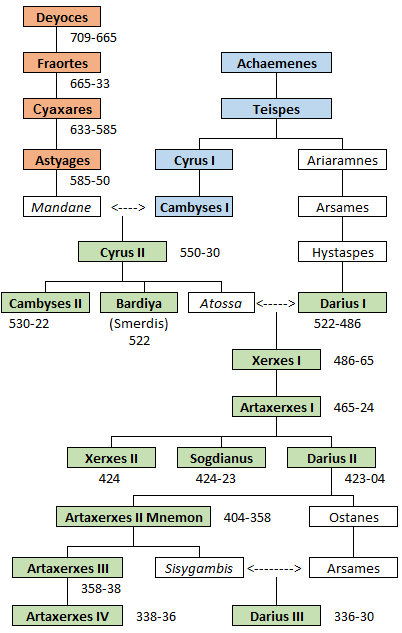 Source: ACHAEMENES TREE, CC BY-SA 4.0, Ekvcpa via Wikimedia Commons. Historical context only; Esther’s theological reading does not depend on a firm Xerxes identification.
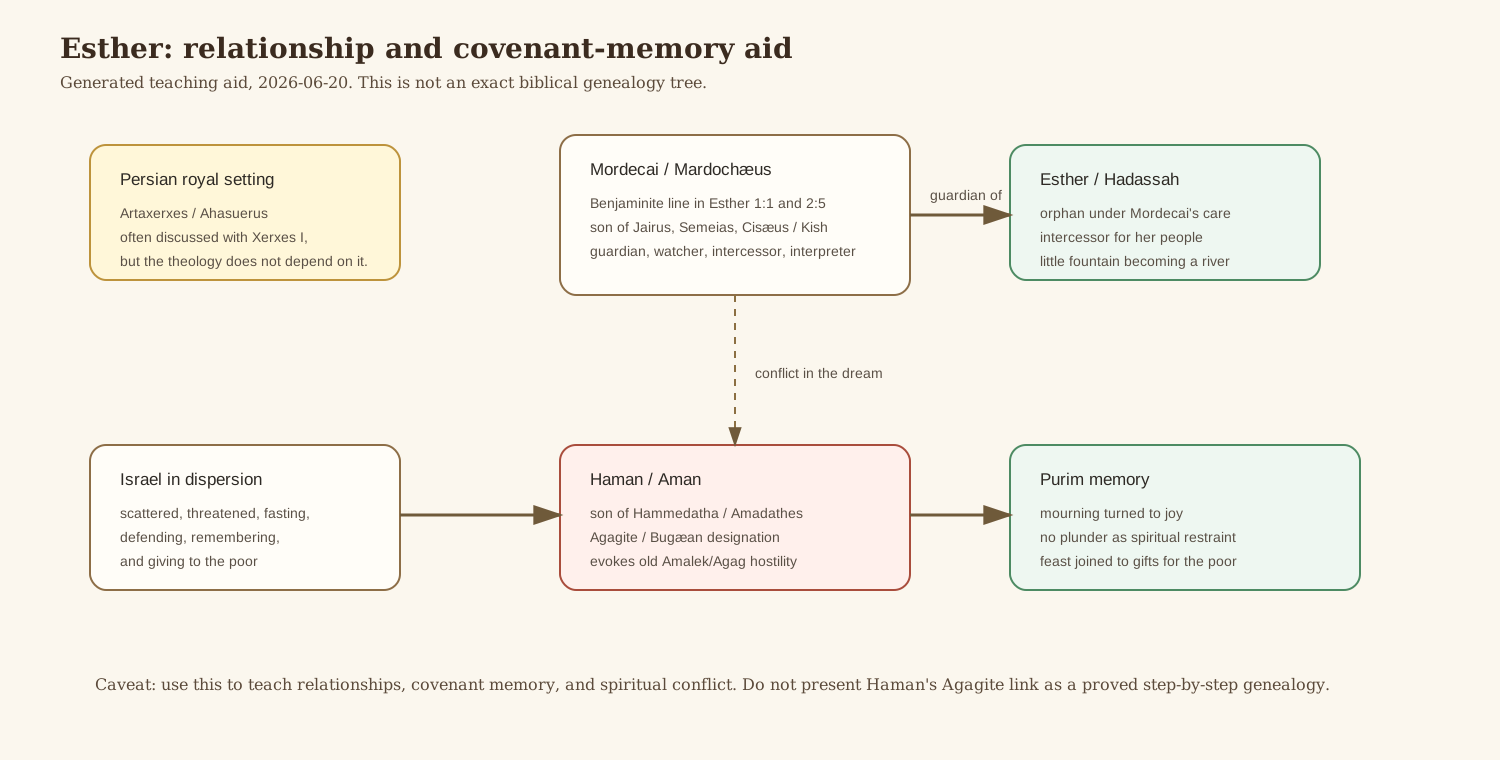 Source: Relationship schematic, 2026-06-20. This generated teaching diagram summarizes narrative relationships and covenant-memory links; it is not an exact biblical genealogy.
These images offer different kinds of context: a broad imperial map, a historical family tree, and a schematic of narrative relationships. The last is not an exact genealogy, and none supplies a missing identification or family link in Scripture.
The Characters 👥
Esther is an orphan brought into the royal household. The Hebrew text also calls her Hadassah; the Greek does not use that name. Her position becomes a responsibility toward the threatened people, and her prayer reveals how little safety a crown can give.
Mardochaeus (Mordecai) is Esther’s kinsman and guardian, a Jew of Benjamin whose family is connected with the captivity. He keeps the dream in his heart, watches over Esther, uncovers danger, mourns with his people, and finally interprets their rescue before God. Greek Esther 2:7 differs from the Hebrew about his relationship to Esther, as the first session explains.
Artaxerxes (Ahasuerus) holds imperial authority but lacks steady discernment. Astin (Vashti), the queen whose refusal opens the palace crisis, shows how quickly a person’s dignity can be made subject to public display. Gai (Hegai) is the chamberlain charged with the women’s care; Esther finds favor with him before she is brought to the king.
Aman (Haman) joins wounded pride to the power of accusation. Addition A already connects his hostility to the exposure of the chamberlains’ conspiracy; the refusal to bow will deepen the conflict. The scattered Jews share the danger, fast together, receive deliverance together, and keep its memory through feasting and care for the poor.
Name key for Brenton: Artaxerxes = Ahasuerus; Astin = Vashti; Aman = Haman; Mardochaeus, also printed Mardochæus = Mordecai; Gai = Hegai; Zosara = Zeresh; Achrathaeus = Hathach; Bugathan = Harbonah; Phrurae, also printed Phruræ = Purim. Some correspondences identify characters occupying the same narrative role, rather than translating the name itself.
Light from the Word 🕯️
God is named inside the narrative
The Greek text speaks of God between the large additions as well as within them. Four short readings shape the whole story:
- Esther 2:20: Mordecai commands Esther “to fear God, and perform his commandments”. The queen’s hidden identity is joined to an unchanged manner of life.
- Esther 4:8: “Do thou call upon the Lord” comes before the appeal to the king. Intercession before God precedes advocacy before earthly power.
- Esther 6:1: “the Lord removed sleep from the king” names the agent at the story’s hinge. The Hebrew says that the king could not sleep, without naming the Lord.
- Esther 6:13: “for the living God is with him” appears even in the warning given to Haman by his own household. That clause is absent from the Hebrew.
The shorter Hebrew account leaves readers to discern providence through events. Greek Esther also gives it a spoken confession. The additions and the shared narrative belong together because the prayer, the event, and the interpretation answer one another.
Following the additions across different Bibles
These studies use familiar NKJV chapter and verse references for the shared narrative, with Brenton’s English Septuagint as the embedded reading. NKJV does not contain Additions A to F. A reader using another edition may find the same material under quite different numbers.
| Addition | Brenton’s placement | KJV Apocrypha reference | Content and session |
|---|---|---|---|
| A | Within 1:1, before the familiar royal opening | 11:2-12:6 | Dream and chamberlains’ plot, session 1 |
| B | Within 3:13 | 13:1-7 | The extermination letter, session 2 |
| C | Within 4:17 | 13:8-14:19 | Mordecai’s and Esther’s prayers, session 2 |
| D | At 5:1-2 | 15:1-16 | Esther’s entrance before the king, session 3 |
| E | Within 8:12 | 16:1-24 | The answering royal letter, session 4 |
| F | Within 10:3, after Mordecai’s public honor | 10:4-11:1 | Interpretation and colophon, session 5 |
NABRE identifies the additions with letters A to F, beginning with A:1-17. NRSV-family editions can retain the older chapter numbers while restoring the material to the Greek narrative order; letters in their notes identify the same passages. Douay-Rheims follows the Vulgate arrangement, but its entrance scene is 15:4-19, not the KJV Apocrypha’s 15:1-16. Douay-Rheims 15:1-3 supplies the preceding appeal to Esther. The table is a crosswalk of locations, not a claim that these translations have identical wording.2
The prayers receive their answers
Greek Esther teaches remembrance by joining a petition to its answer. The end of the book is more than the reversal of bad circumstances: the people can recognize that God heard the words they prayed.
| The cry or threat | Its answer within the book |
|---|---|
| In Addition A, the righteous cry to God, and a little fountain becomes a great river. | In Addition F, Mordecai identifies the river as Esther and Israel as the people “that cried to God, and were delivered”. |
| In Addition C, Mordecai asks God to “turn our mourning into gladness, that we may live and sing praise to thy name”. | Esther 9:22 remembers the month in which their condition changed “from mourning to joy”. |
| In Addition C, Esther asks God to “turn their counsel against themselves”. | Esther 9:25 says that “all the calamities he tried to bring upon the Jews came upon himself”. |
| Haman casts lots to destroy the people in 3:7. | Addition F speaks of God’s two lots, brought to their appointed time “for a day of judgment, before God”. |
The dream begins in the first session, the prayers are heard in Esther 3-4, and their answers become explicit in Esther 9-10. The two lots carry the same correction into Purim’s name: the enemy cast a lot as if he could dispose of Israel’s future, but the ending places the outcome before God’s judgment. Chance does not have the last word.
Mordecai’s final confession, “These things have been done of God”, gathers those connections into thanksgiving. The people have received more than relief. They have received a memory of prayer answered. For the Christian, that is a discipline of attention: after danger passes, return to the prayer you made, recognize the mercy received, and let gratitude have a longer life than panic.
Courage learned in dependence
Esther’s most important preparation is shared prayer. The woman who must stand before the king first asks her people to fast with her. Her fear is brought into communion rather than carried as a private disgrace. Mordecai likewise prays as one member of the inheritance God redeemed from Egypt. Their intercession is personal without becoming solitary.
That order changes ordinary decisions. A servant carrying a difficult responsibility can ask others to pray before trying to appear untroubled. A household facing danger can bring its fear to God without pretending the outcome is already known. Esther’s courage has room for trembling because its strength is received, not performed.
Gems from the Fathers 💎
There are direct ancient Christian witnesses to Esther. Saint Clement of Alexandria, writing in Stromata IV.19, presents her faith and prayer as the means by which one woman opposed the decree against Israel. His Alexandrian witness places her spiritual courage, rather than her royal appearance, at the center. Origen likewise cites the prayers of Mordecai and Esther among scriptural examples of request in On Prayer. These are direct uses of Esther; they are distinct from the thematic witnesses that follow.3
Saint Basil the Great’s teaching on fasting addresses the heart that prays under pressure. Abstinence is meant to release the soul from evil, including the anger that can survive an empty stomach. In the excerpt from Homily 1 on Fasting, section 10, preserved in the NPNF Prolegomena, he says: “Beware of limiting the good of fasting to mere abstinence from meats. Real fasting is alienation from evil.”4 Read beside Esther, this is a thematic witness: fasting should purify the desire for deliverance, so that fear does not ripen into hatred.
Saint Athanasius supplies the larger Christian horizon, also thematically rather than as a commentary on Esther. In On the Incarnation, section 20.2, Christ offers His own body for all, to “show Himself more powerful even than death”.5 Esther’s rescue preserves a people threatened with death; Christ’s sovereign, willing Passion and Resurrection break death’s dominion itself. Esther is not the Gospel, and Haman’s gallows are not the Cross. The Christian reads the earlier deliverance in the light of that greater mercy, without making every court detail an allegory.
Deliverance that becomes restraint and mercy
The ending demands careful attention to both Greek and Hebrew witnesses. In the Hebrew form, Esther 8:11 permits plunder, but 9:10, 9:15, and 9:16 each report that the Jews did not take it. Brenton’s Greek has a different reading at 9:10, saying that they did plunder there; it retains refusals of property or spoil at 9:15-16. Those are differences between textual witnesses, not a contradiction to be explained away by inventing an inward change of heart.
Other differences also matter: the Greek has a narrower formulation of the defense in 8:11, omits the Hebrew summary of killing in 9:5, and gives fifteen thousand rather than seventy-five thousand killed in 9:16. The chapter 8 study and final session distinguish these readings where they occur. The violence remains severe. It is no pattern for Christian retaliation or hostility toward another people.
Purim’s feast is accompanied by portions for neighbors and gifts to the poor. Memory opens the hand. The person rescued from danger can still be tempted to make safety into a private possession, but Esther’s ending gives joy a communal form. Thanksgiving reaches its neighbor when the poor can share in it.
The Church’s Voice in Worship ⛪
This passage has no established place in the Coptic Orthodox lectionary.
The book nevertheless helps us understand how petition and thanksgiving belong together in the Church’s life. Its ending returns to the cry with which it began; the saved people gather in gladness before God. In our prayer, too, urgent requests should become remembered mercies rather than disappear as soon as life becomes easier. The connection here is thematic, not an appointment of Esther for a particular service or feast.
Fasting and generosity also belong together in this account. The body shares the cry in chapter 4, and the poor share the feast in chapter 9. A fast that leaves our resentment untouched, or a celebration that forgets the hungry, separates what the book holds together.
Spiritual Fruit 🍇
-
Give answered prayer a memory. Keep one concrete request before God, then return to it in thanksgiving when help comes. Record the mercy without claiming to know every hidden reason for the trial. Mordecai’s ending teaches recognition, not mastery of providence.
-
Let dependence prepare action. Esther asks for a shared fast before entering the court. Bring a frightening responsibility to prayer with a trusted person, then take the truthful step that is yours to take. Waiting for fear to vanish can become a way of postponing obedience.
-
Keep the commandment beneath the crown. Esther 2:20 locates her identity in the fear of God. When work, family, or public expectations press upon you, name the particular obedience that must remain unchanged: truthful speech, refusal of cruelty, purity, or faithful prayer.
-
Make relief generous. The end of danger can turn us inward, guarding what remains. Purim directs joy outward through shared portions and gifts to the poor. Let a received mercy become a definite act of help, offered without demanding recognition.
The little fountain is not impressive beside the palace. Yet the dream’s river begins where the threatened people cry to God. Bring Him what is small enough to be yours: the fear you cannot silence, the duty you can still fulfill, the neighbor you can still help. His mercy need not wait for you to become powerful.
Teaching Notes
Whole-book orientation
- Ask: What changes when God is named within the shared narrative as well as in the six additions?
- Emphasize: Trace 2:20, 4:8, 6:1, and 6:13 before using the crosswalk. Keep the five combined sessions intact.
- Watch for: Distinguish an account of Brenton’s arrangement, Athanasius’ ancient list, and any claim about present Coptic reception. The first two do not by themselves establish the third.
- Show: Use the map for Susa and the reach of the decrees. Treat the historical family tree and relationship schematic as limited aids, not additional biblical evidence.
Suggested five-session flow
- Esther 1-2: the dream, the palace’s use of persons, Esther’s fear of God, and the repeated conspiracy account.
- Esther 3-4: slander becomes a decree; fasting and Addition C turn the crisis into intercession.
- Esther 5-7: trembling entrance, the Lord’s removal of sleep, remembered service, and Haman’s fall.
- Esther 8: rescue must reach the whole people; distinguish the Greek and Hebrew defense decrees.
- Esther 9-10: read the hard ending in both witnesses, trace the prayers’ answers, and let Addition F interpret the dream and the lots.
Prayer and remembrance
- Ask: How do 9:22 and 9:25 answer the two prayers in Addition C?
- Connect: Return from those answers to the river in Addition F. Keep the greater deliverance in Christ clear without assigning a Christian counterpart to every detail.
- Watch for: A survivor of coercion must not hear the palace as God’s approval of abuse. Faithful endurance includes seeking protection and help; no one must remain unsafe to imitate Esther.
Restraint and shared joy
- Ask: What is lost when thanksgiving remains private?
- Emphasize: Read the plunder evidence in the Esther 8 study and Esther 9-10 study, rather than treating the witnesses as identical.
- Connect: End with a concrete act of generosity and a prayer of thanksgiving for a named mercy.
Sources
Embedded Scripture is from Brenton’s English Septuagint (LXX).
Brenton, complete Greek Esther, especially 2:20; 4:8 and Addition C; 6:1, 13; 8:11; 9:10, 15-16, 22, 25; and Addition F with its colophon. The Greek and Hebrew textual witnesses are distinguished in the relevant sessions.
NKJV, Esther 8-9, for the comparison of the defense decree and refusal of plunder.
Direct witnesses: Saint Athanasius’ Festal Letter 39 for canonical history; Saint Clement of Alexandria and Origen for ancient Christian use of Esther. Saint Basil on fasting and Saint Athanasius on Christ’s victory over death are thematic witnesses, not comments on these court scenes.
KJV Apocrypha, Additions to Esther 10, 11, and 15, for the crosswalk, especially the colophon and entrance scene.
NABRE introduction to Esther, for the lettered additions and Vulgate crosswalk; NRSVue introductory numbering note; and Douay-Rheims, Esther 15, for its distinct entrance-scene numbering.
The visual attributions identify an Orthodox image, historical context images, and a generated relationship schematic. They are not interchangeable forms of evidence.
Footnotes
-
Saint Athanasius, Festal Letter 39, sections 4 and 7, AD 367, NPNF2 4; section 7 in the complete letter. ↩
-
Jerome, notes before the Greek additions, translated by Kevin P. Edgecomb, in Notes on the Additions to Esther. Edgecomb’s introductory crosswalk distinguishes Vulgate 15:4-19 from the renumbered 15:1-16. See also the NABRE and NRSVue introductory notes listed above. ↩ ↩2
-
Saint Clement of Alexandria, Stromata, book IV, chapter 19, ANF 2, complete book with chapter headings; Origen, On Prayer, “The Content of Prayer: Its Four Moods,” chapter IX in W. Curtis’ arrangement, the discussion of Mordecai and Esther. ↩
-
Saint Basil the Great, Homily 1 on Fasting, section 10, quoted in the Prolegomena to NPNF2 8, part IV, “Homiletical,” p. lxi, paragraph beginning “The conclusion is a warning against mere carnal abstinence”. This link contains the editorial introduction and its quotation, not the full homily. ↩
-
Saint Athanasius, On the Incarnation of the Word, section 20.2, NPNF2 4, complete treatise with numbered sections. ↩