


This narration is from a previous version of the study and may include a combined recording of multiple chapters.
The day appointed for destruction still arrives. Aman (Haman) is dead, but the threatened Jews must pass through the consequences of his decree. Esther 9 records deaths, defense, and rest; then the book turns toward a question that reaches beyond the battlefield: what will the delivered people do with their memory?
They establish days of joy, send portions to one another, and give to the poor. The prayers spoken in their danger begin to reappear as answers: mourning becomes joy, and Haman’s counsel returns upon himself. At the end Mardochæus (Mordecai) interprets the opening dream and confesses that God has done these things. Deliverance becomes a remembered gift, offered back to God and shared with neighbors.
Historical and Scriptural Context
This session follows the counter-decree in Esther 8. The first accusation has been answered, the Jews have been authorized to assemble, and officials now fear Mordecai. In Brenton, the king is Artaxerxes (Ahasuerus). His orders change the public situation, while the appointed day remains part of the story.
The Greek and Hebrew witnesses differ at several points. Most importantly, the Hebrew account refuses plunder three times, while Brenton has plunder at 9:10 and refuses it at 9:15 and 9:16. The difference at 9:10 belongs to the comparison of texts; it is not an inward moral contradiction that a later refrain resolves. Reading each witness distinctly allows the actual evidence for restraint to be heard without obscuring the violence.
Chapter 10 records Mordecai’s honor, then Addition F supplies the theological close within 10:3. The dream that opened Greek Esther is interpreted at the end. The little fountain has become a river, Israel’s cry has been heard, and the lots stand before God. The book’s final confession answers its opening fear.
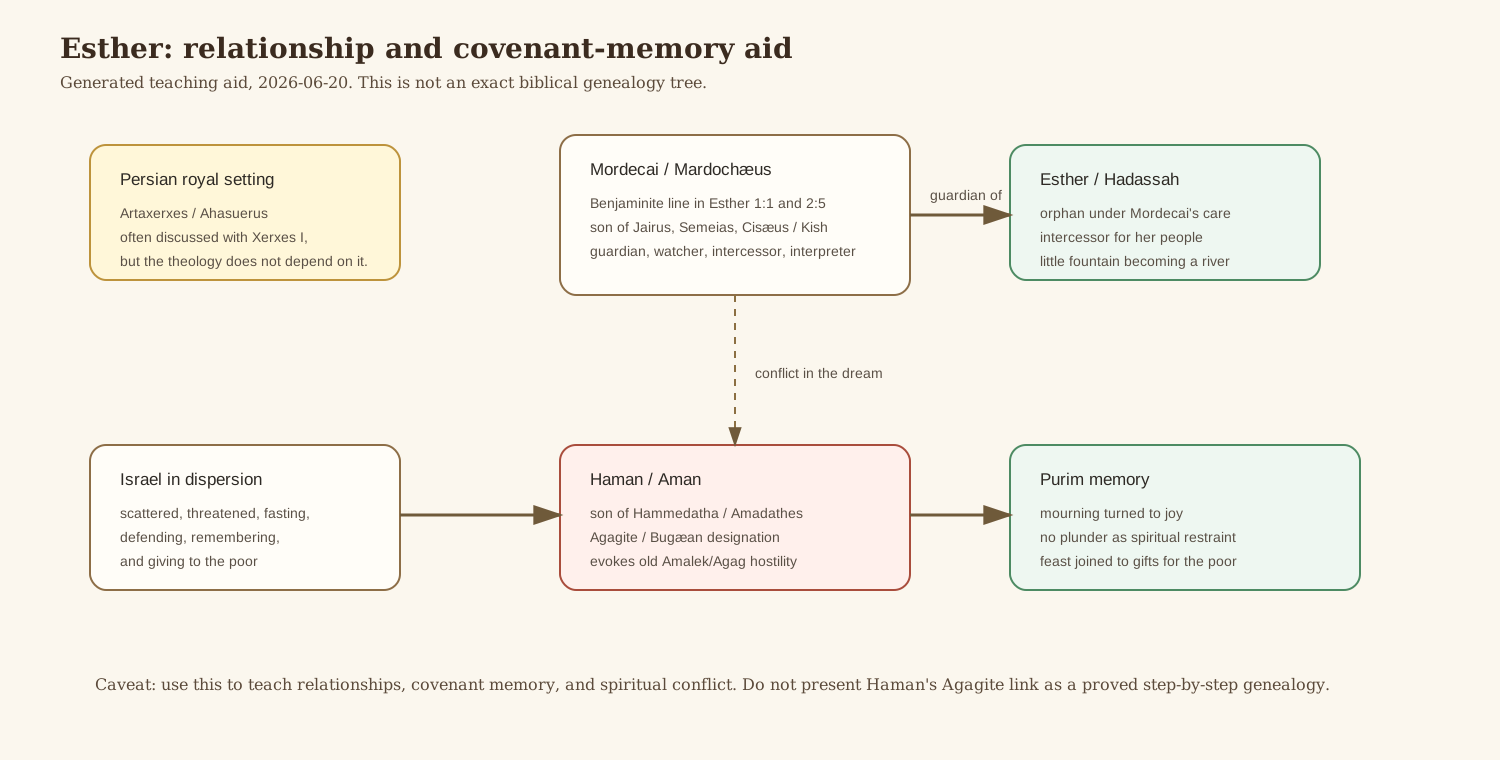 Source: Generated teaching aid for this project, 2026-06-20. It is not an exact biblical genealogy tree; it summarizes narrative relationships and covenant-memory links with caveats.
The Appointed Day and the Fear of Mordecai (Esther 9:1-4)
The date. The thirteenth of Adar here agrees with 8:12 and Addition E. Earlier dates in Brenton differ, as explained in Esther 3-4.1
1 For in the twelfth month, on the thirteenth day of the month which is Adar, the letters written by the king arrived. 2 In that day the adversaries of the Jews perished: for no one resisted, through fear of them. 3 For the chiefs of the satraps, and the princes and the royal scribes, honoured the Jews; for the fear of Mardochæus lay upon them. 4 For the order of the king was in force, that he should be celebrated in all the kingdom.
The day has lost the meaning Haman intended for it. He had planned that the Jews should be isolated and destroyed. They are now able to assemble, and the officials honor them because the fear of Mordecai has fallen upon the court’s representatives. The change is public and practical: a people once exposed to legalized violence has powerful protection.
Fear remains the stated reason for the officials’ conduct. Their cooperation is not described as repentance or affection. The ending will therefore take us beyond the fear of Mordecai to joy before God. Public support can secure a needed space for life, but gratitude reaches its proper object only when the people acknowledge the Lord who heard them.
For a person emerging from danger, the first relief may be the discovery that help has arrived and isolation has ended. That relief is real even before the whole story can be understood. Prayer can hold both facts together: thanksgiving for the help already given, and dependence on God for the day still to be faced.
The Deaths in Susa and the Difference About Plunder (Esther 9:6-11)
Greek and Hebrew readings. Brenton passes from 9:4 to 9:6 because the Greek text represented here lacks Hebrew 9:5, which summarizes the Jews’ striking their enemies with the sword and doing as they pleased to those who hated them. The absent verse number reflects that textual difference. At 9:10 Brenton says that the property of Haman’s sons was plundered. The Hebrew-based NKJV says that the Jews did not lay a hand on the plunder. The Hebrew repeats that refusal at 9:15 and 9:16; Brenton repeats it at those latter two places but reports plunder here. These distinct readings must remain distinct, rather than being made into a single account of an action later morally corrected. The forms of the sons’ names also differ: Brenton’s Pharsannes, for example, is Parshandatha in the NKJV.1
6 And in the city Susa the Jews slew five hundred men: 7 both Pharsannes, and Delphon and Phasga, 8 and Pharadatha, and Barea, and Sarbaca, 9 and Marmasima, and Ruphæus, and Arsæus, and Zabuthæus, 10 the ten sons of Aman the son of Amadathes the Bugæan, the enemy of the Jews, and they plundered their property on the same day: 11 and the number of them that perished in Susa was rendered to the king.
Five hundred men die in Susa, and the ten sons of Haman are named. A death-decree aimed at a whole people has brought calamity back upon the accuser’s own household. The list makes the cost particular. These are deaths in a city and in a family, not simply a number marking success.
Brenton reports the seizure of property in this scene. The Hebrew account makes a different claim: even here the Jews leave the plunder untouched. Each reading must be explained on its own terms. The Greek refusals later in the chapter remain evidence for restraint in those subsequent actions; the Hebrew’s threefold refusal gives that restraint a more sustained emphasis.
The violence gives Christians no pattern for retaliation; love of enemies remains joined to the duty to protect vulnerable people. The threatened Jews’ survival and the severity of the deaths can both be faced truthfully. A Christian reading should lead toward mercy and sober judgment rather than pleasure in another household’s ruin.
Esther’s Severe Request and the Refusal of Spoil (Esther 9:12-16)
Greek and Hebrew readings. Brenton’s 9:16 gives fifteen thousand deaths in the provinces; the NKJV gives seventy-five thousand. Both witnesses state that spoil was not taken there. Together with the omission of the Hebrew slaughter summary at 9:5 and the less explicit authorization at Greek 8:11, the smaller number makes the Greek account less extensive in several descriptions of violence. The differences are observable; they do not by themselves establish why an ancient writer or translator produced them.1
12 And the king said to Esther, The Jews have slain five hundred men in the city Susa; and how, thinkest thou, have they used them in the rest of the country? What then dost thou yet ask, that it may be done for thee?
13 And Esther said to the king, Let it be granted to the Jews so to treat them to-morrow as to hang the ten sons of Aman. 14 And he permitted it to be so done; and he gave up to the Jews of the city the bodies of the sons of Aman to hang. 15 And the Jews assembled in Susa on the fourteenth day of Adar, and slew three hundred men, but plundered no property.
16 And the rest of the Jews who were in the kingdom assembled, and helped one another, and obtained rest from their enemies: for they destroyed fifteen thousand of them on the thirteenth day of Adar, but took no spoil.
Esther asks for another day in Susa, and the king gives the bodies of Haman’s sons to be hung. Verse 14 identifies them as bodies: the public hanging follows the deaths already reported. The request is severe. The text does not tell us enough to reconstruct every continuing threat in the city or to settle Esther’s unspoken motives.
The narrative then specifies what was not taken. On the second day in Susa, three hundred are killed, but no property is plundered. In the provinces the Jews help one another and obtain rest, but take no spoil. The Hebrew witness makes this refusal threefold, including the first Susa action. Its significance is sharpened by Hebrew 8:11: they had permission to plunder and declined it. Restraint is a limit placed on a permitted advantage.
The refusal can be heard without making the deaths easy. It distinguishes survival from enrichment, and rest from an appetite that cannot stop acquiring. That distinction reaches into conflicts far from a battlefield. A person vindicated after slander can still crave another’s humiliation. A family that has secured necessary safety can still be tempted to make someone pay indefinitely. The refusal of spoil tests what the heart seeks after the immediate danger has passed.
Rest, Joy, Portions, and the Poor (Esther 9:17-22)
17 And they rested on the fourteenth of the same month, and kept it as a day of rest with joy and gladness. 18 And the Jews in the city Susa assembled also on the fourteenth day and rested; and they kept also the fifteenth with joy and gladness. 19 On this account then it is that the Jews dispersed in every foreign land keep the fourteenth of Adar as a holy day with joy, sending portions each to his neighbour.
20 And Mardochæus wrote these things in a book, and sent them to the Jews, as many as were in the kingdom of Artaxerxes, both them that were near and them that were afar off, 21 to establish these as joyful days, and to keep the fourteenth and fifteenth of Adar; 22 for on these days the Jews obtained rest from their enemies: and as to the month, which was Adar, in which a change was made for them, from mourning to joy, and from sorrow to a good day, to spend the whole of it in good days of feasting and gladness, sending portions to their friends, and to the poor.
The appointed days become days of rest. The dispersed communities keep them together, and Mordecai writes to those near and far. The letter gives their scattered joy a common memory. Distance does not have to turn deliverance into separate stories belonging only to separate households.
Verse 22 answers Mordecai’s prayer in Addition C. In the danger he asked God to “turn our mourning into gladness, that we may live and sing praise to thy name”.2 Now the month is remembered for the change “from mourning to joy”. The verbal echo makes the feast an answer to prayer, not merely an outcome of effective court politics. The people had cried to God while death was before their eyes; their rest is received in the light of that cry.
The answer also changes the use of their possessions. Portions are sent to friends and to the poor. A person without a plentiful table is included in the community’s gladness. The memory of being endangered can open the hand toward another’s need. A feast that shuts out the poor would keep the date while losing something essential in its gratitude.
Gems from the Fathers 💎: A gift that becomes the giver’s own
Saint Basil the Great provides a thematic witness, not commentary on Esther. In Homily VI, on the rich man who would enlarge his barns, section 3, he urges the hearer to imitate fruitful earth by feeding others. The NPNF Prolegomena quotes his words: “Thou hast given to the poor, and the gift becomes thine own, and comes back with increase.”3 His argument reverses the miser’s calculation. What is withheld may be lost; what is given bears fruit before God. Purim’s portions to the poor give remembered joy this generous shape.
Purim Established as Memorial (Esther 9:23-32)
Greek and Hebrew readings. Brenton calls Haman the Macedonian in 9:24, as Addition E does; the NKJV calls him the Agagite. The Hebrew designation and its echo of Saul and Agag are discussed in Esther 3-4. Phruræ is Brenton’s Greek form for the feast familiar as Purim, named from the lots. The Greek text here lacks Hebrew 9:30, which describes Mordecai’s letters of peace and truth to the 127 provinces, so Brenton moves from 9:29 to 9:31. At 9:31 the NKJV refers to fasting and lamenting, while Brenton’s statement about a private fast and a plan against their own health is obscure. Its last clause cannot safely bear a precise explanation of their purpose or bodily practice.1
23 And the Jews consented to this accordingly as Mardochæus wrote to them, 24 shewing how Aman the son of Amadathes the Macedonian fought against them, how he made a decree and cast lots to destroy them utterly; 25 also how he went in to the king, telling him to hang Mardochæus: but all the calamities he tried to bring upon the Jews came upon himself, and he was hanged, and his children. 26 Therefore these days were called Phruræ, because of the lots; (for in their language they are called Phruræ;) because of the words of this letter, and because of all they suffered on this account, and all that happened to them. 27 And Mardochæus established it, and the Jews took upon themselves, and upon their seed, and upon those that were joined to them to observe it, neither would they on any account behave differently: but these days were to be a memorial kept in every generation, and city, and family, and province. 28 And these days of the Phruræ, said they, shall be kept for ever, and their memorial shall not fail in any generation.
29 And queen Esther, the daughter of Aminadab, and Mardochæus the Jew, wrote all that they had done, and the confirmation of the letter of Phruræ.
31 And Mardochæus and Esther the queen appointed a fast for themselves privately, even at that time also having formed their plan against their own health. 32 And Esther established it by a command for ever, and it was written for a memorial.
The feast is established through writing, consent, and repetition in every generation, family, city, and province. These words give memory a household as well as a public life. Children must learn why the day is kept. People far from Susa receive a share in an event that preserved them too.
Verse 25 answers Esther’s prayer in Addition C. She had asked the Lord to “turn their counsel against themselves, and make an example of him who has begun to injure us.”2 The memorial now recalls that the calamities Haman tried to bring upon the Jews came upon himself. His scheme was truly dangerous, yet it failed to secure the future he imagined. The feast remembers God’s answer to the prayer before the throne-room appeal, rather than giving human ingenuity the final credit.
The name itself changes the memory of the lot. Haman’s casting of lots had appointed destruction; Phruræ now names a shared deliverance. In 2 Maccabees 15:36, Nicanor’s defeat is commemorated on the thirteenth of Adar, the day before “Mardocheus’ day.”4 This is a separate commemoration, but its dating assumes that Mordecai’s day is already a recognizable point in the people’s calendar.
Verse 31 also remembers fasting beside the feast. The Greek’s obscure final clause limits how much can be inferred from it, while the reference to fasting itself is plain. Gladness can remain near the memory of supplication. We need not make past affliction disappear before giving thanks; prayer can carry it into a mercy that is remembered without being endlessly relived.
Gems from the Fathers 💎: The festival born of heard prayer
Origen speaks directly of Esther and Mordecai in On Prayer 13.2. Their fasting and prayer are examples of prayer heard by God: “When the people were already on the point of perishing under a single decree as the result of Haman’s conspiracy, it was the heard prayer with fasting of Mordecai and Esther that added to the Mosaic festivals and gave rise to the Mordecaic day of rejoicing for the people.”5 Origen locates the source of the feast in God’s answer. The annual joy remembers a relationship with the Lord, not simply an escape. Thanksgiving is the prayer that follows supplication when mercy has been received.
Mordecai’s Greatness as Service (Esther 10:1-3)
1 And the king levied a tax upon his kingdom both by land and sea. 2 And as for his strength and valour, and the wealth and glory of his kingdom, behold, they are written in the book of the Persians and Medes, for a memorial. 3 And Mardochæus was viceroy to king Artaxerxes, and was a great man in the kingdom, and honoured by the Jews, and passed his life beloved of all his nation.
The empire remembers taxation, strength, wealth, and glory. Mordecai is remembered as honored and beloved by his people. Brenton’s verse 3 describes their regard for him; the Hebrew-based NKJV explicitly adds his seeking their good and speaking peace to his countrymen.6 The two accounts help us distinguish office from the good an office can serve, without attributing the Hebrew’s exact wording to the Greek verse.
His authority follows the prayers, the shared defense, and the establishment of a feast that includes the poor. Those narrated acts give substance to the people’s love. A title by itself would tell us little about the lives made safer through its use. The ring received in chapter 8 has reached beyond its bearer.
Every responsibility in the Church comes under the lordship of Christ. A servant’s honor is rightly received when it enables others to live, pray, and give thanks more freely. The temptation to turn a needed task into a search for recognition is exposed by the simple difference between being important and doing good. Mordecai’s place among his people directs attention toward the latter.
Mordecai Interprets the Dream Before God (Esther 10:3, Addition F)
The Greek conclusion. Addition F and the closing notice of transmission are absent from the Hebrew text underlying the NKJV. Brenton places them within 10:3. The dream’s interpretation therefore follows immediately upon Mordecai’s public honor and supplies Greek Esther’s final explanation of the deliverance.
[And Mardochæus said, These things have been done of God. For I remember the dream which I had concerning these matters: for not one particular of them has failed. There was the little fountain, which became a river, and there was light, and the sun, and much water. The river is Esther, whom the king married, and made queen. And the two serpents are I and Aman. And the nations are those nations that combined to destroy the name of the Jews. But as for my nation, this is Israel, even they that cried to God, and were delivered: for the Lord delivered his people, and the Lord rescued us out of all these calamities; and God wrought such signs and great wonders as have not been done among the nations. Therefore did he ordain two lots, one for the people of God, and one for all the other nations. And these two lots came for an appointed season, and for a day of judgment, before God, and for all the nations. And God remembered his people, and vindicated his inheritance. And they shall observe these days, in the month Adar, on the fourteenth and on the fifteenth day of the month, with an assembly, and joy and gladness before God, throughout the generations for ever among his people Israel. In the fourth year of the reign of Ptolemy and Cleopatra, Dositheus, who said that he was a priest and a Levite, and Ptolemy his son, brought in the published letter of Phruræ, which they said existed, and which Lysimachus the son of Ptolemy, who was in Jerusalem, had interpreted.]
Mordecai’s confession gathers the answers already heard: these things have been done of God. In Addition A the nation’s cry was followed by a great river from a little fountain. Here the river is identified as Esther, and Israel as the nation that cried to God and was delivered. The dream and its explanation enclose the story in a divine promise fulfilled through human prayer and action. The little fountain becomes a fitting image of help whose reach far exceeds the apparent resources of the one through whom it comes.
Esther’s royal position now belongs within that larger account. She truly fasted, spoke, and interceded, yet Mordecai gives God the final credit for the life preserved through her. Prayer did not make Esther passive. It placed her costly action within dependence on the Lord. The river flowed to people she could not personally visit, just as the answering letter reached places beyond the palace.
The two lots deserve particular attention. In chapter 3 Haman cast a lot to fix the time of destruction. Addition F now says that God ordained two lots, one for His people and one for the other nations, and that both came before Him for an appointed season and a day of judgment. The explanation does not simply substitute a more fortunate throw. It changes who governs the outcome: the lots stand before the Lord, who remembers His people and vindicates His inheritance. The feast’s name confesses God’s judgment and remembrance rather than the mastery of chance. Providence includes real choices and real suffering; its confession here names the deliverance God gave, not a claim that every human act in the story was righteous.
The closing notice, or colophon, identifies Lysimachus son of Ptolemy in Jerusalem as the interpreter of the letter of Phruræ. It says that Dositheus and his son brought the letter under Ptolemy and Cleopatra. This joins a Jerusalem translation to transmission in a Ptolemaic setting, meaningful for readers in Egypt, while leaving the identification of the rulers and the precise date unsettled here.
For Christians, remembrance reaches its greatest object in the death and Resurrection of Christ. John 16:20-22 promises the disciples that their sorrow will become joy when they see Him again. Their gladness arises from the Lord Himself, whose sovereign, willing Passion opens into victory over death. Purim and Pascha are distinct; the echo of sorrow becoming joy directs us toward a greater salvation rather than equating the two feasts.
Gems from the Fathers 💎: The greater victory over death
Saint Athanasius supplies a thematic witness in On the Incarnation, not direct Esther commentary. In section 20.5 he describes the union of the Word with His mortal body and the victory accomplished through it: “death and corruption were wholly done away by reason of the Word that was united with it.”7 Israel’s rescue in Esther preserves lives from one threatened destruction. Christ gives incorruption, life beyond the dominion of death, through the body He willingly offers for all. That greater gift allows Christian thanksgiving to remain hopeful even where an earthly danger is not removed.
The Church’s Voice in Worship ⛪
This passage has no established place in the Coptic Orthodox lectionary.
The connection with the Church’s worship is thematic. Esther’s memorial joins answered prayer to an assembly before God and gifts to the poor. Christian thanksgiving likewise receives God’s mercy as a shared gift, with an obligation to the neighbor who would otherwise remain outside our gladness. The particular point here is the open table and the open hand: remembrance has become mature when another person can taste its fruit.
The Paschal connection rests on Christ’s promise in John 16:20-22 and His Resurrection, not on an assignment of Esther to Pascha or an identification of Purim with the Eucharist. The Church’s joy has the risen Lord as its source. In Him, thanksgiving can reach even the person whose suffering continues, without requiring that person to pretend the wound has already healed.
Spiritual Fruit 🍇
Learn to notice an answer. Mordecai prayed for mourning to become gladness; the feast remembers that change. Return to a particular petition you have made. Give thanks for the mercy actually received, including help that arrived through another person, without inventing an explanation for everything that remains unresolved.
Leave the spoil of a conflict untouched. The refusals in 9:15 and 9:16, and the Hebrew’s threefold refrain, distinguish relief from acquisition. Once necessary safety or truth has been secured, examine the desire for added control, attention, or another’s humiliation. The heart can plunder without touching gold. Ask Christ to heal that appetite rather than feeding it with the language of justice.
Give your thanksgiving a recipient. Purim sends portions to friends and the poor. Set aside part of your next celebration for someone who cannot repay you. A meal, a needed payment, or time freely given can make another household a participant in your gratitude.
Remember in God’s presence. Addition F gives the story back to the Lord. Bring a painful memory into prayer with its particular losses and the particular mercies that sustained you. Honest thanksgiving can loosen the wish to keep the injury alive as the center of your identity.
The little fountain has become a river, and Mordecai names the mercy that carried his people. Bring your small resources before Christ without despising them. Ask that the help He gives through you may reach farther than you can see. Rest in the risen Lord, whose gift is greater than an escape and whose joy can be shared without being diminished.
Teaching Notes
The Appointed Day and the Fear of Mordecai (Esther 9:1-4)
- Ask: What changes about the appointed day, and what still has to be faced?
- Emphasize: Explain the absence of Hebrew 9:5 before moving to the next reading.
- Watch for: Fear of an official describes a public situation, not inward conversion.
The Deaths in Susa and the Difference About Plunder (Esther 9:6-11)
- Ask: What does each witness actually say at 9:10?
- Emphasize: Read the text slowly enough to hear the named deaths and the textual divergence.
- Watch for: The later Greek refusals do not turn the Hebrew-Greek difference into an interior moral contradiction.
Esther’s Severe Request and the Refusal of Spoil (Esther 9:12-16)
- Ask: What is the significance of declining gain that has been permitted?
- Emphasize: Keep the fifteen-thousand/seventy-five-thousand comparison precise, and distinguish the deaths from the later display of bodies.
- Watch for: The continuing danger and Esther’s motives should not be reconstructed beyond what the text states.
Rest, Joy, Portions, and the Poor (Esther 9:17-22)
- Ask: Where can the answer to Mordecai’s prayer be heard in verse 22?
- Connect: Put Addition C’s petition beside this verse and let the shared words carry the connection.
- Emphasize: Basil is quoted through the NPNF Prolegomena, not a complete English translation of his homily.
Purim Established as Memorial (Esther 9:23-32)
- Ask: How does verse 25 answer Esther’s prayer?
- Emphasize: Keep Origen’s direct reading of Purim as heard prayer distinct from the thematic witnesses.
- Watch for: The obscure final clause of 9:31 cannot establish a particular practice of bodily harm.
- Connect: Distinguish Nicanor’s day from the following Mordecai day in 2 Maccabees 15:36.
Mordecai’s Greatness as Service (Esther 10:1-3)
- Ask: What distinguishes the empire’s record of greatness from the people’s regard for Mordecai?
- Watch for: Identify the Hebrew wording about seeking good and speaking peace rather than attributing it to Brenton.
Mordecai Interprets the Dream Before God (Esther 10:3, Addition F)
- Ask: How do the river, the nation’s cry, and the two lots interpret the whole story?
- Emphasize: Let Addition F supply the theological close; explain the colophon after distinguishing it from Mordecai’s speech.
- Watch for: Providence is not fatalism, and the closing notice does not by itself establish a modern calendar date.
- Show: Use the retained relationship aid as a narrative schematic, not a proved genealogy. Its Agagite connection belongs to the Hebrew witness, not to Brenton’s Macedonian designation.
- Connect: Keep the Paschal resonance grounded in John 16:20-22 and Christ’s willing sacrifice, with Purim and Pascha distinct.
Sources
Embedded Scripture is from Brenton’s English Septuagint (LXX). Hebrew-text comparisons use the NKJV. References follow the usual chapter and verse sequence; Addition F remains within Brenton’s 10:3.
Origen speaks directly of Esther, Mordecai, and the festival as the fruit of heard prayer. Basil on giving and Athanasius on victory over death are thematic witnesses.
Brenton, Esther 9 and Esther 10; the prayers in Esther 4 and dream in Esther 1.
NKJV, Esther 8-10, for the stated comparisons.
Origen, On Prayer 13.2, William A. Curtis translation. This edition groups the passage under chapter VIII; the standard 13.2 locator is preserved in Paul Koetschau’s translation, BKV 48, 1926, section XIII.2.
Saint Basil the Great, Homily VI, section 3, quoted in the Prolegomena, “IV. Homiletical”, NPNF2 8, pp. lvi-lvii.
Saint Athanasius, On the Incarnation 20-27, Archibald Robertson translation, NPNF2 4.
Brenton, 2 Maccabees 15:36; John 16:20-22.
Coptic Orthodox lectionary and Synaxarium: current reading and commemoration records.
Generated relationship and covenant-memory schematic, 2026-06-20.
Footnotes
-
Brenton, Esther 9 and Esther 8; NKJV, Esther 8-9. ↩ ↩2 ↩3 ↩4
-
Brenton, Esther 4, Addition C within 4:17. ↩ ↩2
-
Saint Basil the Great, Homily VI, section 3, on the rich man’s barns, quoted in the NPNF2 8 Prolegomena, “IV. Homiletical”, pp. lvi-lvii. ↩
-
Brenton, 2 Maccabees 15:36. ↩
-
Origen, On Prayer 13.2, William A. Curtis translation, the passage on heard prayer. The standard section is also identifiable in Koetschau, BKV 48, XIII.2. ↩
-
Brenton, Esther 10; NKJV, Esther 10. ↩
-
Saint Athanasius, On the Incarnation 20.5, Archibald Robertson translation, NPNF2 4; primary text. ↩