


This narration is from a previous version of the study and may include a combined recording of multiple chapters.
Esther 5-7 is the turning point where fasting becomes trembling intercession. Addition D does not show Esther as fearless. It shows her body bearing the cost of her vocation: she passes through the doors, sees the terrifying throne, faints, and is strengthened by God’s hidden action before she can speak.
Between Esther’s two banquets, the Lord takes sleep from the king. The Greek names Him at the very hinge of the story. Aman (Haman) comes to seek the death of Mardochaeus (Mordecai) and finds himself ordered to proclaim his honor. Before Esther names the slanderer, providence has already interrupted his plan.
Haman prepares wood for Mordecai’s humiliation, but the trap returns upon him. His fall exposes the judgment to which vainglory and vengeance lead. Prayer, hidden faithfulness, and the plea for another’s life stand against the hunger to make another person small.
Historical and Scriptural Context
The preceding session ended with fasting and prayer. The people in Susa fasted for Esther, Esther and her maidens fasted, Mordecai prayed, and Esther confessed her fear before God. The third day now brings her before Artaxerxes (Ahasuerus). The prayer for words before the lion meets the ruler whose anger can cost her life.
Brenton’s Greek Esther places Addition D at Esther 5:1-2. These verses expand Esther’s entrance before the king, showing her fear, fainting, and God’s action in changing the king’s spirit to gentleness. Chapters 5-7 then move through two banquets, Haman’s rage against Mordecai, the sleepless night and remembered record, Mordecai’s public honor, Esther’s accusation, and Haman’s death on the gallows he prepared.
The earthly spaces matter because each exposes a different kind of power: the inner court where uncalled approach means death, the banquet hall where truth waits for its hour, the night records where hidden faithfulness is remembered, the public street where Haman must honor Mordecai, and the second banquet where the slanderer is named.
Esther Enters Trembling After Prayer (Esther 5:1-2)
LXX and NKJV note: The Hebrew behind NKJV gives a short account of Esther’s entrance: she stands in the court, finds favor, and approaches the golden sceptre held out to her. Brenton’s Greek text includes Addition D here, describing her fear and fainting, her attendants, and God’s change of the king’s spirit to gentleness. These are substantial differences in the text, not details omitted from the reading below. Addition D corresponds to KJV Apocrypha 15:1-16.
1 And it came to pass on the third day, when she had ceased praying, that she put off her mean dress, and put on her glorious apparel. And being splendidly arrayed, and having called upon God the Overseer and Preserver of all things, she took her two maids, and she leaned upon one, as a delicate female, and the other followed bearing her train. And she was blooming in the perfection of her beauty; and her face was cheerful, as it were benevolent, but her heart was straitened for fear. And having passed through all the doors, she stood before the king: and he was sitting upon his royal throne, and he had put on all his glorious apparel, covered all over with gold and precious stones, and was very terrible. And having raised his face resplendent with glory, he looked with intense anger: and the queen fell, and changed her colour as she fainted; and she bowed herself upon the head of the maid that went before her. But God changed the spirit of the king to gentleness, and in intense feeling he sprang from off his throne, and took her into his arms, until she recovered: and he comforted her with peaceable words, and said to her, What is the matter, Esther? I am thy brother; be of good cheer, thou shalt not die, for our command is openly declared to thee, Draw nigh.
2 And having raised the golden sceptre he laid it upon her neck, and embraced her, and said, Speak to me. And she said to him, I saw thee, my lord, as an angel of God, and my heart was troubled for fear of thy glory; for thou, my lord, art to be wondered at, and thy face is full of grace. And while she was speaking, she fainted and fell. Then the king was troubled, and all his servants comforted her.
The Greek text begins with the third day, after prayer. Esther has fasted and prayed, but she is still afraid. This is spiritually important. Prayer does not always remove the body’s trembling before obedience. Sometimes prayer makes obedience possible while fear remains present.
Esther puts off the mean dress and puts on glorious apparel, but the text does not let the reader be dazzled by the clothing. Her face appears cheerful, but her heart is straitened for fear. She is outwardly royal and inwardly pressed by mortal danger. The scene shows the bodily cost of intercession. She passes through all the doors. She stands before a throne that is covered with gold and precious stones. The king looks with anger. Esther falls, changes colour, and faints.
Her weakness is bodily, not a refusal of love. She has entered the court for the endangered people even while her strength gives way. Prayer has made this act possible without making it painless. A person facing a necessary, truthful conversation can take heart here: trembling does not by itself mean that faith has failed.
The decisive line is not that Esther manages the king. It is that God changes the spirit of the king to gentleness. The earthly throne appears absolute, but it is not ultimate. The king’s face can terrify, his law can kill, and his sceptre can grant survival, yet his spirit is still under God’s hidden rule.
The golden sceptre matters, but it is not the final throne. Esther lives because the king extends mercy against the death-law of his court. Hebrews 4:14-16 brings the Christian before Christ, the true High Priest, who opens the throne of grace. Our access rests in the Son’s sovereign, willing obedience and saving self-offering, not in the unstable favor of an earthly ruler. We may bring weakness openly to Him because the One enthroned there has Himself entered our suffering without sin.
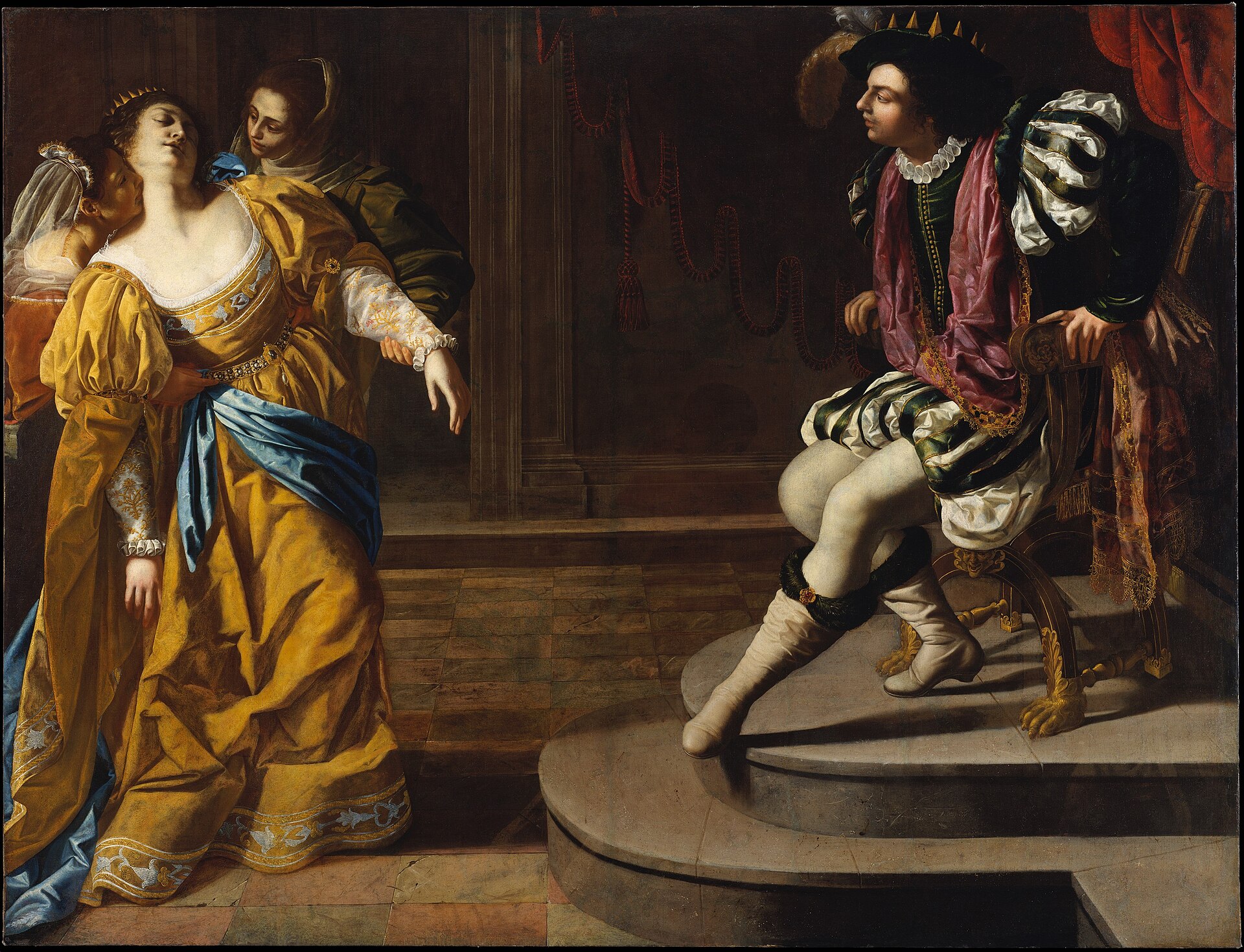 Source: Esther before Ahasuerus, Artemisia Gentileschi, CC0 via the Metropolitan Museum of Art and Wikimedia Commons. Western biblical art, not Orthodox iconography; useful here for Esther’s bodily vulnerability before the throne.
The First Banquet and Patient Petition (Esther 5:3-8)
3 And the king said, What wilt thou, Esther? and what is thy request? ask even to the half of my kingdom, and it shall be thine. 4 And Esther said, To-day is my great day: if then it seem good to the king, let both him and Aman come to the feast which I will prepare this day. 5 And the king said, Hasten Aman hither, that we may perform the word of Esther. So they both come to the feast of which Esther had spoken.
6 And at the banquet the king said to Esther, What is thy request, queen Esther? speak, and thou shalt have all that thou requirest. 7 And she said, My request and my petition are: 8 if I have found favour in the sight of the king, let the king and Aman come again to-morrow to the feast which I shall prepare for them, and to-morrow I will do the same.
The king offers Esther up to half the kingdom, but she does not immediately name Haman. She invites the king and Haman to a feast. At the banquet the king asks again, and Esther delays again, inviting them to return the next day.
The text does not disclose all her reasons for waiting. It does show what happens in the interval: Haman prepares the gallows, the king loses sleep, and Mordecai receives honor. Read after her prayer and dangerous entrance, the banquets are not a manual for manipulating powerful people. The delay becomes an occasion for God’s action beyond Esther’s knowledge.
The two banquets also draw Haman into exposure. At the first banquet he experiences exclusive honor: no one but the king and Haman is invited by the queen. His pride grows larger. His self-importance becomes easier to see. Esther’s patience allows evil to reveal itself without her needing to exaggerate it.
Not every true word should be spoken at the first available moment. Esther has already accepted mortal risk; her next invitation keeps the petition before the king while the hour of disclosure is delayed. The sequence holds patient speech beside decisive action without making either an excuse to abandon the people in danger.
For Christian life, the question is whether our speech serves the endangered person or merely relieves our own impatience. Esther will speak with great clarity. Until then, the reader is allowed to see what she cannot: the Lord is preparing the way while the petition waits.
Haman’s Joy Poisoned by Vainglory (Esther 5:9-14)
Name note: Zosara (Zeresh) is the Greek form used here for the woman named Zeresh in the Hebrew text and NKJV.
9 So Aman went out from the king very glad and merry: but when Aman saw Mardochæus the Jew in the court, he was greatly enraged. 10 And having gone into his own house, he called his friends, and his wife Zosara. 11 And he shewed them his wealth, and the glory with which the king had invested him, and how he had caused him to take precedence and bear chief rule in the kingdom. 12 And Aman said, The queen has called no one to the feast with the king but me, and I am invited to-morrow. 13 But these things please me not, while I see Mardochæus the Jew in the court. 14 And Zosara his wife and his friends said to him, Let there be a gallows made for thee of fifty cubits, and in the morning do thou speak to the king, and let Mardochæus be hanged on the gallows: but do thou go in to the feast with the king, and be merry. And the saying pleased Aman, and the gallows was prepared.
Haman leaves the banquet glad and merry, but one sight of Mordecai destroys his joy. This is the anatomy of vainglory. Haman has wealth, royal honor, precedence, public rule, and exclusive invitation to Esther’s banquet. Yet he says, “these things please me not,” because Mordecai remains unbent.
The passion is irrational, but it is not random. Vainglory makes the soul dependent on the attention and submission of others. It cannot enjoy good things because it does not really receive them as gifts. It needs them to prove the self. That is why one refusal can poison an entire life.
The gallows reveal what is already in Haman’s heart. He does not only want Mordecai corrected. He wants him displayed in humiliation. The height of fifty cubits makes the vengeance public and theatrical. Pride prepares a stage because pride wants its enemies to become evidence of its greatness.
This is a spiritual trap. Whenever a person begins to imagine another person’s humiliation with pleasure, the gallows are already being built inwardly. It may not be literal violence. It may be the desire to expose, shame, defeat, embarrass, ruin a reputation, win an argument in public, or make another person small enough to comfort wounded pride. Esther 5 exposes that desire before judgment falls.
Gems from the Fathers 💎: Vainglory Can Rob Even Almsgiving
Saint John Chrysostom’s Homily 71 on Matthew is a thematic witness here, not commentary on Haman. His immediate target is vainglory in almsgiving: a person can give to the poor while turning their distress into a public display of his own generosity. He writes, “Where moth corrupts not, nor thief breaks through, vainglory scatters.”1 Haman’s hunger for recognition is exposed in a far darker form, but Chrysostom brings the danger into Christian service. The same desire to be admired can corrupt even an act of mercy. Its cure begins when the neighbor’s need matters more than our reputation for meeting it.
The Sleepless King and the Forgotten Record (Esther 6:1-5)
LXX and NKJV note: The Greek says “the Lord removed sleep from the king”; the Hebrew behind NKJV says only that the king could not sleep. The Greek names the Lord inside the main narrative at its decisive turn. At 6:3 the servants say that nothing has been done for Mordecai, although Addition A said that the king gave him gifts for exposing the chamberlains. Together with 2:21-23, these are repeated accounts of the plot and its recognition, often called a literary doublet. The tension is unresolved in the received Greek story; the text does not explain that the earlier gifts were different from the later honor.
1 But the Lord removed sleep from the king that night: and he told his servant to bring in the books, the registers of daily events, to read to him. 2 And he found the records written concerning Mardochæus, how he had told the king concerning the two chamberlains of the king, when they were keeping guard, and sought to lay hands on Artaxerxes.
3 And the king said, What honour or favour have we done to Mardochæus? And the king’s servants said, Thou hast not done anything to him. 4 And while the king was enquiring about the kindness of Mardochæus, behold, Aman was in the court. And the king said, Who is in the court? Now Aman was come in to speak to the king, that he should hang Mardochæus on the gallows, which he had prepared. 5 And the king’s servants said, Behold, Aman stands in the court. And the king said, Call him.
Chapter 6 begins quietly, but the whole book turns here. The Lord removes sleep from the king. The records are read. Mordecai’s service comes before the king again. Within this scene, the servants’ answer that nothing has been done for him prepares the public honor that Haman must proclaim. The discrepancy with Addition A remains, but the force of this night is plain: the account of faithful service interrupts the plan for murder.
This is hidden providence in one of its clearest forms. God does not need spectacle to govern history. He works through a sleepless night, an opened register, a delayed memory, and an apparently ordinary question. The record that seemed useless in chapter 2 now becomes decisive at the exact hour when Haman arrives to ask for Mordecai’s death.
The timing is sharp. Haman comes to speak about hanging Mordecai on the gallows he prepared. Before he can speak his own plan, the king’s question turns the scene. Evil arrives with a request for humiliation, but providence has already opened the book of remembrance.
The passage gives comfort to hidden faithfulness without promising public repayment for every good deed. A record made earlier now protects a life in immediate danger. Many acts of faithfulness seem to disappear into silence: a prayer no one hears, a mercy no one thanks, a restraint no one notices. Their value before God does not depend on whether a human audience ever applauds them.
Gems from the Fathers 💎: Remember Benefits and Sins Specifically
Saint John Chrysostom directly cites Mordecai’s remembered service in Homily 38 on Acts. He urges Christians to keep an exact account of two things: God’s benefits to us and our sins against Him. General statements that we are sinners and God is good can leave the heart untouched; remembering particular mercies and particular sins makes thanksgiving truthful and repentance concrete. He asks us to examine “what sins we have committed against God, and what good He has done to us”.2
The contrast heals both pride and despair. Remembered sin prevents us from treating mercy as wages owed to us; remembered protection prevents us from imagining that our failures have exhausted God’s care. Chrysostom ends by urging us to “return our united thanks all of us to God”.3 The king’s opened record becomes a summons to open the record of our own lives before the Lord.
Haman Designs His Own Humiliation (Esther 6:6-11)
6 And the king said to Aman, What shall I do to the man whom I wish to honour? And Aman said within himself, Whom would the king honour but myself? 7 and he said to the king, As for the man whom the king wishes to honour, 8 let the king’s servants bring the robe of fine linen which the king puts on, and the horse on which the king rides, 9 and let him give it to one of the king’s noble friends, and let him array the man whom the king loves; and let him mount him on the horse, and proclaim through the street of the city, saying, Thus shall it be done to every man whom the king honours. 10 Then the king said to Aman, Thou hast well said: so do to Mardochæus the Jew, who waits in the palace, and let not a word of what thou hast spoken be neglected.
11 So Aman took the robe and the horse, and arrayed Mardochæus, and mounted him on the horse, and went through the street of the city, and proclaimed, saying, Thus shall it be to every man whom the king wishes to honour.
Haman hears the question and assumes he is the answer. “Whom would the king honour but myself?” That inward sentence exposes him more fully than any accusation could. Pride does not only desire honor. It assumes that honor naturally belongs to the self.
His proposed reward reveals his imagination: royal clothing, the king’s horse, a noble attendant, public proclamation through the city. Haman designs the honor he wants for himself. Then the king commands him to give that exact honor to Mordecai the Jew.
The reversal is precise. Haman wanted Mordecai lifted on a gallows; now Haman must lift Mordecai in public honor. Haman wanted the city to see Mordecai humiliated; now the city hears Haman proclaim Mordecai honored. The words he shaped for his own glory become his public humbling.
This scene is not merely irony. It is judgment. God lets vainglory speak long enough to reveal itself, then turns its own speech against it. The passage warns the soul to fear self-designed glory. The honor we imagine for ourselves can become the place where God exposes how sickly our desires have become.
Christian humility does not mean pretending that honor never exists. It means receiving every gift as stewardship before God, refusing to make recognition the food of the soul. Haman cannot do this. Mordecai, by contrast, receives public honor and then returns to the palace. The text gives him no speech of self-celebration. The contrast is quiet and severe.
Haman’s Fall Begins Before the Living God (Esther 6:12-14)
LXX and NKJV note: The Greek adds “for the living God is with him” to the counsel of Haman’s wife and friends. The Hebrew behind NKJV warns of his fall before Mordecai but has no corresponding mention of the living God. Zosara (Zeresh), who earlier advised the gallows, now hears the failure of that plan interpreted in God’s presence.
12 And Mardochæus returned to the palace: but Aman went home mourning, and having his head covered. 13 And Aman related the events that had befallen him to Zosara his wife, and to his friends: and his friends and his wife said to him, If Mardochæus be of the race of the Jews, and thou hast begun to be humbled before him, thou wilt assuredly fall, and thou wilt not be able to withstand him, for the living God is with him. 14 While they were yet speaking, the chamberlains arrived, to hasten Aman to the banquet which Esther had prepared.
Mordecai returns to the palace, but Haman goes home mourning with his head covered. The man who began chapter 5 very glad and merry is now clothed in humiliation before the second banquet even begins. His fall has started inwardly and publicly.
The words of Zosara and the friends are striking: “thou wilt assuredly fall, and thou wilt not be able to withstand him, for the living God is with him.” They are not presented as models of covenant faith, but they see something true. Haman is not merely losing to Mordecai’s cleverness. He is standing against a people guarded by the living God.
This phrase gathers what the Greek has already made explicit. God changed the king’s spirit in Addition D; the Lord removed his sleep in 6:1; now even Haman’s household speaks of the living God. His action works through ordinary events, but His name is not absent from the story. The reader hears the prayers of chapter 4 beginning to receive their answer.
The timing remains relentless. While Haman is hearing that he will fall, the chamberlains arrive to hasten him to Esther’s banquet. He is being hurried to the place where truth will be spoken. The same invitation that inflated his pride now carries him to exposure.
For the spiritual life, this is a warning against delayed repentance. Haman receives signs of collapse before the final judgment: rage without rest, gallows built in vengeance, public humiliation, counsel that he will fall. Yet there is no repentance in the text. A passion that is not brought to God becomes a path that carries the soul faster than it intended to go.
Esther Names Her People and the Slanderer (Esther 7:1-6)
1 So the king and Aman went in to drink with the queen. 2 And the king said to Esther at the banquet on the second day, What is it, queen Esther? and what is thy request, and what is thy petition? and it shall be done for thee, to the half of my kingdom. 3 And she answered and said, If I have found favour in the sight of the king, let my life be granted to my petition, and my people to my request. 4 For both I and my people are sold for destruction, and pillage, and slavery; both we and our children for bondmen and bondwomen: and I consented not to it, for the slanderer is not worthy of the king’s palace. 5 And the king said, Who is this that has dared to do this thing? 6 And Esther said, The adversary is Aman, this wicked man. Then Aman was troubled before the king and the queen.
At the second banquet Esther finally speaks plainly. Her request is not wealth, rank, security, or revenge. It is life: “let my life be granted to my petition, and my people to my request.” She binds herself to the condemned people. She does not ask for private escape from public danger.
This is one of the central acts of intercession in the book. Esther has hidden her people until the appointed hour, but now hiddenness ends. She names herself with them. Their sentence is her sentence. Their danger is her petition. This is the opposite of using privilege as shelter. It is privilege offered as risk.
Her description of the decree is careful and forceful: destruction, pillage, slavery, children included, a slanderer unworthy of the king’s palace. She does not begin with an emotional attack. She names what has been done and what is at stake. Truth spoken after prayer is not vague. It is clear enough for evil to be identified.
When the king asks, “Who is this?” Esther answers: “The adversary is Aman, this wicked man.” Haman is troubled before the king and queen. The slanderer who made a whole people sound dangerous now stands named. His speech is answered by Esther’s speech.
Esther’s petition shows the cost of solidarity. She asks for neither herself nor her people to be abandoned. Christians see a greater intercession in the Son who truly took flesh and made our cause His own in perfect love. He freely offers Himself for our salvation. Esther risks her life before a ruler who may refuse her; Christ is Himself the Lord who saves, willingly bearing our sins and conquering death.
The Gallows Prepared for Mordecai (Esther 7:7-10)
Name note: Bugathan (Harbonah) is the chamberlain named at 7:9; the Hebrew text and NKJV use Harbonah.
7 And the king rose up from the banquet to go into the garden: and Aman began to intreat the queen; for he saw that he was in an evil case.
8 And the king returned from the garden; and Aman had fallen upon the bed, intreating the queen. And the king said, Wilt thou even force my wife in my house? And when Aman heard it, he changed countenance. 9 And Bugathan, one of the chamberlains, said to the king, Behold, Aman has also prepared a gallows for Mardochæus, who spoke concerning the king, and a gallows of fifty cubits high has been set up in the premises of Aman. And the king said, Let him be hanged thereon. 10 So Aman was hanged on the gallows that had been prepared for Mardochæus: and then the king’s wrath was appeased.
Once exposed, Haman begins to beg. The man who had plotted the destruction of others now pleads for his own life. He falls near Esther, and the king interprets the scene as another violation. The reversal accelerates. The one who accused becomes accused. The one who planned public humiliation is publicly condemned.
Bugathan names the gallows. This detail matters because it reveals that Haman’s judgment is tied to his own prepared vengeance. The gallows were not an emergency measure. They had already been built in his house, fifty cubits high, for Mordecai, the man who had spoken for the king’s safety. Haman’s private hatred had already taken public form.
The text says Haman was hanged on the gallows prepared for Mordecai. His sentence exposes the character of the vengeance he planned: its intended victim had protected the king, while its maker had used royal authority to pursue a private hatred. The instrument he built now bears witness against him.
Haman’s gallows are an instrument of vengeance turned back upon its maker. They are not a type of the Cross merely because both involve wood and death. The Lord’s Passion is His sovereign, willing obedience, through which He bears human malice, forgives, dies, and rises to destroy death. The Christian’s hope rests in that saving victory, not in the spectacle of an enemy’s humiliation.
This keeps the teaching from triumphal mockery. Haman’s fall is severe. It should make the soul sober, not smug. The question is not only where Haman is in the story. It is where Haman’s passions live in us: the need to be honored, the inability to bear being refused, the fantasy of another’s humiliation, and the refusal to repent while mercy still calls.
The Church’s Voice in Worship ⛪
This passage has no established place in the Coptic Orthodox lectionary.
Chrysostom’s call to united thanksgiving gives this passage a particular connection to the Church’s prayer. The opened register leads him to remember God’s concrete mercies together with our sins. In worship, thanksgiving and repentance need not compete: the more truthfully we acknowledge what we have done, the more gratefully we can receive the mercy we did not earn. This is a thematic connection, not a claim that Esther 6 is appointed as a Coptic reading.
Esther’s dangerous entrance also throws the promise in Hebrews into relief. She waits for permission to live; Christians approach the throne of grace through the crucified and risen High Priest. The confidence of prayer is received from His mercy, not manufactured by hiding weakness.
Spiritual Fruit 🍇
-
Carry fear into prayer instead of waiting to feel fearless. Esther faints, yet she obeys. Before a necessary conversation, ask God for truthful words and a heart free from the desire to wound. Trembling need not prevent the next faithful step.
-
Examine the reason for delay. Esther has already accepted danger before she waits. If you are postponing a duty, name before God whether you are protecting another person’s good or merely avoiding discomfort. Seek wise counsel when the right time is uncertain.
-
Watch the first timber of the gallows in the heart. Haman’s public gallows began as wounded pride. Repent early of the desire to shame, expose, defeat, or humiliate another person.
-
Keep a truthful record before God. Following Chrysostom’s reading of Mordecai, recall one particular mercy and one particular sin rather than remaining with general religious words. Thank God for the first; confess the second and take the needed step of amendment. Remembered mercy gives repentance hope.
-
Approach the true throne through Christ. The earthly king’s sceptre could spare Esther for one moment. Christ opens the throne of grace for sinners, servants, and the fearful. Pray with humble confidence because mercy has been opened by Him.
Teaching Notes
Esther Enters Trembling After Prayer (Esther 5:1-2)
- Ask: What changes when the class sees Esther fainting instead of imagining her as fearless?
- Emphasize: Courage is not fearlessness. It is prayer-born obedience under mortal risk.
- Watch for: Do not romanticize the throne room or make the king’s favor the center of the scene.
- Connect: Hebrews 4:14-16 brings the fearful to Christ, who opens the throne of grace.
- Show: Use Artemisia’s Esther before Ahasuerus as Western biblical art, not iconography. Its depiction of bodily fragility can illuminate the scene, but let the Scripture govern what is said about Esther’s fear and God’s action.
The First Banquet and Patient Petition (Esther 5:3-8)
- Ask: Why might Esther wait instead of naming Haman immediately?
- Emphasize: The interval between the banquets includes the Lord’s removal of the king’s sleep and the interruption of Haman’s plan.
- Watch for: The narrator does not reveal every reason for Esther’s delay. Distinguish the events we can trace from motives we cannot establish.
- Connect: Prayer forms both boldness and timing. Truth must be spoken in God’s hour and spirit.
- Show: Trace the movement from request to banquet to second invitation so the class feels the slow providential pace.
Haman’s Joy Poisoned by Vainglory (Esther 5:9-14)
- Ask: Why do all Haman’s honors fail to satisfy him?
- Emphasize: Vainglory makes the soul dependent on recognition and unable to rejoice.
- Watch for: Do not keep Haman safely outside the room as a cartoon villain.
- Connect: The gallows begin inwardly wherever pride imagines another person’s humiliation with pleasure.
- Show: Contrast Haman’s list of honors with his sentence, “these things please me not.”
The Sleepless King and the Forgotten Record (Esther 6:1-5)
- Ask: What ordinary details does God use to turn the story in Esther 6?
- Emphasize: Hidden providence works through sleeplessness, records, delayed remembrance, and timing.
- Watch for: Do not call it coincidence with a religious moral added afterward.
- Connect: Chrysostom asks for specific remembrance of both God’s benefits and our sins, issuing in repentance and united thanksgiving.
- Show: Compare Addition A, 2:21-23, and 6:3. Name the literary doublet and unresolved gifts/no-reward tension; do not invent a distinction between earlier gifts and later honor as though the text supplied it.
Haman Designs His Own Humiliation (Esther 6:6-11)
- Ask: What does Haman’s inner question reveal about pride?
- Emphasize: He designs honor for himself and becomes the servant of Mordecai’s public honor.
- Watch for: Do not let the class enjoy the irony without receiving the warning against self-designed glory.
- Connect: Christian humility receives gifts as stewardship and does not feed on recognition.
- Show: Follow the exact reversal: horse, robe, proclamation, public street, and Mordecai named.
Haman’s Fall Begins Before the Living God (Esther 6:12-14)
- Ask: Why is the phrase “the living God is with him” important in a book where God’s action is often hidden?
- Emphasize: Providence has been hidden but living from the beginning.
- Watch for: Do not treat Haman’s fear as repentance. The text shows collapse, not conversion.
- Connect: Delayed repentance hardens the path of a passion until it carries the person faster than expected.
- Show: Place Haman’s mourning beside his earlier gladness so the class sees the instability of vainglory.
Esther Names Her People and the Slanderer (Esther 7:1-6)
- Ask: What does Esther risk by saying, “my life” and “my people” together?
- Emphasize: Intercession means solidarity. Esther refuses private safety apart from the condemned people.
- Watch for: Do not turn her speech into mere court rhetoric. She names destruction, slander, and the adversary.
- Connect: Christ fulfills intercession by making our cause His own through the Incarnation, Cross, and Resurrection.
- Show: Let the class hear the movement from hidden identity to public solidarity.
The Gallows Prepared for Mordecai (Esther 7:7-10)
- Ask: What does the prepared gallows reveal about Haman before his sentence is pronounced?
- Emphasize: Vengeance builds outward what pride has already built inward.
- Watch for: Do not teach the fall as gleeful revenge. Keep the tone sober.
- Connect: Keep the distinction between Haman’s punitive death and Christ’s sovereign, willing self-offering. The shared presence of wood is not enough to establish a type.
- Show: End with self-examination: where do we secretly want another person made small?
Sources
Embedded Scripture is from Brenton’s English Septuagint (LXX).
Saint John Chrysostom directly cites Mordecai’s remembered service in Homily 38 on Acts. His Homily 71 on Matthew addresses vainglory, particularly its corruption of almsgiving, and supplies thematic teaching here rather than commentary on Haman.
Primary and source anchors used for this session:
- Brenton’s English Septuagint, Esther 5, Esther 6, and Esther 7.
- Artemisia Gentileschi, Esther before Ahasuerus, Metropolitan Museum of Art Open Access / Wikimedia Commons 🔗.
- Saint John Chrysostom, Homily 38 on Acts, concluding exhortation on exact remembrance and thanksgiving.
- Saint John Chrysostom, Homily 71 on Matthew, concluding exhortation on vainglory in almsgiving.
- Hebrews 4:14-16, for Christ as the true access to the throne of grace.
- Colossians 2:13-15, for Christ’s victory over hostile powers and the handwriting against us.
Further reading:
Carey A. Moore, Esther, Anchor Yale Bible.
Michael V. Fox, Character and Ideology in the Book of Esther.
Karen H. Jobes, Esther.
Footnotes
-
Saint John Chrysostom, Homily 71 on Matthew, NPNF1 10, exhortation on vainglory and almsgiving. ↩
-
Saint John Chrysostom, Homily 38 on Acts, NPNF1 11, concluding exhortation, immediately after the reference to Mordecai. ↩
-
Saint John Chrysostom, Homily 38 on Acts, NPNF1 11, final paragraph. ↩