


This narration is from a previous version of the study and may include a combined recording of multiple chapters.
Esther 3-4 is the crisis of the book. A private wound in Aman (Haman) becomes public slander, public slander becomes imperial paperwork, and imperial paperwork becomes a death decree against the people of God. Evil does not only rage. It reasons, flatters itself, buys permission, writes letters, uses official language, and then sits down to drink while the city trembles.
Mardochaeus (Mordecai) mourns publicly. The Jews fast together. Esther learns that her hidden position has become costly responsibility. Addition C then opens the inner truth of the chapter: Mordecai refuses the glory of man because only God is to be worshipped, and Esther’s courage is born from helpless prayer. Their petitions reach beyond this crisis into the book’s final joy: the people who ask to live and praise God will remember that their mourning was changed into gladness.
Esther’s willingness to die comes after fasting, communal intercession, and the confession that help belongs to God. Providence does not excuse her from responsibility. It summons her into obedience.
Historical and Scriptural Context
The first two chapters placed Esther inside the Persian court and showed Mordecai watching at the gate. Chapters 3-4 reveal why that hidden placement matters. Haman rises in honor, Mordecai refuses to give him the demanded obeisance, and Haman’s rage expands from one man to a whole people. Addition A has already given Haman a further grudge against Mordecai because of the two chamberlains whose plot he exposed. The refusal to bow intensifies hostility already present in the Greek story. The crisis reaches across the kingdom of Artaxerxes (Ahasuerus), from India to Ethiopia, through one hundred and twenty-seven provinces.
In Brenton’s Greek Esther, the additions are not detached from the crisis. Addition B appears inside Esther 3:13 as the royal extermination letter. Addition C appears inside Esther 4:17 as the prayers of Mordecai and Esther. The narrative therefore moves from slander and decree to mourning and fasting, then into prayer. The Orthodox reader should not separate the political crisis from the spiritual response.
This passage also prepares the later throne-room scene. Esther does not enter the king’s presence because she has learned a technique for influence. She enters because the people have fasted, because Mordecai has prayed, because she has prayed, and because obedience has become unavoidable.
Haman Exalted and Mordecai’s Refusal (Esther 3:1-6)
LXX and NKJV note: The Hebrew text behind NKJV calls Haman “the Agagite”; Brenton’s Greek text calls him “the Bugæan,” while Addition E calls him “a Macedonian.” These are different textual designations, not interchangeable translations of one name. The Hebrew sets the Agagite against Mordecai, the Benjaminite traced through Kish in 2:5, recalling Saul son of Kish and Agag in 1 Samuel 15. This is a literary echo, not proof of Haman’s ancestry, and it gives no warrant for ethnic hatred.
1 And after this king Artaxerxes highly honoured Aman son of Amadathes, the Bugæan, and exalted him, and set his seat above all his friends. 2 And all in the palace did him obeisance, for so the king had given orders to do: but Mardochæus did not do him obeisance. 3 And they in the king’s palace said to Mardochæus, Mardochæus, why dost thou transgress the commands of the king?
4 Thus they spoke daily to him, but he hearkened not unto them; so they represented to Aman that Mardochæus resisted the commands of the king: and Mardochæus had shewn to them that he was a Jew. 5 And when Aman understood that Mardochæus did not obeisance to him, he was greatly enraged, 6 and took counsel to destroy utterly all the Jews who were under the rule of Artaxerxes.
The scene begins with exaltation. Haman is raised, his seat is set above the king’s friends, and the whole palace is ordered to give him obeisance. His reaction to one man’s refusal shows how readily received honor can become a demand that everyone confirm one’s importance.
Mordecai’s refusal is therefore not random stubbornness. Later, his prayer will say plainly that he refused because he would not set the glory of man above the glory of God. He even says he would have kissed the soles of Haman’s feet for Israel’s safety if that had not crossed into false worship. That means his refusal must be read as holy resistance to false glory, not as ego answering ego.
Haman’s reaction reveals the passion of vainglory. He cannot bear one unbent knee. He does not merely punish Mordecai. He takes counsel to destroy all the Jews under Artaxerxes. This is how wounded pride becomes public evil. A private humiliation is enlarged into collective hatred. One person becomes a symbol. A whole people becomes disposable.
This is spiritually severe because the pattern is not ancient only. A wounded heart can turn one offense into contempt for a family, a ministry, a parish group, a people, or anyone associated with the offender. The first battlefield is not the royal court. It is the heart that refuses repentance when its pride is touched.
The Lot, the Slander, and the Price of Death (Esther 3:7-11)
LXX and NKJV date note: The Greek gives the fourteenth of Adar here and in Addition B. Later it gives the thirteenth at 8:12, in Addition E, and at 9:1. NKJV, following the Hebrew, names the thirteenth as the appointed day at 3:13, 8:12, and 9:1; its 3:7 names Adar without specifying a day. There is a real thirteenth/fourteenth inconsistency within the Greek narrative. Brenton also prints “the first day of the twelfth month” at 3:13. Rahlfs-Hanhart’s Greek there reads “ἐν ἡμέρᾳ μιᾷ,” naturally “on one day,” without naming that day as the first.1 Brenton’s wording is retained in the reading below, but it should not be treated as a securely stated third date. The surviving differences remain unresolved.
7 And he made a decree in the twelfth year of the reign of Artaxerxes, and cast lots daily and monthly, to slay in one day the race of Mardochæus: and the lot fell on the fourteenth day of the month which is Adar. 8 And he spoke to king Artaxerxes, saying, There is a nation scattered among the nations in all thy kingdom, and their laws differ from those of all the other nations; and they disobey the laws of the king; and it is not expedient for the king to let them alone. 9 If it seem good to the king, let him make a decree to destroy them: and I will remit into the king’s treasury ten thousand talents of silver. 10 And the king took off his ring, and gave it into the hands of Aman, to seal the decrees against the Jews. 11 And the king said to Aman, Keep the silver, and treat the nation as thou wilt.
Haman casts lots to choose the day of murder. The “pur,” or lot, will later give Purim its name. This is one of Esther’s deep reversals: the instrument meant to schedule destruction becomes part of the memory of deliverance. Addition F will place the lots before God’s judgment. What Haman uses to arrange death will become a witness that the people’s future lay in greater hands than his.
The speech to the king is an anatomy of evil rhetoric. Haman begins with depersonalization: “There is a nation.” He does not name persons, families, worship, children, elders, or neighbors. He then exaggerates difference into danger: their laws differ from others. Then he slanders them as disobedient to the king. Then he turns murder into policy: “it is not expedient for the king to let them alone.” Finally, he offers money. Hatred buys administrative permission.
The king’s response is morally chilling. He gives his ring to Haman and says, “treat the nation as thou wilt.” He hands over authority without seeking truth. The ring becomes the seal of careless power, and careless power can be as deadly as active malice when it gives malice machinery.
For the Church, this passage teaches watchfulness over speech before speech becomes action. Slander almost never begins by saying, “I want to destroy.” It begins by making people sound dangerous, inconvenient, unreasonable, unclean, disloyal, or impossible to live with. The Christian must resist this early, in gossip, social contempt, factional talk, and every careless sentence that turns persons into problems.
The Extermination Letter and the Troubled City (Esther 3:12-15)
Reader note: Addition B is the full royal letter printed within Brenton’s 3:13. NKJV has the shorter Hebrew account without this letter. Its fourteenth-of-Adar date and Brenton’s “first day” wording are explained in the date note immediately before 3:7-11.
12 So the king’s recorders were called in the first month, on the thirteenth day, and they wrote as Aman commanded to the captains and governors in every province, from India even to Ethiopia, to a hundred and twenty-seven provinces; and to the rulers of the nations according to their several languages, in the name of king Artaxerxes. 13 And the message was sent by posts throughout the kingdom of Artaxerxes, to destroy utterly the race of the Jews on the first day of the twelfth month, which is Adar, and to plunder their goods. [And the following is the copy of the letter; The great king Artaxerxes writes thus to the rulers and inferior governors of a hundred and twenty-seven provinces, from India even to Ethiopia, who hold authority under him. Ruling over many nations, and having obtained dominion over the whole world, I was minded, (not elated by the confidence of power, but ever conducting myself with great moderation and with gentleness,) to make the lives of my subjects continually tranquil, desiring both to maintain the kingdom quiet and orderly to its utmost limits, and to restore the peace desired by all men. But when I had enquired of my counsellors how this should be brought to pass, Aman, who excels in soundness of judgment among us, and has been manifestly well inclined without wavering and with unshaken fidelity, and has obtained the second post in the kingdom, informed us that a certain ill-disposed people is mixed up with all the tribes throughout the world, opposed in their laws to every other nation, and continually neglecting the commands of the kings, so that the united government blamelessly administered by us is not quietly established. Having then conceived that this nation alone of all others is continually set in opposition to every man, introducing as a change a foreign code of laws, and injuriously plotting to accomplish the worst of evils against our interests, and against the happy establishment of the monarchy; we have accordingly appointed those who are signified to you in the letters written by Aman, who is set over the public affairs and is our second governor, to destroy them all utterly with their wives and children by the swords of the enemies, without pitying or sparing any, on the fourteenth day of the twelfth month Adar, of the present year; that the people aforetime and now ill-disposed to us having been violently consigned to death in one day, may hereafter secure to us continually a well constituted and quiet state of affairs.]
14 And the copies of the letters were published in every province; and an order was given to all the nations to be ready against that day. 15 And the business was hastened, and that at Susa: and the king and Aman began to drink; but the city was troubled.
Addition B lets the reader hear the decree in its full public voice. This is not only a plot summary. It is the sound of evil becoming respectable. The letter speaks of moderation, gentleness, tranquility, order, peace, sound judgment, unshaken fidelity, and a well constituted state. Inside that polished language is the command to kill men, women, and children without pity.
That contradiction is the point. Public documents can make evil sound orderly. The letter does not say, “We are acting from wounded pride.” It says the kingdom must be quiet. It does not say, “Aman hates Mordecai.” It says a certain ill-disposed people is mixed among the tribes. It does not say, “We are murdering the innocent.” It says the state will be secured. Administrative language becomes a veil over blood.
The final verse gives the moral image of the chapter: the business is hastened, the king and Haman drink, and the city is troubled. Power relaxes while ordinary people shake. This is one of Scripture’s sharpest portraits of irresponsible authority. The palace can celebrate its decisiveness while the city tastes fear.
The Christian fulfillment is not that Christ gives the Church a better empire. It is that Christ exposes the powers, cancels the hostile handwriting against us, and opens a Kingdom that cannot be secured by lies or murder. Every official word, church word, family word, and private word will stand before Him. This should make servants careful with speech.
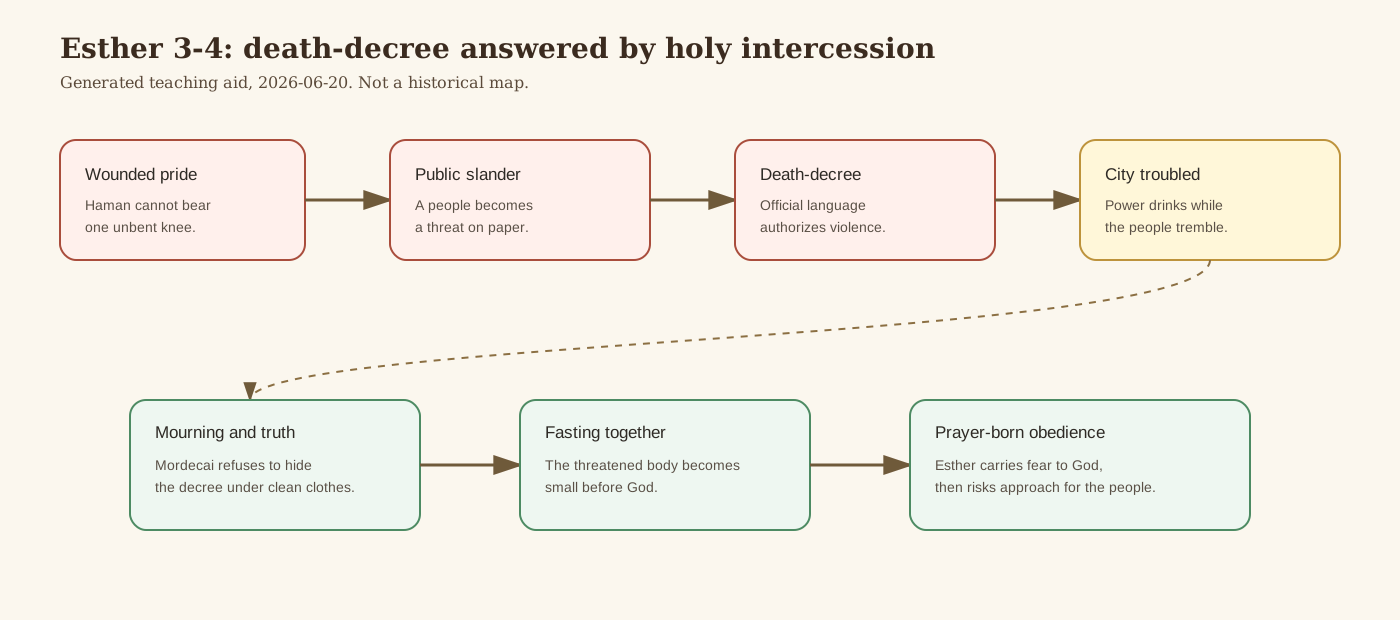 Source: Generated teaching aid for this project, 2026-06-20. It is not a historical map; it traces the spiritual movement from slander and decree to fasting, prayer, and costly obedience.
Mourning, Sackcloth, and the Copy of the Decree (Esther 4:1-8)
LXX and NKJV note: Brenton moves from verse 5 to verse 7 because the Greek lacks Hebrew 4:6, where Hathach goes out to Mordecai in the city square before the king’s gate. Achrathaeus (Hathach), spelled “Achrathæus” in the reading, is the same messenger. In 4:8 the Greek adds “Do thou call upon the Lord”; the Hebrew behind NKJV has no corresponding appeal to God. Prayer before the appeal to the king is explicit within the Greek’s main narrative, not only in Addition C.
1 But Mardochæus having perceived what was done, rent his garments, and put on sackcloth, and sprinkled dust upon himself; and having rushed forth through the open street of the city, he cried with a loud voice, A nation that has done no wrong is going to be destroyed. 2 And he came to the king’s gate, and stood; for it was not lawful for him to enter into the palace, wearing sackcloth and ashes. 3 And in every province where the letters were published, there was crying and lamentation and great mourning on the part of the Jews: they spread for themselves sackcloth and ashes.
4 And the queen’s maids and chamberlains went in and told her: and when she had heard what was done, she was disturbed; and she sent to clothe Mardochæus, and take away his sackcloth; but he consented not. 5 So Esther called for her chamberlain Achrathæus, who waited upon her; and she sent to learn the truth from Mardochæus.
7 And Mardochæus shewed him what was done, and the promise which Aman had made the king of ten thousand talents to be paid into the treasury, that he might destroy the Jews. 8 And he gave him the copy of the writing that was published in Susa concerning their destruction, to shew to Esther; and told him to charge her to go in and intreat the king, and to beg him for the people, remembering, said he, the days of thy low estate, how thou wert nursed by my hand: because Aman who holds the next place to the king has spoken against us for death. Do thou call upon the Lord, and speak to the king concerning us, to deliver us from death.
Mordecai answers the decree with public mourning. He rends his garments, puts on sackcloth, sprinkles dust, and cries in the open street. His cry names the truth that the decree hides: “A nation that has done no wrong is going to be destroyed.” The court’s letter said order. Mordecai says murder.
The mourning is not private. In every province where the letters arrive, there is crying, lamentation, and great mourning. The Jews spread sackcloth and ashes. The body of the people answers together because the threat is against the body of the people. Esther will later ask for a fast because the crisis already has a corporate shape.
Esther first sends clothes to Mordecai, but he refuses them. The text does not tell us whether she hopes to comfort him or to make his distress less visible. It does show that changing his clothes cannot change the decree. She sends to learn the truth, and Mordecai sends the actual writing. Compassion grows into responsibility when she receives the facts of the people’s danger.
His charge is decisive: “Do thou call upon the Lord, and speak to the king concerning us, to deliver us from death.” The order matters. Call upon the Lord. Speak to the king. Intercession before God comes before appeal to earthly power. Mordecai does not ask Esther to become clever first. He asks her to pray and then to act.
Vocation Without Fatalism and Courage After Fasting (Esther 4:9-17)
9 So Achrathæus went in and told her all these words. 10 And Esther said to Achrathæus, Go to Mardochæus, and say, 11 All the nations of the empire know, that whoever, man or woman, shall go in to the king into the inner court uncalled, that person cannot live: only to whomsoever the king shall stretch out his golden sceptre, he shall live: and I have not been called to go in to the king, for these thirty days. 12 And Achrathæus reported to Mardochæus all the words of Esther. 13 Then Mardochæus said to Achrathæus, Go, and say to her, Esther, say not to thyself that thou alone wilt escape in the kingdom, more than all the other Jews. 14 For if thou shalt refuse to hearken on this occasion, help and protection will be to the Jews from another quarter; but thou and thy father’s house will perish: and who knows, if thou hast been made queen for this very occasion? 15 And Esther sent the man that came to her to Mardochæus, saying, 16 Go and assemble the Jews that are in Susa, and fast ye for me, and eat not and drink not for three days, night and day: and I also and my maidens will fast; and then I will go in to the king contrary to the law, even if I must die. 17 So Mardochæus went and did all that Esther commanded him.
Esther’s fear is real. The law of the inner court is known throughout the empire: the uncalled person dies unless the king stretches out the golden sceptre. She has not been called for thirty days. The text does not shame her fear. It lets the danger stand.
Mordecai’s answer is one of the most quoted lines in Esther, but it must not be turned into fatalism or motivational language. He does not say, “Everything will happen automatically, so your obedience does not matter.” He says the opposite. If she refuses, help and protection will come from another quarter, but she and her father’s house will perish. Providence is real, but it does not make Esther irrelevant. It makes her responsible.
“Who knows, if thou hast been made queen for this very occasion?” is not flattery. It is a trembling question placed before the conscience. Esther’s position is not proof of personal importance. It is stewardship under judgment. The hidden faithful person must become visible when love of the people requires it. She must decide whether privilege will become shelter or intercession.
Her answer begins with a fast. She commands Mordecai to assemble the Jews in Susa, to fast for her, and to eat and drink nothing for three days, night and day. She and her maidens will fast also. Only then will she go to the king contrary to the law. The famous sentence, “even if I must die,” comes after communal fasting. Her courage is prayer-born, bodily, shared, and trembling.
Gems from the Fathers 💎: Faith That Carries Others
Saint Clement of Rome gives a direct ancient Christian witness to Esther’s intercession. He places her among those who risk themselves out of love for others: “Esther also, being perfect in faith, exposed herself to no less danger, in order to deliver the twelve tribes of Israel from impending destruction.”2 He then joins her fasting and humiliation to God’s deliverance of the people. Her faith becomes visible in accepting another’s peril as her own.
Saint Basil the Great supplies a thematic witness, not commentary on Esther. His Homily 1 on Fasting, section 10, joins bodily abstinence to renouncing evil: “Beware of limiting the good of fasting to mere abstinence from meats. Real fasting is alienation from evil.”3 The NPNF Prolegomena quote these words from the homily. They search our own fasting: a restrained appetite cannot excuse a tongue still feeding on slander. Esther’s three-day abstinence describes an exceptional crisis, not a rule to copy without pastoral and medical discernment.
Mordecai’s Prayer: Refusing the Glory of Man (Addition C, within Esther 4:17)
Reader note: Brenton places both prayers of Addition C within 4:17 and brackets material absent from the Hebrew. NKJV therefore has neither prayer. The same material is found in KJV Apocrypha 13:8-14:19; the division here follows the change from Mordecai’s prayer to Esther’s, without creating new verse numbers.
[And he besought the Lord, making mention of all the works of the Lord; and he said, Lord God, king ruling over all, for all things are in thy power, and there is no one that shall oppose thee in thy purpose to save Israel. For thou hast made the heaven and the earth, and every wonderful thing in the world under heaven. And thou art Lord of all, and there is no one who shall resist thee the Lord. Thou knowest all things: thou knowest, Lord, that it is not in insolence, nor haughtiness, nor love of glory, that I have done this, to refuse obeisance to the haughty Aman. For I would gladly have kissed the soles of his feet for the safety of Israel. But I have done this, that I might not set the glory of man above the glory of God: and I will not worship any one except thee, my Lord, and I will not do these things in haughtiness. And now, O Lord God, the King, the God of Abraam, spare thy people, for our enemies are looking upon us to our destruction, and they have desired to destroy thine ancient inheritance. Do not overlook thy peculiar people, whom thou hast redeemed for thyself out of the land of Egypt. Hearken to my prayer, and be propitious to thine inheritance, and turn our mourning into gladness, that we may live and sing praise to thy name, O Lord; and do not utterly destroy the mouth of them that praise thee, O Lord. And all Israel cried with all their might, for their death was before their eyes.
Mordecai’s prayer clarifies the whole chapter. He begins with God’s sovereignty: all things are in God’s power, and no one can oppose His purpose to save Israel. This is not abstract theology. It is the confession needed when earthly power has issued a decree of death.
Then Mordecai names his motive. He did not refuse Haman out of insolence, haughtiness, or love of glory. The prayer matters because it keeps his refusal from being read as personality conflict. He says he would have kissed Haman’s feet for the safety of Israel. The refusal came only because he would not set the glory of man above the glory of God.
This is a needed lesson in discernment. Not every refusal is holy. Some refusal is pride, stubbornness, fear, or the desire to appear principled. Mordecai asks God, who knows all things, to judge his heart. Holy resistance must be purified before God, or it becomes another form of vainglory.
The prayer then turns from motive to intercession. Mordecai does not ask for personal vindication first. He asks God to spare His people, His ancient inheritance, His peculiar people redeemed from Egypt. He asks that mourning be turned into gladness so that the people may live and sing praise to God’s name. The issue is worship. If the people are destroyed, the mouth of praise is silenced.
The prayer’s answer will be remembered in Esther 9:22: the month is changed “from mourning to joy.” The threatened mouth of praise remains alive. Deliverance therefore leads beyond relief into thanksgiving. In our own petitions, it is easy to ask for danger to end and then forget the One to whom we cried. Mordecai asks for life that can become praise.
Esther’s Prayer: Destitute Before God (Addition C, within Esther 4:17)
Reader note: This is the second prayer of Addition C, continuing within Brenton’s 4:17; it corresponds to KJV Apocrypha 14:1-19 and is absent from the Hebrew text behind NKJV.
And queen Esther betook herself for refuge to the Lord, being taken as it were in the agony of death. And having taken off her glorious apparel, she put on garments of distress and mourning; and instead of grand perfumes she filled her head with ashes and dung, and she greatly brought down her body, and she filled every place of her glad adorning with the torn curls of her hair. And she besought the Lord God of Israel, and said, O my Lord, thou alone art our king: help me who am destitute, and have none to help me but thee, for my danger is near at hand. I have heard from my birth, in the tribe of my kindred, that thou, Lord, tookest Israel out of all the nations, and our fathers out of all their kindred for a perpetual inheritance, and hast wrought for them all that thou hast said. And now we have sinned before thee, and thou hast delivered us into the hands of our enemies, because we honoured their gods: thou art righteous, O Lord. But now they have not been contented with the bitterness of our slavery, but have laid their hands on the hands of their idols, in order to abolish the decree of thy mouth, and utterly to destroy thine inheritance, and to stop the mouth of them that praise thee, and to extinguish the glory of thine house and thine altar, and to open the mouth of the Gentiles to speak the praises of vanities, and in order that a mortal king should be admired for ever. O Lord, do not resign thy sceptre to them that are not, and let them not laugh at our fall, but turn their counsel against themselves, and make an example of him who has begun to injure us. Remember us, O Lord, manifest thyself in the time of our affliction, and encourage me, O king of gods, and ruler of all dominion. Put harmonious speech into my mouth before the lion, and turn his heart to hate him that fights against us, to the utter destruction of him and of them that consent with him. But deliver us by thine hand, and help me who am destitute, and have none but thee, O Lord. Thou knowest all things, and knowest that I hate the glory of transgressors, and that I abhor the couch of the uncircumcised, and of every stranger. Thou knowest my necessity, for I abhor the symbol of my proud station, which is upon my head in the days of my splendour: I abhor it as a menstruous cloth, and I wear it not in the days of my tranquillity. And thy handmaid has not eaten at the table of Aman, and I have not honoured the banquet of the king, neither have I drunk wine of libations. Neither has thy handmaid rejoiced since the day of my promotion until now, except in thee, O Lord God of Abraam. O God, who hast power over all, hearken to the voice of the desperate, and deliver us from the hand of them that devise mischief; and deliver me from my fear.]
Esther’s prayer destroys any shallow reading of her courage. She takes refuge in the Lord while seized by the agony of death. She removes glorious apparel, puts on garments of distress and mourning, replaces perfumes with ashes, and brings down her body. The queen becomes spiritually truthful by stripping away the signs of security.
Her first confession is the center of the prayer: “O my Lord, thou alone art our king.” She is about to stand before Artaxerxes, but she knows that he is not ultimate. The throne that matters most is God’s. Her request is therefore not, “Make me impressive.” It is, “Help me who am destitute.” She has no support apart from the Lord.
She prays as a member of the people, not as a solitary heroine. “We have sinned before thee.” She remembers Israel’s calling, the inheritance, God’s word, the threat to praise, the danger to the house and altar, and the shame that would let vanities be praised. This is covenant prayer. Esther carries the people into her own danger.
She also asks for speech. “Put harmonious speech into my mouth before the lion.” That is a servant’s prayer. There are moments when courage is not noise, but the grace to speak rightly before danger. Esther needs words that serve deliverance, not words that advertise herself.
Esther also asks God to “turn their counsel against themselves.” Esther 9:25 answers that request by recalling how the calamities Haman prepared returned upon him. The prayer and the later memorial belong to one account of God hearing His endangered people. This severe judgment is not permission to cultivate hatred in prayer. Christians ask for evil to be stopped and for the deliverance of those in danger, while seeking the repentance of the wrongdoer.
The final request is deeply human: “deliver me from my fear.” Esther brings her fear to the King above the king. In Hebrews 4:14-16, Christ the true High Priest opens the throne of grace, where His people receive mercy and find help in time of need. He saves through His sovereign, willing obedience, freely entering death for us. Our confidence rests in Him, not in an earthly ruler’s changing favor.
Gems from the Fathers 💎: The Prayers Received as Scripture
Origen treats these very prayers as biblical examples of “request,” the petition offered by someone in need. In On Prayer 14.3, he cites both Mordecai and Esther among scriptural supplicants: “Mordecai made request of God, recalling all the works of the Lord, and said; Lord, Lord, King Almighty,” and Esther herself “made request of the Lord God of Israel and said: Lord our King … ”4 This is direct testimony to the Christian reading of Addition C. The prayers give need a truthful voice before God; destitution becomes a reason to approach Him rather than a reason to remain silent.
The Church’s Voice in Worship ⛪
This passage has no established place in the Coptic Orthodox lectionary.
The gathering of the Jews in Susa nevertheless shows why intercession belongs to a whole people. Esther will stand before the king, but she asks others to fast for her, and her maidens share her fast. Prayer joins the person carrying a public burden to those whose support may remain unseen. In parish life, praying for a servant facing a difficult conversation is already a real share in that service; the next faithful act belongs to the same offering.
The two prayers also hold confession and praise together. Mordecai remembers the Exodus; Esther confesses the people’s sin; both ask that the mouth of praise remain open. Such prayer keeps danger from becoming the whole horizon. The Church cries for mercy as a people already indebted to God’s saving love.
Spiritual Fruit 🍇
-
Recognize the speech of evil early. Haman exaggerates, slanders, depersonalizes, and buys permission before the sword appears. Watch the smaller versions of this in the heart: gossip, contempt, factional language, and the easy habit of making people sound disposable.
-
Refuse false glory without becoming proud of refusal. Mordecai’s prayer is essential. He refuses because God’s glory cannot be replaced by man’s glory, but he also asks God to witness that he is not acting from haughtiness. The soul must resist idolatry and also resist pride in being resistant.
-
Join another person’s burden in prayer. Name someone who must speak a difficult truth or protect someone vulnerable. Pray for that person before offering advice. Let your own fasting, according to pastoral guidance, include giving up the slander and resentment Basil names as enemies of a true fast.
-
Answer a real need without waiting for fear to disappear. Esther asks God to deliver her from fear, then accepts the responsibility before her. Name the faithful act you are postponing, ask for help, and take the next honest step. Providence gives grounds for obedience rather than an excuse to leave someone else in danger.
-
Let petition ripen into thanksgiving. Mordecai asks for mourning to become gladness, and the book later remembers that answer. Keep one concrete petition before God and return to thank Him for His care, even when the form or timing differs from what you hoped. Through Christ the High Priest, fear can speak honestly without having the final word.
Teaching Notes
Haman Exalted and Mordecai’s Refusal (Esther 3:1-6)
- Ask: What does Haman’s reaction reveal about the spiritual danger of wounded pride?
- Emphasize: Mordecai’s refusal is clarified by his prayer. He refuses false glory, not ordinary humility or peace.
- Watch for: Do not turn Mordecai into a model for stubborn personality conflict. The prayer in Addition C purifies the motive.
- Connect: Link this to worship. Only God receives the place that belongs to God.
- Show: If using a slide, contrast an image of court honor with the later image of sackcloth to show the clash between human glory and holy grief.
The Lot, the Slander, and the Price of Death (Esther 3:7-11)
- Ask: What steps does Haman take before the decree becomes public?
- Emphasize: Evil speech depersonalizes, exaggerates, slanders, and then seeks permission.
- Watch for: Keep the class from discussing this only as ancient politics. Bring it down to gossip, contempt, and factional speech.
- Connect: The lot meant for death becomes part of the memory of deliverance. Providence is not ruled by the tools of the wicked.
The Extermination Letter and the Troubled City (Esther 3:12-15)
- Ask: Which words in the letter make murder sound orderly or reasonable?
- Emphasize: Addition B exposes how official language can hide cruelty.
- Watch for: Do not make this partisan. Teach moral discernment about speech, authority, and truth.
- Connect: Christ exposes the powers and judges every word. Public authority is accountable before God.
- Show: Use the death-decree and intercession flow schematic to show how official slander is answered by mourning, fasting, prayer, and costly obedience.
Mourning, Sackcloth, and the Copy of the Decree (Esther 4:1-8)
- Ask: Why does Mordecai refuse to remove the sackcloth when Esther sends clothes?
- Emphasize: The truth must be seen before it can be interceded for.
- Watch for: Do not shame Esther’s initial distance. Let the passage show how she moves from disturbance to truth to obedience.
- Connect: Call upon the Lord, then speak to the king. Prayer comes before appeal to earthly power.
Vocation Without Fatalism and Courage After Fasting (Esther 4:9-17)
- Ask: How does Esther 4:14 avoid both passivity and self-importance?
- Emphasize: Providence summons responsibility. It does not cancel it.
- Emphasize: Read courage through the sequence of fasting, prayer, and obedience. The willingness to die is offered for others, not displayed for admiration.
- Watch for: Do not use “for such a time as this” as a motivational slogan detached from death, fasting, and intercession.
- Connect: Esther’s courage is communal and ascetical. The fast comes before the entrance.
- Show: Consider placing Esther 4:16 on a handout as the session’s memory verse, but include the fasting context, not only “if I must die.”
Mordecai’s Prayer: Refusing the Glory of Man (Addition C, within Esther 4:17)
- Ask: What does Mordecai’s prayer clarify about his refusal to bow?
- Emphasize: Holy resistance must be purified before God. Motive matters.
- Watch for: Do not confuse anti-idolatry with pride, harshness, or love of conflict.
- Connect: The purpose of deliverance is praise. Mordecai asks that the mouth of praise not be destroyed.
- Show: Set the request to turn mourning into gladness beside its answer in 9:22.
Esther’s Prayer: Destitute Before God (Addition C, within Esther 4:17)
- Ask: What changes when we hear Esther praying before she acts?
- Emphasize: She is trembling, stripped of court glory, and dependent on God.
- Watch for: Do not teach Esther as self-confidence. Her courage is born from prayer and fear brought honestly to God.
- Connect: Set her request against the enemy’s counsel beside 9:25. Then connect Hebrews 4:14-16 to Christ, the true High Priest who opens access to mercy.
- Emphasize: Let shared prayer lead into concrete action. Neither private anxiety nor public activity can replace dependence on God.
- Show: If using artwork, choose a scene of Esther in prayer or Esther before the king that does not romanticize palace glamour. The point is intercession, not costume drama.
Sources
Embedded Scripture is from Brenton’s English Septuagint (LXX).
Saint Clement of Rome speaks directly about Esther’s faith, fasting, and peril for Israel. Origen quotes the Addition C prayers as scriptural examples of request. Saint Basil the Great supplies thematic teaching on fasting; his words are cited from the excerpts in the NPNF Prolegomena, not from a complete translation of the homily.
Primary and source anchors used for this session:
Rahlfs-Hanhart, Septuaginta, Esther 3, for the Greek date wording.
Saint Clement of Rome, First Epistle to the Corinthians 55, CCEL: 🔗.
Origen, On Prayer 14.2-3, W. Curtis translation, the definitions and Esther examples.
Saint Basil the Great, Homily 1 on Fasting 10, quoted in the Prolegomena to NPNF2 8, pp. lxi-lxii.
Hebrews 4:14-16, for Christ as the true access to the throne of grace.
Colossians 2:13-15, for Christ’s victory over hostile powers and the handwriting against us.
Further reading:
Carey A. Moore, Esther, Anchor Yale Bible.
Michael V. Fox, Character and Ideology in the Book of Esther.
Karen H. Jobes, Esther.
Footnotes
-
Rahlfs-Hanhart, Septuaginta, Esther 3:13. Compare the explicit fourteenth at 3:7 and in Addition B, and the thirteenth at 8:12, in Addition E, and at 9:1. ↩
-
Saint Clement of Rome, First Epistle to the Corinthians 55, ANF 1, Chapter 55. ↩
-
Saint Basil the Great, Homily 1 on Fasting 10, quoted in the Prolegomena to NPNF2 8, pp. lxi-lxii. ↩
-
Origen, On Prayer 14.3, trans. W. Curtis, Esther examples. Standard location: Paul Koetschau, ed., Origenes Werke II (1899), p. 331, lines 23-26, Greek edition. ↩