


Zechariah 9 is famous because the Gospels receive it at Christ’s entry into Jerusalem. But the whole chapter matters: proud cities are humbled, Zion rejoices, the King comes meekly, war is broken, prisoners are freed by covenant blood, and the Lord saves His flock.
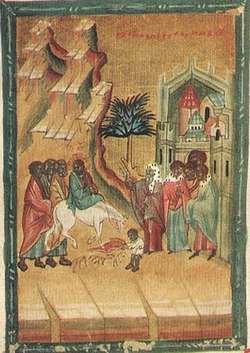 Source: Palm Sunday icon, Tver, 15th century, public domain, via Wikimedia Commons.
Placement in the Book and Grouping Rationale
This chapter begins the later oracle section and should stand alone because Zechariah 9:9 becomes one of the clearest Passion-threshold prophecies in Christian worship. It moves from judgment on proud powers to the meek King whose reign is peace.
The Pride of the Nations Humbled (Zechariah 9:1-8)
1 The burden of the word of the Lord in the land of Sedrach, and his sacrifice shall be in Damascus; for the Lord looks upon men, and upon all the tribes of Israel. 2 And in Emath, even in her coasts, are Tyre and Sidon, because they were very wise. 3 And Tyrus built strong-holds for herself, and heaped up silver as dust, and gathered gold as the mire of the ways.
4 And therefore the Lord will take them for a possession, and will smite her power in the sea; and she shall be consumed with fire. 5 Ascalon shall see, and fear; Gaza also, and shall be greatly pained, and Accaron; for she is ashamed at her trespass; and the king shall perish from Gaza, and Ascalon shall not be inhabited. 6 And aliens shall dwell in Azotus, and I will bring down the pride of the Philistines. 7 And I will take their blood out of their mouth, and their abominations from between their teeth; and these also shall be left to our God, and they shall be as a captain of a thousand in Juda, and Accaron as a Jebusite. 8 And I will set up a defence for my house, that they may not pass through, nor turn back, neither shall there any more come upon them one to drive them away: for now have I seen with mine eyes.
The oracle names cities associated with power, wealth, maritime strength, and Philistine pride. The Lord sees them all. Their security is not ultimate.
Yet even judgment has a gathering edge. The remnant of former enemies may be left for God. Zechariah is not interested in nationalist boasting. He is preparing the reader to see a King whose peace reaches beyond ordinary borders.
The Meek King Comes to Zion (Zechariah 9:9-10)
9 Rejoice greatly, O daughter of Sion; proclaim it aloud, O daughter of Jerusalem; behold, the King is coming to thee, just, and a Saviour; he is meek and riding on an ass, and a young foal. 10 And he shall destroy the chariots out of Ephraim, and the horse out of Jerusalem, and the bow of war shall be utterly destroyed; and there shall be abundance and peace out of the nations; and he shall rule over the waters as far as the sea, and the rivers to the ends of the earth.
Zion is commanded to rejoice because her King comes just, saving, meek, and riding on an ass. He does not arrive as another warlord. He breaks chariots, horses, and bows, and His peace reaches the nations.
This is why the Church hears this passage at the threshold of Palm Sunday. Christ enters Jerusalem openly, but not with worldly display. He is King precisely in His humility. The donkey is not a sentimental detail. It reveals the character of His reign.
Gems from the Fathers 💎
Justin Martyr reads Zechariah 9:9 with Jacob’s prophecy of the foal and sees the nations brought under Christ’s word.1 John Chrysostom emphasizes that Christ enters not with an army, but meekly, teaching that His Kingdom is not worldly pomp.2 Cyril of Alexandria adds that Christ rides with perfect self-restraint and leads the formerly untrained Gentiles toward the Jerusalem above.3
LXX / Translation Insight
Brenton’s wording, “just, and a Saviour; he is meek,” keeps the King’s righteousness, salvation, and humility together. If any of these is separated from the others, the passage is distorted. The King saves as the righteous and meek One.
Prisoners Released by the Blood of the Covenant (Zechariah 9:11-17)
11 And thou by the blood of thy covenant hast sent forth thy prisoners out of the pit that has no water. 12 Ye shall dwell in strongholds, ye prisoners of the congregation: and for one day of thy captivity I will recompense thee double. 13 For I have bent thee, O Juda, for myself as a bow, I have filled Ephraim; and I will raise up thy children, O Sion, against the children of the Greeks, and I will handle thee as the sword of a warrior. 14 And the Lord shall be over them, and his arrow shall go forth as lightning: and the Lord Almighty shall blow with the trumpet; and shall proceed with the tumult of his threatening. 15 The Lord Almighty shall protect them, and they shall destroy them, and overwhelm them with sling-stones; and they shall swallow them down as wine, and fill the bowls as the altar. 16 And the Lord their God shall save them in that day, even his people as a flock; for holy stones are rolled upon his land. 17 For if he has anything good, and if he has anything fair, the young men shall have corn, and there shall be fragrant wine to the virgins.
The covenant blood releases prisoners from the waterless pit. In the immediate prophetic world this is restoration language, but in Christian reading it opens naturally toward the Passion and Eucharistic life.
The Lord saves His people as a flock, and they become like precious stones in His land. The chapter ends not with military intoxication but with grain and wine, signs of life, blessing, and restored joy. The meek King gives freedom, not domination.
The Church’s Voice in Worship ⛪
Zechariah 9:9-15 is read on Lazarus Saturday of Great Lent, beside Genesis 49, Isaiah 40, and Zephaniah 3. Zechariah 9:11-14 also appears on Great Thursday, Third Hour. The lectionary logic is rich: the King who raises Lazarus comes to Jerusalem meekly, and His covenant blood opens the prison.
Spiritual Fruit 🍇
This passage asks whether we actually want Christ as He comes, or only a king who confirms our ambitions. The true King is meek, but not weak; peaceful, but not passive; humble, but not small. To receive Him is to let His covenant blood free us from the pits we have accepted as normal.
Teaching Notes
The Pride of the Nations Humbled (Zechariah 9:1-8)
- Ask: What kinds of security does this opening oracle challenge?
- Emphasize: The Lord sees proud powers and prepares a different kind of kingdom.
- Watch for: Do not turn judgment on the nations into contempt. The chapter moves toward peace for the nations.
- Connect: Connect to Christ disarming powers without imitating their pride.
- Show: Show the Persian-period map from the Introduction if students need regional context.
The Meek King Comes to Zion (Zechariah 9:9-10)
- Ask: Why is meekness essential to this King’s identity?
- Emphasize: Christ fulfills this prophecy by entering humbly, not as a warlord.
- Watch for: Avoid sentimental Palm Sunday readings that miss the destruction of war.
- Connect: Connect to Lazarus Saturday, Palm Sunday, and the Cross as royal humility.
- Show: Show the embedded Palm Sunday icon here.
Prisoners Released by the Blood of the Covenant (Zechariah 9:11-17)
Ask: What waterless pits do people accept as normal?
Emphasize: The covenant blood frees prisoners and restores joy.
Watch for: Do not reduce the blood of the covenant to an abstract doctrine. It is liberation and communion.
Connect: Connect to the Eucharist and to Christ freeing those held by death.
Show: Show the Passion lectionary-flow schematic from the Introduction if comparing Lazarus Saturday and Great Thursday.
Sources
Embedded Scripture is from Brenton’s English Septuagint (LXX).
Brief New Testament references are cited by reference.
Coptic Orthodox lectionary references are from the project’s lectionary reference tables and Holy Pascha reference tables.
Footnotes
-
Justin Martyr, Dialogue with Trypho 53, quoting Zechariah 9:9 and reading the foal as the nations brought under Christ (🔗). ↩
-
John Chrysostom, Homilies on John, Homily 66 on John 12, on Christ entering meekly and not with an army (🔗). ↩
-
Cyril of Alexandria, Commentary on John, Book 8 on John 12:14-15, T. Randell translation, public-domain source index (🔗). ↩