


Zephaniah 3 is not a sudden mood change from judgment to happiness. It is the transformation of a corrupt city into a purified, meek, gathered people. Zion rejoices because the Lord Himself is in her midst.
The Corrupt City and the Just Lord (Zephaniah 3:1-8)
1 Alas the glorious and ransomed city. 2 The dove hearkened not to the voice; she received not correction; she trusted not in the Lord, and she drew not near to her God. 3 Her princes within her were as roaring lions, her judges as the wolves of Arabia; they remained not till the morrow. 4 Her prophets are light and scornful men: her priests profane the holy things, and sinfully transgress the law.
5 But the just Lord is in the midst of her, and he will never do an unjust thing: morning by morning he will bring out his judgment to the light, and it is not hidden, and he knows not injustice by extortion, nor injustice in strife. 6 I have brought down the proud with destruction; their corners are destroyed: I will make their ways completely waste, so that none shall go through: their cities are come to an end, by reason of no man living or dwelling in them. 7 I said, But do ye fear me, and receive instruction, and ye shall not be cut off from the face of the land for all the vengeance I have brought upon her: prepare thou, rise early: all their produce is spoilt.
8 Therefore wait upon me, saith the Lord, until the day when I rise up for a witness: because my judgment shall be on the gatherings of the nations, to draw to me kings, to pour out upon them all my fierce anger: for the whole earth shall be consumed with the fire of my jealousy.
The chapter begins with a painful contrast. The city is called glorious and ransomed, yet she does not listen, receive correction, trust the Lord, or draw near to God. Her leaders devour, her prophets are light, and her priests profane holy things.
Verse 5 is the answer: “But the just Lord is in the midst of her.” The city is unjust, but the Lord in her midst is never unjust. Judgment is therefore not arbitrary anger. It is the presence of the Holy One exposing what cannot remain in communion with Him.
Verse 7 contains the phrase Cyril of Jerusalem uses in his Resurrection catechesis: “prepare thou, rise early.” Cyril hears Zephaniah’s rising-at-dawn language in relation to the disciples expecting the Resurrection. His use should be handled carefully, but it is a beautiful Paschal witness: the prophetic call to rise early is fulfilled in the dawn of Christ’s victory.
Gems from the Fathers 💎: Expect the Resurrection
Cyril of Jerusalem writes, “See how He says to the disciples, Prepare thyself, rise up at dawn: at dawn expect the Resurrection.”1
Purified Lips and a Meek Remnant (Zephaniah 3:9-13)
9 For then will I turn to the peoples a tongue for her generation, that all may call on the name of the Lord, to serve him under one yoke. 10 From the boundaries of the rivers of Ethiopia will I receive my dispersed ones; they shall offer sacrifices to me. 11 In that day thou shalt not be ashamed of all thy practices, wherein thou hast transgressed against me: for then will I take away from thee thy disdainful pride, and thou shalt no more magnify thyself upon my holy mountain. 12 And I will leave in thee a meek and lowly people; 13 and the remnant of Israel shall fear the name of the Lord, and shall do no iniquity, neither shall they speak vanity; neither shall a deceitful tongue be found in their mouth: for they shall feed, and lie down, and there shall be none to terrify them.
Brenton’s unusual phrase “a tongue for her generation” describes speech given so that all may call on the Lord and serve Him together. Read beside verse 13, where deceit disappears from the remnant’s mouth, it suggests healed speech: the tongue once used for taunting and lies becomes an instrument of prayer.
The remnant is meek and lowly: it fears the Lord, refuses deceit, and rests without terror. Ethiopia, under judgment in 2:12, appears again in 3:10 as the region from which God receives His dispersed people. The distant horizon now belongs to the promise of gathering and worship.
LXX and source-shape insight
Brenton’s phrase “to serve him under one yoke” gives the passage a strong ecclesial feel. The healed peoples are not merely private believers. They are gathered into common service under the Lord.
Gems from the Fathers 💎: A Remnant Gathered for Worship
Eusebius of Caesarea reads Zephaniah 3:9 and the following remnant promises as gathering believing Jews together with people called from the nations. Shared worship, not pride in belonging to a superior people, is the hope this reading illuminates.
Rejoice, Daughter of Zion (Zephaniah 3:14-20)
14 Rejoice, O daughter of Sion; cry aloud, O daughter of Jerusalem; rejoice and delight thyself with all thine heart, O daughter of Jerusalem. 15 The Lord has taken away thine iniquities, he has ransomed thee from the hand of thine enemies: the Lord, the King of Israel, is in the midst of thee: thou shalt not see evil any more.
16 At that time the Lord shall say to Jerusalem, Be of good courage, Sion; let not thine hands be slack. 17 The Lord thy God is in thee; the Mighty One shall save thee: he shall bring joy upon thee, and shall refresh thee with his love; and he shall rejoice over thee with delight as in a day of feasting. 18 And I will gather thine afflicted ones. Alas! who has taken up a reproach against her?
19 Behold, I will work in thee for thy sake at that time, saith the Lord: and I will save her that was oppressed, and receive her that was rejected; and I will make them a praise, and honoured in all the earth. 20 And their enemies shall be ashamed at that time, when I shall deal well with you, and at the time when I shall receive you: for I will make you honoured and a praise among all the nations of the earth, when I turn back your captivity before you, saith the Lord.
The final oracle is full of joy, but it is joy after purification. Zion rejoices because the Lord has taken away her iniquities and ransomed her from her enemies. The center is not Zion’s mood. The center is the Lord: “The Lord, the King of Israel, is in the midst of thee.”
Verse 17 is one of the most tender lines in the prophets. The Mighty One saves, brings joy, refreshes with His love, and rejoices over His people as in a day of feasting. The God who searched Jerusalem with a candle now rejoices over the people He has healed.
Verse 18’s question about reproach is difficult, but its setting is clear: God gathers the afflicted and gives honour to the rejected. Zion’s joy does not leave the wounded outside. It includes those whom He receives and heals.
Orthodox Theological Reading
Zephaniah 3 shows that the goal of judgment is communion. The corrupt city is not replaced by a fantasy city. It is purified into a meek and worshiping people. God does not merely remove enemies around Zion. He removes pride and deceit within Zion.
Joy without purification becomes sentiment; purification without joy becomes despair. The Lord gives both cleansing and joy.
Christological Reading
Christ is the Lord and King in the midst of His people. In His Incarnation, God truly comes into the midst. In His Passion, He gathers the rejected by becoming rejected. In His Resurrection, He turns mourning into joy. In His Church, He purifies lips for prayer, praise, and Eucharistic thanksgiving.
The Daughter of Zion reaches its fullness as the Church rejoicing in her King. This should be said carefully: the historical word to Zion remains real, and the Christian fulfillment deepens rather than erases it.
The Church’s Voice in Worship ⛪
The St. Mary Ottawa Holy Pascha book appoints Zephaniah 3:11-20 for Hosanna Sunday, Ninth Hour. The Katameros cycle also lists 3:14-20 for Lazarus Saturday, without naming an hour.
At this threshold, Zion’s rejoicing prepares us to welcome the King who comes to save through His Passion. The joy rests not on safe circumstances but on His presence: “The Lord, the King of Israel, is in the midst of thee.”
Iconography and Visual Teaching 🖼️
The prophetic-row image can be used to show Zephaniah among the wider company of prophets. It should not be presented as an icon of Zephaniah 3 specifically unless a verified scroll inscription supports that.
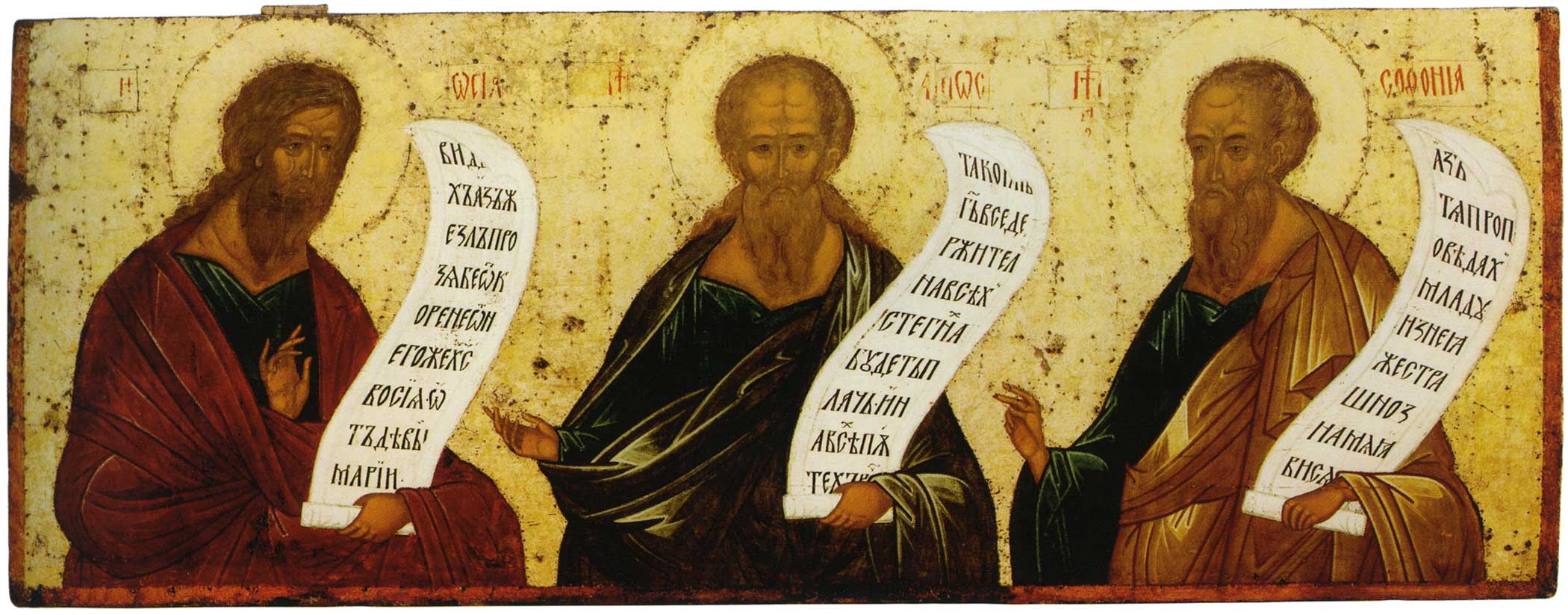 Source: Kirillo-Belozersky iconostasis prophetic row, 1497, Public domain. 🔗
Spiritual Fruit 🍇
Zephaniah 3 invites the soul to become part of the meek remnant. Let God purify speech. Refuse vanity and deceit. Draw near to the Lord instead of remaining a ransomed city that will not listen.
The chapter also teaches how to receive joy. Christian joy is not denial of judgment. It is the fruit of being gathered, cleansed, forgiven, and loved by the Lord who is in our midst. Pray this chapter as a movement from confession to praise.
Teaching Notes
The Corrupt City and the Just Lord
- Ask: How can a city be called ransomed and still refuse correction?
- Emphasize: The Lord’s presence exposes injustice because He is just.
- Watch for: Do not use judgment language to crush wounded people. The goal is purification and communion.
- Connect: Cyril’s dawn reading can point toward Resurrection hope, but keep it tied to the text and Paschal context.
- Show: Use the book arc schematic to keep judgment and joy connected.
Purified Lips and a Meek Remnant
- Ask: What would it mean for God to purify our speech as prayer, truth, and worship?
- Emphasize: The remnant is meek and lowly, not powerful and self-protective.
- Watch for: Do not make remnant language proud. The remnant exists by mercy.
- Connect: The Church is gathered into one worshiping service under Christ.
- Show: Use the prophetic-row image only as context for Zephaniah among the prophets.
Rejoice, Daughter of Zion
- Ask: Why does Zephaniah place joy after purification?
- Emphasize: The center of the joy is the Lord in the midst, not human optimism.
- Watch for: Do not preach joy without repentance and healing.
- Connect: The Ottawa Hosanna Sunday appointment and the Katameros Lazarus Saturday listing place Zion’s joy at the threshold of the King’s Passion.
- Show: If teaching Holy Week, pair this passage with Zechariah 9 and the Palm Sunday entrance.
Sources
- Embedded Scripture is from Brenton’s English Septuagint (LXX).
- St. Mary Ottawa, Holy Pascha, Lent 1734 A.M./2018 A.D.: Hosanna Sunday, Ninth Hour, 3:11-20 (historical printed witness). Katameros cycle: Lazarus Saturday, 3:14-20 (working local source; hour unspecified). Neither establishes an unqualified claim of current parish practice.
- Cyril of Jerusalem, Catechetical Lecture 14.6. 🔗
- Eusebius of Caesarea, Proof of the Gospel II.3, section 52, on Zephaniah 3:9 and the meek remnant, trans. W. J. Ferrar. This argument occurs within a polemic about Jewish unbelief; the guide draws on its gathering of believing Jews and people from the nations, not its collective denunciations. II.2, section 17, lists 3:8 separately. 🔗
- Visual source details are recorded in
Resources Used - Zephaniah.mdandAssets/zephaniah-visual-manifest.json.