


Zephaniah 1 is not severe because God delights in destruction. It is severe because false security is spiritually deadly. The chapter exposes idolatry, religious mixture, indifference, and the belief that God will neither act in mercy nor judge in truth.
The Prophet in Josiah’s Days (Zephaniah 1:1)
1 The word of the Lord which came to Sophonias the son of Chusi, the son of Godolias, the son of Amorias, the son of Ezekias, in the days of Josias son of Amon, king of Juda.
Zephaniah begins with history, not abstraction. The word of the Lord comes to Sophonias, or Zephaniah, in the days of King Josiah. This matters because Josiah’s reforms did not automatically purify every heart. A time of external reform can still hide internal compromise.
The long genealogy gives the prophet weight inside Judah’s memory. Brenton gives the names as Chusi, Godolias, Amorias, and Ezekias. The possible connection between Ezekias and King Hezekiah is worth noting, but it should remain cautious. The spiritual point is clearer than the genealogical certainty: this is a word to Judah from within Judah, not a detached attack from outside.
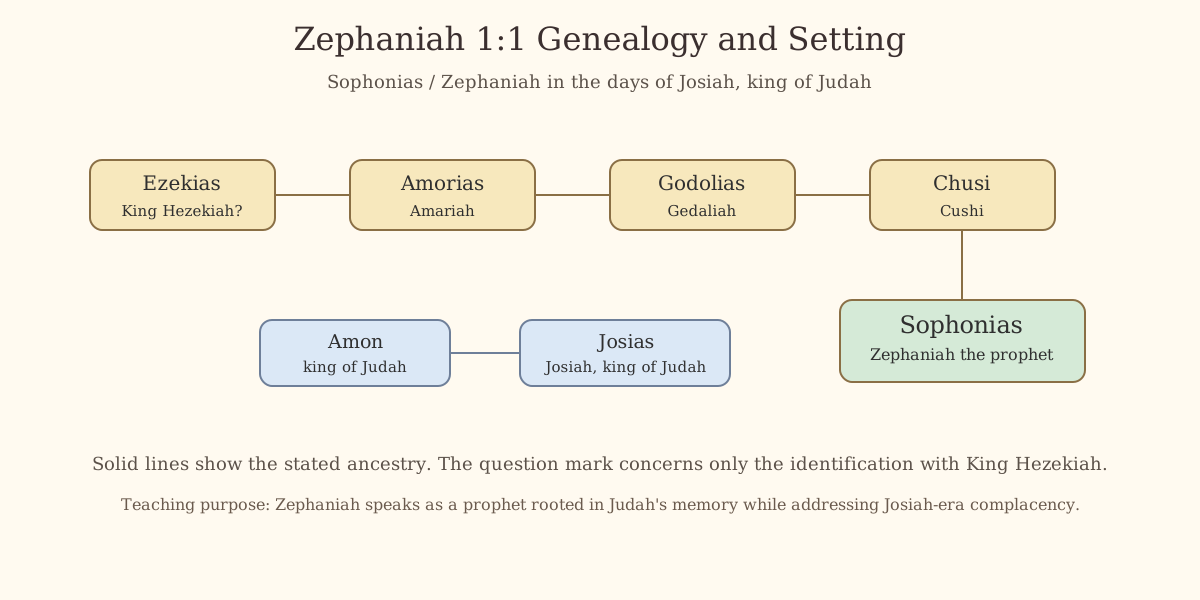 Source: Local teaching schematic from Zephaniah 1:1. The ancestry is explicit; the label marks the uncertain identification of Ezekias with King Hezekiah.
The Lord Removes Mixed Worship (Zephaniah 1:2-6)
2 Let there be an utter cutting off from the face of the land, saith the Lord. 3 Let man and cattle be cut off; let the birds of the air and the fishes of the sea be cut off; and the ungodly shall fail, and I will take away the transgressors from the face of the land, saith the Lord. 4 And I will stretch out mine hand upon Juda, and upon all the inhabitants of Jerusalem; and I will remove the names of Baal out of this place, and the names of the priests; 5 and them that worship the host of heaven upon the house-tops; and them that worship and swear by the Lord, and them that swear by their king; 6 and them that turn aside from the Lord, and them that seek not the Lord, and them that cleave not to the Lord.
The opening judgment sounds cosmic: man and cattle, birds and fish, the face of the land. Zephaniah is deliberately undoing the language of creation. Sin is not a private flaw added to an otherwise healthy world. It unravels communion with God and disorders the created order around us.
The Lord then names Judah and Jerusalem. Judgment begins where God’s name has been known. The danger is not only Baal worship. It is divided worship: those who worship the host of heaven, those who swear by the Lord and by another king, and those who have turned aside from seeking the Lord. The chapter exposes the soul that wants religious language without surrendered love.
This is a strong word for Orthodox Christians because external worship can become a cover for divided allegiance. A person can know the hymns, attend the services, and still keep secret altars of fear, comfort, money, status, or bitterness.
The Day of the Lord as Sacrifice (Zephaniah 1:7-13)
7 Fear ye before the Lord God; for the day of the Lord is near; for the Lord has prepared his sacrifice, and has sanctified his guests. 8 And it shall come to pass in the day of the Lord’s sacrifice, that I will take vengeance on the princes, and on the king’s house, and upon all that wear strange apparel. 9 And I will openly take vengeance on the porches in that day, on the men that fill the house of the Lord their God with ungodliness and deceit.
10 And there shall be in that day, saith the Lord, the sound of a cry from the gate of men slaying, and a howling from the second gate, and a great crashing from the hills. 11 Lament, ye that inhabit the city that has been broken down, for all the people has become like Chanaan; and all that were exalted by silver have been utterly destroyed.
12 And it shall come to pass in that day, that I will search Jerusalem with a candle, and will take vengeance on the men that despise the things committed to them; but they say in their hearts, The Lord will not do any good, neither will he do any evil. 13 And their power shall be for a spoil, and their houses for utter desolation; and they shall build houses, but shall not dwell in them; and they shall plant vineyards, but shall not drink the wine of them.
“Fear ye before the Lord God” calls for reverence before the One who sees truly. The Day of the Lord is described as a sacrifice, with guests already sanctified. This is terrifying because the people who thought they were safe are being summoned before God as the day itself becomes liturgical judgment.
Verse 12 is one of the spiritual centers of the chapter: the Lord searches Jerusalem with a candle. He is not vague. He searches the hidden corners, the settled habits, the little rooms where the heart has stored indifference. The condemned words are not open atheism, but practical atheism: “The Lord will not do any good, neither will he do any evil.”
That sentence is spiritually dangerous because it deadens both repentance and hope. If God does no good, we stop praying with expectation. If God does no evil, meaning no judgment against evil, we stop fearing sin. Zephaniah shatters both errors.
The chapter also attacks wealth as false refuge. Houses and vineyards cannot protect a soul that refuses God. This does not condemn work, property, or ordinary provision. It condemns the heart that trusts possessions more than repentance.
The Near and Bitter Day (Zephaniah 1:14-18)
14 For the great day of the Lord is near, it is near, and very speedy; the sound of the day of the Lord is made bitter and harsh. 15 A mighty day of wrath is that day, a day of affliction and distress, a day of desolation and destruction, a day of gloominess and darkness, a day of cloud and vapour, 16 a day of the trumpet and cry against the strong cities, and against the high towers. 17 And I will greatly afflict the men, and they shall walk as blind men, because they have sinned against the Lord; therefore he shall pour out their blood as dust, and their flesh as dung. 18 And their silver and their gold shall in nowise be able to rescue them in the day of the Lord’s wrath; but the whole land shall be devoured by the fire of his jealousy; for he will bring a speedy destruction on all them that inhabit the land.
The final movement presses urgency. The great Day of the Lord is near, speedy, bitter, harsh, dark, and full of trumpet cry. Zephaniah refuses to let judgment become a theory. It is a summons now.
The St. Mary Ottawa Holy Pascha book appoints Zephaniah 1:2-12 for Monday Eve, First Hour, and 1:14-2:2 for the Third Hour. In this Paschal setting, the warning that silver and gold cannot rescue prepares us to watch Christ enter His Passion. Salvation comes from the Lord Himself, not from what we possess.
LXX and source-shape insight
Brenton’s phrase “the Lord has prepared his sacrifice” helps the Paschal hearing of the chapter. The day is not merely a disaster date. It is a solemn encounter with God. The passage warns us that worship without repentance becomes judgment, while repentance turns judgment into healing.
Orthodox Theological Reading
The Lord searches not only obvious rebellion, but the quiet lie that He is inactive.
This should not produce despair. A searching God is also a healing God. The candle that exposes the heart is severe mercy. It shows us what must be confessed before it becomes permanent ruin.
Christological Reading
Christ fulfills the Day of the Lord not by canceling judgment, but by entering it. On the Cross, the Judge stands with the judged and bears the fire of divine love against sin. Zephaniah’s warning that wealth cannot rescue becomes visible in Holy Week: only Christ’s self-giving love can save.
He exposes false refuge so that He may become our true refuge.
The Church’s Voice in Worship ⛪
These Monday Eve readings in the Ottawa Pascha book turn our attention inward: before we condemn Judas, the leaders, the crowds, or the nations, we let the Lord search our own false security.
Iconography and Visual Teaching 🖼️
The Zephaniah icon should be used as orientation, not as a claim about a particular verse. It reminds the reader that the Church receives Zephaniah as one of the prophets whose word still speaks in worship.
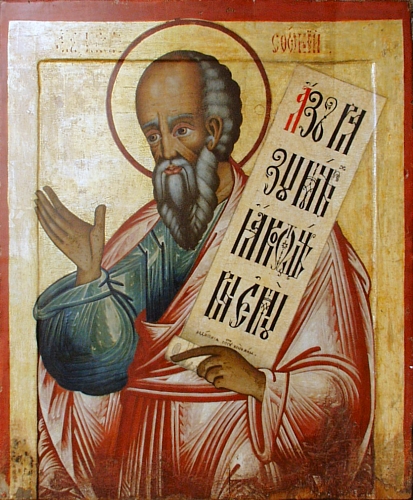 Source: Wikimedia Commons, Prophet Zephaniah, old Russian Orthodox icon, Public domain. 🔗
Spiritual Fruit 🍇
Zephaniah 1 asks for honest repentance before the Lord who searches with a candle. The practical question is not only, “What obvious sin must I stop?” It is also, “Where have I begun to live as though God will neither do good nor judge evil?”
The fruit of this chapter is holy sobriety. Pray with expectation because God does good. Repent with seriousness because God judges evil. Hold possessions lightly because silver and gold cannot rescue. Enter Holy Week as one who is willing to be searched and healed.
Teaching Notes
The Prophet in Josiah’s Days
- Ask: Why does it matter that Zephaniah speaks during Josiah’s reign rather than in a completely pagan setting?
- Emphasize: External reform does not replace personal repentance.
- Watch for: Do not overstate the Ezekias/Hezekiah identification as certain.
- Connect: The Lord speaks to His own people first because covenant privilege increases responsibility.
- Show: Use the genealogy schematic to explain the setting and the uncertainty around Ezekias.
The Lord Removes Mixed Worship
- Ask: Where can worship become mixed with fear, status, comfort, or hidden loyalties?
- Emphasize: Zephaniah condemns divided allegiance, not only obvious idol worship.
- Watch for: Do not let students think church attendance alone proves the heart is undivided.
- Connect: Christ calls the whole heart to love the Lord without rival altars.
- Show: Keep the prophet icon visible as a reminder that the Church receives this warning as a living word.
The Lord Searches Jerusalem (Zephaniah 1:7-13)
- Ask: What does practical atheism look like in a person who still uses religious language?
- Emphasize: “The Lord will not do any good, neither will he do any evil” kills both hope and repentance.
- Watch for: Do not reduce the Day of the Lord to end-times curiosity. In Zephaniah it is first a call to repentance.
- Connect: Christ searches the heart in order to heal it.
- Show: Use the prophet icon briefly to frame Zephaniah as a living prophetic witness in the Church.
The Near and Bitter Day
- Ask: How does this warning prepare us for Pascha in the Ottawa service book?
- Emphasize: Wealth, houses, and vineyards cannot save the soul from judgment.
- Watch for: Avoid despair. The warning is meant to awaken repentance before ruin.
- Connect: The Cross is where judgment and mercy meet.
- Show: Use the late-Judah map only for historical orientation, not as the main spiritual point.
Sources
- Embedded Scripture is from Brenton’s English Septuagint (LXX).
- St. Mary Ottawa, Holy Pascha, Lent 1734 A.M./2018 A.D.: Monday Eve, First Hour (1:2-12) and Third Hour (1:14-2:2). Historical printed witness, not independently established here as current parish practice.
- Visual source details are recorded in
Resources Used - Zephaniah.mdandAssets/zephaniah-visual-manifest.json.