


This narration is from a previous version of the study and may include a combined recording of multiple chapters.
This passage moves from names to worship. The returned people are not an anonymous crowd. Families, priests, Levites, singers, porters, servants, and leaders are counted before the altar is raised and the foundation is laid. Restoration begins with people gathered for worship, not with a faceless construction project.
Why This Passage Matters
1 Esdras 5:7-73 teaches that restoration is communal, liturgical, and costly. The people return by name. The altar is restored before the temple is finished. The Feast of Tabernacles is kept according to the Law. The foundation brings both joy and weeping because restoration remembers both mercy and loss.
The chapter moves from receiving a scattered people to discerning a proposed partnership. The altar’s purpose governs both acts: people are gathered to worship the Lord faithfully. The final refusal needs to be heard beside the unexpected gathering from other nations in verse 50.
Context in the Book
After the Darius-era return in 4:42-5:6, this passage retells the Cyrus-era return: verses 55 and 71 name Cyrus’s authorization, and verse 73 takes the work forward to Darius. The book has centered the truth contest before returning to the older list. It is arranging episodes by theological purpose, not providing an unbroken chronology. The parallels are Ezra 2, Ezra 3, and Ezra 4:1-5.1
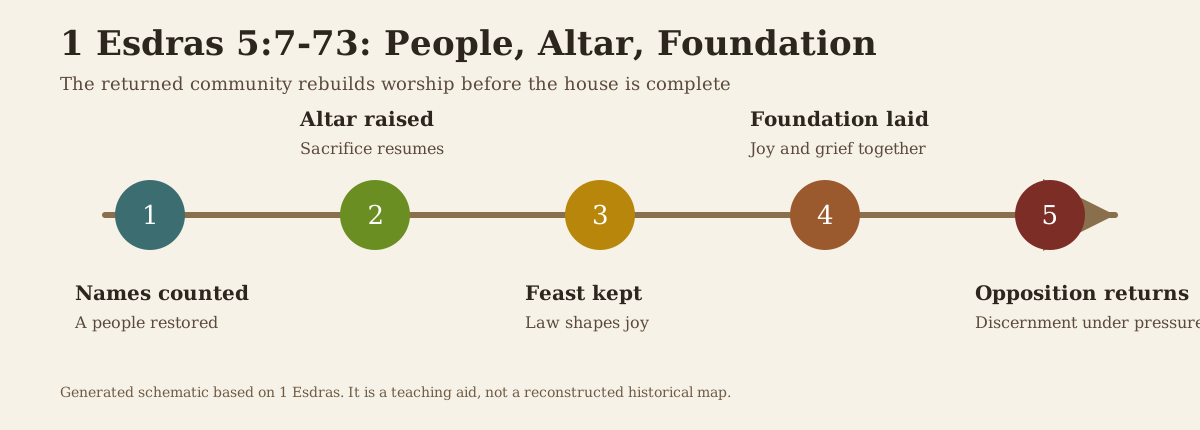
Generated schematic based on 1 Esdras 5:7-73. It is a teaching aid, not a reconstructed historical map.
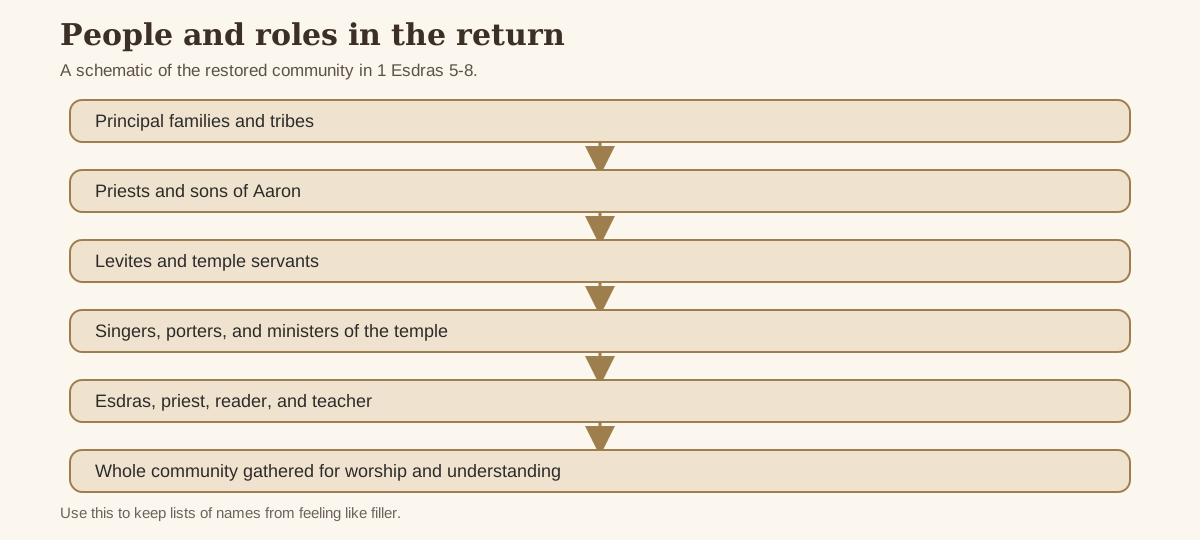
Generated teaching aid based on 1 Esdras 5-8. It is a schematic of roles in restoration, not a complete census or genealogy.
1 Esdras is not included in the NKJV. The Scripture below follows the wording and verse numbers of the Brenton edition.
The Returned People Are Counted by Name (1 Esdras 5:7-22)
7 And these are they of Jewry that came up from the captivity, where they dwelt as strangers, whom Nabuchodonosor the king of Babylon had carried away unto Babylon. 8 And they returned unto Jerusalem, and to the other parts of Jewry, every man to his own city, who came with Zorobabel, and Jesus, Nehemias, Zaraias, Reesaias, Enenius, Mardocheus, Beelsarus, Aspharasus, Reelius, Roimus, and Baana, their guides.
9 The number of them of the nation, and their governors: the sons of Phoros, two thousand an hundred seventy and two: the sons of Saphat, four hundred seventy and two:
10 The sons of Ares, seven hundred fifty and six:
11 The sons of Phaath Moab, among the sons of Jesus and Joab, two thousand eight hundred and twelve:
12 The sons of Elam, a thousand two hundred fifty and four: the sons of Zathui, nine hundred seventy and five: the sons of Corbe, seven hundred and five: the sons of Bani, six hundred forty and eight:
13 The sons of Bebai, six hundred thirty and three: the sons of Argai, one thousand three hundred twenty and two:
14 The sons of Adonikan, six hundred thirty and seven: the sons of Bagoi, two thousand six hundred and six: the sons of Adin, four hundred fifty and four:
15 The sons of Ater, son of Ezekias, ninety and two: the sons of Cilan and Azenan, threescore and seven: the sons of Azarus, four hundred thirty and two:
16 The sons of Annis, an hundred and one: the sons of Arom, thirty-two: the sons of Bassai, three hundred twenty and three: the sons of Arsiphurith, an hundred and two:
17 The sons of Beterus, three thousand and five: the sons of Bethlomon, an hundred twenty and three:
18 They of Netophah, fifty and five: they of Anathoth, an hundred fifty and eight: they of Bethsamos, forty and two:
19 They of Kiriathiarius, twenty and five: they of Caphira and Beroth, seven hundred forty and three.
20 They of Chadias and Ammidoi, four hundred twenty and two: they of Cirama and Gabbes, six hundred twenty and one:
21 They of Macalon, an hundred twenty and two: they of Betolius, fifty and two: the sons of Nephis, an hundred fifty and six:
22 The sons of Calamolalus and Onus, seven hundred twenty and five: the sons of Jerechus, two hundred forty and five:
The list can feel slow, but it is spiritually important. Exile scattered families and identities. Restoration counts them. The people are not only a political population; they are households brought back from captivity.
The names also resist the false idea that salvation is abstract. God restores real people, with histories, fathers, towns, losses, and responsibilities. The return from Babylon is not only about land. It is about a people being reassembled before God. Jesus, the familiar Jeshua or Joshua, is the high priest; Zorobabel is Zerubbabel, the Davidic leader. Nabuchodonosor is Nebuchadnezzar. The names Nehemias and Mardocheus correspond to Nehemiah and Mordecai, but this list alone does not establish that they are the famous figures of the later books. A shared name is not a demonstrated biography.
Light from the Word 🕯️
The God who restores Jerusalem also remembers names. Lists in Scripture can be acts of mercy. They say that the scattered are not forgotten and that the people of God are more than statistics.
For Our Life
A parish, ministry, or family should never treat people as numbers only. Counting can become bureaucracy, but in Scripture it can also become remembrance. The question is whether the counting serves love, worship, and responsibility.
Priests, Levites, Singers, Porters, and Servants Return (1 Esdras 5:23-46)
23 The sons of Sanaas, three thousand three hundred and one.
24 The priests: the sons of Jeddu, the son of Jesus, among the sons of Sanasib, eight hundred seventy and two: the sons of Emmeruth, two hundred fifty and two:
25 The sons of Phassaron, a thousand forty and seven: the sons of Carme, two hundred and seventeen.
26 The Levites: the sons of Jessue, and Cadmiel, and Banuas, and Sudias, seventy and four.
27 The holy singers: the sons of Asaph, an hundred twenty and eight.
28 The porters: the sons of Salum, the sons of Atar, the sons of Tolman, the sons of Dacobi, the sons of Ateta, the sons of Tobis, in all an hundred thirty and nine.
29 The servants of the temple: the sons of Esau, the sons of Asipha, the sons of Tabaoth, the sons of Ceras, the sons of Sud, the sons of Phaleas, the sons of Labana, the sons of Agraba,
30 The sons of Acud, the sons of Uta, the sons of Cetab, the sons of Agaba, the sons of Subai, the sons of Anan, the sons of Cathua, the sons of Geddur,
31 The sons of Jairus, the sons of Daisan, the sons of Noeba, the sons of Chaseba, the sons of Cazera, the sons of Ozia, the sons of Phinees, the sons of Azara, the sons of Bastai, the sons of Assana, the sons of Mani, the sons of Naphisi, the sons of Acuph, the sons of Achiba, the sons of Asub, the sons of Pharacim, the sons of Basalem,
32 The sons of Meedda, the sons of Coutha, the sons of Charea, the sons of Barcue, the sons of Serar, the sons of Thomoi, the sons of Nasith, the sons of Atipha.
33 The sons of the servants of Solomon: the sons of Azaphioth, the sons of Pharira, the sons of Jeieli, the sons of Lozon, the sons of Isdael, the sons of Saphui,
34 The sons of Hagia, the sons of Phacareth, the sons of Sabi, the sons of Sarothi, the sons of Misaias, the sons of Gas, the sons of Addus, the sons of Suba, the sons of Apherra, the sons of Barodis, the sons of Saphag, the sons of Allom.
35 All the ministers of the temple, and the sons of the servants of Solomon, were three hundred seventy and two.
36 These came up from Thermeleth and Thelersas, Charaathalan leading them, and Aalar; 37 they could not shew their families or their stock, how they were of Israel: the sons of Dalan, the son of Baenan, the sons of Necodan, six hundred fifty and two.
38 And of the priests that usurped the office of the priesthood, and were not found: the sons of Obdia, the sons of Acbos, the sons of Jaddus, who married Augia one of the daughters of Phaezeldæus, and was named after his name.
39 And when the description of the kindred of these men was sought in the register, and was not found, they were removed from executing the office of the priesthood: 40 for unto them said Nehemias and Attharias, that they should not be partakers of the holy things, till there arose up an high priest clothed with doctrine and truth.
41 So of Israel, from them of twelve years old and upward, beside menservants and womenservants, they were all in number forty thousand, two thousand three hundred and sixty. 42 Their menservants and handmaids were seven thousand three hundred thirty and seven: the singing men and singing women, two hundred forty and five: 43 four hundred thirty and five camels, seven thousand thirty and six horses, two hundred forty and five mules, five thousand five hundred twenty and five beasts used to the yoke:
44 And certain of the chief of their families, when they came to the temple of God that is in Jerusalem, vowed to set up the house again in his own place according to their ability, 45 and to give into the holy treasury of the works a thousand pounds of gold, five thousand of silver, and an hundred priestly vestments. 46 And so dwelt the priests and the Levites and the people in Jerusalem, and in the country, the singers also and the porters; and all Israel in their villages.
The list widens to priests, Levites, singers, porters, temple servants, and those whose genealogies are uncertain. Restoration requires different ministries. Sacrifice, song, gates, service, and order all matter.
The uncertain genealogies are especially sobering. Some cannot show their lineage clearly. Verse 39 withholds priestly office, and verse 40 restricts participation in the holy things while the community waits for discernment. Attharias corresponds to the governor’s title in the parallel Ezra 2:63; here the line also names Nehemias. This pause distinguishes an unresolved claim to office from a judgment that a person has no dignity.
‘An high priest clothed with doctrine and truth’ translates the priestly means of discernment known as the Urim and Thummim. Ezra 2:63 renders them ‘Lights and Perfections’; Exodus 28:30 in Brenton speaks of ‘the Manifestation and the Truth’. The traditional objects are not explained in detail here. The differing renderings show Greek interpretations of the same priestly terms, not three different promises.1
Within 1 Esdras, the waiting for truth-bearing priestly judgment recalls the truth contest in 3:1-4:41. That literary connection supports a Christian reading without pretending that the returned people already possessed the full Gospel revelation. Christ is the Truth (John 14:6), the Light of the world (John 8:12), and the High Priest perfected forever (Hebrews 7:28). The discernment they await finds its fullness in Him, not in the strength of a register or a claim to status.
Light from the Word 🕯️
‘Till there arose up’ makes restraint an act of hope. The leaders do not manufacture certainty to end an uncomfortable pause. A ministry can wait for a truthful judgment while continuing to care for the people affected by it. In Christ, patience serves the truth and protects persons from our haste.
Guardrail for Reading
Do not treat questions of genealogy as contempt for people. The passage protects priestly service and worship order. It does not deny the dignity of those whose records are uncertain.
The Altar Is Raised and the Feast Is Kept (1 Esdras 5:47-55)
47 But when the seventh month was at hand, and when the children of Israel were every man in his own place, they came altogether with one consent into the open place of the first gate which is toward the east. 48 Then stood up Jesus the son of Josedec, and his brethren the priests, and Zorobabel the son of Salathiel, and his brethren, and made ready the altar of the God of Israel, 49 to offer burnt sacrifices upon it, according as it is expressly commanded in the book of Moses the man of God.
50 And there were gathered unto them out of the other nations of the land, and they erected the altar upon his own place, because all the nations of the land were at enmity with them, and oppressed them; and they offered sacrifices according to the time, and burnt offerings to the Lord both morning and evening. 51 Also they held the feast of tabernacles, as it is commanded in the law, and offered sacrifices daily, as was meet: 52 and after that, the continual oblations, and the sacrifice of the sabbaths, and of the new moons, and of all holy feasts.
53 And all they that had made any vow to God began to offer sacrifices to God from the first day of the seventh month, although the temple of the Lord was not yet built.
54 And they gave unto the masons and carpenters money, meat, and drink, with cheerfulness. 55 Unto them of Zidon also and Tyre they gave carrs, that they should bring cedar trees from Libanus, which should be brought by floats to the haven of Joppe, according as it was commanded them by Cyrus king of the Persians.
The people come together with one consent at the eastward first gate, a detail absent from Ezra 3:1. Ezekiel 43:1-5 sees God’s glory entering by the eastern gate, and Ezekiel 44:1-3 keeps that gate marked by His presence. The shared direction offers a modest biblical resonance for the Church’s prayer toward the east; it does not identify this gate with Ezekiel’s visionary gate or prove a Christian liturgical rule from the verse.
Jesus the son of Josedec and Zerubbabel raise the altar together. This Joshua or Jeshua is the high priest beside Zerubbabel in Haggai 1:1. In Zechariah 3, he receives clean garments in place of filthy ones; in Zechariah 6:11-13, he is crowned as the oracle announces the Branch and a peaceable counsel between royal and priestly figures. Zechariah 4:14 describes two anointed ones before the Lord. Read together with these leaders, the visions prepare the Christian confession of Christ as both King and High Priest. The Greek name Jesus is the same name borne by our Lord, but the returned high priest is a historical person distinct from Him.
Verse 50 also differs from Ezra 3:3: it says that people from other nations gathered to them, before describing the nations’ enmity. It does not identify the first group’s motives or precisely assign each person’s labor. We can say that the Brenton text includes this gathering, not that every foreign group opposed the altar or that the verse supplies a complete account of conversion. Its complexity matters when the later building partnership is refused.
They keep the Feast of Tabernacles according to the Law. Restoration is not invention. It is return to the worship God gave. The people do not wait for perfect security before obeying. They begin with sacrifice, time, and feast.
Light from the Word 🕯️
The altar comes before the completed house. This teaches that worship can begin even when the larger rebuilding is unfinished. A people returning from exile starts with the offering of itself to God.
Gems from the Fathers 💎: The priest and the people clothed anew
St. Justin Martyr reads the vision of Joshua in Zechariah as an announcement of the saving work of our High Priest, Christ. He then applies the change of garments to believers cleansed by Christ: ‘we have by the grace of our Jesus, according to His Father’s will, stripped ourselves of all those filthy wickednesses with which we were imbued.’2 His interpretation is of Zechariah, not direct commentary on the altar verse here. It makes the priestly name fruitful for repentance: our King and Priest does not merely rebuild an external house; He clothes His people anew.
Lactantius also reads Zechariah’s priest Christologically and connects His enduring priesthood to the Church as an enduring temple. His theological argument reaches beyond the historical Joshua, whom he explicitly distinguishes from Christ.3 The correspondence is a Christian reading of the prophetic vision, not an assertion that the historical priest and our Lord are one person.
The Foundation Is Laid with Joy and Grief (1 Esdras 5:56-65)
56 And in the second year and second month after his coming to the temple of God at Jerusalem began Zorobabel the son of Salathiel, and Jesus the son of Josedec, and their brethren, and the priests, and the Levites, and all they that were come unto Jerusalem out of the captivity: 57 and they laid the foundation of the house of God in the first day of the second month, in the second year after they were come to Jewry and Jerusalem. 58 And they appointed the Levites from twenty years old over the works of the Lord. Then stood up Jesus, and his sons and brethren, and Cadmiel his brother, and the sons of Emadabun, with the sons of Joda the son of Eliadud, with their sons and brethren, all Levites, with one accord setters forward of the business, labouring to advance the works in the house of the Lord. So the builders built the temple of the Lord.
59 And the priests stood arrayed in their vestments with musical instruments and trumpets; and the Levites the sons of Asaph had cymbals, 60 singing songs of thanksgiving, and praising the Lord, according as David the king of Israel had ordained.
61 And they sung with loud voices songs to the praise of the Lord, because his mercy and glory is for ever in all Israel. 62 And all the people sounded trumpets, and shouted with a loud voice, singing songs of thanksgiving unto the Lord for the rearing up of the house of the Lord.
63 Also of the priests and Levites, and of the chief of their families, the ancients who had seen the former house came to the building of this with weeping and great crying. 64 But many with trumpets and joy shouted with loud voice, 65 insomuch that the trumpets might not be heard for the weeping of the people; yet the multitude sounded marvellously, so that it was heard afar off.
The foundation is laid with priests, trumpets, Levites, cymbals, praise, and shouting. The displayed verse 61 says that ‘his mercy and glory is for ever in all Israel’. Ezra 3:11 also praises His goodness, but that wording should not displace this account’s pairing of mercy with glory. The returned people praise the Lord’s enduring faithfulness at the very place where glory had seemed lost. Yet the elders who had seen the former house weep with a loud voice.
This is one of the most human moments in the book. Restoration is joyful, but it does not erase memory. The younger may hear only triumph; the older remember what was lost. Scripture allows both voices to stand together.
Light from the Word 🕯️
The elders’ memory belongs beside Haggai 2:3-9, which asks who saw the former house and promises a greater latter glory. Zechariah 4:10 rebukes despising the small beginning. The smaller visible result need not be the limit of God’s promise. Memory can lament a true loss while faith receives the work God is doing now.
Gems from the Fathers 💎: A greater house of living stones
St. Augustine interprets Haggai’s greater-glory promise as fulfilled in Christ’s Church, rather than in the magnificence of the rebuilt stone temple. He writes: ‘But this house which pertains to the new testament is just as much more glorious as the living stones, even believing, renewed men, of which it is constructed are better.’4 His explanation of Haggai illuminates the elders’ tears here. Christian hope is not a competition between buildings or a contempt for Israel’s grief. Christ forms living persons into His house, whose promised glory reaches beyond what the builders can measure.
For Our Life
When a family, parish, or ministry is restored after loss, different generations may feel it differently. Some rejoice because something new begins. Others grieve because they remember what was broken. A wise servant honors both while asking what living persons are being renewed.
Opposition Returns After Worship Begins (1 Esdras 5:66-73)
66 Wherefore when the enemies of the tribe of Juda and Benjamin heard it, they came to know what the noise of trumpets should mean. 67 And they perceived that they that were of the captivity did build the temple unto the Lord God of Israel. 68 So they went to Zorobabel and Jesus, and to the chief of the families, and said unto them, We will build together with you. 69 For we likewise, as ye, do obey your Lord, and do sacrifice unto him from the days of Azbazareth the king of the Assyrians, who brought us hither.
70 Then Zorobabel and Jesus and the chief of the families of Israel said unto them, It is not for us and you to build together an house unto the Lord our God. 71 We ourselves alone will build unto the Lord of Israel, according as Cyrus the king of the Persians hath commanded us. 72 But the heathen of the land lying heavy upon the inhabitants of Judea, and holding them strait, hindered their building; 73 and by their secret plots, and popular persuasions and commotions, they hindered the finishing of the building all the time that king Cyrus lived: so they were hindered from building for the space of two years, until the reign of Darius.
When the enemies hear the sound of trumpets, they notice the rebuilding. Their offer to build together is refused by Zerubbabel, Jesus, and the chiefs of the families. Then the people of the land burden the inhabitants, restrain them, and hinder the work through plots, persuasion, and commotion.
Azbazareth is Esarhaddon, named in the parallel Ezra 4:2 as the Assyrian ruler associated with the resettlement. The background in 2 Kings 17:24-41 is worship mixed with other gods: the resettled nations feared the Lord and served their own gods (verse 33). This is syncretism, the combining of allegiance to the Lord with incompatible worship. That background illuminates why a claim to sacrifice to the same Lord does not by itself settle the proposal. The opposition that follows also reveals the offer’s troubled setting.
Light from the Word 🕯️
‘We will build together with you’ sounds generous, but shared construction cannot substitute for faithful worship. The refusal concerns the calling of God’s house; it is not a warrant for racial separation or contempt toward Samaritans. The gathering from the nations in verse 50 and the later Passover inclusion in 1 Esdras 7:13 prevent us from treating ancestry as the final boundary. Seeking the Lord and leaving abominations are decisive.
Christ receives the Samaritan woman and teaches worship in spirit and truth (John 4:21-24). Samaria receives the word and the Holy Spirit (Acts 8:5-17), and a Samaritan leper returns to give thanks (Luke 17:11-19). Ephesians 2:14-22 confesses Christ as our peace, making one household from those once separated. Christian fidelity therefore joins freedom from idolatry to welcome, witness, and mercy.
The Church’s Voice in Worship ⛪
1 Esdras is not read in the Coptic lectionary. On Palm Sunday, the Pauline reading is Hebrews 9:11-28: Christ comes as High Priest and enters the holy place by His own blood. The priestly discernment awaited in verse 40 is received in worship beside the Priest who opens communion through His willing sacrifice.5
The Myron preparation order lists Zechariah 4:1-14, the vision of the lampstand and olive trees; the church-consecration order lists Ezekiel 43:1-7 and 44:1-5. Myron is the holy chrism used in anointing. The visions direct attention from human rebuilding toward the Lord’s Spirit and glory.6
The foundation prayer service appoints Psalm 122:1-2 (LXX 121:1-2), rejoicing at the call to the Lord’s house, and the Agpeya prays that psalm in the Eleventh Hour.78 Psalm 136 (LXX 135), with its repeated thanksgiving for enduring mercy, supplies the substance of the Second Hoos, or canticle, of Midnight Praise. Verses 1-2 are also appointed as Psalm excerpts on the fifth Sunday and sixth Saturday of the Holy Fifty Days.9 Its repeated refrain gives the thanksgiving at the foundation a voice still heard in the Church.10
John 4:1-42 is the Gospel of the Sunday of the Samaritan Woman, the fourth Sunday of Great Lent. Its answer to the boundary question is the worship the Father seeks, in spirit and truth.11
Christological Types and Prophecies
The counted people point toward the Church gathered by name. Christ the Shepherd knows His sheep and calls them by name. The restoration of Israel after exile becomes a sign of the deeper gathering of the people of God from sin, death, and scattering.
The altar before the completed house points toward Christ’s sacrifice as the center of restoration. The Church is built around the altar because salvation is not self-improvement. It is communion with the crucified and risen Lord.
The promise of the latter glory directs the reader toward Christ’s house of living stones. The true foundation is not measured only by the size of a recovered building. Christ renews the people who gather around Him, and His Spirit joins them into the dwelling of God.
Spiritual Fruit 🍇
Remember a person whose role is easily missed. The return includes porters, singers, and temple servants as well as leaders. Learn one name, thank one hidden worker, and arrange one act of support. Ordered service becomes love when it remembers the people carrying it.
Begin worship before life looks finished. The altar stands while the house still waits for completion. Set apart time for prayer amid the unfinished work rather than postponing God until every obligation is secure. Offer the present day honestly, including its weakness.
Let restraint protect truth. The disputed priestly claims wait for discernment. Resist resolving a difficult situation merely to remove your discomfort; seek counsel, keep the people affected within your care, and distinguish uncertainty about a role from rejection of a person.
Honor grief without making the past your only measure. The elders weep, and Haggai promises a glory beyond what they can see. In a parish rebuilding after loss, ask who is being brought closer to Christ, not only what has been recovered materially.
Hear the thanksgiving rise from the foundation. Mercy and glory belong to the Lord even when the house is incomplete. Christ the High Priest stands at the center of His people, cleansing what we cannot cleanse for ourselves. Come to His altar with a truthful heart, ready both to receive the stranger and to leave the idol behind.
Teaching Notes
The Returned People Are Counted by Name (1 Esdras 5:7-22)
- Ask: Why does Scripture preserve long lists of names and families?
- Emphasize: Restoration is personal and communal, not abstract.
- Watch for: Do not rush past the list as meaningless filler.
- Connect: Christ knows and gathers His people by name.
- Show: Invite students to notice the repeated pattern of families returning from captivity.
Priests, Levites, Singers, Porters, and Servants Return (1 Esdras 5:23-46)
- Ask: What kinds of service are needed for worship to be restored?
- Emphasize: The truth-bearing high priest in verse 40 joins worship order to patient discernment. Deacons serve the LORD, not their own visibility.
- Watch for: Do not treat uncertain genealogy as rejection of human dignity.
- Connect: The Church needs ordered service and merciful care together.
- Show: Use the people-and-roles schematic to map sacrifice, song, gates, service, leadership, and discernment.
The Altar Is Raised and the Feast Is Kept (1 Esdras 5:47-55)
- Ask: Why does the altar come before the completed temple?
- Emphasize: Worship begins in obedience even before everything is secure.
- Watch for: Avoid treating worship as something postponed until life is perfect.
- Connect: The Eucharistic altar is central to Christian restoration.
- Show: Compare altar, feast, morning offering, and evening offering.
The Foundation Is Laid with Joy and Grief (1 Esdras 5:56-65)
- Ask: Why are some shouting and others weeping?
- Emphasize: Restoration can hold joy and grief together.
- Watch for: Do not shame grief in the name of positivity.
- Connect: Haggai’s greater-glory promise and Augustine’s house of living stones give the foundation its Christian horizon.
- Show: Discuss how different generations experience rebuilding after loss.
Opposition Returns After Worship Begins (1 Esdras 5:66-73)
- Ask: What makes discernment necessary in a holy work?
- Emphasize: Covenant worship must be guarded without ethnic contempt.
- Watch for: Do not turn this passage into hostility toward outsiders.
- Connect: The Church receives repentance but cannot surrender worship to confusion.
- Show: Contrast welcome, discernment, and compromise.
Sources
Embedded Scripture is from Brenton’s English Septuagint (LXX). Compare Ezra 2, Ezra 3, and Ezra 4. Haggai 1-2 and Zechariah 3-6 illuminate the priestly and royal leaders and the foundation.
Footnotes
-
R. Glenn Wooden, ‘1 Esdras: To the Reader’, A New English Translation of the Septuagint, overview, translation profile, and editorial policy. Introduction. For the Greek verse divisions, compare the Rahlfs-derived CATSS transcription. ↩ ↩2
-
St. Justin Martyr, Dialogue with Trypho, chapters 115-116, particularly chapter 116 for the change of garments, text. ↩
-
Lactantius, Divine Institutes, Book 4, chapter 14, opening account of Christ’s temple and priesthood and the discussion of Joshua son of Josedech, text. ↩
-
St. Augustine, City of God, Book 18, chapter 48, on Haggai’s greater-glory promise, text. ↩
-
Coptic Katameros, Palm Sunday, Liturgy Pauline Epistle, Hebrews 9:11-28. ↩
-
Holy Myron preparation service order, main readings, Zechariah 4:1-14; Church consecration service order, main readings, Ezekiel 43:1-7 and 44:1-5. ↩
-
Foundation and cornerstone prayer service, Psalm 122:1-2 (LXX 121:1-2). ↩
-
Agpeya, the hours specified above, St. Bishoy edition. ↩
-
Coptic Katameros, fifth Sunday and sixth Saturday of the Holy Fifty Days, Liturgy Psalm excerpts, Psalm 136:1-2 (LXX 135:1-2). ↩
-
Coptic Katameros, fourth Sunday of Great Lent, Liturgy Gospel, John 4:1-42. ↩