


This narration is from a previous version of the study and may include a combined recording of multiple chapters.
After delay and opposition, the work begins again through prophecy. Aggeus and Zacharias, Haggai and Zechariah, speak in the name of the Lord. Zerubbabel, called Zorobabel in Brenton, and Jesus son of Josedec, Joshua or Jeshua the high priest, rise to build. The question of authority returns, but this time the work is not stopped. The Lord visits the captivity, the royal record is found, the temple is completed, and the people keep Passover.
Why This Passage Matters
This passage shows that restoration needs the prophetic word. Permission alone was not enough. Human memory was not enough. The people needed the prophets of the Lord with them, helping them. When obedience has stalled, the mercy of God often comes as a word that calls tired builders to rise again.
It also shows that God can use records, rulers, decrees, elders, prophets, priests, Levites, and feasts in one act of mercy. The end of the passage is not merely a finished building. It is purified worship and Passover joy.
The Place of This Passage
Chapters 6 and 7 belong together because the prophetic restart, Darius’s search, the confirmed decree, the completion of the temple, and the Passover form one restoration arc. The temple is not complete until worship is restored.
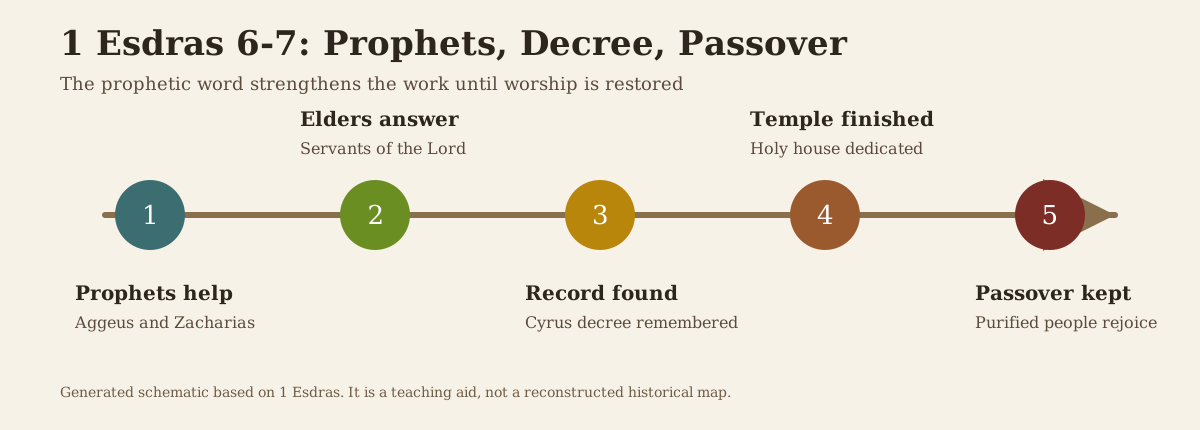
Scripture schematic of 1 Esdras 6-7, not a reconstructed historical map.
The same restoration is narrated in Ezra 5-6. Reading the accounts together brings their shared history and distinctive wording into view.
1 Esdras is not included in the NKJV. The Scripture below follows Brenton’s wording and verse numbers; other Greek editions and translations sometimes divide the verses differently.
The Prophets Help the Builders (1 Esdras 6:1-12)
1 Now in the second year of the reign of Darius, Aggeus and Zacharias the son of Addo, the prophets, prophesied unto the Jews in Jewry and Jerusalem in the name of the Lord God of Israel, which was upon them.
2 Then stood up Zorobabel the son of Salathiel, and Jesus the son of Josedec, and began to build the house of the Lord at Jerusalem, the prophets of the Lord being with them, and helping them. 3 At the same time came unto them Sisinnes the governor of Syria and Phenice, with Sathrabuzanes and his companions, and said unto them, 4 By whose appointment do ye build this house and this roof, and perform all the other things? and who are the workmen that perform these things?
5 Nevertheless the elders of the Jews obtained favour, because the Lord had visited the captivity; 6 and they were not hindered from building, until such time as signification was given unto Darius concerning them, and an answer received.
7 The copy of the letters which Sisinnes, governor of Syria and Phenice, and Sathrabuzanes, with their companions, rulers in Syria and Phenice, wrote and sent unto Darius; To king Darius, greeting: 8 Let all things be known unto our lord the king, that being come into the country of Judea, and entered into the city of Jerusalem, we found in the city of Jerusalem the ancients of the Jews that were of the captivity 9 building an house unto the Lord, great and new, of hewn and costly stones, and the timber already laid upon the walls. 10 And those works are done with great speed, and the work goeth on prosperously in their hands, and with all glory and diligence is it made.
11 Then asked we these elders, saying, By whose commandment build ye this house, and lay the foundations of these works? 12 Therefore to the intent that we might give knowledge unto thee by writing, we demanded of them who were the chief doers, and we required of them the names in writing of their principal men.
The work resumes in the second year of Darius because Aggeus and Zacharias prophesy in the name of the Lord. The builders do not restart by optimism alone. They rise because the word of God strengthens them.
In Haggai 1, the people had found reasons to postpone the house while attending to their own homes. In Zechariah 4, the Lord promises that Zerubbabel will finish what his hands began, through His Spirit. Prophecy here is help given alongside the builders. A word that exposes our evasions can also release us from them.
The officials question the work, but the elders receive favor because the Lord had visited the captivity. This phrase is full of mercy. God visits His people not only to inspect them, but to remember, help, and restore them.
The parallel in Ezra 5:5 speaks of the eyes of God upon the elders. Here the phrase is “the Lord had visited the captivity.” The accent falls on God drawing near to His afflicted people. Luke 1:68 and Luke 1:78 use the language of visitation in the song of Zacharias, Zechariah the father of John the Baptist: redemption comes because the Lord remembers His covenant and comes to those in darkness. This is a biblical resonance, not a claim that Luke is quoting 1 Esdras.
Light from the Word 🕯️
“The prophets of the Lord being with them, and helping them” describes courage sustained through companionship as well as speech. A servant can know the right work and still need someone faithful beside him. Receive correction from Scripture, and become the person whose presence helps another obey it.
For Our Life
A ministry can have permission, resources, and plans, yet still need the word of God to stand up again. When fear, delay, or fatigue settles in, the Church does not live by administration alone. She lives by the word of the Lord.
The Elders Answer as Servants of the Creator (1 Esdras 6:13-22)
13 So they gave us this answer, We are the servants of the Lord which made heaven and earth. 14 And as for this house, it was builded many years ago by a king of Israel great and strong, and was finished. 15 But when our fathers provoked God unto wrath, and sinned against the Lord of Israel which is in heaven, he gave them over into the power of Nabuchodonosor king of Babylon, king of the Chaldees; 16 who pulled down the house, and burned it, and carried away the people captives unto Babylon.
17 But in the first year that king Cyrus reigned over the country of Babylon, Cyrus the king wrote to build this house. 18 And the holy vessels of gold and of silver, that Nabuchodonosor had carried away out of the house at Jerusalem, and had set them in his own temple, those Cyrus the king brought forth again out of the temple at Babylon, and they were delivered to Zorobabel, that is, to Sanabassarus the ruler, 19 with commandment that he should carry away the same vessels, and put them in the temple at Jerusalem; and that the temple of the Lord should be built in that place. 20 Then the same Sanabassarus, being come hither, laid the foundations of the house of the Lord at Jerusalem; and from that time to this being still building, it is not yet finished.
21 Now therefore, if it seem good unto the king, let search be made among the records of king Cyrus: 22 and if it be found that the building of the house of the Lord at Jerusalem hath been done with the consent of king Cyrus, and if our lord the king be so minded, let him signify unto us thereof.
The elders answer with humility and truth: We are the servants of the Lord which made heaven and earth.
They remember the former temple, confess the sin of the fathers, name the judgment of exile, and recount Cyrus’s command to restore the house and vessels.
This is a model confession. They do not deny the sin that led to exile. They also do not let the past cancel God’s present mercy. Their identity is not we are innocent
but we are servants of the Lord.
Nabuchodonosor is Nebuchadnezzar, the Babylonian king. Verse 18 makes a striking identification: the vessels are delivered to Zerubbabel, “that is, to Sanabassarus the ruler.” Sanabassarus corresponds to Sheshbazzar, named Sanabassar earlier in 1 Esdras 2:12. Ezra 5:14 names Sheshbazzar without this identification. This Greek account identifies the two at this point; it does not settle the historical debate about whether the names always denote the same person. We can hear the narrative clearly without forcing every witness into one spelling or biography.
Light from the Word 🕯️
“We are the servants of the Lord which made heaven and earth” places the elders before a greater authority than Darius. Yet that confession gives them no exemption from truth: they immediately admit their ancestors’ sin. Faith can resist intimidation while surrendering self-justification.
For Our Life
When questioned, the servant of God does not need to pretend the past was pure. Repentance can tell the truth about sin without surrendering hope. The truest identity is not our failure, but our calling to belong to the Lord.
The Record Is Found and the Decree Is Confirmed (1 Esdras 6:23-34)
23 Then commanded king Darius to seek among the records at Babylon: and so at Ecbatana the palace, which is in the country of Media, there was found a roll wherein these things were recorded. 24 In the first year of the reign of Cyrus, king Cyrus commanded that the house of the Lord at Jerusalem should be built again, where they do sacrifice with continual fire: 25 whose height shall be sixty cubits, and the breadth sixty cubits, with three rows of hewn stones, and one row of new wood of that country; and the expences thereof to be given out of the house of king Cyrus: 26 and that the holy vessels of the house of the Lord, both of gold and silver, that Nabuchodonosor took out of the house at Jerusalem, and brought to Babylon, should be restored to the house at Jerusalem, and be set in the place where they were before.
27 And also he commanded that Sisinnes the governor of Syria and Phenice, and Sathrabuzanes, and their companions, and those which were appointed rulers in Syria and Phenice, should be careful not to meddle with the place, but suffer Zorobabel the servant of the Lord, and governor of Judea, and the elders of the Jews, to build the house of the Lord in that place. 28 I have commanded also to have it built up whole again; and that they look diligently to help those that be of the captivity of the Jews, till the house of the Lord be finished: 29 and out of the tribute of Celosyria and Phenice, a portion carefully to be given these men for the sacrifices of the Lord, that is, to Zorobabel the governor, for bullocks, and rams, and lambs; 30 and also corn, salt, wine, and oil, and that continually every year without further question, according as the priests that be in Jerusalem shall signify to be daily spent: 31 that offerings may be made to the most high God for the king and for his children, and that they may pray for their lives. 32 And he commanded that whosoever should transgress, yea, or make light of any thing herein written, out of his own house should a tree be taken, and he thereon be hanged, and all his goods seized for the king.
33 The Lord therefore, whose name is there called upon, utterly destroy every king and nation, that stretcheth out his hand to hinder or endamage that house of the Lord in Jerusalem. 34 I Darius the king have ordained that according unto these things it be done with diligence.
Darius commands a search, and the record of Cyrus’s decree is found. The decree confirms the rebuilding of the house, the restoration of the vessels, and protection for the work. The earlier command is not lost.
The record matters because God’s providence can work through memory, archives, and public accountability. A forgotten command becomes visible again, and opposition is restrained by the very authority it had appealed to.
The search begins at Babylon but succeeds at Ecbatana, a royal residence in Media. The change of place matters: the sought decree exists even though it is not found where the search begins. Darius then turns tribute from the surrounding province into support for the worship it had questioned. The builders receive material help without making royal favor the measure of God’s faithfulness. The execution threatened in verse 32 remains the language of an imperial decree, not a pattern for Christian correction.
Light from the Word 🕯️
“That they may pray for their lives” makes even the king a petitioner before the Most High. Jeremiah 29:7, in the letter to the exiles, Jeremiah 36:7 LXX, had commanded prayer for the land of captivity. In 1 Timothy 2:1-2, prayer for rulers seeks peace in which people may live godly lives. Intercession neither canonizes a ruler’s conduct nor excuses injustice. It asks God to guide those whose decisions affect the vulnerable.
The Coptic Liturgy of St. Basil gives this intercession a continuing voice: “Remember, O Lord, the king (president) of our land, your servant, keep him in peace, justice and might.”1 A ruler remains a servant, and justice belongs within the prayer itself.
The Holy House Is Finished and Dedicated (1 Esdras 7:1-9)
1 Then Sisinnes the governor of Celosyria and Phenice, and Sathrabuzanes, with their companions, following the commandments of king Darius, 2 did very carefully oversee the holy works, assisting the ancients of the Jews and governors of the temple. 3 And so the holy works prospered, when Aggeus and Zacharias the prophets prophesied.
4 And they finished these things by the commandment of the Lord God of Israel; and with the consent of Cyrus, Darius, and Artaxerxes, kings of Persia, 5 the holy house was finished in the three and twentieth day of the month Adar, in the sixth year of king Darius.
6 And the children of Israel, the priests, and the Levites, and others that were of the captivity, that were added unto them, did according to the things written in the book of Moses. 7 And to the dedication of the temple of the Lord they offered an hundred bullocks, two hundred rams, four hundred lambs; 8 and twelve goats for the sin of all Israel, according to the number of the chief of the tribes of Israel. 9 The priests also and the Levites stood arrayed in their vestments, according to their kindreds, in the service of the Lord God of Israel, according to the book of Moses: and the porters at every gate.
The officials now assist rather than hinder. The holy works prosper while Aggeus and Zacharias prophesy. The house is finished by the commandment of the Lord God of Israel and with the consent of Persian kings.
The dedication includes offerings for all Israel, twelve goats according to the tribes. The returned community is smaller than the old kingdom, but worship remembers the fullness of Israel before God.
The list “Cyrus, Darius, and Artaxerxes” gathers the royal support for restoration, as Ezra 6:14 does; Artaxerxes’s later reign does not move this completion out of Darius’s sixth year. Even the day differs between accounts: this text gives the twenty-third of Adar, whereas Brenton’s Ezra 6:15 gives the third. The difference is retained rather than silently harmonized; its precise textual origin is uncertain.
Light from the Word 🕯️
The temple is finished by the commandment of the Lord. Kings consent, governors assist, elders supervise, and prophets speak, but the Lord is the source of completion.
Verse 6 also remembers “others … that were added unto them.” The worshipping community can receive people as it remains ordered by Moses’s book. Its wholeness is expressed in twelve goats for all Israel, not in the builders’ claim that they alone exhaust God’s people.
For Our Life
A finished holy work should lead to dedication, not self-congratulation. The purpose of rebuilding is not that we may admire what we built, but that what is built may be offered back to God.
Gems from the Fathers 💎
St. John Chrysostom, explaining John 2:19-22, moves from the temple building to Christ’s own flesh and the Resurrection. His discussion includes a reference to the later temple, accompanied in this edition by Ezra 6:15, before explaining the sign of Christ’s divine power. He describes it as “being able to set up a trophy of victory over death”.2 This is commentary on John, not on 1 Esdras. It gives the completed house its Christian horizon: communion with God reaches its fullness in the incarnate Lord who willingly lays down His life and raises it again.
The Returned People Keep Passover (1 Esdras 7:10-15)
10 And the children of Israel that were of the captivity held the passover the fourteenth day of the first month, after that the priests and the Levites were sanctified, 11 together with all the children of the captivity; for they were sanctified, because the Levites were all sanctified together.
12 And so they offered the passover for all them of the captivity, and for their brethren the priests, and for themselves. 13 And the children of Israel that came out of the captivity did eat, even all they that had separated themselves from the abominations of the people of the land, and sought the Lord. 14 And they kept the feast of unleavened bread seven days, making merry before the Lord, 15 for that he had turned the counsel of the king of Assyria toward them, to strengthen their hands in the works of the Lord God of Israel.
The passage ends with Passover. The priests and Levites are sanctified, the sacrifice is offered for the captives, their brethren, and themselves, and the people keep the Feast of Unleavened Bread with joy.
This is the true goal of restoration. The house is built so that the people may worship. The return from Babylon is interpreted through the memory of the Exodus. The God who brought Israel out of Egypt now strengthens the hands of those who returned from captivity.
The feast includes those who separate from the surrounding abominations and seek the Lord (7:13). Read alongside the people “added unto them” (7:6), the sentence places turning toward God at the heart of participation. It helps illuminate both the refusal of partnership in 1 Esdras 5:66-73 and the marriage crisis in 1 Esdras 8:68-9:36. These texts cannot be reduced to a doctrine of inherited ethnic worth.
Light from the Word 🕯️
“The fourteenth day of the first month” recalls Josiah’s Passover in 1 Esdras 1:1. The same feast stands before the collapse and after the return: worship lost, worship restored. Paul carries this memory into Christian life in 1 Corinthians 5:7-8, where Christ our Passover calls us to the feast with sincerity and truth. Paschal joy asks for the removal of malice from the heart, not merely the observance of a date.
“The king of Assyria” in verse 15 is an inherited imperial designation used here for the Persian ruler, not the arrival of a separate Assyrian king. Proverbs 21:1 places the king’s heart in God’s hand. The unexpected turning of royal counsel strengthens hands that had once been weakened by opposition.
The Church’s Voice in Worship ⛪
The Coptic lectionary has no verse-addressed reading from 1 Esdras. Related readings let the Church hear the same promises in other biblical voices. Luke 1:57-80 is the Liturgy Gospel on the Fourth Sunday of Kiahk; its song of visitation gives the renewed work a fitting Advent horizon. The Pauline reading on Thursday of the sixth week of Great Lent is 1 Timothy 2:1-3:4, including prayer for rulers. The church-consecration rite appoints 1 Kings 8:22-61 and Ezekiel 43:1-7 and Ezekiel 44:1-5, joining a holy house to prayer and God’s dwelling among His people.3
The Coptic Synaxarium commemorates the Departure of Haggai the Prophet on Kiahk 20 and the Martyrdom of the Righteous Zechariah the Prophet on Amshir 15. These commemorations honor the prophets who helped the builders; the biblical account itself does not narrate Zechariah’s martyrdom.4
Christological Types and Prophecies
The temple, Passover, and prophetic word converge in Christ: He is the dwelling of God among us, the sacrifice that delivers us, and the Lord who gives His people the courage to worship. Their fulfillment calls the Church to holiness and thanksgiving, with room at the feast for those who turn to Him.
Spiritual Fruit 🍇
When obedience has stalled, begin with the word that first gave the work its purpose. A parish responsibility, a neglected prayer rule, or a reconciliation postponed can become an unfinished house. Receive one concrete command from Scripture and take the next faithful step, seeking the companionship that helped these builders.
The elders answer without inventing an innocent past. In confession, resist the urge to explain every failure by someone else’s behavior. Name what was yours, then receive the mercy that permits work to begin again. Shame need not become your permanent identity when you belong to the Lord who made heaven and earth.
Completion asks for dedication. Thank the people who helped, pray for those in authority, and offer the result to God without quietly claiming it as your monument. The Passover feast includes people who seek Him. Let the joy of Pascha make your welcome wider and your resistance to malice firmer.
The builders put down their tools and gather for the feast. The Lord who visited their captivity has brought them to worship again. Bring Him the unfinished places of your life, and the works you thought were already yours to possess. Ask to receive both as occasions for thanksgiving.
Teaching Notes
The Prophets Help the Builders (1 Esdras 6:1-12)
- Ask: What changes when Aggeus and Zacharias prophesy?
- Emphasize: The word of God strengthens tired builders.
- Watch for: Do not reduce prophecy to prediction only.
- Connect: The Church still needs the prophetic word of Scripture to rebuild faithfully.
- Show: Compare the hindered work in 1 Esdras 5:66-73 with renewed work here. Use the schematic for the sequence and a broad Persian-period map for orientation, not as the cause of restoration.
The Elders Answer as Servants of the Creator (1 Esdras 6:13-22)
- Ask: How do the elders speak about their past?
- Emphasize: They confess sin without surrendering hope.
- Watch for: Avoid defensive rewriting of history.
- Connect: Repentance tells the truth and receives mercy.
- Show: Compare
we are servantswith identity built on shame or pride.The Record Is Found and the Decree Is Confirmed (1 Esdras 6:23-34)
- Ask: Why does the found record matter in the story?
- Emphasize: God’s providence can use ordinary means like records and letters.
- Watch for: Do not make bureaucracy the hero of the passage.
- Connect: God remembers His promises even when people forget.
- Show: Trace the vessels from Jerusalem to Babylon and back.
The Holy House Is Finished and Dedicated (1 Esdras 7:1-9)
- Ask: Who is credited with the completion of the house?
- Emphasize: The house is finished by the commandment of the Lord.
- Watch for: Avoid self-congratulation after ministry success.
- Connect: Every completed work should be offered back to God.
- Show: Note the twelve goats for all Israel as a sign of covenant wholeness.
The Returned People Keep Passover (1 Esdras 7:10-15)
- Ask: Why does the story end this movement with Passover?
- Emphasize: Restoration reaches its goal in sanctified worship.
- Watch for: Do not treat the temple as merely an architectural achievement.
- Connect: Christ is our Passover and the true deliverance from captivity.
- Show: Compare Exodus deliverance, Babylonian return, and Pascha in Christ.
Sources
Embedded Scripture is from Brenton’s English Septuagint (LXX).
Biblical parallels: Ezra 5-6; Haggai 1; Zechariah 4; Jeremiah 29:7 (LXX Jeremiah 36:7); Proverbs 21:1; Exodus 12; 1 Corinthians 5:7-8.
Footnotes
-
The Coptic Liturgy of St. Basil, intercessions after the Gospel, http://www.coptic.net/prayers/stbasilliturgy.html. ↩
-
St. John Chrysostom, Homilies on the Gospel of John, Homily 23, sections 2-3, on John 2:19-22, https://www.newadvent.org/fathers/240123.htm. The temple-completion reference occurs at the end of section 2; the quoted Resurrection explanation is in section 3. ↩
-
Coptic Orthodox lectionary: Fourth Sunday of Kiahk, Liturgy Gospel, Luke 1:57-80; Thursday of the sixth week of Great Lent, Pauline Epistle, 1 Timothy 2:1-3:4; church-consecration rite, readings from 1 Kings 8 and Ezekiel 43-44. ↩
-
Coptic Orthodox Synaxarium, Kiahk 20, “The Departure of Haggai the Prophet”; Amshir 15, “The Martyrdom of the Righteous Zechariah the Prophet the Son of Berechiah, the Son of Iddo.” ↩