


This narration is from a previous version of the study and may include a combined recording of multiple chapters.
Safe arrival and faithful delivery of the vessels do not end the story. Esdras, Ezra in the familiar spelling, now hears that unfaithfulness has entered the households of the returned people, including their rulers and priests. He tears his garments and prays before he speaks to the assembly. The correction that follows reaches wives and children, whose loss must be faced rather than hidden behind the word “reform.”
Why This Passage Matters
The passage shows that restoration is not complete when people arrive safely, deliver the vessels, and offer sacrifices. The community itself must be healed from covenant compromise. Esdras responds first with mourning and prayer before public correction.
This old-covenant crisis cannot authorize racial contempt, the abandonment of a spouse because of unbelief, or coercive Christian correction. Its concern is faithfulness to God, not an inherited difference in human worth. Christ’s commandments and the apostolic teaching on existing marriages govern the Church’s pastoral care; the children named at the end remain persons to be loved and protected. The parallel account unfolds in Ezra 9 and Ezra 10.
The Place of This Passage
This passage covers the whole covenant-crisis unit: report, mourning, confession, covenant warning, assembly, correction, and named accountability. It belongs together because the painful correction can only be understood in the context of Esdras’s prayer and the mercy already shown by God.
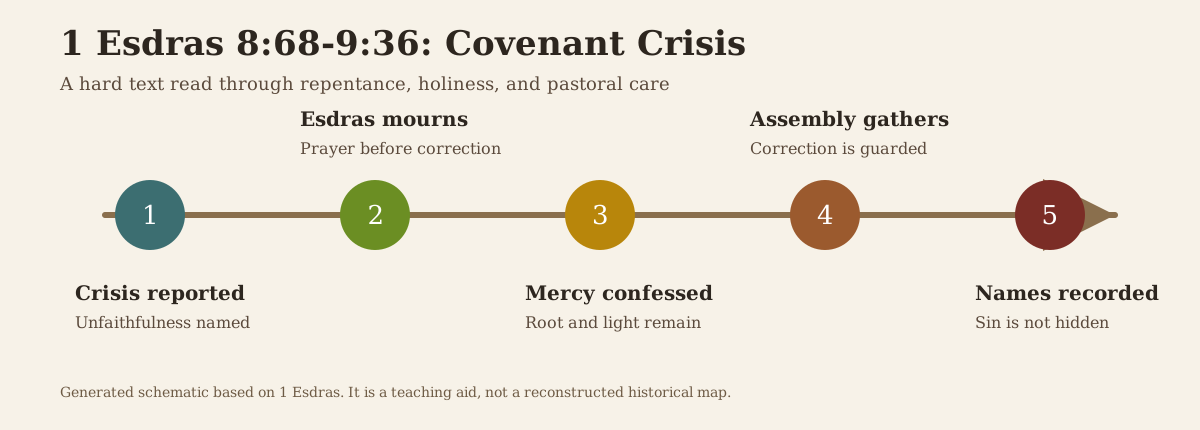
Scripture schematic of 1 Esdras 8:68-9:36, not a reconstructed historical map.
1 Esdras is not included in the NKJV. The Scripture below follows Brenton’s wording and verse numbers; other Greek editions and translations sometimes divide the verses differently.
The Covenant Crisis Is Reported and Esdras Mourns (1 Esdras 8:68-75)
68 Now when these things were done, the rulers came unto me, and said, 69 The nation of Israel, the princes, the priests and the Levites, have not put away from them the strange people of the land, nor their pollutions from the Gentiles, to wit, the Canaanites, Hittites, Pheresites, Jebusites, and the Moabites, Egyptians, and Edomites. 70 For both they and their sons have married with their daughters, and the holy seed is mixed with the strange people of the land; and from the beginning of this matter the rulers and the great men have been partakers of this iniquity.
71 And as soon as I had heard these things, I rent my clothes, and the holy garment, and pulled off the hair from off my head and beard, and sat me down sad and very heavy. 72 So all they that were then moved at the word of the Lord God of Israel assembled unto me, whilst I mourned for the iniquity: but I sat still full of heaviness until the evening sacrifice.
73 Then rising up from the fast with my clothes and the holy garment rent, and bowing my knees, and stretching forth my hands unto the Lord, 74 I said, O Lord, I am confounded and ashamed before thy face; 75 for our sins are multiplied above our heads, and our ignorances have reached up unto heaven.
The report names princes, priests, and Levites before speaking of “the holy seed.” Those charged with guiding the people have participated “from the beginning.” The danger is described in the vocabulary of pollution and iniquity: household alliances threaten faithfulness to the covenant. Yet the passage gives no separate account of each wife’s beliefs or conduct. Its collective judgment must not become an invented biography of every woman in the list.
Esdras does not begin by attacking others. He tears his garments, pulls hair from his head and beard, sits heavily, and gathers those moved at the word of the Lord. The first response to communal sin is grief before God.
The mention of Egyptians and Moabites can wound a reader who hears only an ethnic list. Scripture itself prevents that conclusion. Deuteronomy 23:7, numbered 23:8 in Brenton, forbids abhorring an Egyptian; Isaiah 19:19-25 promises an altar and healing in Egypt and blesses God’s people there. Christ is sheltered in Egypt and called out of it (Matthew 2:15). Ruth the Moabite and Rahab stand in His genealogy (Matthew 1:5). God’s purpose for the nations cannot be reduced to this crisis list.
Light from the Word 🕯️
“The holy seed” must be heard within the whole promise of God. Paul identifies Abraham’s promised Seed with Christ and those who belong to Christ with Abraham’s seed (Galatians 3:16; Galatians 3:29). Holiness reaches the nations through communion with Him. The feast in 1 Esdras 7:13 had already received those who separated from abominations and sought the Lord.
At the evening sacrifice, Esdras stretches out his hands and confesses his shame. Psalm 141:2 (LXX Psalm 140:2) joins uplifted hands to the evening sacrifice. Here the priest’s first offering is a heart that cannot excuse what has happened. Grief becomes prayer instead of an accusation kept safely at a distance.
Esdras Confesses Sin and Remembers Mercy (1 Esdras 8:76-83)
76 For ever since the time of our fathers we have been and are in great sin, even unto this day. 77 And for our sins and our fathers’ we with our brethren and our kings and our priests were given up unto the kings of the earth, to the sword, and to captivity, and for a prey with shame, unto this day.
78 And now in some measure hath mercy been shewed unto us from thee, O Lord, that there should be left us a root and a name in the place of thy sanctuary; 79 and to discover unto us a light in the house of the Lord our God, and to give us food in the time of our servitude. 80 Yea, when we were in bondage, we were not forsaken of our Lord; but he made us favoured before the kings of Persia, so that they gave us food; 81 yea, and honoured the temple of our Lord, and raised up the desolate Sion, so that they have given us a sure abiding in Jewry and Jerusalem.
82 And now, O Lord, what shall we say, having these things? for we have transgressed thy commandments, which thou gavest by the hand of thy servants the prophets, saying, 83 That the land, which ye enter into to possess as an heritage, is a land polluted with the pollutions of the strangers of the land, and they have filled it with their uncleanness.
Esdras prays in the first person plural. He does not say, They have sinned.
He says, we have been and are in great sin.
He stands with the people before God.
The prayer also remembers mercy: a root, a name, light in the house of the Lord, food in servitude, favor before Persian kings, and a sure abiding in Jerusalem. Confession is not despair. It is truth spoken in the presence of mercy.
“A root and a name” names the fragile survival of a people who could have disappeared in exile. “A light in the house” is the mercy by which they can see and live again. Isaiah 11:10 gives the image of the root of Jesse a greater horizon among the nations, and Revelation 22:16 names Christ the Root and Offspring of David. These are a Christian development of the imagery, not a claim that the “root” in Esdras’s prayer already names Christ explicitly.
Light from the Word 🕯️
“We were not forsaken” gives confession the confidence to remain truthful. Esdras remembers food, favor, and a restored sanctuary while admitting renewed disobedience. Grace received becomes a reason to repent, not evidence that repentance is no longer needed.
For Our Life
When a family, parish, or ministry faces failure, the faithful response is not scapegoating. Esdras teaches corporate humility: we have sinned
, and yet we were not forsaken.
The Covenant Warning Names the Danger (1 Esdras 8:84-96)
84 Therefore now shall ye not join your daughters unto their sons, neither shall ye take their daughters unto your sons. 85 Moreover ye shall never seek to have peace with them, that ye may be strong, and eat the good things of the land, and that ye may leave the inheritance of the land unto your children for evermore.
86 And all that is befallen is done unto us for our wicked works and great sins: for thou, O Lord, didst make our sins light, 87 and didst give unto us such a root: but we have turned back again to transgress thy law, and to mingle ourselves with the uncleanness of the nations of the land. 88 Mightest not thou be angry with us to destroy us, till thou hadst left us neither root, seed, nor name?
89 O Lord of Israel, thou art true: for we are left a root this day. 90 Behold, now are we before thee in our iniquities, for we cannot stand any longer by reason of these things before thee. 91 And as Esdras in his prayer made his confession, weeping, and lying flat upon the ground before the temple, there gathered unto him from Jerusalem a very great multitude of men and women and children: for there was great weeping among the multitude.
92 Then Jechonias the son of Jeelus, one of the children of Israel, called out and said, O Esdras, we have sinned against the Lord; we have married strange women of the nations of the land, and now is all Israel aloft. 93 Let us make an oath to the Lord, that we will put away all our wives, which we have taken of the heathen, with their children, 94 like as thou hast decreed, and as many as do obey the law of the Lord. 95 Arise, and put into execution: for to thee doth this matter appertain, and we will be with thee: do valiantly. 96 So Esdras arose, and took an oath of the chief of the priests and Levites of all Israel to do after these things; and so they sware.
Esdras names the danger with severe old-covenant language. The people have received a root, but they are turning back to transgress the Law and mingle themselves with uncleanness. He asks whether God might justly destroy them until no root, seed, or name remains.
“Thou art true” (8:89) recalls the acclamation of truth in 1 Esdras 4:41. Truth has moved from a victorious court speech to a confession in which the speaker can no longer stand before God. It is costly to acknowledge God’s righteousness when we ourselves have failed.
Jechonias son of Jeelus, a member of Israel whose office is not given, answers the priest’s grief. The difficult phrase “now is all Israel aloft” in Brenton is clearer as hope in the parallel Ezra 10:2. His call to rise turns mourning toward action, but the action he proposes includes the wives and children. Hope voiced by the assembly does not erase that cost.
Light from the Word 🕯️
“Behold, now are we before thee” refuses escape into excuses. Esdras names what the community has done in the presence of the God who spared it. The warning against seeking the nations’ peace belongs to this covenant appeal. Christian intercession follows Christ’s command to love and pray for enemies, rather than treating every neighbor outside the Church as someone whose good must be refused (Matthew 5:44).
The Assembly Gathers for Correction (1 Esdras 9:1-17)
1 Then Esdras rising from the court of the temple went to the chamber of Joanan the son of Eliasib, 2 and remained there, and did eat no meat nor drink water, mourning for the great iniquities of the multitude. 3 And there was a proclamation in all Jewry and Jerusalem to all them that were of the captivity, that they should be gathered together at Jerusalem: 4 and that whosoever met not there within two or three days, according as the elders that bare rule appointed, their cattle should be seized to the use of the temple, and himself cast out from them that were of the captivity.
5 And in three days were all they of the tribe of Juda and Benjamin gathered together at Jerusalem the twentieth day of the ninth month. 6 And all the multitude sat in the broad court of the temple, trembling because of the present foul weather.
7 So Esdras arose up, and said unto them, Ye have transgressed the law in marrying strange wives, thereby to increase the sins of Israel. 8 And now by confessing give glory unto the Lord God of our fathers, 9 and do his will, and separate yourselves from the heathen of the land, and from the strange women.
10 Then cried the whole multitude, and said with a loud voice, Like as thou hast spoken, so will we do. 11 But forasmuch as the people are many, and it is foul weather, so that we cannot stand without, and this is not a work of a day or two, seeing our sin in these things is spread far: 12 therefore let the rulers of the multitude stay, and let all them of our habitations that have strange wives come at the time appointed, 13 and with them the rulers and judges of every place, till we turn away the wrath of the Lord from us for this matter.
14 Then Jonathan the son of Azael and Ezechias the son of Theocanus accordingly took this matter upon them: and Mosollam and Levis and Sabbatheus helped them. 15 And they that were of the captivity did according to all these things. 16 And Esdras the priest chose unto him the principal men of their families, all by name: and in the first day of the tenth month they sat together to examine the matter. 17 So their cause that held strange wives was brought to an end in the first day of the first month.
Esdras continues fasting and mourning. A proclamation gathers the returned people to Jerusalem, and verse 6 specifically says they tremble “because of the present foul weather.” Ezra 10:9 names both the matter and the rain. Here the weather makes prolonged standing outside impossible; the assembly asks for appointed times and local judges because the work is too extensive for a day or two. The narrative describes a coercive public process, including threatened confiscation and exclusion, not simply voluntary private counsel.
The passage is painful. It names public correction, real consequences, and a process involving appointed leaders. It does not portray correction as casual, impulsive, or private vengeance. The matter is examined because it is too serious for careless action.
Light from the Word 🕯️
“By confessing give glory unto the Lord” joins repentance to doxology, the giving of glory to God. Joshua 7:19 joins the same two acts in the appeal to Achan, called Achar in Brenton. Confession honors God by relinquishing the story that protects our innocence. Yet its outcome is more than a spoken formula: Esdras asks the people to do God’s will, and an examination begins.
Names Are Recorded and Reconcilement Is Sought (1 Esdras 9:18-36)
18 And of the priests that were come together, and had strange wives, there were found; 19 of the sons of Jesus the son of Josedec, and his brethren; Matthelas, and Eleazar, and Joribus, and Joadanus. 20 And they gave their hands to put away their wives, and to offer rams to make reconcilement for their errors.
21 And of the sons of Emmer: Ananias, and Zabdeus, and Manes, and Samæus, and Hiereel, and Azarias. 22 And of the sons of Phaisur; Elionais, Massias, Ismael, and Nathanael, and Ocodelus, and Saloas.
23 And of the Levites; Jozabad, and Semis, and Coïus, who was called Calitas, and Patheus, and Judas, and Jonas. 24 Of the holy singers: Eleasabus, Bacchurus. 25 Of the porters; Salumus, and Tolbanes.
26 Of them of Israel, of the sons of Phoros; Hiermas, and Jezias, and Melchias, and Maelus, and Eleazar, and Asebias, and Banæas. 27 Of the sons of Ela; Matthanias, Zacharias, and Jezrielus, and Joabdius, and Hieremoth, and Aïdias. 28 And of the sons of Zamoth; Eliadas, Eliasimus, Othonias, Jarimoth, and Sabatus, and Zeralias. 29 Of the sons of Bebai; Joannes, and Ananias, and Josabad, and Amatheis. 30 Of the sons of Mani; Olamus, Mamuchus, Jedeus, Jasubus, Jasael, and Hieremoth. 31 And of the sons of Addi; Naathus, and Moosias, Lacunus, and Naidus, Matthanias, and Sesthel, Balnuus, and Manasseas. 32 And of the sons of Annas; Elionas, and Asaias, and Melchias, and Sabbeus, and Simon Chosameus. 33 And of the sons of Asom; Altaneus, and Mattathias, and Sabanneus, Eliphalat, and Manasses, and Semei. 34 And of the sons of Baani: Jeremias, Momdis, Ismaerus, Juel, Mabdai, and Pedias, and Anos, Rabasion, and Enasibus, and Mamnitanaimus, Eliasis, Bannus, Eliali, Samis, Selemias, Nathanias: and of the sons of Ezora; Sesis, Esril, Azaelus, Samatus, Zambri, Josephus. 35 And of the sons of Ethma; Mazitias, Zabadaias, Edaïs, Juel, Banaias.
36 All these had taken strange wives, and they put them away with their children.
The list begins with descendants of Jesus son of Josedec, Joshua or Jeshua the high priest, then names other priests, Levites, singers, porters, and Israelite families. Priesthood gives no immunity from examination. The priests in verses 19-20 pledge their hands and offer rams for reconcilement; the passage does not say that every household in the remaining list offers the same sacrifice.
The last sentence reaches “their children.” The women and children are largely unheard in this account, but their silence does not make their loss less real. A Christian reading must now hear 1 Corinthians 7:12-14: an existing marriage is not to be broken because one spouse does not believe and is willing to remain. Paul declares the children holy rather than unclean. Christ’s command guards the bond God has joined (Matthew 19:6). These words govern the Church’s response to this ancient separation; they are not a denial that Israel’s crisis was serious.
Light from the Word 🕯️
“Reconcilement” in verse 20 names the return to God sought by the offending priests. The sacred task begins with the servants themselves under judgment. When a leader has failed, correcting everyone else cannot substitute for his own confession.
Gems from the Fathers 💎
St. John Chrysostom, explaining 1 Corinthians 7:14 in Homily 19, section 4, addresses a believer’s fear of becoming unclean through an existing marriage with an unbeliever. He writes, “the cleanness of the wife overcomes the uncleanness of the husband; and again, the cleanness of the believing husband overcomes the uncleanness of the unbelieving wife.”1 He explains that “there is hope that the lost member may be saved through the marriage”.1 His interpretation concerns a couple already married, with the unbeliever willing to remain; it is not permission to participate in idolatry or a promise of automatic conversion. Love can become an instrument of sanctification without surrendering faith.
The Church’s Voice in Worship ⛪
The Coptic lectionary has no verse-addressed reading from 1 Esdras. Psalm 141 (LXX Psalm 140), prayed in the Agpeya Twelfth Hour and Midnight Third Watch, gives the evening intercessor the words of uplifted hands and sacrifice. The Liturgy Gospel of the Entrance of the Lord into Egypt, Bashans 24, is Matthew 2:13-23; Egypt is a place of shelter within the saving history, not a people shut out of it. Matthew 1:1-17, read at the Nativity Paramoun, names Ruth and Rahab within the Lord’s ancestry.2
The baptismal rite includes 1 Corinthians 7:12-14 in the mother’s absolution for a female child, and the crowning rite appoints Matthew 19:1-6. These distinct services let the apostolic word concerning holy children and Christ’s word concerning marriage stand beside the pain of this ending.3
Christological Types and Prophecies
Esdras shares the people’s shame in prayer; Christ, who is without sin, willingly bears our sins and heals us through His Cross. The people need more than an external rearrangement of households. Communion with Christ gives the holiness toward which the covenant points, and His apostolic word guards spouses and children from being treated as contamination. Truth confessed and love practiced belong to the same healing.
Spiritual Fruit 🍇
Begin correction before God. When someone else’s failure angers you, pray honestly before rehearsing the speech you want to deliver. Esdras names “our sins” and remembers that the people were not forsaken. Confess any participation of your own, including the habit of shielding influential people while condemning those with less power.
Let remembered mercy deepen repentance. Name a grace you have received, then ask where your life has contradicted it. God’s help in the past is a reason to return now, not an argument that the wound can remain untreated. Give glory to Him through a truthful confession and a concrete change.
Protect the people who can disappear inside a policy. The final verse makes children bear consequences they did not choose. When speaking about family difficulties, keep names, needs, safety, and pastoral care before you. Christ’s teaching calls for fidelity and mercy; serious harm requires responsible help, not a demand that someone endure abuse to prove holiness.
Esdras kneels with his hands stretched out at the evening sacrifice. The Lord is true, and the people who have failed are still before Him. Bring your own household and the wounded households of the Church into that prayer. Ask for repentance that tells the truth and for love that refuses to make another person disposable.
Teaching Notes
The Covenant Crisis Is Reported and Esdras Mourns (1 Esdras 8:68-75)
- Ask: What is the actual danger named in the report?
- Emphasize: The crisis concerns covenant worship and idolatrous pollution, not ethnic contempt.
- Watch for: Stop any reading that turns
holy seedinto racial pride.- Connect: Christ makes His people holy by communion with God, not by ethnicity.
- Show: Put
pollutions,iniquity, andword of the Lordat the center of the discussion.Esdras Confesses Sin and Remembers Mercy (1 Esdras 8:76-83)
- Ask: Why does Esdras pray
we?- Emphasize: Confession holds sin and mercy together.
- Watch for: Avoid scapegoating others while protecting ourselves.
- Connect: Christ bears the sins of His people and opens repentance.
- Show: List the mercy words: root, name, light, food, favor, abiding.
The Covenant Warning Names the Danger (1 Esdras 8:84-96)
- Ask: Why is the warning so severe?
- Emphasize: Restoration can be endangered by returning to the old captivity.
- Watch for: Do not use this as a simple modern marriage or divorce rule.
- Connect: In Christ, holiness means faithfulness to God and freedom from idolatry.
- Show: Contrast mercy received with transgression repeated.
The Assembly Gathers for Correction (1 Esdras 9:1-17)
- Ask: What steps happen before correction is completed?
- Emphasize: Mourning, assembly, confession, and ordered discernment matter.
- Watch for: Do not justify coercive or abusive pastoral behavior.
- Connect: Church discipline must seek salvation with truth and mercy.
- Show: Use only the existing process schematic here. Avoid ethnic boundary imagery, sensational family images, or anything that turns the passage into a simple policy template.
Names Are Recorded and Reconcilement Is Sought (1 Esdras 9:18-36)
- Ask: Why does the text preserve the names?
- Emphasize: Sin is concrete, accountability is concrete, and reconciliation is sought.
- Watch for: Do not speak of the wives and children as abstractions or disposable problems.
- Connect: Christ heals sin without denying its cost.
- Show: End with prayer for humility, purity, and pastoral mercy.
Sources
Embedded Scripture is from Brenton’s English Septuagint (LXX).
Biblical parallels: Ezra 9; Ezra 10; Isaiah 19:19-25; Deuteronomy 23:7 (Brenton 23:8); Psalm 141:2 (LXX Psalm 140:2); Joshua 7:19; Matthew 1:5; Matthew 19:6; 1 Corinthians 7:12-16; Galatians 3:16; Galatians 3:29.
Footnotes
-
St. John Chrysostom, Homilies on First Corinthians, Homily 19, section 4, on 1 Corinthians 7:12-14, https://www.newadvent.org/fathers/220119.htm. ↩ ↩2
-
Coptic Orthodox Agpeya, Twelfth Hour and Midnight Third Watch, Psalm 141 (LXX Psalm 140); Entrance of the Lord into Egypt, Bashans 24, Liturgy Gospel, Matthew 2:13-23; Nativity Paramoun, Vespers Gospel, Matthew 1:1-17. ↩
-
Coptic Orthodox baptismal service, mother’s absolution for a female child, 1 Corinthians 7:12-14; holy-matrimony crowning service, Matthew 19:1-6. ↩