


This narration is from a previous version of the study and may include a combined recording of multiple chapters.
Ezra begins with the Lord keeping His word after exile. Cyrus is named, but he is not the hero. The Lord stirs him, stirs the fathers of Judah and Benjamin, restores the vessels of the temple, and remembers the returned people by family, city, and service. Ezra 1-2 therefore teaches that return is not simply permission to move home; it is a restored summons to worship, holy memory, ordered priesthood, and communal giving before God.
The two chapters belong together. Ezra 1 gives the decree and the restored vessels. Ezra 2 gives the names, servants, priests, uncertain genealogies, offerings, and settlement. Together they show that God’s mercy is both public and personal: He moves kingdoms, and He remembers households.
Historical and Scriptural Context
Ezra opens where 2 Chronicles ends. The exile had come through covenant judgment, yet Jeremiah had spoken of a return after seventy years, and the Chronicler closes with Cyrus’s decree as a sign that the Lord had not forgotten His people. Ezra 1:1 names this theological key directly: the word of the Lord by Jeremiah, named Jeremias in Brenton, is being fulfilled. The decree is political in its visible form, but providential in its true source.
The wider biblical background includes Jeremiah 25:11-12, Jeremiah 29:10-14 (in the letter to the exiles, LXX Jeremiah 36), Isaiah 44:28, Isaiah 45:1, and 2 Chronicles 36:22-23. Isaiah names Cyrus as the Lord’s instrument before Ezra narrates Cyrus’s decree. The Cyrus Cylinder, preserved by the British Museum, gives historical context for Cyrus’s royal restoration language. It neither names Judah nor replaces Ezra’s account of the Lord’s purpose. Ezra’s concern is sharper: the Lord stirred Cyrus because the Lord’s word had to stand.
Ezra 2 then slows the story down. After an imperial proclamation, Scripture gives a register. The Lord who governs empires also counts families, priests, singers, gatekeepers, servants, animals, gifts, and unsettled priestly claims. This is not clerical trivia. It is sacred memory after trauma. A people who had been carried away are not restored as a vague crowd. They are remembered as a covenant community.
The list also prepares the reader for Ezra 7. Genealogy in Ezra is not pride in bloodline; it is holy memory ordered toward worship. The returned community needs families, priests, Levites, singers, gatekeepers, servants, and accountability because worship is not rebuilt by enthusiasm alone.
Geographical Significance ⛰️
The return moves from Babylon and the place of transportation to Judah and Jerusalem. Geographically, this is a return from the imperial center of Mesopotamia to the smaller, wounded hill country of Judah. The route was not a simple straight line through empty desert. Return from exile meant leaving the security and pressure of Babylon, travelling through imperial territory, and going up to Jerusalem for worship.
The geography matters spiritually. Jerusalem is not merely the ancestral city; it is the place where the house of the Lord is to be rebuilt. Judah is not merely ethnic land; it is the arena where worship, priesthood, Scripture, and obedience must be restored. The distance of the return and Judah’s small place within Persia sharpen the contrast: the Lord’s word is stronger than imperial scale.
The Characters 👥
- The Lord God of heaven: The true actor in the passage. He fulfills Jeremiah’s word, stirs Cyrus, stirs the fathers, and restores worship.
- Cyrus king of the Persians: The Persian ruler who issues the decree. Ezra presents him as an instrument stirred by the Lord, not as the spiritual center of the story.
- Jeremias: Brenton’s form of Jeremiah, the prophet whose word concerning return after exile is fulfilled.
- The chiefs of the families of Juda and Benjamin: The lay family heads who respond to the divine stirring and lead the return.
- The priests and Levites: Those responsible for holy service. Their presence shows that the return is liturgical from the beginning.
- Mithradates the treasurer: The Persian official who hands over the temple vessels by number.
- Sasabasar: Brenton’s form commonly associated with Sheshbazzar, the chief man of Judah who receives the vessels.
- Zerubbabel: Named Zorobabel in Brenton, the leader named at the head of the returned community in Ezra 2.
- Jesus: The Greek form of Jeshua or Joshua, the priestly leader of the return, not our Lord Jesus Christ. His name is the same Greek name as our Lord’s; his high-priestly role is developed in Ezra 3.
- The returned families: The register of Ezra 2 gives names, cities, roles, and numbers. Their remembered names are part of the theology of restoration.
- The Athersastha: A Persian governor or authority figure, often rendered Tirshatha, who restrains uncertain priestly claimants from most holy things until proper discernment is available.
Ezra 1-2 moves in six natural movements. First, the Lord stirs Cyrus and fulfills the word spoken through Jeremiah. Second, the Lord stirs the fathers of Judah and Benjamin and restores the vessels of the temple. Third, the returned families are remembered by name. Fourth, the priests, Levites, singers, gatekeepers, and servants are named because worship requires ordered service. Fifth, uncertain genealogy is handled with reverent restraint around the priesthood. Sixth, the community gives according to its power and settles for worship.
The Lord stirs Cyrus and fulfills Jeremiah (Ezra 1:1-4)
1 Now in the first year of Cyrus king of the Persians, that the word of the Lord by the mouth of Jeremias might be fulfilled, the Lord stirred up the spirit of Cyrus king of the Persians, and he issued a proclamation through all his kingdom, and that in writing, saying,
2 Thus said Cyrus king of the Persians, The Lord God of heaven has given me all the kingdoms of the earth, and he has given me a charge to build him a house in Jerusalem that is in Judea. 3 Who is there among you of all his people? for his God shall be with him, and he shall go up to Jerusalem that is in Judea, and let him build the house of the God of Israel: he is the God that is in Jerusalem. 4 And let every Jew that is left go from every place where he sojourns, and the men of his place shall help him with silver, and gold, and goods, and cattle, together with the voluntary offering for the house of God that is in Jerusalem.
Light from the Word 🕯️
The opening sentence tells the reader how to read the whole book. Cyrus issues the decree, but the Lord is the one fulfilling His word. The text does not begin with Persian greatness. It begins with prophecy, providence, and divine stirring. The Lord who allowed judgment also appoints mercy.
The phrase “the Lord stirred up the spirit of Cyrus” is crucial. Cyrus does not become a covenant prophet, priest, or king of Israel. He remains the Persian king. Yet the Lord can move even a foreign ruler to serve His purpose. Ezra therefore refuses a narrow view of providence. God’s mercy is not trapped inside the visible borders of His people.
The decree calls the exiles to go up to Jerusalem and build the house of the God of Israel. The return is therefore worship-centered from the first line. The people are not released merely for ethnic comfort, political autonomy, or sentimental return. They are called back to the house of God.
Gems from the Fathers 💎
St. John Chrysostom, in Homily 8 on Hebrews, section 9, recalls God’s preservation of Scripture through Moses, the prophets, Ezra, and the apostles. He says of Ezra, “Again, He inspired another admirable man to publish them, Ezra I mean, and caused them to be put together from the remains.”1 His argument rebukes neglect of Scripture: God took such care to preserve His word, yet people leave it unread. Cyrus’s decree opens the road home; the word of God gives the return its purpose.
St. Irenaeus likewise remembers Ezra’s later ministry under Artaxerxes. He writes that God “inspired Esdras the priest, of the tribe of Levi, to recast all the words of the former prophets, and to re-establish with the people the Mosaic legislation.”2 This witness concerns Ezra’s restoration of Scripture, not his presence in Cyrus’s first return. It helps us see what rebuilding must finally serve: a people formed again by the word of God.
Spiritual application
A person often imagines return to God as something that begins only when the inner life already feels ready. Ezra begins differently. The Lord stirs. He stirs Cyrus, then He stirs the fathers of the people. Sometimes the first grace is not full understanding, but a movement in the spirit that says, “Go up. Return. Build.”
Ask where the Lord is stirring you toward obedience. It may be a return to confession, a neglected prayer rule, reconciliation with someone wounded, renewed faithfulness at the liturgy, or a ministry that has become too easy to postpone. Do not wait until every circumstance is ideal. Ezra begins with the Lord’s word breaking open a door.
God stirs the fathers and restores the holy vessels (Ezra 1:5-11)
5 Then the chiefs of the families of Juda and Benjamin arose, and the priests, and the Levites, all whose spirit the Lord stirred up to go up to build the house of the Lord that is in Jerusalem. 6 And all that were round about strengthened their hands with vessels of silver, with gold, with goods, and with cattle, and with presents, besides the voluntary offerings.
7 And king Cyrus brought out the vessels of the house of the Lord, which Nabuchodonosor had brought from Jerusalem, and put in the house of his god. 8 And Cyrus king of the Persians brought them out by the hand of Mithradates the treasurer, and he numbered them to Sasabasar, the chief man of Juda. 9 And this is their number: thirty gold basons, and a thousand silver basons, nine and twenty changes, thirty golden goblets, 10 and four hundred and ten double silver vessels, and a thousand other vessels. 11 All the gold and silver vessels were five thousand four hundred, even all that went up with Sasabasar from the place of transportation, from Babylon to Jerusalem.
Light from the Word 🕯️
The stirring of Cyrus is matched by the stirring of the people. The chiefs of Judah and Benjamin, together with priests and Levites, arise because the same Lord who moves rulers also moves worshippers. The return is not automatic. Those whose spirits are stirred must rise and go.
The holy vessels are central. Nebuchadnezzar had taken them from Jerusalem and placed them in the house of his god. Their restoration is not merely financial restitution. The vessels belong to the house of the Lord, and holy things must be returned to holy use. Ezra even numbers them, because what is consecrated is not handled carelessly.
The displayed inventory totals 2,499 objects, while verse 11 gives 5,400. The list and its stated total do not agree, and the passage does not explain the difference. 1 Esdras 2:13-14 preserves a different inventory that does add up to its stated 5,469. We can acknowledge the textual difficulty without inventing missing vessels or adjusting the numbers.
The passage also shows that restoration involves others strengthening the hands of those who return. Some go up. Others give silver, gold, goods, cattle, presents, and voluntary offerings. The community is rebuilt through both movement and support.
Apostolic reading
St. Paul calls the believer to become a vessel for honor, sanctified and useful to the Master (2 Timothy 2:20-21). Ezra’s vessels are real objects restored to the sanctuary, not a secret code for the soul. Yet their return exposes a personal question: are we offering to God what already belongs to Him, or keeping it in the service of an idol?
Spiritual application
Ask what in your life has been carried into Babylon and needs to be returned to God. Time can become a vessel used for vanity. Speech can become a vessel used for anger. Money can become a vessel used for self-protection. A talent given for service can sit in the temple of the ego.
Restoration means more than escaping captivity. It means returning what is holy to holy use. In confession and repentance, we do not merely ask to feel better. We ask that the Lord reclaim the vessels.
The returned families are remembered by name (Ezra 2:1-35)
1 And these are the people of the land that went up, of the number of prisoners who were removed, whom Nabuchodonosor king of Babylon carried away to Babylon, and they returned to Juda and Jerusalem, every man to his city; 2 who came with Zorobabel: Jesus, Neemias, Saraias, Reelias, Mardochæus, Balasan, Masphar, Baguai, Reum, Baana. The number of the people of Israel:
3 The children of Phares, two thousand one hundred and seventy-two.
4 The children of Saphatia, three hundred and seventy-two.
5 The children of Ares, seven hundred and seventy-five.
6 The children of Phaath Moab, belonging to the sons of Jesue and Joab, two thousand eight hundred and twelve.
7 The children of Ælam, a thousand two hundred and fifty-four.
8 The children of Zatthua, nine hundred and forty-five.
9 The children of Zacchu, seven hundred and sixty.
10 The children of Banui, six hundred and forty-two.
11 The children of Babai, six hundred and twenty-three.
12 The children of Asgad, a thousand two hundred and twenty-two.
13 The children of Adonicam, six hundred and sixty-six.
14 The children of Bague, two thousand and fifty-six.
15 The children of Addin, four hundred and fifty-four.
16 The children of Ater the son of Ezekias, ninety-eight.
17 The children of Bassu, three hundred and twenty-three.
18 The children of Jora, a hundred and twelve.
19 The children of Asum, two hundred and twenty-three.
20 The children of Gaber, ninety-five.
21 The children of Bethlaem, a hundred and twenty-three.
22 The children of Netopha, fifty-six.
23 The children of Anathoth, a hundred and twenty-eight.
24 The children of Azmoth, forty-three.
25 The children of Cariathiarim, Chaphira, and Beroth, seven hundred and forty-three.
26 The children of Rama and Gabaa, six hundred and twenty-one.
27 The men of Machmas, a hundred and twenty-two.
28 The men of Bæthel and Aia, four hundred and twenty-three.
29 The children of Nabu, fifty-two.
30 The children of Magebis, a hundred and fifty-six.
31 The children of Elamar, a thousand two hundred and fifty-four.
32 The children of Elam, three hundred and twenty.
33 The children of Lodadi and Ono, seven hundred and twenty-five.
34 The children of Jericho, three hundred and forty-five.
35 The children of Senaa, three thousand six hundred and thirty.
Light from the Word 🕯️
After the drama of the decree and the vessels, Ezra gives names and numbers. Modern readers may be tempted to hurry past the register, but Scripture lingers. These are the people who had been carried away and now return to Judah and Jerusalem. The exile scattered households. The return restores remembered persons and places.
The phrase “every man to his city” matters. Restoration is not only a journey to a sacred building. It is the reknitting of a people into their inherited life. Bethlehem, Anathoth, Jericho, Bethel, Ai, and other places are not decorative geography. They witness that exile wounded local memory, family memory, and covenant identity.
Brenton preserves many names in Greek-influenced forms. “Neemias” and “Mardochæus” are forms of Nehemiah and Mordecai; this register does not establish that they are the familiar figures of Nehemiah and Esther. Names alone cannot settle identity. 1 Esdras 5:7-46 preserves the parallel register in a different Greek account. In both, the return is a community of remembered persons, not an anonymous success story.
Apostolic and spiritual reading
The wider scriptural and liturgical tradition helps the Church receive this register. The Lord tells the disciples to rejoice that their names are written in heaven, and Hebrews speaks of the assembly of the firstborn registered in heaven. In the Orthodox life, names are not treated as disposable data. They are given in baptism, remembered in prayer, carried in commemorations, and offered before God. Ezra’s register belongs to this holy seriousness about persons.
Spiritual application
Genealogies and registers test whether we believe in divine memory. A hurried reader sees numbers. A wounded person needs to know that God remembers names. After exile, shame, loss, migration, family rupture, and hidden grief, the Lord does not restore abstractions. He restores people.
This movement invites concrete prayer. Bring names before God. Pray for your family by name, the sick by name, the departed by name, the servants of the Church by name, and the estranged by name. Ezra 2 trains the heart to resist vague love.
Priests, Levites, singers, gatekeepers, servants, and holy service (Ezra 2:36-58)
36 And the priests, the sons of Jedua, belonging to the house of Jesus, were nine hundred and seventy-three. 37 The children of Emmer, a thousand and fifty-two. 38 The children of Phassur, a thousand two hundred and forty-seven. 39 The children of Erem, a thousand and seven.
40 And the Levites, the sons of Jesus and Cadmiel, belonging to the sons of Oduia, seventy-four.
41 The sons of Asaph, singers, a hundred and twenty-eight.
42 The children of the porters, the children of Sellum, the children of Ater, the children of Telmon, the children of Acub, the children of Atita, the children of Sobai, in all a hundred and thirty-nine.
43 The Nathinim: the children of Suthia, the children of Asupha, the children of Tabaoth, 44 the sons of Cades, the children of Siaa, the children of Phadon, 45 the children of Labano, the children of Agaba, the sons of Acub, 46 the children of Agab, the children of Selami, the children of Anan, 47 the children of Geddel, the children of Gaar, the children of Raia, 48 the children of Rason, the children of Necoda, the children of Gazem, 49 the children of Azo, the children of Phase, the children of Basi, 50 the children of Asena, the children of Moünim, the children of Nephusim, 51 the children of Bacbuc, the children of Acupha, the children of Arur, 52 the children of Basaloth, the children of Mauda, the children of Arsa, 53 the children of Barcos, the children of Sisara, the children of Thema, 54 the children of Nasthie, the children of Atupha. 55 The children of the servants of Solomon: the children of Sotai, the children of Sephera, the children of Phadura, 56 the children of Jeela, the children of Darcon, the children of Gedel, 57 the children of Saphatia, the children of Atil, the children of Phacherath, the children of Aseboim, the children of Emei. 58 All the Nathanim, and the sons of Abdeselma were three hundred and ninety-two.
Light from the Word 🕯️
The register now turns from families and towns to worship service. Priests, Levites, singers, porters or gatekeepers, the Nathinim, and the servants of Solomon are named. Ezra is teaching the reader that restoration requires the whole order of worship, not only the return of a crowd.
The numbers are striking. The priests are many, while the Levites are few. The singers and gatekeepers have their place. The Nathinim, whose name is connected with those given or appointed for temple service, are recorded with care. Hidden service belongs to the restoration as truly as public leadership does.
This matters for parish life. Deacons serve the LORD, and a worshipping community is not sustained only by visible leaders. It depends on priests, deacons, chanters, readers, servants, cleaners, doorkeepers, administrators, donors, parents, and quiet intercessors. Ezra dignifies holy service by naming it.
Apostolic and spiritual reading
The apostolic pattern fills out the spiritual reading. St Peter calls the faithful a holy priesthood offering spiritual sacrifices acceptable to God through Jesus Christ. St Paul teaches that the body has many members and that the less visible members are still necessary. Ezra’s old-covenant list is not collapsed into the Church without distinction, but it does prepare the heart to see worship as ordered, communal, and multi-membered.
The Orthodox liturgy makes this visible. Holy service is not a performance by one person. The altar, the readings, the responses, the incense, the order, the singing, and the guarding of the holy place all teach that worship forms a body.
Spiritual application
Do not despise the hidden task. The gatekeeper may not be remembered by the world, but Scripture remembers the gatekeepers. The singer may not rebuild a wall, but worship needs song. The servant who prepares, cleans, opens doors, watches children, makes coffee, prints papers, or prays in the back may be doing work that keeps the community able to worship.
This movement also warns against envy in service. If the Lord records many kinds of service, then the servant should ask for faithfulness, not visibility. In the Church, holiness is not measured by how often one is seen.
Uncertain genealogy and reverent restraint around priesthood (Ezra 2:59-63)
59 And these are they that went up from Thelmelech, Thelaresa, Cherub, Hedan, Emmer: and they were not able to tell the house of their fathers, and their seed, whether they were of Israel: 60 the children of Dalæa, the children of Bua, the children of Tobias, the children of Necoda, six hundred and fifty-two. 61 And of the children of the priests, the children of Labeia, the children of Akkus, the children of Berzellai, who took a wife of the daughter of Berzellai the Galaadite, and was called by their name. 62 These sought their genealogy as though they had been reckoned, but they were not found; and they were removed, as polluted, from the priesthood. 63 And the Athersastha told them that they should not eat of the most holy things, until a priest should arise with Lights and Perfections.
Light from the Word 🕯️
This movement is delicate. Some returnees cannot prove the house of their fathers or whether they are of Israel. Some priestly families seek their genealogy, but it is not found. The response is not mockery and not erasure from the community. The specific restriction concerns priestly service and eating of the most holy things.
The Athersastha orders restraint until a priest should arise with “Lights and Perfections,” Brenton’s rendering connected with Urim and Thummim, the ancient priestly means of discernment. The point is reverence. The community is not casual about the priesthood because worship is holy.
This is not a lesson in cruelty toward people with uncertain records. It is a lesson that holy service requires discernment, calling, and proper recognition. The restored community must be merciful, but mercy does not mean carelessness around the altar.
Apostolic and spiritual reading
The New Testament clarifies the deeper priestly fulfillment. Hebrews teaches that no one takes the honor of priesthood to himself (Hebrews 5:4), and reveals Christ as the true High Priest. The parallel in 1 Esdras 5:40 speaks of a high priest clothed with “doctrine and truth.” Both expressions concern the ancient Urim and Thummim, instruments of priestly discernment. Christian hope reaches beyond such instruments to Christ Himself, the Light of the world and the Truth (John 8:12; John 14:6), whose priesthood is perfected forever (Hebrews 7:28). This is a Christological fulfillment, not a claim that the ancient objects were Jesus. In the Church, ordination is not self-appointment, and holy things are not approached as private property. Ezra’s restraint is fulfilled, not abolished, in the reverent order of Christ’s Body.
The passage also teaches patient restraint. Not every uncertainty must be solved by speed. Sometimes reverence means waiting until the Church can discern rightly.
Spiritual application
This movement speaks to ambition, insecurity, and spiritual impatience. A person may desire a role, a title, a ministry, or a recognition that has not yet been blessed. Ezra teaches that being among the returned people is already mercy. Not every person must seize priestly honor to be remembered by God.
It also speaks to leaders. Guard holy things without humiliating people. The passage restrains priestly service, but it does not sneer at the families. Orthodox pastoral care must hold both truths: the altar is holy, and wounded people must not be crushed.
The community gives and settles for worship (Ezra 2:64-70)
64 And all the congregation together were about forty-two thousand three hundred and sixty; 65 besides their men-servants and maid-servants, and these were seven thousand three hundred and thirty-seven: and among these were two hundred singing men and singing women. 66 Their horses were seven hundred and thirty-six, their mules, two hundred and forty-five. 67 Their camels, four hundred and thirty-five; their asses, six thousand seven hundred and twenty.
68 And some of the chiefs of families, when they went into the house of the Lord that was in Jerusalem, offered willingly for the house of God, to establish it on its prepared place. 69 According to their power they gave into the treasury of the work pure gold sixty-one thousand pieces, and five thousand pounds of silver, and one hundred priests’ garments.
70 So the priests, and the Levites, and some of the people, and the singers, and the porters, and the Nathinim, dwelt in their cities, and all Israel in their cities.
Light from the Word 🕯️
The stated group counts in the displayed Brenton text of Ezra 2:3-60 add up to 30,009, while verse 64 gives about 42,360. One possible explanation is that the larger total includes people not separately itemized, but the text does not resolve the discrepancy.
The chapter ends with totals, possessions, willing offerings, and settlement. The return is embodied. People arrive with servants, singers, animals, resources, and limits. Scripture is not embarrassed by practical details because worship in history requires practical obedience.
The phrase “according to their power” is one of the most important spiritual phrases in the unit. The chiefs give willingly, not theatrically. They give for the house of God, to establish it on its prepared place. Restoration is not sustained by sentiment alone. It asks for real offering.
The final line says that priests, Levites, people, singers, porters, and Nathinim dwelt in their cities, and “all Israel” in their cities. Not every exile has returned, and the community remains small under Persian rule, yet the text speaks covenantally. The returned remnant carries the name and responsibility of Israel.
Apostolic and spiritual reading
St. Paul describes the Macedonians as giving according to their ability and beyond it, freely (2 Corinthians 8:3). His point is willing generosity, not a demand that every person exceed safe limits. The apostolic Church receives the principle of giving according to one’s capacity with sober joy. The New Testament repeatedly joins generosity to grace, not compulsion. Ezra’s chiefs give because the house of God must be established; Christians give because they have received everything in Christ and offer themselves, their resources, and their life back to God.
The remnant language also points forward. In Christ, God gathers the scattered children into one. Ezra’s “all Israel” is not numerical triumphalism. It is covenant hope carried by a humbled people.
Spiritual application
Return must become concrete. It is possible to admire restoration and never contribute to it. Ezra 2 asks a simple question: what can you give according to your power? Money may be part of the answer, but not all of it. Time, prayer, attention, forgiveness, preparation, hospitality, skill, and steadiness may be the offering God is asking for.
The community also settles. Spiritual return is not only one intense moment. It becomes a life, a city, a rhythm, a parish, a family table, a rule of prayer, and a place in the worshipping body.
The Church’s Voice in Worship ⛪
No reading from Ezra is appointed in the Coptic lectionary. Related passages let the Church hear the return through prophecy and prayer rather than treating Ezra 1-2 as an assigned reading.
Isaiah 45:1-10 and Isaiah 45:11-17 are listed in the Great Lent cycle, while Isaiah 45:15-20 is listed for Bright Saturday’s Ninth Hour.3 Isaiah names Cyrus as God’s instrument, then directs hope to the God who saves. The exile psalm, Psalm 137 (LXX Psalm 136), is prayed in the Agpeya’s Twelfth Hour: remembrance of loss and the desire for Jerusalem remain part of daily prayer.4
The Prayer of the Oblations in the Liturgy of St. Cyril remembers offerings in abundance and scarcity, including “those who wish to offer to You but have none.”5 Read beside “according to their power,” this prayer protects the poor from shame. God receives the willing heart even where the hand has nothing to place in the treasury.
Iconography and Visual Teaching 🖼️
Ezra 1-2 is best read with historical and map-based visuals. The point is not to let artifacts replace Scripture, but to help readers feel the scale of the Lord’s providence: a small returned remnant is moved home from inside a vast imperial world.
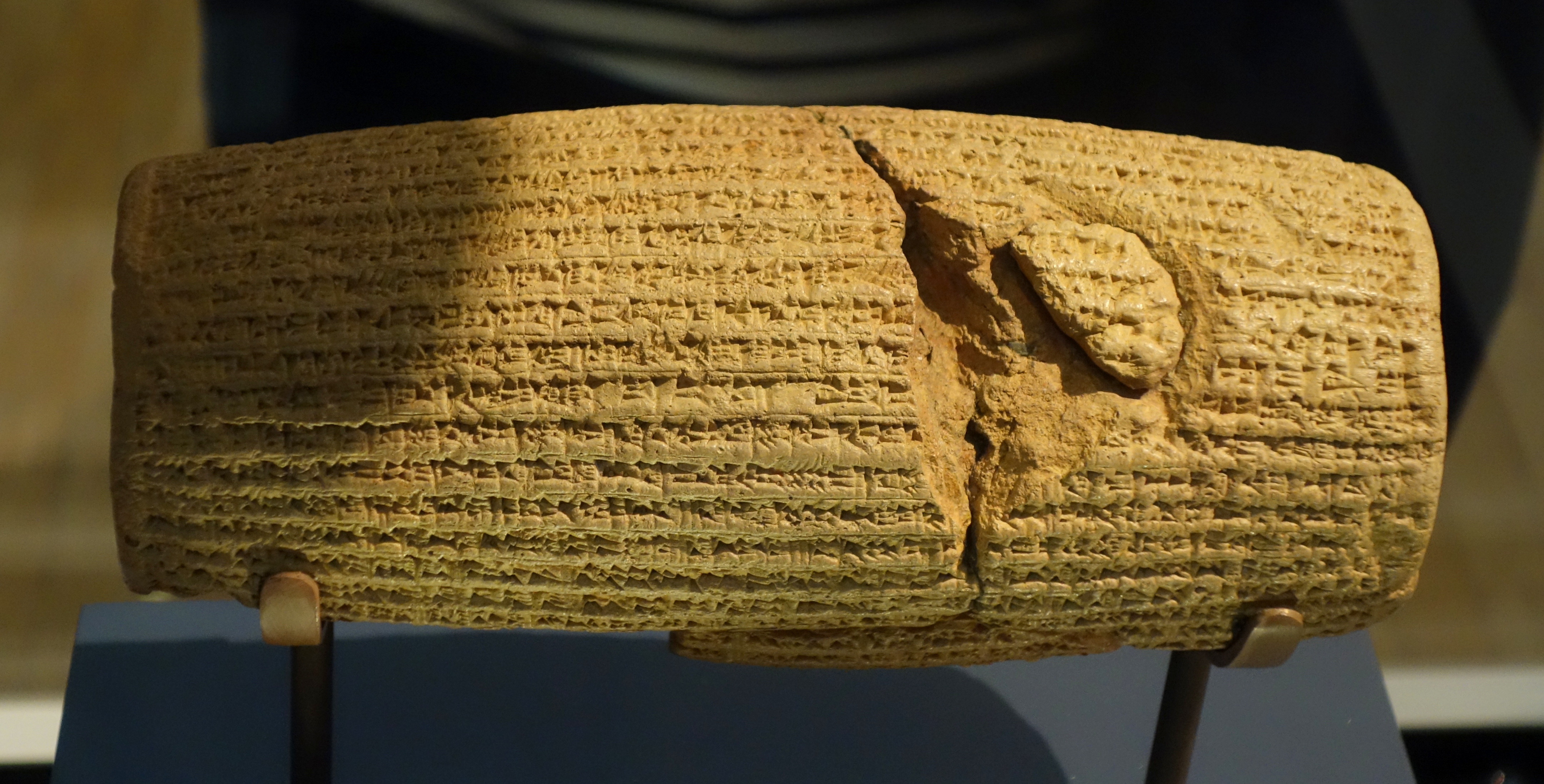 Source: Daderot photograph of the Cyrus Cylinder, British Museum, CC0 via Wikimedia Commons.
The cylinder helps situate Cyrus in the wider Persian practice of royal restoration language. It does not prove every detail of Ezra 1; it helps the reader understand the kind of imperial world in which the Lord stirred Cyrus.
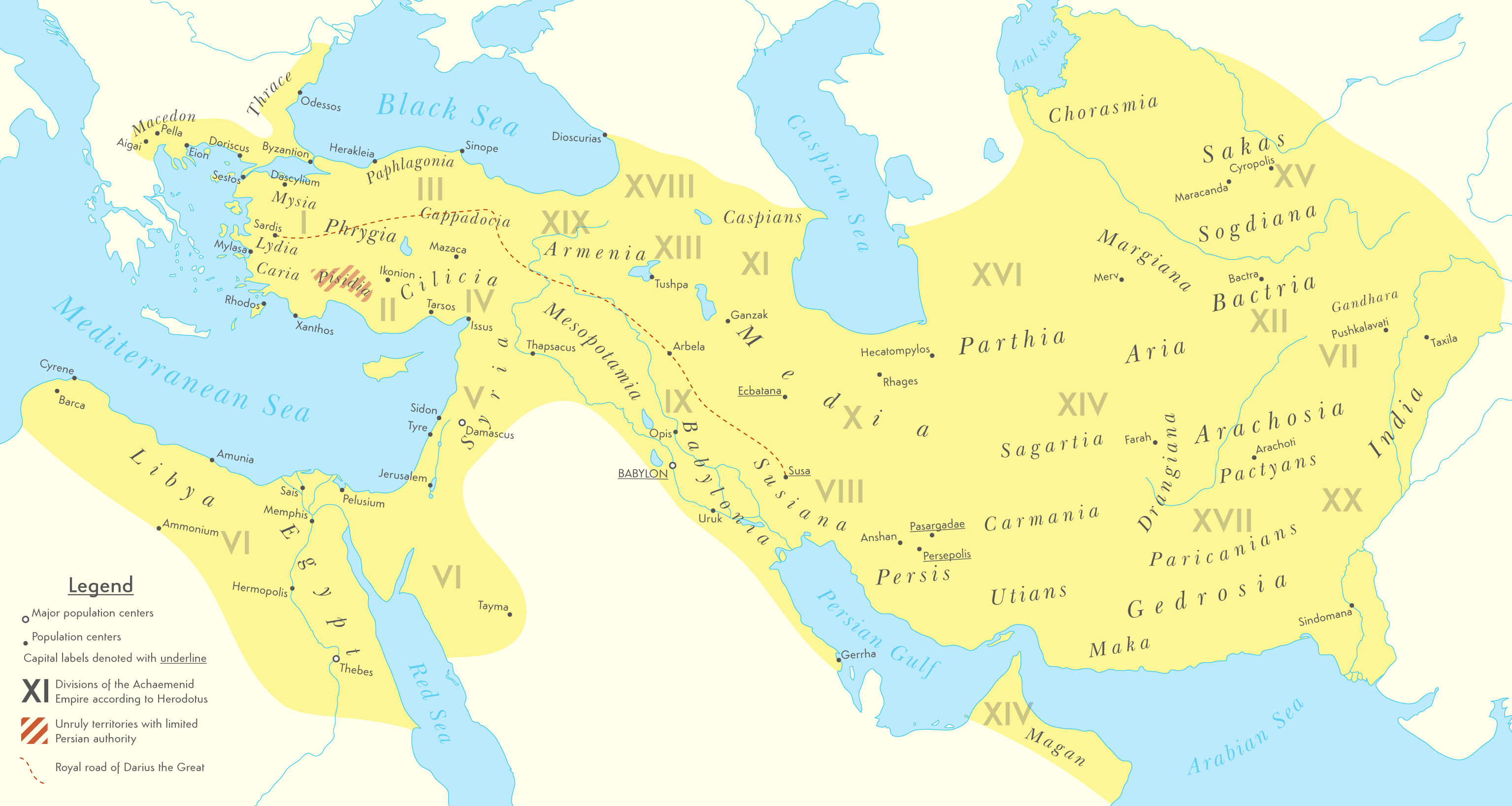 Source: Cattette, Achaemenid Empire 500 BCE, CC BY 4.0 via Wikimedia Commons.
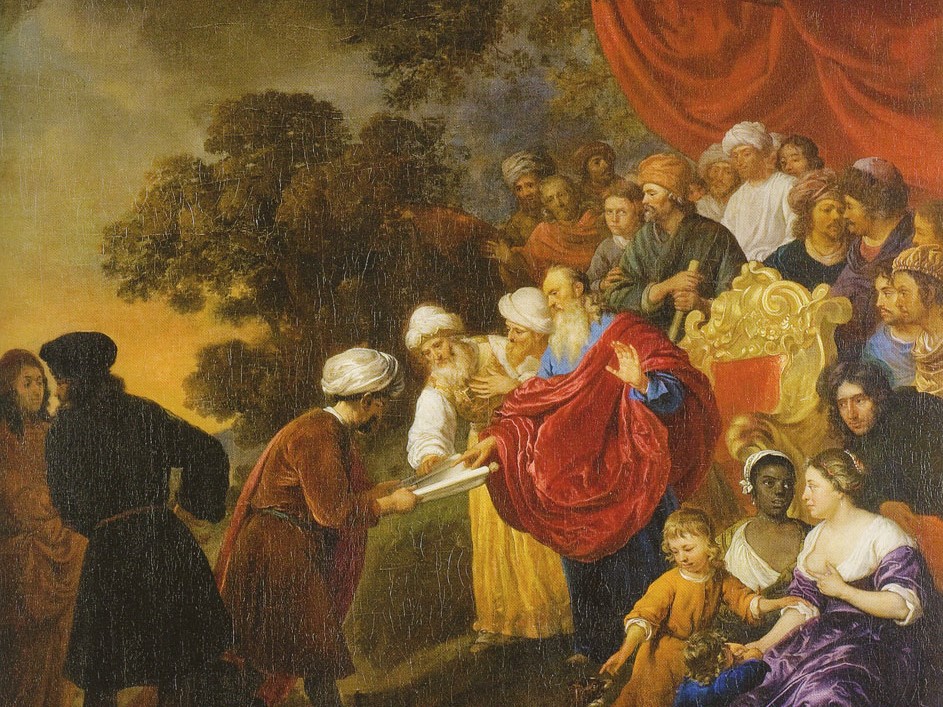 Source: Jacob van Loo, Zerubbabel and Cyrus, public domain via Wikimedia Commons. Western biblical art, not a documentary reconstruction.
Van Loo’s painting is Western biblical imagination around Zerubbabel, Cyrus, and rebuilding, not evidence for the appearance of the historical meeting. The biblical burden remains that God restores worship, holy vessels, names, and priestly memory.
Glossary
- Athersastha: Brenton’s form for a Persian governor or authority figure, often rendered Tirshatha, who rules that uncertain priestly claimants should not eat the most holy things until proper priestly discernment is available.
- Cyrus: King of Persia. In Ezra 1 he issues the decree permitting return and temple rebuilding, while the text stresses that the Lord stirred him.
- Jeremias: Brenton’s form of Jeremiah, the prophet whose word concerning return after exile is fulfilled.
- Juda: Brenton’s form of Judah.
- Lights and Perfections: Brenton’s rendering connected with Urim and Thummim, the ancient priestly means of discernment.
- Mithradates: The treasurer through whom Cyrus returns the temple vessels.
- Nathinim or Nathanim: Temple servants listed in Ezra 2. The form is connected with those given or appointed for service.
- Sasabasar: Brenton’s form commonly associated with Sheshbazzar, the chief man of Judah entrusted with the vessels.
- Vessels of the house of the Lord: Sacred objects taken from Jerusalem by Nebuchadnezzar and restored by Cyrus for use in the Lord’s house.
- Zerubbabel: Named Zorobabel in Brenton, the leader listed at the head of the returned community.
Spiritual Fruit 🍇
- Trust the Lord who fulfills His word. Ezra begins after judgment, but not after God has forgotten. When repentance feels late, remember that the Lord can still open a door of return.
- Respond when the spirit is stirred. Do not despise the first movement of grace. If God is stirring prayer, confession, service, reconciliation, or generosity, rise and go.
- Return holy vessels to holy use. Ask what part of your life has been used in the house of an idol. Let the Lord reclaim time, attention, speech, skill, body, money, and memory.
- Remember people by name. Love becomes concrete when it prays by name and serves particular persons. Ezra’s register trains the heart against vague compassion.
- Give according to your power. God does not ask theatrical giving. He asks willing offering. Bring what you actually have, and let restoration become embodied.
The road home begins with a word God has kept. Place before Him one name you have stopped remembering and one gift you have kept back. Let your return become an offering, quiet enough to be honest and concrete enough to help someone worship.
Teaching Notes
- Suggested timing: 10 minutes for context and geography, 12 minutes for Movement 1, 10 minutes for Movement 2, 12 minutes for Movement 3, 8 minutes for Movement 4, 8 minutes for Movement 5, 8 minutes for Movement 6, and 10 minutes for discussion and prayer.
- Where to linger: Linger on the repeated phrase that the Lord stirred the spirit, the return of the vessels, the register of names, and the restraint around priestly genealogy.
- Where to compress: Do not spend class time pronouncing every family name unless the group is studying the register itself. Summarize the pattern and read enough names to let the weight of remembrance be felt.
- Key phrases to say slowly: “The Lord stirred.” “Holy things must be returned to holy use.” “God restores people by name.” “According to their power.”
- Pastoral cautions: Do not politicize Cyrus. Do not use the genealogy section to shame people with complicated family histories. Do not turn giving into pressure on the poor. Do not treat hidden service as second-class service.
- Teaching aim: By the end, the class should see that restoration is providential, liturgical, personal, ordered, reverent, and concrete.
The Lord stirs Cyrus and fulfills Jeremiah (Ezra 1:1-4)
- Ask: Why does Ezra say that Cyrus acted so Jeremiah’s word might be fulfilled?
- Emphasize: The Lord is the main actor. Cyrus is an instrument, not the center.
- Watch for: Turning the passage into political admiration for Cyrus instead of worship of the Lord who fulfills His word.
- Connect: The same God who opened return after exile opens repentance and return in Christ.
God stirs the fathers and restores the holy vessels (Ezra 1:5-11)
- Ask: What is the difference between being released from exile and returning holy things to holy use?
- Emphasize: God stirs both rulers and worshippers. The people must rise and respond.
- Watch for: Treating the vessels as treasure only. They are signs of worship restored.
- Connect: In Christ, the whole person is reclaimed as a vessel for holiness.
The returned families are remembered by name (Ezra 2:1-35)
- Ask: Why might Scripture spend so much space naming returned families?
- Emphasize: God restores people by name, not as a faceless group.
- Watch for: Treating lists of names as spiritually empty because they are hard to pronounce.
- Connect: The Church remembers names before God in baptism, intercession, and commemoration.
Priests, Levites, singers, gatekeepers, servants, and holy service (Ezra 2:36-58)
- Ask: Why does Ezra name singers, porters, and servants alongside priests?
- Emphasize: Worship is restored through ordered and varied service.
- Watch for: Ranking ministries by visibility rather than faithfulness.
- Connect: The Church is one Body in Christ, with many members serving the one worship of God.
Uncertain genealogy and reverent restraint around priesthood (Ezra 2:59-63)
- Ask: Why is restraint around priestly service an act of reverence rather than mere exclusion?
- Emphasize: Holy ministry requires calling, discernment, and order.
- Watch for: Using this passage to shame people with complicated family histories or uncertain records.
- Connect: Christ is the true High Priest, and His Church approaches holy things with reverence and mercy.
The community gives and settles for worship (Ezra 2:64-70)
- Ask: What does “according to their power” teach about willing offering?
- Emphasize: Restoration needs concrete giving, not only emotion.
- Watch for: Reducing giving to money alone or using the passage to pressure the poor.
- Connect: In Christ, the faithful offer themselves and their gifts for the building up of the Church.
Sources
Embedded Scripture is from Brenton’s English Septuagint (LXX).
Brenton, The Septuagint Version of the Old Testament, Ezra 1-2; the parallel history in 1 Esdras 2:1-15 and 1 Esdras 5:7-46.
2 Chronicles 36:22-23; Jeremiah 25:11-12; Jeremiah 29:10-14; Isaiah 44:28; Isaiah 45; Exodus 28:30; Hebrews 5:4; Hebrews 7:28; 2 Corinthians 8:3.
Cyrus Cylinder photograph, British Museum artifact; return-from-exile map; Achaemenid Empire map.
Further reading: H. G. M. Williamson, Ezra, Nehemiah, Word Biblical Commentary 16; Jacob M. Myers, Ezra, Nehemiah, Anchor Bible 14.
Footnotes
-
St. John Chrysostom, Homilies on Hebrews, Homily 8 (Hebrews 5:1-3), section 9, text. ↩
-
Coptic Katameros, Great Lent cycle, Isaiah 45:1-10 and Isaiah 45:11-17; Bright Saturday service order, Ninth Hour, Isaiah 45:15-20. ↩
-
Agpeya, Twelfth Hour, Psalm 137 (LXX Psalm 136), prayer book. ↩
-
Liturgy of St. Cyril, Prayer of the Oblations, paragraph beginning “And as You have received the offerings,” service text. ↩