


This narration is from a previous version of the study and may include a combined recording of multiple chapters.
Ezra 8 shows the return as a holy procession, not a private relocation. Ezra names the companions, notices the absence of Levites, proclaims a fast at Aüe (Ahava), refuses to lean on a military escort, weighs the holy vessels, and weighs them again after arrival. The chapter teaches that the restored people must travel with order, dependence, accountability, and reverence. God protects the road, but Ezra still counts, assigns, guards, records, worships, and delivers the king’s commissions.
The spiritual center is trust that becomes disciplined stewardship. Ezra does not confuse faith with carelessness. He prays because the journey is dangerous, and he weighs the vessels because holy things are not handled casually. In Christ, the Church learns the same pattern: fasting before service, reverence before holy things, and faithful guarding of the good deposit entrusted to us.
This is one of the most practical spiritual lessons in Ezra. Trust in God does not cancel planning; planning does not replace trust in God. Fasting and inventory belong together when holy things are entrusted to weak human hands.
The same journey appears in 1 Esdras 8:28-67. Reading the two accounts together reveals their shared trust and their distinct wording, especially in the names and final offering totals.
Historical and Scriptural Context
Ezra 7 introduced Ezra as a priest and scribe who prepared his heart to seek the Law of the Lord, do it, and teach it in Israel. Ezra 8 now shows that mission as it moves from authorization to embodied obedience. The king’s favor has opened the way, but the company still needs leaders, Levites, fasting, courage, holy stewardship, and safe arrival. The next chapter will turn from the road to the wound within the community, as Ezra hears of covenant unfaithfulness and begins intercession.
Historically, this journey takes place under Persian rule in the reign of Arthasastha, the Brenton form of Artaxerxes. The return is official, funded, and protected by royal decree, yet Ezra refuses to reduce the work of God to Persian patronage. The chapter balances two truths: God can use royal favor, and God’s people must still humble themselves before Him. The hand of God appears repeatedly as the real protection behind the visible journey.
Scripturally, Ezra 8 gathers several older patterns. Numbers 4 gives careful priestly and Levitical responsibility for holy objects in the wilderness. 1 Chronicles 15 recalls David’s corrected care in bringing up the ark, where holy service must be done according to proper order. Psalm 121 (LXX Psalm 120) gives the pilgrim confidence that the Lord keeps one’s going out and coming in. In the New Testament, Matthew 6:16-18, Acts 13:2-3, Acts 14:23, 2 Corinthians 4:7, 2 Timothy 1:14, and Hebrews 9 help the Church read Ezra’s fast, mission, holy vessels, and priestly reverence in the light of Christ.
Geographical Significance ⛰️
The journey runs from the Babylonian world toward Jerusalem. A direct desert crossing would be harsh and dangerous, so return-from-exile travel is usually represented as moving along the great river routes before turning toward Judah. The chapter’s named gathering place is the river Aüe, commonly associated with Ahava, but the exact location is uncertain. The narrative does not supply a location precise enough to settle the question.
The geography matters because the road itself becomes a test of faith. Ezra has publicly confessed that the good hand of God is upon those who seek Him, yet the route contains enemies, adversaries, children, possessions, and holy vessels. The journey is not only a line on a map. It is a movement from exile toward worship, through danger, under prayer.
The journey exposes families and temple treasures to the same road. The broad Persian map below supplies context, not the exact route or a secure identification of the gathering place.
The Characters 👥
- Ezra or Esdras: Priest, scribe, and narrator of this chapter. He leads by attention, prayer, fasting, accountability, and reverence for the Lord’s name.
- Arthasastha: Brenton’s form of Artaxerxes. The king’s authorization stands behind the mission, but Ezra refuses to let royal favor replace trust in God.
- The heads of families: Named leaders who go up with Ezra. They show that the return is ordered through households and accountable representatives, not through an anonymous mass.
- The priests: Especially the twelve chiefs entrusted with silver, gold, and vessels. Their holiness is tied to the holiness of the things they carry.
- The Levites: Initially absent at the review, then gathered through deliberate effort. Their absence threatens proper service because the house of God requires ordered ministry.
- The Nathinim: Temple servants appointed for the service of the Levites. Ezra records them by name, honoring hidden service connected to worship.
- The children and the vulnerable households: Ezra explicitly prays for a straight way for the company, their children, and their property. The return is not a military expedition of the strong only.
- The enemy and adversary in the way: Unnamed threats along the route. Their presence makes Ezra’s fast and refusal of escort spiritually serious, not theatrical.
- Merimoth, Eleazar, Jozabad, and Noadia: Priestly and Levitical receivers in Jerusalem who help weigh and record the vessels after arrival.
- The governors beyond the river: Persian officials who receive the king’s mandate after the people arrive. The mission ends with public order as well as worship.
Companions by name and return as ordered community (Ezra 8:1-14)
1 And these are the heads of their families, the leaders that went up with me in the reign of Arthasastha the king of Babylon. 2 Of the sons of Phinees; Gerson: of the sons of Ithamar; Daniel: of the sons of David; Attus. 3 Of the sons of Sachania, and of the sons of Phoros; Zacharias: and with him a company of a hundred and fifty. 4 Of the sons of Phaath-Moab; Eliana the son of Saraia, and with him two hundred that were males. 5 And of the sons of Zathoes; Sechenias the son of Aziel, and with him three hundred males. 6 And of the sons of Adin; Obeth the son of Jonathan, and with him fifty males. 7 And of the sons of Elam; Isæas the son of Athelia, and with him seventy males. 8 And of the sons of Saphatia; Zabadias the son of Michael, and with him eighty males. 9 And of the sons of Joab; Abadia the son of Jeiel, and with him two hundred and eighteen males. 10 And of the sons of Baani; Selimuth the son of Josephia, and with him a hundred and sixty males. 11 And of the sons of Babi; Zacharias the son of Babi, and with him twenty-eight males. 12 And of the sons of Asgad; Joanan the son of Accatan, and with him a hundred and ten males. 13 And of the sons of Adonicam were the last, and these were their names, Eliphalat, Jeel, and Samæa, and with them sixty males. 14 And of the sons of Baguæ, Uthai, and Zabud, and with him seventy males.
Light from the Word 🕯️
Ezra begins the journey with names. The list is not as long as Ezra 2, but it has the same spiritual instinct. Return is not treated as a crowd movement with interchangeable people. The heads of families are named, and the number travelling with each leader is recorded. The restored community moves with memory, order, and accountability.
The leaders are attached to fathers and households. Some names recall priestly lines, royal lines, and earlier return families. This means Ezra’s company is not inventing a new identity on the road. They are returning within the sacred memory of Israel. The phrase “went up with me” also matters. Ezra is not merely issuing instructions from a distance. He travels with them.
Attus is the familiar Hattush, named here among the sons of David. First Chronicles 3:19-22 places Hattush within the descendants of Zerubbabel. The return includes the Davidic line remembered in Matthew 1:12-13, even while Judah remains under a foreign king. A royal ancestry is present without a restored throne.
The list includes large and small companies. One leader has three hundred males with him, another twenty-eight. Scripture honors both. The Lord’s work is not measured only by the size of a group. The community is strengthened when each household takes its place in obedience.
Apostolic reading
The wider biblical and liturgical mind of the Church receives lists of names as spiritually serious. The Lord tells the disciples to rejoice that their names are written in heaven, and the Church prays by name for the living and the departed. Ezra’s register therefore resists a thin view of salvation. God restores persons in communion, households in order, and servants in relation to worship.
The ordered company also prepares the reader for the Church’s own visible order. The Church is not a vague spiritual feeling. She is a gathered body with bishops, priests, deacons, monks, families, servants, catechumens, children, and the poor. Order does not quench grace when it serves worship and truth.
Spiritual application
This movement asks whether our service is accountable or vague. Many people love the idea of renewal, but fewer are willing to be counted, named, entrusted, and led. Ezra teaches that return to God becomes concrete when a person takes his place in the body and accepts responsibility before God.
It also comforts those whose contribution feels small. The list does not erase the smaller company. If the Lord records twenty-eight alongside three hundred, then the hidden servant, the quiet family, the small class, and the weak beginning are not beneath His notice.
Missing Levites and the need for proper service (Ezra 8:15-20)
15 And I gathered them to the river that comes to Evi, and we encamped there three days: and I reviewed the people and the priests, and found none of the sons of Levi there. 16 And I sent men of understanding to Eleazar, to Ariel, to Semeias, and to Alonam, and to Jarib, and to Elnatham, and to Nathan, and to Zacharias, and to Mesollam, and to Joarim, and to Elnathan. 17 And I forwarded them to the rulers with the money of the place, and I put words in their mouth to speak to their brethren the Athinim with the money of the place, that they should bring us singers for the house of our God. 18 And they came to us, as the good hand of our God was upon us, even a man of understanding of the sons of Mooli, the son of Levi, the son of Israel, and at the commencement came his sons and his brethren, eighteen. 19 And Asebia, and Isaia of the sons of Merari, his brethren and his sons, twenty. 20 And of the Nathinim, whom David and the princes had appointed for the service of the Levites there were two hundred and twenty Nathinim; all were gathered by their names.
Light from the Word 🕯️
Ezra stops at the river and reviews the company. The pause matters. A leader who is spiritually alert does not assume that enthusiasm is enough. Ezra looks at the people and the priests, and he notices what is missing: none of the sons of Levi are there.
Brenton calls the gathering river “Evi” in verse 15 and “Aüe” in verses 21 and 31. These varying Greek-based spellings refer to the Ahava gathering place within this narrative. Likewise “Athinim” in verse 17 and “Nathinim” in verse 20 name the temple servants, not two unrelated orders. Verse 17 specifically asks for singers for the house of God; that detail belongs to the displayed Greek-based account.
This absence is not a minor staffing inconvenience. The journey is directed toward the house of God. Without Levites and temple servants, the restored worshipping life will be wounded. Ezra therefore sends men of understanding, gives them words to speak, and seeks those needed for service. The good hand of God is upon the mission, but Ezra still acts carefully.
The result is both divine mercy and human obedience. Levites from the sons of Mooli and Merari come, along with two hundred and twenty Nathinim. Ezra notes that the Nathinim had been appointed by David and the princes for the service of the Levites, and that all were gathered by their names. Hidden service is not accidental in the house of God. It is remembered, appointed, and necessary.
Apostolic reading
The older scriptural pattern is clear. Numbers 4 gives detailed responsibilities for the sons of Levi in carrying and guarding holy things. 1 Chronicles 15 shows David correcting the transport of the ark so that it is carried according to holy order. Ezra stands in this same reverent line. The Lord’s work is not only that the people arrive. The Lord’s work is that worship be restored rightly.
The apostolic Church does not copy the Levitical order as if Christ had not come, but she receives the principle of ordered service. The body has many members, and not every member has the same office. Holy service requires calling, preparation, obedience, and blessing. Ezra’s concern for Levites warns the Church against casual worship and casual leadership.
Spiritual application
Before moving forward, Ezra asks what is missing. This is a necessary question for every servant. A parish can have energy, plans, donors, youth, buildings, and publicity, yet still lack something essential for worship and formation. The wise servant reviews the company before the journey continues.
This movement also honors hidden workers. The Nathinim are not the public face of the return, yet Scripture records them by name. In the parish, the quiet forms of service often protect the worship of everyone else. Do not despise the people who prepare, carry, clean, guard, translate, teach, chant, open doors, copy papers, and pray unnoticed.
The Ahava fast and trust without military escort (Ezra 8:21-23)
21 And I proclaimed there a fast, at the river Aüe, that we should humble ourselves before our God, to seek of him a straight way for us, and for our children, and for all our property. 22 For I was ashamed to ask of the king a guard and horsemen to save us from the enemy in the way: for we had spoken to the king, saying, The hand of our God is upon all that seek him, for good; but his power and his wrath are upon all that forsake him. 23 So we fasted, and asked of our God concerning this; and he hearkened to us.
Light from the Word 🕯️
This is the spiritual heart of the chapter. Ezra proclaims a fast at Aüe, or Ahava, not to make a religious display, but so the people may humble themselves before God and seek a straight way. He prays for the whole company: “for us, and for our children, and for all our property.” The road is dangerous, and the vulnerable are named.
Ezra’s refusal to ask for a guard and horsemen must be read carefully. It is not a law against accepting protection, and it is not a romantic invitation to recklessness. In this specific moment, Ezra had already confessed to the king that the hand of God is upon all who seek Him for good. To ask for a military escort after that confession would weaken his witness. His stated concern is the witness he has already given about God. The account does not settle every motive in his heart. Nehemiah 2:9 records a faithful servant travelling with army officers and horsemen. Ezra’s decision is therefore integrity in this particular mission, not a rule against accepting protection.
The text holds prayer and public integrity together. Ezra fasts because he knows the road contains enemies. He refuses the escort because he has testified to God’s hand. He asks God because faith is not bravado. The Lord hearkens to them, and the later safe arrival confirms that the fast was not empty ritual.
“The hand of our God is upon all that seek him, for good” can be heard beside Romans 8:28. God works for the good of those who love Him; that promise gives endurance in hardship, rather than immunity from every danger. Ezra asks for a straight way for children as well as leaders, so dependence on God includes responsibility for those least able to protect themselves.
Gems from the Fathers 💎: Fasting before the unseen God
St. John Chrysostom, in the opening exposition of Matthew 6:16 in Homily 20, explains that the Lord protects fasting from the craving to be admired. Freedom from an audience is part of its fruit: one is “freed from the grievous bondage of men” and becomes “a true worker of virtue.”1 Ezra’s company humbles itself before God rather than staging confidence for the Persian court. When fasting makes us proud of what others can see, we have exchanged its freedom for another bondage.
In Acts 13:2-3, the Church fasts and prays before sending Barnabas and Saul; Acts 14:23 joins fasting and prayer to the appointment of elders. The Apostles’ Fast can be approached in this same spirit of prayer for service, without treating Acts 13 as the historical institution of that later fast.
Spiritual application
Ezra teaches the servant to fast before beginning dangerous work. This danger may not be physical travel. It may be a hard conversation, a new ministry, family restoration, confession after a long delay, ordination, a move, a medical burden, or leadership in a wounded community. The straight way is not found by self-confidence. It is sought by humility before God.
The movement also asks whether our public words about God are matched by private dependence on God. Ezra has spoken of the Lord’s hand, so he fasts. If we speak of trust in God but secretly rely only on control, reputation, money, cleverness, or institutional cover, the heart is divided. Faith becomes truthful when it kneels.
Holy vessels weighed and entrusted (Ezra 8:24-30)
24 And I gave charge to twelve of the chiefs of the priests, to Saraia, to Asabia, and ten of their brethren with them. 25 And I weighed to them the silver, and the gold, and the vessels of the first-fruits of the house of our God, which the king, and his councillors, and his princes, and all Israel that were found, had dedicated. 26 I even weighed into their hands six hundred and fifty talents of silver, and a hundred silver vessels, and a hundred talents of gold; 27 and twenty golden bowls, weighing about a thousand drachms, and superior vessels of fine shining brass, precious as gold. 28 And I said to them, Ye are holy to the Lord; and the vessels are holy; and the silver and the gold are freewill-offerings to the Lord God of our fathers. 29 Be watchful and keep them, until ye weigh them before the chief priests and the Levites, and the chiefs of families in Jerusalem, at the chambers of the house of the Lord. 30 So the priests and the Levites took the weight of the silver, and the gold, and the vessels, to bring to Jerusalem into the house of our God.
Light from the Word 🕯️
Ezra now entrusts the holy vessels and offerings. The repeated verb is weight. He weighs the silver, gold, and vessels into the hands of the priests and Levites, and he commands them to keep watch until the items are weighed again in Jerusalem. This is not distrustful bureaucracy. It is reverent accountability.
The key sentence is: “Ye are holy to the Lord; and the vessels are holy.” The persons and the objects are both set apart. The priests do not become holy because they possess valuable things. They are entrusted with holy things because their service belongs to the Lord. The vessels are not merely cargo. They are first-fruits, freewill-offerings, and instruments for the house of God.
Ezra’s charge is spiritually mature. He does not say, “Trust God, so do not count.” He says, in effect, “Because this belongs to God, be watchful and keep it.” Faith increases accountability. Holy things deserve clearer stewardship, not less.
Isaiah 52:11-12 speaks directly to this double concern: those who bear the Lord’s vessels must separate themselves from uncleanness, while the Lord goes before them and guards their rear. The charge is holiness with protected departure, rather than panic or flight. St. Paul uses Isaiah’s call to separation in 2 Corinthians 6:17. The vessels are guarded by holy bearers; the bearers themselves depend on God. This biblical connection illuminates Ezra’s witness about protection without claiming that Isaiah commands him to refuse an escort.
Gems from the Fathers 💎: The sanctuary opens toward Christ
St. John Chrysostom’s Homily 15 on Hebrews, sections 1 and 4, reads the tabernacle as pointing beyond itself to heavenly access and the flesh of Christ. On the greater and more perfect tabernacle, he explains, “Here he means the flesh.”2 Ezra’s vessels are genuinely holy within Israel’s worship, but their final significance is found in the living High Priest, not in the preciousness of their metal. Christ’s willing self-offering opens communion with God.
The apostolic stewardship language then becomes personal and ecclesial. The treasure is carried in earthen vessels (2 Corinthians 4:7); the good deposit is guarded by the Holy Spirit (2 Timothy 1:14), and Timothy must keep what was entrusted to him (1 Timothy 6:20). The Church receives Scripture, apostolic faith, and sacramental life as gifts to preserve and hand on, not possessions to reshape around a servant’s preferences.
Spiritual application
Ask what God has weighed into your hands. A servant may be entrusted with children, a class, money, confidential suffering, a chanter’s gift, a priestly blessing, a small group, a ministry key, a wounded friendship, or a Scripture passage to teach. The question is not whether the trust is visible. The question is whether it is holy to the Lord.
Ezra’s command is simple: be watchful and keep them. Watchfulness means more than avoiding scandal. It means attention, prayer, clean motives, clear records, honest handoff, and humble fear before God. If holy things pass through our hands, they should not be diminished by our negligence.
Safe arrival, re-weighing, offerings, and royal commissions delivered (Ezra 8:31-36)
31 And we departed from the river of Aüe on the twelfth day of the first month, to come to Jerusalem: and the hand of our God was upon us, and delivered us from the hand of the enemy and adversary in the way. 32 And we came to Jerusalem, and abode there three days. 33 And it came to pass on the fourth day that we weighed the silver, and the gold, and the vessels, in the house of our God, into the hand of Merimoth the son of Uria the priest; and with him was Eleazar the son of Phinees, and with them Jozabad the son of Jesus, and Noadia the son of Banaia, the Levites. 34 All things were reckoned by number and weight, and the whole weight was written down.
35 At that time the children of the banishment that came from the captivity offered whole-burnt-offerings to the God of Israel, twelve calves for all Israel, ninety-six rams, seventy-seven lambs, twelve goats for a sin-offering: all whole-burnt-offerings to the Lord. 36 And they gave the king’s mandate to the king’s lieutenants, and the governors beyond the river: and they honoured the people and the house of God.
Light from the Word 🕯️
The company departs from Aüe on the twelfth day of the first month and arrives in Jerusalem. Ezra names the danger plainly: enemy and adversary were in the way. The safe arrival is not attributed to luck, strategy, or Ezra’s courage. “The hand of our God was upon us.” The fast of verses 21-23 is answered in verse 31.
They depart on the twelfth day of the first month, two days before the Passover date of the fourteenth. The company is still on the road, so this is not a report of a Passover celebrated that day. Yet the date, the return, and the Lord’s protecting hand recall the Exodus. Exodus 13:9 remembers the mighty hand by which God brought His people out of Egypt; Ezra describes a new deliverance toward worship.
After arrival, the people rest three days. Then the vessels are weighed again in the house of God. This completes the accountability begun before the journey. The whole weight is written down. Holy stewardship includes a faithful ending, not only a faithful beginning.
The chapter then moves from accounting to worship. The children of the banishment offer whole-burnt-offerings, with twelve calves for all Israel and twelve goats for a sin-offering. The returned remnant worships on behalf of all Israel, not as a private faction. Finally, the king’s mandate is delivered to the governors beyond the river, and they honor the people and the house of God. The mission ends with worship and public order together.
Brenton’s Ezra 8:35 counts seventy-seven lambs, while 1 Esdras 8:66 counts seventy-two. This is a difference between the parallel accounts, not a reason to alter the displayed text. The precise history of the different numerals is uncertain. In Ezra, the twelve calves and twelve goats explicitly keep all Israel in view; the lamb count must not be changed to force every offering into a multiple of twelve.
Apostolic reading
Psalm 121 (LXX Psalm 120) gives the pilgrim language that fits this arrival: the Lord keeps going out and coming in. Ezra’s testimony is the historical form of that prayer. The company went out from Aüe under fasting and came into Jerusalem under God’s hand.
The apostolic pattern again deepens the spiritual reading. Ministry does not end when a task feels successful. Gifts are received, accounted for, offered, and handed over. The Lord who guards the road also receives worship. The Church learns to close work with thanksgiving, repentance, records, and obedience, not with self-congratulation.
Spiritual application
Many failures happen after arrival. A person prays intensely during danger, then becomes careless when relief comes. Ezra does not do that. He rests, weighs, records, offers, and delivers. The end of a grace-filled task is a dangerous moment because the heart wants to take credit or relax into disorder.
This movement calls us to finish faithfully. After a retreat, ministry trip, confession, fundraising effort, move, project, or reconciliation, ask what must be weighed, written down, offered to God, and delivered to the proper hands. Thanksgiving is not vague emotion. It becomes worship, accountability, and obedience.
The Church’s Voice in Worship ⛪
Ezra has no verse-addressed appointment in the Coptic lectionary collections cited here. Matthew 6:1-18, the Liturgy Gospel on the Sunday before Great Lent, joins fasting to almsgiving and prayer before the Father who sees in secret. It gives Ezra’s bodily humility a Christian companion: the fast empties our need to be seen so that we may seek God more truthfully.3
Romans 8:28-39 is the Pauline reading on Abib 27. Its confidence in God’s love strengthens Ezra’s confession about the good hand of God without promising an untroubled road.3
Psalm 121 (LXX Psalm 120) is prayed in the Agpeya’s Eleventh Hour and the Second Watch of the Midnight Prayer. The Lord who keeps our going out and coming in is remembered as the day closes and the night deepens. Ezra’s safe arrival gives historical substance to that pilgrim prayer.4
Iconography and Visual Teaching 🖼️
The empire map places the journey within the Persian world. It is geographical context rather than an icon or a reconstruction of the precise route.
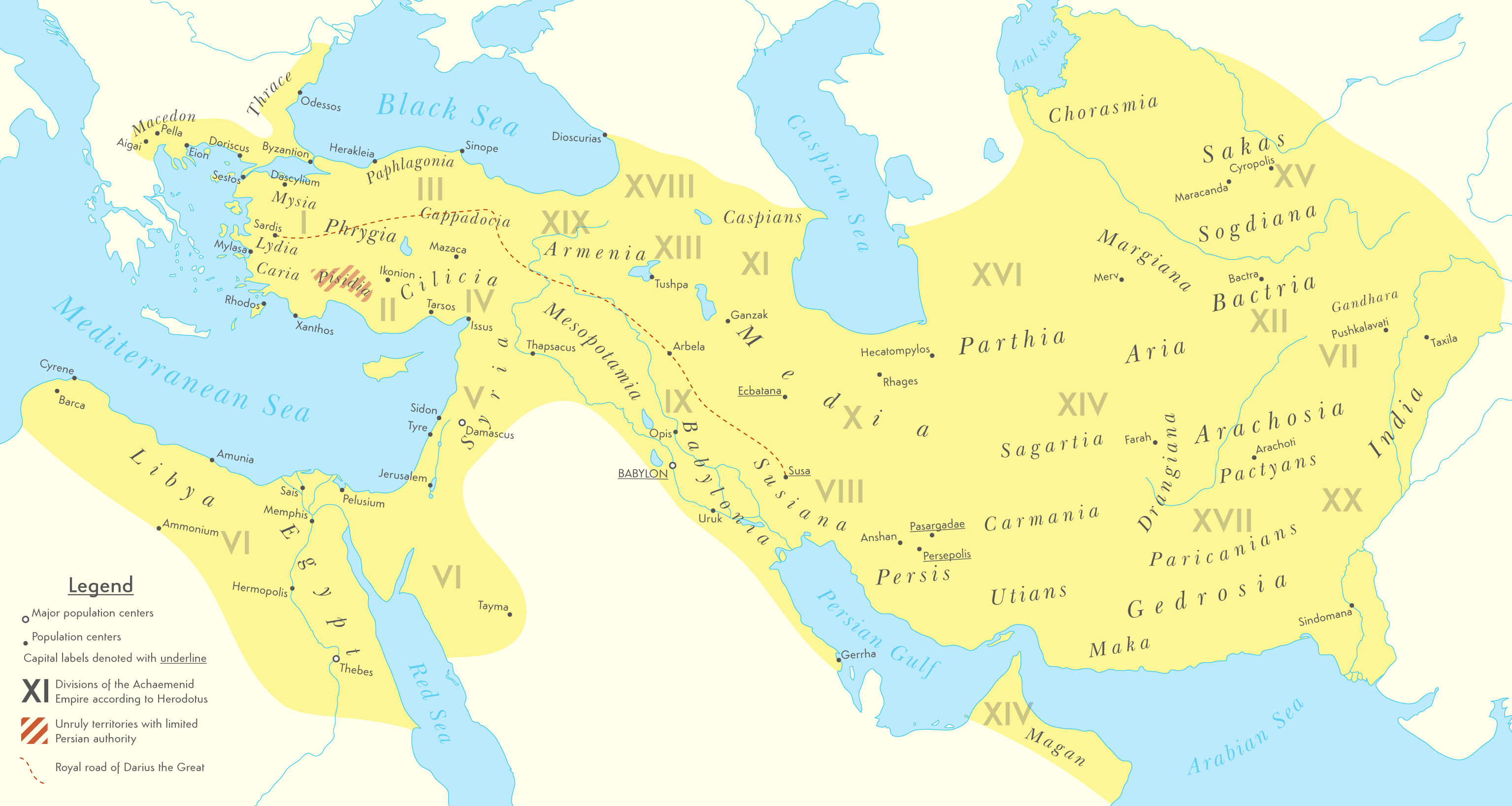 Source: Cattette, Achaemenid Empire 500 BCE, CC BY 4.0 via Wikimedia Commons.
This map gives broad Persian-period context, not an exact Ahava route. Ahava’s precise identification remains uncertain. The point is spiritual: fasting and practical accountability belong together. Ezra trusts the good hand of God and still weighs the holy vessels carefully.
Spiritual Fruit 🍇
- Begin service with humility. Before a journey, project, ministry, family decision, or hard conversation, fast and pray in a way appropriate to your state of life and under spiritual guidance. Ask God for a straight way, not only a successful outcome.
- Let your public words about God become private dependence on God. Ezra had spoken of God’s hand, so he humbled himself before God. Do not speak confidently about trust while secretly living from control and fear.
- Notice what is missing before moving forward. Ezra reviews the company and sees the absence of Levites. A wise servant asks what the ministry lacks: prayer, repentance, training, reverence, clarity, children, the poor, proper service, or peace.
- Guard what has been weighed into your hands. Holy things include more than vessels. Souls, time, money, teaching, confidential pain, Scripture, and sacramental life can all be entrusted to us. Be watchful and keep them.
- Finish with thanksgiving and accountability. After arrival, Ezra weighs, writes, offers, and delivers. Do not let relief make you careless. Complete the work before God.
The vessels have reached Jerusalem, and their weight is written down. Bring before Christ the people and responsibilities entrusted to you, including those whose needs are easy to forget after the danger passes. Thank Him for what He has guarded. Ask for the watchfulness to finish faithfully and return His gifts without claiming them as your own.
Teaching Notes
- Suggested timing: 8 minutes for context and geography, 8 minutes for Movement 1, 10 minutes for Movement 2, 14 minutes for Movement 3, 14 minutes for Movement 4, 10 minutes for Movement 5, and 10 minutes for discussion and prayer.
- Where to linger: Linger at Ezra 8:21-23 and Ezra 8:28-29. These two units carry the heart of the lesson: humility before danger and holy accountability before God.
- Where to compress: The opening list can be summarized after reading enough names for the class to feel the ordered community. Do not spend the whole session solving every name.
- Key phrases to say slowly: “That we should humble ourselves before our God.” “The hand of our God is upon all that seek him, for good.” “Ye are holy to the Lord; and the vessels are holy.” “All things were reckoned by number and weight.”
- Pastoral cautions: Do not use Ezra’s refusal of a guard to shame people who need practical help, medical care, legal protection, or security. Do not treat fasting as proof of spiritual superiority. Do not turn accountability into suspicion, or trust into looseness.
- Teaching aim: By the end, the class should see that Orthodox trust is not careless. It fasts, prays, orders service, guards holy things, gives thanks, and finishes responsibly.
Companions by name and return as ordered community (Ezra 8:1-14)
- Ask: Why does Ezra begin the journey by naming leaders and households?
- Emphasize: Restoration moves through remembered persons and ordered community, not through an anonymous crowd.
- Watch for: Treating biblical lists as empty because they are hard to pronounce or slow to read.
- Connect: In the Church, names, households, and ministries are remembered before God because the Body of Christ is personal and ordered.
Missing Levites and the need for proper service (Ezra 8:15-20)
- Ask: Why does Ezra stop the company when he discovers that Levites are missing?
- Emphasize: A restored community needs proper service for the house of God, not only willing travellers.
- Watch for: Treating worship as if sincerity removes the need for order, preparation, and appointed service.
- Connect: Christ gathers the Church as one Body with many members, each serving the holy worship of God in his proper place.
The Ahava fast and trust without military escort (Ezra 8:21-23)
- Ask: Why does Ezra fast instead of asking for the military escort that was probably available to him?
- Emphasize: Ezra’s refusal is tied to his public confession about God’s hand, not to contempt for practical wisdom.
- Watch for: Turning this passage into a rule against all protection, planning, medicine, counsel, or prudent help.
- Connect: The Church fasts and prays before service because Christ’s servants must begin with humility, not self-reliance.
Holy vessels weighed and entrusted (Ezra 8:24-30)
- Ask: Why does Ezra weigh the vessels before the journey instead of simply trusting the priests generally?
- Emphasize: Holy trust requires reverent accountability. The people are holy, and the vessels are holy.
- Watch for: Treating accountability as a lack of faith or treating ministry resources as private property.
- Connect: Christ entrusts the Church with the good deposit, and the Holy Spirit teaches us to guard it without possessiveness.
Safe arrival, re-weighing, offerings, and royal commissions delivered (Ezra 8:31-36)
- Ask: What does Ezra do after safe arrival, and why does that matter?
- Emphasize: God’s hand delivered them, and faithful stewardship continued after deliverance.
- Watch for: Stopping the lesson at “God protected them” without teaching re-weighing, offerings, and completed responsibility.
- Connect: In Christ, the Church receives mercy, gives thanks, guards what was entrusted, and offers all things back to God.
Glossary
Arthasastha: Brenton’s form of Artaxerxes, the Persian king under whose reign Ezra’s mission takes place.
Aüe or Ahava: Brenton’s form for the gathering place by a river or canal before the journey. The exact location is uncertain.
Good hand of God: Ezra’s repeated phrase for God’s gracious providence, protection, and favor upon those who seek Him.
Levites: Members of the tribe of Levi assigned to service connected with the house of God. Their absence in Ezra 8 threatens proper worship service.
Mooli: Brenton’s form of Mahli, connected with Levitical descent.
Nathinim: Temple servants appointed for service to the Levites. Ezra records them as necessary to restored worship.
Straight way: The safe and right path sought from God through fasting and prayer, not merely efficient travel.
Vessels: Sacred objects, silver, and gold dedicated for the house of God. In Ezra 8 they are weighed, entrusted, guarded, and weighed again.
Whole-burnt-offering: A sacrifice wholly offered to the Lord, here given by the returned exiles after safe arrival.
Sources
Embedded Scripture is from Brenton’s English Septuagint (LXX).
Primary sources
- Brenton, The Septuagint Version of the Old Testament, Ezra 8:1-36, used for the embedded Scripture quotations.
- Numbers 4; 1 Chronicles 15; Psalm 121 (LXX Psalm 120); Matthew 6:16-18; Acts 13:2-3; Acts 14:23; 2 Corinthians 4:7; 2 Timothy 1:14; Hebrews 9.
Patristic sources
- St. John Chrysostom, Homilies on Matthew, Homily 20, opening exposition of Matthew 6:16, before section 2, on fasting without hypocrisy.1
- St. John Chrysostom, Homilies on Hebrews, Homily 15, sections 1 and 4, on the sanctuary and the flesh of Christ.2
Coptic Orthodox and liturgical sources
- Coptic Katameros, Sunday before Great Lent and Abib 27.3
- Agpeya, Eleventh Hour and Midnight Second Watch, Psalm 121 (LXX Psalm 120).4
Maps, images, and historical aids
- Jews Return from Exile, Bible Mapper Atlas: https://biblemapper.com/blog/index.php/2022/09/26/jews-return-from-exile/
- Bible maps, Exile and Return, FreeBibleimages: https://www.freebibleimages.org/illustrations/bm-maps-exile-return/
- Model of Jerusalem in the Second Temple Period, Israel Museum: https://www.imj.org.il/en/wings/shrine-book/model-jerusalem-second-temple-period
Secondary academic sources and reference aids
H. G. M. Williamson, Ezra, Nehemiah, Word Biblical Commentary 16. Standard further reading for historical and textual questions, not directly quoted in this guide.
Jacob M. Myers, Ezra, Nehemiah, Anchor Bible 14. Standard further reading for historical background, not directly quoted in this guide.
Footnotes
-
St. John Chrysostom, Homilies on Matthew, Homily 20, opening exposition of Matthew 6:16, before section 2, https://www.newadvent.org/fathers/200120.htm. ↩ ↩2
-
St. John Chrysostom, Homilies on Hebrews, Homily 15, sections 1 and 4; section 4 explains Hebrews 9:11, https://www.ccel.org/ccel/schaff/npnf114.v.xix.html. ↩ ↩2
-
Coptic Katameros, Sunday before Great Lent, Liturgy Gospel, Matthew 6:1-18; Abib 27, Pauline reading, Romans 8:28-39. Date-resolved readings from CopticChurch.net. ↩ ↩2 ↩3
-
Agpeya, Eleventh Hour and Midnight Prayer, Second Watch, Psalm 121 (LXX Psalm 120). ↩ ↩2