


This narration is from a previous version of the study and may include a combined recording of multiple chapters.
Haggai 2 speaks to people whose obedience has begun but whose courage is fragile. The temple work looks small compared with former glory. The chapter holds three dated words: be strong, for the Lord is with you; holiness cannot be borrowed from holy work; and Zerubbabel is taken again as the Lord’s seal. With Haggai 1, the book has four dated words. This chapter has three.
Why This Passage Matters
This chapter keeps the reader from two opposite errors. The first error is despair: if the work looks small, perhaps God is not present. The second error is presumption: if we are near holy things, perhaps we are already holy. Haggai corrects both. The Lord gives courage by His presence, and He calls the people to a holiness that reaches the heart.
Haggai 2 also opens the book beyond the visible temple. The Lord speaks of shaking heaven, earth, sea, dry land, and nations. Hebrews 12 receives this language as a call to hold fast the kingdom that cannot be shaken. The chapter therefore moves from the real post-exilic temple toward Christ, the true Temple, and the unshaken kingdom of God. That reception is opened in hebrews-26-you-have-come-to-mount-zion.
Placement in the Book and Grouping Rationale
Haggai 2 stays as one guide because its three dated words belong together, and twenty-three verses read well as one unit. The book, not this chapter, has four dated words. The three words of the chapter address three temptations in the renewed work: discouragement before former glory, external holiness without inner repentance, and fear that the Davidic promise has failed. The promise of greater glory belongs inside the first of these three words, not as a fourth date.
Haggai 1 called the people out of delay. Haggai 2 teaches them how to continue: with courage, holiness, hope, and trust in the Lord’s covenant faithfulness.
Be strong because the Lord remains among you (Haggai 2:1-5)
1 In the seventh month, on the twenty-first day of the month, the Lord spoke by Aggæus the prophet, saying, 2 Speak now to Zorobabel the son of Salathiel, of the tribe of Juda, and to Jesus the son of Josedec, the high priest, and to all the remnant of the people, saying,
3 Who is there of you that saw this house in her former glory? and how do ye now look upon it, as it were nothing before your eyes? 4 Yet now be strong, O Zorobabel, saith the Lord; and strengthen thyself, O Jesus the high priest, the son of Josedec; and let all the people of the land strengthen themselves, saith the Lord, and work, for I am with you, saith the Lord Almighty; 5 and my Spirit remains in the midst of you; be of good courage.
The first word addresses discouragement. Some who remembered the former glory look at the new work and see almost nothing. This is a common spiritual danger: obedience begins, but comparison drains courage. The past becomes a weapon against the present.
The date makes the question land harder. The twenty-first of the seventh month is the last day of the Feast of Tabernacles (Leviticus 23:34-36). Solomon dedicated the first temple at that same feast. Brenton says all Israel assembled to the king “in the feast, this is the seventh month” (2 Chronicles 5:3), and that Solomon kept the feast seven days and dismissed the people on the twenty-third day of the seventh month (2 Chronicles 7:8-10). Brenton’s 1 Kings 8:2 names the month Athanin and does not itself say “seventh month.” The Chronicles witness is enough. On the feast when Israel remembered the house in her glory, the Lord asks who still sees that glory, and how the new work looks like nothing.
The Lord does not flatter the people or pretend the new house looks impressive. He gives a stronger word: be strong, work, I am with you, My Spirit remains in the midst of you. Courage does not come from the visible size of the work. It comes from the Lord’s presence.
Brenton’s verse 5 begins with the Spirit remaining in their midst. The Hebrew opens with a clause the Septuagint does not have: the word God covenanted with them when they came out of Egypt. Brenton does not erase the covenant. He simply does not repeat that clause here. What he does give is the promise the discouraged builders most need to hear: the Spirit has not left them.
Brenton again uses Jesus the son of Josedec for Joshua the high priest. This is not Jesus Christ. Joshua is the priestly leader of the returned community. Christian reading should be careful here. Joshua is not the fulfillment, but the priesthood and temple setting prepare the reader to see why Christ, the true High Priest and true Temple, fulfills what the restored community could only begin.
The greater glory and the unshaken kingdom (Haggai 2:6-9)
6 For thus saith the Lord Almighty; Yet once I will shake the heaven, and the earth, and the sea, and the dry land; 7 and I will shake all nations, and the choice portions of all the nations shall come: and I will fill this house with glory, saith the Lord Almighty. 8 Mine is the silver, and mine the gold, saith the Lord Almighty. 9 For the glory of this house shall be great, the latter more than the former, saith the Lord Almighty: and in this place will I give peace, saith the Lord Almighty, even peace of soul for a possession to every one that builds, to raise up this temple.
The Lord’s answer to discouragement is not nostalgia. He promises glory beyond what the people can see. He will shake heaven, earth, sea, dry land, and the nations. This shaking reveals what is temporary and what remains.
Hebrews 12:26-27 quotes the Septuagint form of this word. It has no “it is a little while.” The argument is built on “once.” St. John Chrysostom, in Homily 32 on Hebrews, section 5, comments on that word directly. He takes up the quotation, “Yet once more I shake not the earth only, but also heaven,” and the apostolic explanation that “this word Yet once more, signifieth the removing of those things which are shaken.” Then he says, “All things therefore will be taken away, and will be compacted anew for the better.” The things that remain are “the things to come.” He asks why a believer should grieve in a world that “abideth not” and “will very shortly have passed away.”1
Homily 33 begins at Hebrews 12:28-29. It does not expound the Haggai quotation. It does say, “For not only we ought not to be discouraged at present things, but even to show the greatest gratitude to Him, for those to come.” That is a pastoral word beside the shaking, not the exposition of the shaking itself.2
Gems from the Fathers 💎
Brenton says “the choice portions of all the nations shall come.” Hebrew-based Bibles say “the desire of all nations,” or a treasure the nations bring. The Hebrew word can mean desire or treasure, and it takes a plural verb, which is why the versions do not agree on whether one Desired One comes or many treasures come. St. Augustine, in The City of God, Book 18, chapters 45 and 48, discusses exactly this difference.
In chapter 45 he sets the Hebrew promise, “the desired One shall come to all nations,” beside the Septuagint, “The things shall come that are chosen of the Lord from all nations.” He reads the Greek as more suitable to the body than to the Head, to the Church than to Christ, and he hears in it the Gospel word, “Many are called, but few are chosen.” By those chosen ones, he says, “there is built, through the new testament, with living stones, a house of God far more glorious than that temple was which was constructed by king Solomon, and rebuilt after the captivity.”3
In chapter 48 the NPNF heading names the fulfillment “Not in the Rebuilding of the Temple, But in the Church of Christ.” The new-covenant house is more glorious “as the living stones, even believing, renewed men, of which it is constructed are better.” When God says, “I will give peace in this place,” Augustine will not stop at the rebuilt stones. “Since by that rebuilt place is typified the Church which was to be built by Christ, nothing else can be accepted as the meaning of the saying, ‘I will give peace in this place,’ except I will give peace in the place which that place signifies.” He keeps both wordings. In the Hebrew, “shall come the desired of all nations.” In the Septuagint, “shall come those who are elected of the Lord out of all nations.” He also refuses to pretend the glory is already fully visible. The churches still hold those who will be separated “by the winnowing as in the threshing-floor.” The glory “is not so apparent now as it shall be when every one who is there shall be there always.”4
Augustine is pre-Chalcedonian. He does not settle later Christological formulas. He does give this chapter its ecclesial depth, and he explains the Septuagint reading instead of merely flagging it.
Verse 8 guards the promise from anxiety and from greed: “Mine is the silver, and mine the gold.” St. John Chrysostom, in Homily 34 on First Corinthians, section 9, uses this word against the claim that wealth is proof of God’s favor. Some doubted that a house reduced to dust could appear again. Haggai, “in the person of God,” asks, “Why are ye afraid?” and answers, “The silver is Mine, and the gold is Mine,” and “I need not to borrow from others, and so to beautify the house.” The “as if he said” is Chrysostom’s explanatory paraphrase, not a second Bible verse.5 St. Cyril of Alexandria, commenting on this same word in his Commentary on Haggai, Chapter Two, says, “I look rather for sincere worshipers.”6 The glory of the house is God’s gift, not a prosperity slogan, and not a display borrowed from the nations.
The most tender Brenton phrase in verse 9 is an LXX-only expansion: “peace of soul for a possession to every one that builds.” It is not in the Hebrew, and it is still a gift worth treasuring. The gift is not only a finished structure. It is peace from God. Augustine reads “in this place will I give peace” as peace in the Church that the place signifies. The Septuagint lets that peace become a possession of the soul for everyone who builds.
Holiness cannot be borrowed by contact (Haggai 2:10-19)
10 On the four and twentieth day of the ninth month, in the second year of Darius, the word of the Lord came to Aggæus the prophet, saying, 11 Thus saith the Lord Almighty; Inquire now of the priests concerning the law, saying, 12 If a man should take holy flesh in the skirt of his garment, and the skirt of his garment should touch bread, or pottage, or wine, or oil, or any meat, shall it be holy? And the priests answered and said, No. 13 And Aggæus said, If a defiled person who is unclean by reason of a dead body, touch any of these, shall it be defiled? And the priests answered and said, It shall be defiled. 14 And Aggæus answered and said, So is this people, and so is this nation before me, saith the Lord; and so are all the works of their hands: and whosoever shall approach them, shall be defiled [because of their early burdens: they shall be pained because of their toils; and ye have hated him that reproved in the gates]. 15 And now consider, I pray you, from this day and beforetime, before they laid a stone on a stone in the temple of the Lord, what manner of men ye were. 16 When ye cast into the corn-bin twenty measures of barley, and there were only ten measures of barley: and ye went to the vat to draw out fifty measures, and there were but twenty. 17 I smote you with barrenness, and with blasting, and all the works of your hands with hail; yet ye returned not to me, saith the Lord.
18 Set your hearts now to think from this day and upward, from the four and twentieth day of the ninth month, even from the day when the foundation of the temple of the Lord was laid; 19 consider in your hearts, whether this shall be known on the corn-floor, and whether yet the vine, and the fig-tree, and the pomegranate, and the olive-trees that bear no fruit are with you: from this day will I bless you.
This word is easy to flatten into a clever maxim: uncleanness spreads faster than holiness. Haggai’s point is more searching, and the priests’ two answers are the whole point.
Holy flesh sanctifies what it touches directly, and only one step. Leviticus 6:27 in NKJV numbering, which is Leviticus 6:20 in the Septuagint numbering Brenton follows, says that whoever touches the flesh of the offering shall be holy. The skirt that touched the holy flesh does not then make the bread, the pottage, the wine, or the oil holy. The priests answer, “No.”
Corpse impurity spreads further. Numbers 19:11-13 says that whoever touches a dead body is unclean seven days, and that the uncleanness defiles the tabernacle if it is not purified. Numbers 19:22 adds that whatever the unclean person touches becomes unclean, and the person who touches that thing is unclean until evening. The priests answer, “It shall be defiled.”
The Synaxarium remembers Haggai as a Levite of Aaron’s line who was buried in the tomb of the priests. That is tradition, not a verse of this book. It does make this scene luminous: the prophet questions the priests about the law they are set apart to know.
The people cannot become holy merely by being near holy work. Contact with the temple project does not heal an unrepentant heart. This is a necessary word for Orthodox readers. One can stand near the altar, speak about the Church, serve in visible ways, and still need inner return. Holy things do not become magic. The temple does not sanctify disobedience. The sacraments are life, but they are received rightly through repentance, faith, humility, and communion with Christ.
A spiritual reflection, not a citation from a named Father. In Christ, the logic of verses 12-13 is reversed. He touches the leper (Matthew 8:3), the bier (Luke 7:14), and the dead girl (Mark 5:41). He is not defiled. His holiness heals. That is a Christian meditation on the priests’ answers, not a claim that Haggai already said it, and not a patristic quotation.
The bracketed clause in verse 14 is an LXX expansion. Its last line, “ye have hated him that reproved in the gates,” echoes Amos 5:10: “They hated him that reproved in the gates, and abhorred holy speech.” The clear burden of the oracle does not depend on the bracket. The people’s works have been affected by their condition before God, and the Lord now calls them to consider their hearts from the day the foundation is laid.
Verse 17, “yet ye returned not to me,” closely echoes Amos 4:9, where blight, gardens, and devoured oliveyards still do not bring the people back: “yet not even thus did ye return to me, saith the Lord.” Haggai is not inventing a new accusation. He is standing in the prophetic line that keeps asking why correction has not produced return.
The oracle ends with blessing: “from this day will I bless you.” God does not expose impurity to leave the people condemned. He exposes it so that rebuilding can become holy obedience rather than religious activity covering a divided heart.
Zerubbabel as the chosen seal (Haggai 2:20-23)
20 And the word of the Lord came the second time to Aggæus the prophet, on the four and twentieth day of the month, saying, 21 Speak to Zorobabel the son of Salathiel, of the tribe of Juda, saying, I shake the heaven, and the earth, and the sea, and the dry land;
22 and I will overthrow the thrones of kings, and I will destroy the power of the kings of the nations; and I will overthrow chariots and riders; and the horses and their riders shall come down, every one by the sword striving against his brother. 23 In that day, saith the Lord Almighty, I will take thee, O Zorobabel, the son of Salathiel, my servant, saith the Lord, and will make thee as a seal: for I have chosen thee, saith the Lord Almighty.
The final word comes on the same day as the priestly questions. It is a second word, not a fourth date of the book. Brenton’s verse 21 adds “the sea and the dry land.” The Hebrew has heaven and earth. The Septuagint makes this shaking as wide as the shaking in verse 6.
Thrones, chariots, horses, and riders can be overthrown. The political powers that look permanent are not permanent before the Lord.
Then comes the word the chapter has been waiting for. God told Jeconiah, Zerubbabel’s grandfather, that even if he were the seal on God’s right hand, He would pull it off. Brenton Jeremiah 22:24 reads, “though Jechonias son of Joakim king of Juda were indeed the seal upon my right hand, thence would I pluck thee.” Hebrew-based Bibles say “signet.” Brenton says “seal.” The numbering is Jeremiah 22:24 in Brenton as well. Haggai’s last word gives the seal back. The removed seal is placed on Zerubbabel. The Davidic promise is not dead.
Zerubbabel is not the final king and not the fulfillment of the kingdom. He is a signpost. God preserves the Davidic promise through him even after exile, weakness, and foreign rule.
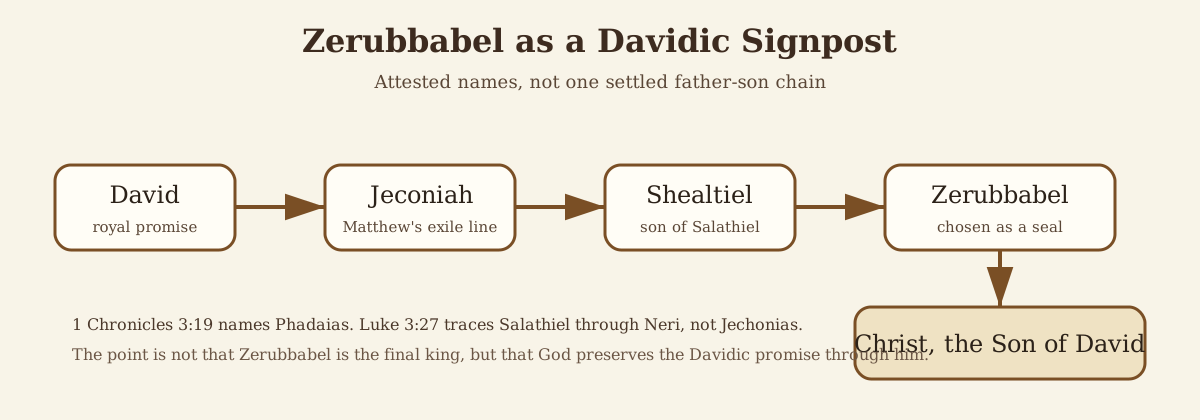 A teaching schematic, not a settled family tree. Haggai, Ezra, Matthew, and Luke call Zerubbabel the son of Shealtiel. Brenton 1 Chronicles 3:19 names Zorobabel among the sons of Phadaias. Luke 3:27-31 traces Shealtiel through Neri and Nathan, not through Jechonias. The tension is left as the texts leave it.
Matthew 1:12-13 places Zerubbabel in the line after the exile. Luke 3:27 also names him, but Luke’s line runs through Neri, not Jeconiah. See matthew-1-the-genealogy-of-the-king and luke-3-21-38-baptism-sonship-and-genealogy. Some explanations in the tradition have tried to reconcile Shealtiel and Pedaiah, or Matthew’s line and Luke’s line, by a levirate marriage or by two different family reckonings. Those are explanations offered in the tradition. They are not stated by Haggai, and this guide does not choose among them.
The point that Haggai does state is enough. God carries the promise forward until the Son of David comes.
Christological reading
Haggai 2 should not skip over the real temple or the real Zerubbabel. The historical meaning comes first. But the chapter also presses forward. The greater glory is not finally explained by architecture. Christ enters the temple, calls His own Body the Temple, and builds the Church as the dwelling place of God.
St. John Chrysostom, in Homily 23 on John, asks why Christ did not resolve the difficulty and say, “I speak not of that Temple, but of My flesh.” Chrysostom’s answer is that they would not have received the word, “for if not even the disciples were able to understand the saying, much less were the multitudes.” The sentence “I speak not of that Temple, but of My flesh” is Chrysostom’s rhetorical formulation of what Christ did not explicitly say at the time. It is not an extra recorded saying of Jesus. The Evangelist, writing later, interprets the saying as the temple of His body.7
The shaking of the nations is received in hebrews-26-you-have-come-to-mount-zion as a call to the unshaken kingdom. The peace promised in the house becomes more than political calm. It points toward the peace Christ gives to His people. Zerubbabel as the chosen seal points beyond himself to the Son of David, whose kingdom cannot be overthrown.
The Church’s Voice in Worship ⛪
The Coptic lectionary data used on this site assigns no reading from Haggai 2. The Church commemorates Haggai on Kiahk 20. That commemoration is not a chapter reading. The day readings are named in haggai-general-introduction.
Explicit. On Hator 8, the Commemoration of the Four Incorporeal Creatures, the Liturgy Pauline Epistle is Hebrews 12:21-13:2, which contains Hebrews 12:26 quoting Haggai 2:6. This is how Haggai’s word is actually heard in Coptic worship.
Inferred. On Friday of the second week of Great Lent, the Liturgy Pauline Epistle is Hebrews 12:28-13:16, Hebrews’ conclusion from the Haggai quotation. The connection is inferred.
Inferred, for verses 7-9. On the Entrance of the Lord into the Temple (Amshir 8), the Liturgy Gospel is Luke 2:21-39, with Simeon’s “depart in peace,” and the Matins Gospel is Luke 2:40-52. Luke 2:25-32 is also the Gospel of the Twelfth Hour in the Agpeya. Glory and peace in “this house” can be heard there. That hearing is inference, not a rubric.
Explicit name, inferred tie. Zerubbabel is named in the Paramoun Vespers Gospel, Matthew 1:1-17, and in the Nativity Vespers Gospel, Luke 3:23-38.
The chapter’s themes also resonate with Orthodox worship: the Lord’s presence in the midst of His people, the temple as a place of glory and peace, holiness that must reach the heart, and the hope of an unshaken kingdom. These resonances are spiritual connections, not verified Haggai chapter readings.
Spiritual Fruit 🍇
Haggai 2 gives courage to obedience that feels small. The Lord does not despise the work because it lacks former splendor. He tells His people: be strong, work, I am with you, My Spirit remains among you. He says it on the feast when the old glory was most vividly remembered.
The chapter also purifies service. We cannot borrow holiness by standing near holy things. A person can work on the temple and still need repentance. A servant can be active in the Church and still need the heart cleansed. Haggai calls us to let holy service become true communion, not a cover for inner disorder.
Finally, Haggai teaches hope. The nations shake. Thrones fall. The visible work may seem weak. But the Lord gives back the seal He had pulled from Jeconiah, and He gives peace of soul to those who build in obedience. The Christian receives this as a call to seek first the kingdom that cannot be shaken.
Teaching Notes
Be strong because the Lord remains among you (Haggai 2:1-5)
- Ask: What makes obedience feel small or unimpressive after it begins?
- Emphasize: The date is the last day of Tabernacles, the feast of the first temple’s dedication. Courage rests on the Lord’s presence, not on visible success. Verse 5 in Brenton lacks the Hebrew clause about the covenant at the exodus.
- Watch for: Do not shame people for discouragement. Haggai names discouragement and brings the Lord’s word into it.
- Connect: Joshua son of Josedec is the high priest, not Jesus Christ. Use that distinction to teach careful reading before typology.
- Show: If helpful, show the Haggai icon from the introduction as a reminder that the prophet’s word is a word of courage, not only rebuke.
The greater glory and the unshaken kingdom (Haggai 2:6-9)
- Ask: What kinds of glory do we look for when we judge whether God’s work is real?
- Emphasize: Brenton says “choice portions of all the nations.” Do not force “the desire of all nations” into his text. Augustine holds both readings, and he reads the greater glory as the Church of living stones, with a future glory not yet fully visible.
- Watch for: Avoid prosperity readings of “Mine is the silver, and mine the gold.” Chrysostom’s warning, and Cyril’s “sincere worshipers,” are the guardrail.
- Connect: hebrews-26-you-have-come-to-mount-zion receives the shaking. Homily 32, section 5, is the patristic anchor for “yet once.” Homily 33 is only the word about gratitude for things to come.
- Show: Use the Persian-period map from the introduction to contrast imperial scale with the Lord’s power to shake nations.
Holiness cannot be borrowed by contact (Haggai 2:10-19)
- Ask: Where do people assume proximity to holy things is the same as holiness?
- Emphasize: Holy flesh sanctifies one step (Leviticus 6:27 NKJV; Leviticus 6:20 LXX). Corpse impurity spreads further (Numbers 19:11-13, 22). That is why the priests give two answers.
- Watch for: Do not turn this into contempt for ritual. The passage honors priestly instruction while insisting that holy work must be joined to repentance. The bracket in verse 14 is an LXX expansion echoing Amos 5:10. Verse 17 echoes Amos 4:9.
- Connect: Orthodox sacramental life is not magic. If you offer the reflection that Christ’s touch heals instead of defiling, label it as a spiritual reflection, not as a Father’s commentary.
- Show: A simple board diagram can contrast the one-step holiness of the offering with the further spread of corpse impurity.
Zerubbabel as the chosen seal (Haggai 2:20-23)
- Ask: Why would the Lord speak about thrones and chariots to a small returned community?
- Emphasize: Jeremiah 22:24 pulled the seal from Jechonias. Haggai 2:23 gives it back to Zerubbabel. Brenton says “seal,” not “signet.” Verse 21 adds “the sea and the dry land.”
- Watch for: Do not resolve the genealogy. 1 Chronicles 3:19 names Phadaias as father. Haggai, Ezra, Matthew, and Luke say Shealtiel. Luke does not trace Shealtiel through Jeconiah. The schematic is a teaching aid, not an authority.
- Connect: matthew-1-the-genealogy-of-the-king and luke-3-21-38-baptism-sonship-and-genealogy carry the promise forward after exile, and they do not do it in the same line.
- Show: Use the schematic, then read the caption aloud so the tension is heard before anyone treats the arrows as a solved family tree.
Sources
Embedded Scripture is from Brenton’s English Septuagint (LXX).
St. John Chrysostom, Homilies on Hebrews, Homily 32, section 5, on Hebrews 12:26-27. Direct source.
St. John Chrysostom, Homilies on Hebrews, Homily 33, section 1, on Hebrews 12:28-29. Direct source.
St. Augustine, The City of God, Book 18, chapters 45 and 48. Chapter 45. Chapter 48.
St. John Chrysostom, Homilies on First Corinthians, Homily 34, section 9, on Haggai 2:8. Direct source.
St. Cyril of Alexandria, Commentary on Haggai, Chapter Two, in Commentary on the Twelve Prophets, vol. 3, trans. Robert C. Hill, Fathers of the Church 124 (Catholic University of America Press, 2012).
St. John Chrysostom, Homilies on John, Homily 23, on John 2:19-22. Direct source.
St-Takla English Synaxarium, 20 Kiahk: The Departure of the Upright Haggai the Prophet.
Fr. Tadros Yacoub Malaty, Book of Haggai, Coptic Treasures Project. Used as a Coptic Orthodox commentary lead, not as early patristic commentary.
Footnotes
-
St. John Chrysostom, Homilies on Hebrews, Homily 32, section 5. He comments on “Yet once more” as signifying the removal of things shaken, and says, “All things therefore will be taken away, and will be compacted anew for the better.” Source: https://www.ccel.org/ccel/schaff/npnf114.v.xxxvi.html. ↩
-
St. John Chrysostom, Homilies on Hebrews, Homily 33, section 1, on Hebrews 12:28-29. He says believers ought not to be discouraged at present things, but to show gratitude for those to come. This homily does not expound the Haggai quotation. Source: https://www.ccel.org/ccel/schaff/npnf114.v.xxxvii.html. ↩
-
St. Augustine, The City of God, Book 18, chapter 45. He sets the Hebrew “desired One” beside the Septuagint “chosen of the Lord from all nations,” and reads the more glorious house as built of living stones. Source: https://www.ccel.org/ccel/schaff/npnf102.iv.XVIII.45.html. ↩
-
St. Augustine, The City of God, Book 18, chapter 48. He reads “I will give peace in this place” as peace in the Church signified by the rebuilt place, keeps both the Hebrew and Septuagint wordings, and says the glory is not yet as apparent as it shall be. Source: https://www.ccel.org/ccel/schaff/npnf102.iv.XVIII.48.html. ↩
-
St. John Chrysostom, Homilies on First Corinthians, Homily 34, section 9. He explains Haggai 2:8 as God’s answer to those who doubted the ruined temple could be restored: “Why are ye afraid?” and “I need not to borrow from others, and so to beautify the house.” Source: https://www.ccel.org/ccel/schaff/npnf112.iv.xxxv.html. ↩
-
St. Cyril of Alexandria, Commentary on Haggai, Chapter Two, in Commentary on the Twelve Prophets, vol. 3, trans. Robert C. Hill, Fathers of the Church 124 (Catholic University of America Press, 2012). On the silver and the gold he says, “I look rather for sincere worshipers.” ↩
-
St. John Chrysostom, Homilies on John, Homily 23. He explains that Christ was speaking of His flesh, and he forms the sentence “I speak not of that Temple, but of My flesh” as the explanation Christ did not give at the time. Source: https://www.ccel.org/ccel/schaff/npnf114.iv.xxv.html. ↩