


This narration is from a previous version of the study and may include a combined recording of multiple chapters.
A woman formed in the law of Moses is trapped by two judges, cries to the God who knows secrets, and is vindicated when a young Daniel separates their testimony. This study stays with that story. For the canon, the Greek text, and why the Church hears Susanna on Bright Saturday, begin with the Susanna overview.
These verses are cited as Susanna 1-64. Brenton prints the Theodotion Greek at the beginning of Daniel, sometimes headed as a first chapter, which is why an older note may say Susanna 1:1. The same text is Daniel 13 in many Latin-based Bibles, and it is absent from the Hebrew Daniel and from the NKJV. Hippolytus says the events happened later, yet the story was “placed before the first book.” That placement is why verse 45 can call Daniel a young youth. The older Greek tells the rescue differently: an angel gives a spirit of understanding to Daniel, already a younger man, as she is led out to die. Brenton follows Theodotion: the Lord hears her voice and raises up the holy spirit of a young youth named Daniel. The overview keeps the fuller note. The text below is Brenton’s.
Susanna is formed before the trial (Susanna 1-6)
1 There dwelt a man in Babylon, called Joacim: 2 and he took a wife, whose name was Susanna, the daughter of Chelcias, a very fair woman, and one that feared the Lord. 3 Her parents also were righteous, and taught their daughter according to the law of Moses. 4 Now Joacim was a very rich man, and had a fair garden joining unto his house; and to him resorted the Jews; because he was more honourable than all others.
5 The same year were appointed two of the ancients of the people to be judges, such as the Lord spake of, that wickedness came from Babylon from ancient judges, who seemed to govern the people. 6 These kept much at Joacim’s house, and all that had any suits in law came unto them.
The first thing Scripture tells us about Susanna is not her beauty. It is that she feared the Lord, and that her parents taught her the law of Moses before the crisis came. In the hour of coercion she does not invent holiness. She draws on a life already shaped by worship, commandment, and reverence.
 Source: Ali Zifan, own work, Wikimedia Commons, Neo-Babylonian Empire (greatest extent), CC BY-SA 4.0. A broad locator for Babylon and the exile only. It is not a map of Susanna’s garden, date, or court.
The story unfolds among the exiled people of God, in the world of Babylon, where faithful Jews still gather, judge, pray, and struggle to keep the law. Joacim’s garden should have been a place of order and hospitality. People come there because he is honorable. The text then sets corrupt judges inside that respected house. Babylon’s wickedness has entered the place where the people seek justice.
Evil does not always arrive as an obvious idol. Sometimes it wears age, rank, and the language of the court. The elders are not strangers breaking in. They are trusted men. True authority fears God, protects the vulnerable, and judges truthfully. Authority that has stopped fearing God is more dangerous, because the people have been trained to believe it.
Gems from the Fathers 💎: The fruit and the garden
Hippolytus says that by the fruit the tree is known. Righteous parents bring into the world children worthy of God, and Susanna’s chastity in Babylon is that fruit.1 He then reads the garden as the calling of the saints, planted like fruitful trees in the Church. The image is beautiful, and it is not naive. A garden can be watched. The Church must be fruitful, and she must also be watchful. His fuller reading of Susanna as a figure of the Church is in the overview.
The eyes that stop looking to heaven (Susanna 7-14)
7 Now when the people departed away at noon, Susanna went into her husband’s garden to walk. 8 And the two elders saw her going in every day, and walking; so that their lust was inflamed toward her. 9 And they perverted their own mind, and turned away their eyes, that they might not look unto heaven, nor remember just judgments. 10 And albeit they both were wounded with her love, yet durst not one shew another his grief. 11 For they were ashamed to declare their lust, that they desired to have to do with her. 12 Yet they watched diligently from day to day to see her.
13 And the one said to the other, Let us now go home: for it is dinner time. 14 So when they were gone out, they parted the one from the other, and turning back again they came to the same place; and after that they had asked one another the cause, they acknowledged their lust: then appointed they a time both together, when they might find her alone.
Verse 9 is the diagnosis. They perverted their own mind. They turned their eyes away, so that they might not look to heaven or remember just judgments. The sin begins before the threat. It begins when the judges stop letting heaven judge them.
The text does not treat lust as a passing weakness. It shows a sequence. They see, then watch, then hide, then plan. Their shame does not lead them to repentance. It leads them into secrecy. When they finally confess to each other, the confession does not heal them. It becomes a conspiracy. Sin shared without repentance becomes agreement in evil.
This matters for the spiritual life. The elders are not overcome in a single instant. They cultivate the gaze. They return to the place. They watch diligently. Repeated consent changes the mind. Watchfulness is mercy. The soul that will not guard the eyes and the thoughts eventually stops seeing heaven.
Susanna walks openly. They hide. She lives in the rhythm of a lawful house. They build a secret counter-rhythm of lust. She will look up toward heaven. They have already turned their eyes away from it.
A choice between human violence and sin before God (Susanna 15-27)
15 And it fell out, as they watched a fit time, she went in as before with two maids only, and she was desirous to wash herself in the garden: for it was hot. 16 And there was nobody there save the two elders, that had hid themselves, and watched her. 17 Then she said to her maids, Bring me oil and washing balls, and shut the garden doors, that I may wash.
18 And they did as she bade them, and shut the garden doors, and went out themselves at private doors to fetch the things that she had commanded them: but they saw not the elders, because they were hid.
19 Now when the maids were gone forth, the two elders rose up, and ran unto her, saying, 20 Behold, the garden doors are shut, that no man can see us, and we are in love with thee; therefore consent unto us, and lie with us. 21 If thou wilt not, we will bear witness against thee, that a young man was with thee: and therefore thou didst send away thy maids from thee.
22 Then Susanna sighed, and said, I am straitened on every side: for if I do this thing, it is death unto me: and if I do it not, I cannot escape your hands. 23 It is better for me to fall into your hands, and not do it, than to sin in the sight of the Lord. 24 With that Susanna cried with a loud voice: and the two elders cried out against her.
25 Then ran the one, and opened the garden door. 26 So when the servants of the house heard the cry in the garden, they rushed in at a private door, to see what was done unto her. 27 But when the elders had declared their matter, the servants were greatly ashamed: for there was never such a report made of Susanna.
Their words are coercion, not courtship. They weaponize secrecy, reputation, and their own public standing. They know that two elders can make a lie sound official. Their sin is lust, and it is also a calculated attempt to make a righteous woman choose between violation, shame, and death.
Susanna’s answer is one of the strongest confessions in Greek Daniel. “I am straitened on every side” is the truth of someone trapped by wicked power. She still sees the deeper death clearly. Sin before God is worse than falling into the hands of men. She is not choosing death because death is good. She is choosing God because sin is the death of the soul. And she cries out. The cry is righteous. The text condemns the men who threatened her, and it will condemn the assembly that believes them without examination.
Hippolytus reads the washing with Pascha in view, and the reading is his. He asks what “fit time” can mean except the Passover, “at which the layer is prepared in the garden for those who burn, and Susannah washes herself, and is presented as a pure bride to God.”2 The English translation prints “layer,” the old spelling of laver. He reads the two maids as faith in Christ and love toward God, the oil as the power of the Holy Spirit with which believers are anointed after the laver, and the ointments as the commandments of the Word. That is his figural reading of verses 15-17. It is not a description of present Coptic baptismal practice, and it must not be turned into one.
He also reads the maids’ leaving by the private doors as the strait gate. The one who wants the water in the garden must leave the broad way. And he sees an older garden in this one. “As of old the devil was concealed in the serpent in the garden, so now too, concealed in the elders, he fired them with his own lust, that he might again a second time corrupt Eve.”3 Eden and the trap stand in one line. The enemy still hides inside respected voices, and still tries to make disobedience look like the only way to live.
Gems from the Fathers 💎: The martyr’s strait
Hippolytus hears Susanna’s trap as the martyr’s situation. In his third century, Christians were seized in the house of God and told, “Come, consent with us, and worship our Gods; and if not, we will bear witness against you.”4 Coptic readers will recognize that pressure. The Church’s own martyrs were offered the same bargain: worship, or be accused. He will not romanticize the cost. He puts her choice in a sentence the soul can keep: “It is better to die by the hand of wicked men and live with God, than, by consenting to them, to be delivered from them and fall into the hands of God.”5
False witnesses and the prayer God hears (Susanna 28-43)
28 And it came to pass the next day, when the people were assembled to her husband Joacim, the two elders came also full of mischievous imagination against Susanna to put her to death; 29 and said before the people, Send for Susanna, the daughter of Chelcias, Joacim’s wife. And so they sent. 30 So she came with her father and mother, her children, and all her kindred.
31 Now Susanna was a very delicate woman, and beauteous to behold. 32 And these wicked men commanded to uncover her face (for she was covered), that they might be filled with her beauty. 33 Therefore her friends and all that saw her wept.
34 Then the two elders stood up in the midst of the people, and laid their hands upon her head. 35 And she weeping looked up toward heaven: for her heart trusted in the Lord.
36 And the elders said, As we walked in the garden alone, this woman came in with two maids, and shut the garden doors, and sent the maids away. 37 Then a young man, who there was hid, came unto her, and lay with her. 38 Then we that stood in a corner of the garden, seeing this wickedness, ran unto them.
39 And when we saw them together, the man we could not hold: for he was stronger than we, and opened the door, and leaped out. 40 But having taken this woman, we asked who the young man was, but she would not tell us: these things do we testify. 41 Then the assembly believed them, as those that were the elders and judges of the people: so they condemned her to death.
42 Then Susanna cried out with a loud voice, and said, O everlasting God, that knowest the secrets, and knowest all things before they be: 43 thou knowest that they have borne false witness against me, and, behold, I must die; whereas I never did such things as these men have maliciously invented against me.
The trial is deliberately painful. The elders do not only accuse her. They command her face to be uncovered, “that they might be filled with her beauty.” The courtroom has not purified them. It has given their sin another stage.
Verse 34 should be read with the law in hand. In Leviticus 24:14, those who heard the blasphemer lay their hands upon his head before the congregation stones him. The gesture belongs to witnesses. These elders perform the legal act of witnesses while they are lying. False witness here is not a rumor in a corner. It borrows the form of the law in order to kill.
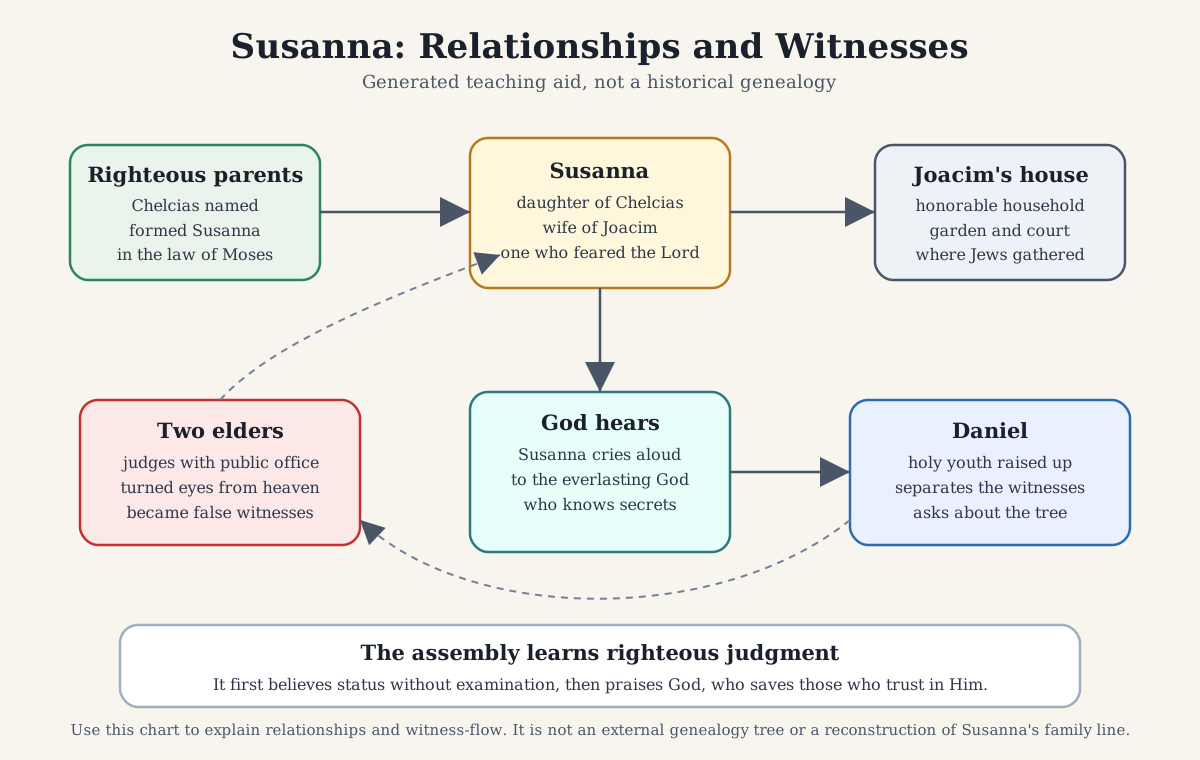 Source: Teaching sketch made for this study, 2026-06-20. It is not a family tree. The text names Chelcias, Susanna’s righteous parents, Joacim, and the children and kindred who stand with her at the trial. It does not give a fuller line, and this sketch does not invent one.
The assembly believes them because they are elders and judges. That is one of the hardest lines in the book. Justice cannot be handed over to reputation. A community without discernment can let false witnesses murder the innocent.
Susanna’s answer is prayer. She looks up because her heart trusts in the Lord. She names God as everlasting, as the One who knows secrets, and as the One who knows all things before they come to be. Human judges do not know the secrets. God does. Human witnesses have lied. God saw. The procedure has failed. God remains Judge.
She is innocent, accused by false witnesses, condemned by a public assembly, and led toward death. The Lord Jesus will stand in that place, and will not be delivered from it. Susanna is saved from death. Christ enters death. Her innocent blood is spared that day. His is poured out to save the guilty. The likeness teaches the Church to recognize the pattern. The difference keeps her from being mistaken for the Savior.
The Church’s Voice in Worship ⛪
On Bright Saturday the Church hears this story in the praises, after the Prayer of Simeon. The service books and the reason for that placement are in the overview. What belongs beside these verses is the Liturgy Gospel of that same day, Matthew 28:1-20. Inside it, Matthew 28:11-15 shows the chief priests assembling with the elders and paying for a false report against the Resurrection. Elders fabricating testimony against the truth: that is the nearest Bright Saturday tie to Susanna’s court, and it is this study’s own reading. The Gospel does not need a Father to say what it already shows.
The Liturgy also lists Psalm 3:3 (LXX Ps 3:3) and Psalm 3:5 (LXX Ps 3:5). In Brenton, Psalm 3:5 (LXX Ps 3:5) says, “I cried to the Lord with my voice, and he heard me out of his holy mountain.” A soul that has just heard Susanna cry, and is about to hear “the Lord heard her voice,” may receive that psalm as the same mercy. That is a hearing of the listed psalm, not a claim about why the compilers chose it.
Gems from the Fathers 💎: Tears and rulers
Hippolytus stays with her tears. “By her tears she attracted the (regard of) the Word from heaven, who was with tears to raise the dead Lazarus.”6 The link is Christological and exact. The Word who will stand at Lazarus’ tomb and weep is already the One who regards a condemned woman when she looks up. Prayer here is not a mood. It draws the regard of Christ.
On the assembly that believed the elders, Hippolytus is blunt. Believers are to be steadfast, to give no heed to lies, and to “yield no obsequious obedience to the persons of rulers, knowing that we have to give account to God.”7 Authority is real. Automatic belief in office is not obedience. It is how innocent blood is sentenced.
Saved by the tree: Daniel exposes the two judges (Susanna 44-64)
44 And the Lord heard her voice.
45 Therefore when she was led to be put to death, the Lord raised up the holy spirit of a young youth, whose name was Daniel: 46 who cried with a loud voice, I am clear from the blood of this woman.
47 Then all the people turned them toward him, and said, What mean these words that thou hast spoken? 48 So he standing in the midst of them said, Are ye such fools, ye sons of Israel, that without examination or knowledge of the truth ye have condemned a daughter of Israel? 49 Return again to the place of judgment: for they have borne false witness against her.
50 Wherefore all the people turned again in haste, and the elders said unto him, Come, sit down among us, and shew it us, seeing God hath given thee the honour of an elder. 51 Then said Daniel unto them, Put these two aside one far from another, and I will examine them.
52 So when they were put asunder one from another, he called one of them, and said unto him, O thou that art waxen old in wickedness, now thy sins which thou hast committed aforetime are come to light: 53 for thou hast pronounced false judgment, and hast condemned the innocent, and hast let the guilty go free; albeit the Lord saith, The innocent and righteous shalt thou not slay. 54 Now then, if thou hast seen her, tell me, Under what tree sawest thou them companying together? And he said, Under a mastick tree.
55 And Daniel said, Very well; thou hast lied against thine own head; for even now the angel of God hath received the sentence of God to cut thee in two. 56 So he put him aside, and commanded to bring the other, and said unto him, O thou seed of Chanaan, and not of Juda, beauty hath deceived thee, and lust hath perverted thine heart. 57 Thus have ye dealt with the daughters of Israel, and they for fear companied with you: but the daughter of Juda would not abide your wickedness. 58 Now therefore tell me, Under what tree didst thou take them companying together? And he said, Under a holm tree.
59 Then said Daniel unto him, Well; thou hast also lied against thine own head: for the angel of God waiteth with the sword to cut thee in two, that he may destroy you.
60 With that all the assembly cried out with a loud voice, and praised God, who saveth them that trust in him. 61 And they arose against the two elders, for Daniel had convicted them of false witness by their own mouth: 62 and according to the law of Moses they did unto them in such sort as they maliciously intended to do to their neighbour: and they put them to death. Thus the innocent blood was saved the same day.
63 Therefore Chelcias and his wife praised God for their daughter Susanna, with Joacim her husband, and all their kindred, because there was no dishonesty found in her. 64 From that day forth was Daniel had in great reputation in the sight of the people.
The turn is one sentence: “And the Lord heard her voice.” The story does not say Daniel is clever first. It says God hears first. Daniel’s wisdom is the form that hearing takes in the assembly.
His protest names the failure of the crowd. “Without examination or knowledge of the truth ye have condemned a daughter of Israel.” The elders lied. The people accepted the condemnation without looking. Daniel restores judgment by slowing them down, separating the witnesses, and making the truth concrete.
Verse 53 reaches for the law these judges were appointed to keep. “The innocent and righteous shalt thou not slay” takes up Exodus 23:7. In Brenton that verse says, “thou shalt not slay the innocent and just, and thou shalt not justify the wicked for gifts.” The elders have done both. They have condemned the innocent, and they have let the guilty go free. Daniel is not inventing a standard. He is putting their own law back into their hands.
Verse 56 needs the same care. “Seed of Chanaan, and not of Juda” is Daniel’s charge against one elder, not a license for the Church to despise a people. Hippolytus notes that Daniel addresses the first elder as a man instructed in the law, and the second as a Gentile, “the seed of Chanaan,” though that elder was then among the circumcision.8 The point is deeds. Ezekiel 16:3 tells Jerusalem that her root and her birth are of the land of Chanaan when her conduct has become Canaanite. In John 8:39-44, those who claim Abraham are answered by their works: lineage that does not do the truth is a claim, not a life. Daniel is exposing what these men have done. He is not inviting a later congregation to repeat his words as an ethnic insult.
Verse 57 is heavier still. The elders had done this before, to the daughters of Israel, and those women yielded because they were afraid. Fear had silenced them. Susanna, called here the daughter of Juda, would not abide the wickedness. Her refusal does not condemn the women who were afraid. It exposes a pattern of abuse that the court had learned not to see. The shame belongs to the judges. A community that honors Susanna and ignores verse 57 has not yet read the story.
Language insight: “mastick tree”, “holm tree”, and “cut thee in two”
Brenton’s “cut thee in two” in both verse 55 and verse 59 hides a Greek pun, and the pairs run in a definite direction.
The first elder says they were under a mastic tree. Greek calls it schinos (σχῖνος). Daniel answers with schisei (σχίσει), “he will split you.” The second elder says they were under a holm tree. That is the holm oak, Greek prinos (πρῖνος), so the study’s word “oak” is the same tree, not a third one. Daniel answers with prisai (πρίσαι), “to saw you.” Brenton flattens both sentences into cutting in two. The Greek lets each lie name its own judgment.
Origen knew the pairs exactly. In the Letter to Africanus he takes up Africanus’ mockery of prinos and prisein, the holm oak and the sawing, and of schinos and schisis, the mastic and the splitting.9 Africanus thought the wordplay proved a late Greek composition. Origen would not let a pun evict a book the Churches were already reading. The pun still does spiritual work. The detail the elders invented to condemn Susanna becomes the detail that condemns them.
The tree does not save by itself. God saves. God saves through Daniel’s question, because the invented tree exposes the invented crime. Their testimony, meant to shed innocent blood, becomes the means by which innocent blood is saved that day.
This study’s own Paschal reading, not a sentence from Hippolytus, hears the wood of the Cross in that reversal. On Bright Saturday the Church has contemplated Christ condemned by false witnesses and hung upon the Tree. In Susanna, a tree exposes false judgment and the innocent is spared from death. In the Gospel, the innocent Christ accepts false judgment and death upon the Tree in order to save the guilty. Susanna is saved from death by God uncovering the lie. We are saved through Christ entering death and making the Cross the Tree of life. The likeness is real. It is this study’s reading of the night, and it is named as such.
The ending is praise. The assembly blesses God, “who saveth them that trust in him.” Vindication does not stop in private relief. It becomes worship. That is the pattern of Pascha: deliverance turns into doxology. The law then does to the false witnesses what they had meant to do to their neighbor. The center of the verse is the clause that follows: “Thus the innocent blood was saved the same day.” The story’s joy is that God stopped a murder by exposing a lie.
Gems from the Fathers 💎: The God who hears
Hippolytus stays with the hearing. “For those who call upon Him from a pure heart, God hears.”10 From deceit and hypocrisy, he says, God turns his face away. When Susanna prayed, the angel was sent to help her. At the end of the commentary Hippolytus applies the old saying that whoever digs a pit for his neighbor shall fall into it, the word of Proverbs 26:27.11 Brenton reads, “He that digs a pit for his neighbour shall fall into it.” The elders dug a legal pit. Their own mouths closed it over them.
He closes by asking the faithful to imitate Susanna: watchful in heart, pure in life, knowing that God is the Judge of all, and that the Word is the Eye from which nothing in the world escapes.
Christological and Paschal reading
Susanna is not Christ. She is a righteous woman, a faithful daughter of Israel, and, in Hippolytus’ reading, an image of the Church. Her story still prepares the Christian imagination for the Passion.
She is innocent and condemned by false witnesses. Christ is innocent and condemned by false witnesses. She is shamed by corrupt authority. Christ is mocked and judged by those who should have known justice. She cries to the everlasting God who knows secrets. Christ commits himself to the Father. She is saved from death at the last moment. Christ saves by passing through death and trampling it down.
That difference matters. Susanna’s deliverance shows that God can stop innocent blood from being shed. Christ’s Passion shows that God can transform even the shedding of innocent blood into salvation for the world. On Bright Saturday both truths are held together. God rescues the righteous, and God also enters the place where the righteous have suffered and died.
Between accusation and vindication, the Christian often lives in a season when the truth is not yet visible, when a false story sounds official, and when the soul feels straitened on every side. Susanna’s witness is not that the faithful will never be accused. Her witness is that the Lord hears, the truth belongs to him, and no false witness finally governs the righteous.
Spiritual Fruit 🍇
Guard the eyes before the plan begins. The elders fell when they stopped looking to heaven and stopped remembering judgment. A Christian cannot cultivate a secret gaze and expect public righteousness to remain whole. Prayer, confession, fasting, and an honest friend protect the soul before desire becomes a conspiracy.
Refuse the bargain that calls sin the practical path. Susanna names the trap, cries out, and chooses God before she sees the rescue. That is courage, not silence. Where fear has already silenced someone, as it silenced the daughters of Israel in verse 57, the shame lies with the one who used fear. Her refusal is not a verdict on them.
Do not outsource truth to rank. The assembly condemned a daughter of Israel because two elders said so. Honor office. Examine testimony. Hippolytus’ warning still stands: no obsequious obedience to the persons of rulers. The God who commands order also commands that the innocent not be slain.
Pray with the facts. Susanna does not offer a vague cry. She tells the everlasting God what the witnesses invented, and she looks up. A faithful soul does not have to choose between trust and protest. She does both. The Lord heard her voice.
Let deliverance become praise. The tree exposes the lie, innocent blood is saved, and the people bless God. On Bright Saturday that praise stands beside a deeper mystery. The study’s own reading is that the Cross is the Tree where false judgment is answered, not by a clever question only, but by the Innocent One entering death. The sealed tomb is not the last courtroom.
Stand for a moment in Joacim’s garden at noon. The doors are shut. Two voices offer life at the price of sin. A woman looks up, and the cry leaves her before she knows the ending. Somewhere in the crowd a youth is about to say that he is clear from her blood. The Lord has already heard. That is enough to keep faith until the morning, and enough to make the Church sing before the stone is rolled away.
Teaching Notes
Susanna is formed before the trial (Susanna 1-6)
- Ask: What has already been formed in Susanna before the elders speak?
- Emphasize: Courage here is not improvised. Righteous parents, the law of Moses, and the fear of the Lord come first.
- Watch for: Treating the garden as a neutral setting. It should be a place of order, and corrupt judgment has entered it.
- Connect: Bright Saturday begins with memory. The Church remembers those already formed in faith before the hour of testing.
- Show: The Babylon locator is orientation only. Then point to the catacomb image in the overview: the early Church remembered this story as judgment and vindication.
The eyes that stop looking to heaven (Susanna 7-14)
- Ask: What changes in the elders before they ever speak to Susanna?
- Emphasize: The fall begins when the eyes leave heaven and the mind stops remembering judgment.
- Watch for: Treating the lust as accidental. The text shows watching, hiding, planning, and agreement in evil.
- Connect: Watchfulness is not fear of the body. It is guarding the heart so that desire does not become violence.
- Show: Stay with verse 9. If an adult class needs a warning about famous Western paintings of this scene, give it without links: they are not icons, many center the bath, and they can repeat the elders’ gaze.
A choice between human violence and sin before God (Susanna 15-27)
- Ask: What does “straitened on every side” reveal about coercion?
- Emphasize: She chooses God before she knows the outcome, and she cries aloud.
- Watch for: Any hint that a victim should stay silent, or that suffering is beautiful. She resists, she cries, and the abusers are condemned.
- Watch for: Turning Hippolytus’ laver reading into a claim about present Coptic baptism. Report it as his reading.
- Connect: His martyr reading will be heard by Copts who know the same bargain: worship, or be accused.
- Show: Let verse 23 stand as the spiritual center of the book.
False witnesses and the prayer God hears (Susanna 28-43)
- Ask: Why does the assembly believe the elders so quickly?
- Emphasize: A community becomes unjust when it trusts rank without examination. Verse 34 borrows the witnesses’ gesture from Leviticus 24:14.
- Watch for: Missing the humiliation in verse 32. Their lust still operates in court.
- Connect: Matthew 28:11-15, inside the Bright Saturday Liturgy Gospel, shows elders paying for a false report against the Resurrection. Present that parallel as the study’s reading.
- Show: The witness-flow sketch traces hidden lust into public condemnation. It is not a genealogy.
Saved by the tree: Daniel exposes the two judges (Susanna 44-64)
- Ask: Why does Daniel ask about the tree instead of only denouncing the elders in general?
- Emphasize: Mastic goes with splitting, and the holm oak goes with sawing. Brenton’s “cut thee in two” hides both puns. God saves; the tree question is the instrument.
- Watch for: Calling the Cross reading a patristic one. It is this study’s Paschal reading. Also watch for using “seed of Chanaan” as an ethnic slur. Daniel is judging deeds.
- Watch for: Using verse 57 to blame women who yielded out of fear. The verse exposes a pattern of abuse.
- Watch for: Celebrating the elders’ death as a model for the parish. The text’s joy is that innocent blood was saved that day.
- Connect: Proverbs 26:27, as Hippolytus applies it, and Exodus 23:7, which verse 53 takes up.
- Show: Do not send the class to a hotlinked Daniel icon or a hotlinked Anastasis. The catacomb image in the overview is the early Christian witness. The Paschal reading can be spoken from the verses themselves.
Glossary
- Apocalypse Night: A common name for Bright Saturday, because the Book of Revelation is read in the service.
- Bright Saturday / Saturday of Light: The Coptic vigil between Good Friday and the Resurrection proclamation.
- False witness: Testimony that lies against another person. In Susanna it becomes an attempt at murder by legal process.
- Greek Daniel: The Greek form of Daniel received in the Church, including Susanna, the Prayer of Azariah and the Song of the Three Holy Children, and Bel and the Dragon.
- Mastick tree and holm tree: The two trees named by the false judges. The mastic, Greek schinos, is paired with schisei, “he will split you.” The holm tree is the holm oak, Greek prinos, paired with prisai, “to saw you.” Brenton hides both puns behind “cut thee in two.”
- Praises of the Prophets: The Bright Saturday sequence in which the Story of Susanna is heard after the Prayer of Simeon, as the service books attest.
- Seed of Chanaan: Daniel’s charge against the second elder. In this story it judges deeds, not a people. See Ezekiel 16:3 and John 8:39-44.
- Tree of the Cross: In this study’s Paschal reading, the wood on which Christ was crucified and by which death is conquered. Hippolytus is not the source of that sentence.
- Young youth: Brenton’s name for Daniel in verse 45. The story is placed at the beginning of Greek Daniel, which is why he can be called young there. See the overview.
Source Notes
Embedded Scripture is from Brenton’s English Septuagint (LXX). The reference style of this study is Susanna 1-64. Daniel 13 names the same text in many Latin-based Bibles.
The older Greek difference at verses 44-45 is taken from the Rahlfs/Hanhart text. Origen’s defense of the book, and his naming of the holm and mastic pairs, is the Letter to Africanus 2 and 11. Hippolytus is cited from the “On Susannah” section of his exegetical fragments, with verse locators.
The Story of Susanna in the Bright Saturday praises is attested by Coptic Heritage and by Tasbeha.org. It is not among the nineteen Midnight Praise rows in the lectionary records used for this study. The Liturgy and hour readings named in the overview are those records. One working list of the Liturgy is marked not yet checked against Coptic Reader. Psalm 82:8 (LXX Ps 81:8) appears only there, and is treated as a candidate.
The reading of Matthew 28:11-15, and the reading of the tree as a window onto the Cross, are this study’s interpretations. They are marked as such in the body.
Exodus 23:7, Leviticus 24:14, Ezekiel 16:3, and Proverbs 26:27 are cited from Brenton. John 8:39-44 and Matthew 28:11-15 are cited by reference from the NKJV studies already published.
John J. Collins, Daniel (Hermeneia), is academic orientation to the Greek additions. He is not a voice in the body of this study. No commentary of Fr. Tadros Yacoub Malaty is cited here, because no specific passage of his Daniel commentary was used.
Sources
Brenton, The Septuagint Version of the Old Testament, for the embedded text, and for Exodus 23:7, Leviticus 24:14, Ezekiel 16:3, and Proverbs 26:27.
Older Greek Susanna 44-45, Rahlfs/Hanhart: die-bibel.de, Susanna 1.
Hippolytus, Exegetical Fragments, “On Susannah,” translated by S. D. F. Salmond, Ante-Nicene Fathers 5: New Advent.
Origen, Letter to Africanus 2, 6, and 11, translated by Frederick Crombie, Ante-Nicene Fathers 4: New Advent.
Coptic Heritage, “Saturday of Light”: copticheritage.org/17-saturday-of-light.
Tasbeha.org, “The Story of Susanna,” Bright Saturday, The Praises and Matins: tasbeha.org/hymn_library/view/1781.
Lectionary records and Synaxarium titles:
@andraws/lectionary-data1.3.3. See the overview for what those records do and do not contain.Susanna overview, for canon, reception, and Bright Saturday.
Walter Lowrie, Monuments of the Early Church (1901), Fig. 67, Catacomb of Callistus, shown in the overview.
Ali Zifan, Neo-Babylonian Empire (greatest extent), CC BY-SA 4.0, used only as a broad locator.
John J. Collins, Daniel: A Commentary on the Book of Daniel, Hermeneia. Academic orientation only.
Footnotes
-
Hippolytus, Exegetical Fragments, “On Susannah,” on v. 2 (ANF 5; New Advent). ↩
-
Hippolytus, Exegetical Fragments, “On Susannah,” on vv. 15 and 18 (ANF 5; New Advent). ↩
-
Hippolytus, Exegetical Fragments, “On Susannah,” on v. 18 (ANF 5; New Advent). ↩
-
Hippolytus, Exegetical Fragments, “On Susannah,” on v. 22 (ANF 5; New Advent). ↩
-
Hippolytus, Exegetical Fragments, “On Susannah,” on v. 23 (ANF 5; New Advent). ↩
-
Hippolytus, Exegetical Fragments, “On Susannah,” on v. 35 (ANF 5; New Advent). ↩
-
Hippolytus, Exegetical Fragments, “On Susannah,” on v. 41 (ANF 5; New Advent). ↩
-
Hippolytus, Exegetical Fragments, “On Susannah,” on v. 52 (ANF 5; New Advent). ↩
-
Origen, Letter to Africanus 6 and 11 (ANF 4; New Advent). ↩
-
Hippolytus, Exegetical Fragments, “On Susannah,” on v. 44 (ANF 5; New Advent). ↩
-
Hippolytus, Exegetical Fragments, “On Susannah,” on v. 61 (ANF 5; New Advent). ↩