


This narration is from a previous version of the study and may include a combined recording of multiple chapters.
The ram cannot be stopped, until it is stopped. The goat seems to cross the earth without touching it, until its great horn breaks. Daniel 8 strips conquest of the illusion that success means permanence. Its hardest question comes when conquest turns against the sanctuary: how long will worship be trampled?
The vision belongs to Baltasar’s third year and follows the vision of chapter 7. Daniel sees himself in Susa in Ælam, beside the Ubal. These are not interchangeable symbols for evil places. They give the vision a particular setting beyond Babylon, while Gabriel will name the powers that dominate it. The chapter moves from imperial rivalry to the suffering of a holy people, and from terrifying images to an interpretation that still leaves Daniel weak and wondering.
Conquest reaches the sanctuary (Daniel 8:1-14)
1 In the third year of the reign of king Baltasar a vision appeared to me, even to me Daniel, after that which appeared to me at the first.
2 And I was in Susa the palace, which is in the land of Ælam, and I was on the bank of Ubal.
3 And I lifted up mine eyes, and saw, and, behold, a ram standing in front of the Ubal; and he had high horns; and one was higher than the other, and the high one came up last.
4 And I saw the ram butting westward, and northward, and southward; and no beast could stand before him, and there was none that could deliver out of his hand; and he did according to his will, and became great.
5 And I was considering, and, behold, a he-goat came from the south-west on the face of the whole earth, and touched not the earth: and the goat had a horn between his eyes.
6 And he came to the ram that had the horns, which I had seen standing in front of the Ubal, and he ran at him with the violence of his strength.
7 And I saw him coming up close to the ram, and he was furiously enraged against him, and he smote the ram, and broke both his horns: and there was no strength in the ram to stand before him, but he cast him on the ground, and trampled on him; and there was none that could deliver the ram out of his hand.
8 And the he-goat grew exceedingly great: and when he was strong, his great horn was broken; and four other horns rose up in its place toward the four winds of heaven.
9 And out of one of them came forth one strong horn, and it grew very great toward the south, and toward the host:
10 and it magnified itself to the host of heaven; and there fell to the earth some of the host of heaven and of the stars, and they trampled on them.
11 And this shall be until the chief captain shall have delivered the captivity: and by reason of him the sacrifice was disturbed, and he prospered; and the holy place shall be made desolate.
12 And a sin-offering was given for the sacrifice, and righteousness was cast down to the ground; and it practised, and prospered.
13 And I heard one saint speaking, and a saint said to a certain one speaking, How long shall the vision continue, even the removal of the sacrifice, and the bringing in of the sin of desolation; and how long shall the sanctuary and host be trampled?
14 And he said to him, Evening and morning there shall be two thousand and four hundred days; and then the sanctuary shall be cleansed.
The ram’s unequal horns belong to one animal. Gabriel will identify it as the Medes and Persians, not leave the reader to supply an unknown modern alliance. One horn rises later and higher, and the animal pushes in several directions without resistance. The repeated statement that none can deliver from its hand describes its apparent supremacy. But the vision will repeat the same helplessness when the ram itself is thrown down. Power that seems to make rescue impossible is not beyond being overthrown.
The goat’s movement conveys speed and violent momentum. It does not merely defeat the ram; it breaks the horns, casts it down, and tramples it. The narrative gives us no reason to call the victor righteous because its opponent was strong. Domination changes hands. The great horn breaks when the goat is strong, not after a long, visible decline. This is a searching correction to the habit of treating success as proof of security. The highest point of visible power may reveal nothing about the nearness of its end.
Gabriel’s explanation in verses 20-22 anchors the ram in Media-Persia and the goat in Greece. Jerome identifies the great horn with Alexander and the four horns with the rulers who divided his empire. He then identifies the later persecuting king with Antiochus Epiphanes, usually called Antiochus IV.1 The historical names help the images become intelligible, but the vision is not an exhaustive map of every succession dispute. Its concentration is on the shape of power and the point at which conquest becomes sacrilege.
The later horn grows out of this divided imperial world. Its reach extends toward the host of heaven and the stars, which are thrown down and trampled. In his comment on verse 9, Jerome understands the imagery through Antiochus’s attack on Israel, a people under angelic protection. The picture raises the stakes without requiring us to imagine that a human king has literally defeated God’s heavenly army. His arrogance treats the holy people as objects underfoot and assaults what belongs to God.
Verses 11-12 are difficult in Brenton’s wording. They should be read with verse 13’s plain question about the removed sacrifice and the trampled sanctuary. The chief captain’s deliverance stands against captivity; the sacrifice is disturbed, the holy place becomes desolate, and righteousness is cast to the ground while the aggressor prospers. The phrase “a sin-offering was given for the sacrifice” is not a command authorizing the king’s profanation. In the vision’s setting, holy worship is being displaced and violated. Whatever remains obscure in the individual clauses, the question that follows makes the injury unmistakable.
Jerome, using a different form of the text, describes the removal of the continual offering made morning and evening and the casting down of the sanctuary.2 His explanation helps identify the historical action, but it must not silently replace the wording printed above. The persecution of Antiochus supplies the concrete setting: 1 Maccabees 1:20-64 describes plunder, coercion, suppression of lawful worship, and the desecrating altar. It also describes people who refuse to abandon the covenant. The suffering people are not merely a background against which empires act. Their fidelity is the human reality at the center of the sanctuary’s affliction.
The holy one’s question is “How long?” rather than “How can I share this power?” Heaven does not admire sacrilege because it succeeds. Nor is lament a failure of belief. The question confesses that the violence is not right and asks for the limit God will set. A threatened congregation may pray the same way without having an explanation for every event. Faithful grief can belong to worship.
Language insight: “evening and morning” and the differing number
Brenton here prints “two thousand and four hundred days.” The Hebrew-based King James Version prints “two thousand and three hundred days”; Jerome’s commentary also works with the latter number.3 The number differs between these English editions; the witnesses compared here do not settle how that difference arose.
“Evening and morning” belongs naturally beside the interrupted daily offering. Jerome describes those offerings at morning and evening, but on verse 14 he takes the expression as the succession of day and night. Another interpretation counts individual offerings, rather than complete days; the note accompanying the Knox edition describes that option.4 The phrase therefore evokes the worship whose rhythm has been broken, but it does not compel one agreed method of counting. The promise closes on the cleansing of the sanctuary, not on the reader’s discovery of a date for the end of the world.
Gems from the Fathers 💎: A historical wound and a final warning
Jerome’s commentary retains both the Antiochus setting and a further Christian horizon. At verse 14 he reports: “Most of our commentators refer this passage to the Antichrist, and hold that that which occurred under Antiochus was only by way of a type which shall be fulfilled under Antichrist.”5 A type is a real earlier event that can disclose a pattern brought to a greater manifestation later. It is not an excuse to make the earlier victims unreal or to forget the Jewish people who suffered and resisted sacrilege.
Saint Irenaeus likewise reads Daniel 8:12 and Daniel 8:23-25 in relation to the Antichrist, joining the assault on worship to the enemy’s arrogant self-exaltation.6 These witnesses establish an ancient Christian reading, not a unanimous commentary on every detail. Their shared warning concerns a power that demands allegiance against God. It gives no warrant for assigning the horn to an ethnic group, another parish, a present political opponent, or a person whose behavior we dislike. Christian discernment begins by refusing false worship and deceit, not by distributing prophetic labels.
Christ later warns about Daniel’s abomination of desolation in Matthew 24:15. This renewed warning does not erase the earlier history. The Christological consequence also needs its proper order. The sanctuary here is the historical holy place under attack; it is not merely an allegory of private feelings. In the Gospel, Christ speaks of the temple of His body and rises after His enemies destroy it (John 2:19-22). Through Him the Church understands that communion with God is not finally at the mercy of a desecrating ruler. This does not make damage to churches or the killing of worshippers insignificant. It makes their suffering something Christ receives and judges, rather than evidence that the enemy has gained divine authority.
Gabriel gives understanding and Daniel returns to his work (Daniel 8:15-27)
15 And it came to pass, as I, even I Daniel, saw the vision, and sought to understand it, that, behold, there stood before me as the appearance of a man.
16 And I heard the voice of a man between the banks of the Ubal; and he called, and said, Gabriel, cause that man to understand the vision.
17 And he came and stood near where I stood: and when he came, I was struck with awe, and fell upon my face: but he said to me, Understand, son of man: for yet the vision is for an appointed time.
18 And while he spoke with me, I fell upon my face to the earth: and he touched me, and set me on my feet.
19 And he said, Behold, I make thee know the things that shall come to pass at the end of the wrath: for the vision is yet for an appointed time.
20 The ram which thou sawest that had the horns is the king of the Medes and Persians.
21 The he-goat is the king of the Greeks: and the great horn which was between his eyes, he is the first king.
22 And as for the one that was broken, in whose place there stood up four horns, four kings shall arise out of his nation, but not in their own strength.
23 And at the latter time of their kingdom, when their sins are coming to the full, there shall arise a king bold in countenance, and understanding riddles.
24 And his power shall be great, and he shall destroy wonderfully, and prosper, and practise, and shall destroy mighty men, and the holy people.
25 And the yoke of his chain shall prosper: there is craft in his hand; and he shall magnify himself in his heart, and by craft shall destroy many, and he shall stand up for the destruction of many, and shall crush them as eggs in his hand.
26 And the vision of the evening and morning that was mentioned is true: and do thou seal the vision; for it is for many days.
27 And I Daniel fell asleep, and was sick: then I arose, and did the king’s business; and I wondered at the vision, and there was none that understood it.
Daniel sees and seeks to understand. He does not treat the experience itself as a sufficient interpretation. Gabriel is named and commanded to make the vision intelligible. The messenger is not an independent source of heavenly information: he serves the command given to him. When he approaches, Daniel falls in awe and must be touched and raised to his feet. The gift accommodates human weakness rather than rewarding spiritual self-importance.
Here Gabriel addresses Daniel as “son of man.” In this setting the phrase names the prophet’s human condition; it does not make Daniel the glorious figure who receives universal dominion in chapter 7. Jerome explains the address as a reminder of frailty for a man admitted to angelic company.7 The same English expression must be interpreted within its scene. A shared phrase is not an automatic identification.
The repeated “appointed time” matters as much as the named kingdoms. It places the period of wrath within God’s government. It does not tell Daniel that the suffering will be brief enough to feel manageable, or that he can control it once he knows its length. The explanation makes the events intelligible without placing the future in his possession. A prophecy can strengthen obedience while leaving the hearer unable to remove the coming trial.
The later king’s bold countenance and understanding of riddles join public shamelessness to cunning. His power destroys mighty people and holy people alike. Strength does not rescue its possessor, and holiness does not guarantee immunity from persecution. Verse 25 adds craft, inward self-magnification, and the image of lives crushed like eggs. The violence is not commended. It exposes the fragility of persons treated as disposable. A Christian use of the chapter must remain on the side of those harmed, rather than becoming fascinated with the successful aggressor.
The instruction to seal the vision guards a true word that concerns many days. Sealing is not permission to hide invented interpretations under a claim of secret knowledge. Daniel is to keep what he has received. The vision’s truth and his incomplete comprehension can coexist. This is a needed discipline when religious certainty is offered as relief from anxiety: the desire for an explanation can make us accept what God has not said.
Gems from the Fathers 💎: Seeing is not yet understanding
On verse 15 Jerome makes a practical comparison with reading Scripture: “He beheld the vision by way of a picture or likeness, and he failed to understand it.”8 Receiving the words and understanding them are related but not identical gifts. Attention, prayer, and teachability matter. The person most impressed by an extraordinary experience is not necessarily the person best equipped to interpret it.
The chapter ends with Daniel asleep and sick, then rising to the king’s business. The text does not call this illness a punishment for sin or a failure of faith. We should not use it to diagnose the spiritual condition of someone who is physically or emotionally exhausted. A faithful person may need rest, medical care, practical support, and time. Daniel’s return to ordinary work is not betrayal of the vision. It is the life of a servant who must obey without exhaustive knowledge.
Jerome sees the apparent tension: Gabriel has interpreted the vision, yet Daniel says no one understood it. He explains that the prophet still lacked the names and timing of what lay ahead, concluding: “And so he did the only thing he could do: he marveled at the vision, and resigned everything to God’s omniscience.”9 The conclusion is not intellectual laziness. Daniel has sought understanding and received an answer; now he refuses to pretend that the answer has made him omniscient.
Gabriel returns in Daniel 9:21 and appears in Luke 1:19 and Luke 1:26 at the announcements to Zacharias and Mary. Irenaeus explicitly joins the interpreter of Daniel’s visions to the announcer of the Incarnation in Against Heresies 5.25.5.10 The continuity is consoling: the God who does not abandon His people under sacrilege is the God who sends His Son into their history. Gabriel’s service directs attention to the Lord, not to an independent fascination with angels.
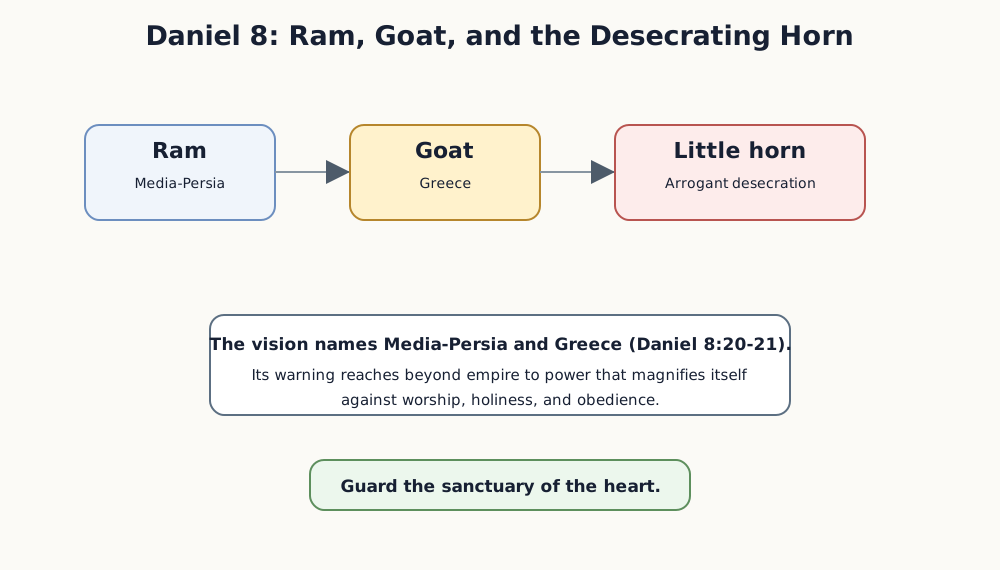 The ram, goat, and divided horns follow Gabriel’s interpretation of the vision.
The Church’s Voice in Worship ⛪
The Coptic Synaxarium commemorates Gabriel the Announcer on Kiahk 22 and Baramhat 30.11 These commemorations illuminate his ministry here and at the Annunciation; they do not establish an appointment of Daniel 8 on those days. No verse-addressed reading from this chapter was found in the Coptic reading order consulted for this study. The spiritual connection remains substantial: the messenger serves God by making His word intelligible, and his greatest announcement turns our attention to the incarnate Lord. Honoring Gabriel should make us more willing to hear and obey, not more eager to possess secret information.
Spiritual Fruit 🍇
Desecration is first a wrong done to God’s worship and to real people. Pray for a congregation unable to gather safely, and seek a reliable way to help people harmed by persecution. Do not turn their distress into material for frightening predictions. The question “How long?” may be offered with them, without pretending to know the answer.
There is also an inward application, but it must not replace their suffering. Ask what repeatedly crowds prayer out of your own life: the demand to remain informed, resentment rehearsed late at night, ambition that claims every quiet moment, or entertainment that leaves the mind restless. Set one boundary that restores room for worship. Choose something small enough to keep and definite enough to test, such as putting the phone away before an established prayer time. The aim is not to dramatize yourself as the sanctuary’s savior; it is to give God the attention you have been withholding.
If religious speculation has become compulsive, stop forwarding predictions and return to the chapter’s own interpretation. Speak to a trusted priest or spiritual guide if the habit is feeding fear or disrupting sleep. Gabriel gives understanding so Daniel can live faithfully, not so he can remain permanently agitated.
For the weary reader, Daniel’s last verse offers permission to be human. Rest is not necessarily refusal of duty, and returning to a quiet responsibility is not necessarily spiritual decline. Receive the care you need, do the next work honestly, and leave the future to God. The sanctuary will not be cleansed because we have mastered every number. It belongs to the Lord who has heard its lament.
Teaching Notes
Conquest reaches the sanctuary (Daniel 8:1-14)
- Ask: Why does the vision repeat that no one can deliver first from the ram, and then deliver the ram itself?
- Emphasize: Let Gabriel’s named kingdoms control the historical explanation; use 1 Maccabees 1:20-64 to make the attack on worship concrete.
- Watch for: Preserve Brenton’s number. Distinguish the observed edition difference from an unverified explanation of its origin, and the daily-offering context from a single compulsory counting method.
Gabriel gives understanding and Daniel returns to his work (Daniel 8:15-27)
- Ask: What remains unknown to Daniel after he has genuinely received an interpretation?
- Connect: Gabriel in Daniel 9:21 and Luke 1:19, 26.
- Watch for: “Son of man” here addresses a frail prophet; illness is not evidence of personal sin or deficient faith.
- Emphasize: End with Daniel’s return to responsible work, not with a guessed identity for a modern little horn.
Sources
Embedded Scripture is from Brenton’s English Septuagint (LXX).
Biblical connections: 1 Maccabees 1:20-64; John 2:19-22; Luke 1:19; Luke 1:26.
Footnotes
-
Jerome, Commentary on Daniel, chapter 8, comments on verses 4-9 and 20-23 as discussed there, translated by Gleason L. Archer, primary text. Jerome is used here as a historical Christian exegete, not as a statement of unanimous Coptic interpretation. ↩
-
Jerome, Commentary on Daniel, on Daniel 8:11-13, primary text. ↩
-
Compare Brenton, Daniel 8:14, King James Version, Daniel 8:14, and Jerome, Commentary on Daniel, on Daniel 8:14, primary text. ↩
-
Jerome, Commentary on Daniel, on Daniel 8:11-14, primary text; compare the note to Daniel 8:14 in the Knox edition, which describes the individual-offering interpretation. ↩
-
Jerome, Commentary on Daniel, on Daniel 8:14, primary text. ↩
-
Saint Irenaeus, Against Heresies 5.25.4, primary text. ↩
-
Jerome, Commentary on Daniel, on Daniel 8:16-19, primary text. ↩
-
Jerome, Commentary on Daniel, on Daniel 8:15, primary text. ↩
-
Jerome, Commentary on Daniel, on Daniel 8:27, primary text. ↩
-
Saint Irenaeus, Against Heresies 5.25.5, primary text. ↩
-
Coptic Synaxarium commemoration titles for Kiahk 22 and Baramhat 30, Gabriel the Announcer. ↩