


This narration is from a previous version of the study and may include a combined recording of multiple chapters.
Nabuchodonosor, the Nebuchadnezzar familiar from many English Bibles, has already seen God deliver the Three Youths from his furnace. Yet witnessing a miracle has not finished the work of repentance. Daniel 4 places a second testimony on the king’s own lips: the man who ordered others to bow must learn to lift his eyes to heaven. This chapter is a severe mercy, but its severity is never permission to despise a person who is ill or brought low.
Embedded Scripture is from Brenton’s English Septuagint (LXX).
The tree under Heaven’s judgment (Daniel 4:1-18)
1 King Nabuchodonosor to all nations, tribes, and tongues, who dwell in all the earth; Peace be multiplied to you. 2 It seemed good to me to declare to you the signs and wonders which the most high God has wrought with me, 3 how great and mighty they are: his kingdom is an everlasting kingdom, and his power to all generations.
4 I Nabuchodonosor was thriving in my house, and prospering. 5 I saw a vision, and it terrified me, and I was troubled on my bed, and the visions of my head troubled me. 6 And I made a decree to bring in before me all the wise men of Babylon, that they might make known to me the interpretation of the dream. 7 So the enchanters, magicians, soothsayers, and Chaldeans came in: and I told the dream before them; but they did not make known to me the interpretation thereof; 8 until Daniel came, whose name is Baltasar, according to the name of my God, who has within him the Holy Spirit of God; to whom I said,
9 O Baltasar, chief of the enchanters, of whom I know that the Holy Spirit of God is in thee, and no mystery is too hard for thee, hear the vision of my dream which I had, and tell me the interpretation of it. 10 I had a vision upon my bed; and behold a tree in the midst of the earth, and its height was great. 11 The tree grew large and strong, and its height reached to the sky, and its extent to the extremity of the whole earth: 12 its leaves were fair, and its fruit abundant, and in it was meat for all; and under it the wild beasts of the field took shelter, and the birds of the sky lodged in the branches of it, and all flesh was fed of it.
13 I beheld in the night vision upon my bed, and, behold, a watcher and an holy one came down from heaven, and cried aloud, and thus he said, 14 Cut down the tree, and pluck off its branches, and shake off its leaves, and scatter its fruit: let the wild beasts be removed from under it, and the birds from its branches. 15 Only leave the stump of its roots in the earth, and bind it with an iron and brass band; and it shall lie in the grass that is without and in the dew of heaven, and its portion shall be with the wild beasts in the grass of the field. 16 His heart shall be changed from that of man, and the heart of a wild beast shall be given to him; and seven times shall pass over him. 17 The matter is by the decree of the watcher, and the demand is a word of the holy ones; that the living may know that the Lord is most high over the kingdom of men, and he will give it to whomsoever he shall please, and will set up over it that which is set at nought of men. 18 This is the vision which I king Nabuchodonosor saw: and do thou, Baltasar, declare the interpretation, for none of the wise men of my kingdom are able to shew me the interpretation of it: but thou, Daniel, art able; for the Holy Spirit of God is in thee.
The royal letter begins with the conclusion toward which the story will move. Peace is proclaimed to the peoples, and the king confesses an everlasting kingdom that is not his own. His recovery is therefore told as a reason for worship, not merely an unusual episode in a ruler’s life. The one who commanded the furnace now publicly describes what the Most High has done with him. Mercy can make even a former persecutor a witness. Saul’s later testimony to Christ’s mercy offers a Christian comparison, though not proof that the two conversions were identical (1 Timothy 1:12-16).
The contrast begins in verses 4-5. Prosperity fills the king’s house, but it cannot keep terror out of his bed. Wealth can surround a person without answering the questions that disturb him. The court’s specialists again fail, and Daniel again receives a task no imperial decree can accomplish. The king’s language about Daniel is striking: Brenton gives “the Holy Spirit of God,” yet the same speaker says that Daniel’s Babylonian name honors “my God.” He recognizes divine power without yet speaking with the clarity of Israel’s confession. We should not turn a pagan ruler’s vocabulary into a developed account of the Trinity.
The tree is not initially described as useless. It feeds living creatures, shelters animals, and receives birds in its branches. Power has a genuine vocation to protect and sustain life. The judgment is more searching than a claim that every great achievement is evil: the king has received something good and has begun to treat it as his private glory. A household, profession, ministry, or kingdom becomes dangerous when those who depend upon it disappear behind the owner’s admiration of himself.
Christ uses a related picture when He describes the mustard seed growing until the birds lodge in its branches (Matthew 13:31-32; Mark 4:30-32). This is a Gospel comparison, not a claim that the dream directly predicts that parable. Babylon’s enormous tree is cut down; the kingdom Christ announces begins in apparent smallness and provides shelter. The contrast teaches us to distinguish visible scale from faithful fruitfulness. The Lord does not need imperial self-exaltation to give life to His creatures.
The watcher is a heavenly messenger, “an holy one,” not a rival deity who can overrule God. Verse 17 speaks of a heavenly decree, and verse 24 will identify it as the decree of the Most High. Heaven’s servants execute His judgment. The title emphasizes wakefulness before God: the king may be secure in his palace, but his conduct has not gone unseen.
The stump, however, is left. Judgment has a limit and a purpose. The bands mark a constrained and preserved remnant rather than a throne that can preserve itself. The text does not explain every feature of the bands, and we need not assign each metal a hidden historical code. What Daniel makes explicit is enough: the kingdom will remain available to the king when he learns Heaven’s rule. The “seven times” describe the appointed period of his abasement; this is not an invitation to calculate a modern political timetable.
Gems from the Fathers 💎: Watchfulness beneath the crown
The ancient Christian commentator Jerome identifies the watchers as angels. Their vigilance also becomes a summons to human prayer: “And so we too follow the example of the angels in their duties when we engage in frequent night-long vigils.”1 His comment brings the dream close to ordinary discipleship. The answer to Heaven’s watchfulness is not fear of secret powers, but a heart willing to wake, pray, and become truthful before God.
Jerome also notes the polytheistic background of the king’s speech about Daniel. That observation helps us honor the wording printed here while recognizing the distance the king still has to travel. Acknowledging a holy person is not yet the same thing as surrendering one’s own supposed sovereignty.
Truth spoken with compassion (Daniel 4:19-27)
19 Then Daniel, whose name is Baltasar, was amazed about one hour, and his thoughts troubled him. And Baltasar answered and said, My lord, let the dream be to them that hate thee, and the interpretation of it to thine enemies. 20 The tree which thou sawest, that grew large and strong, whose height reached to the sky and its extent to all the earth; 21 and whose leaves were flourishing, and its fruit abundant, (and it was meat for all; under it the wild beasts lodged, and the birds of the sky took shelter in its branches:) 22 is thyself, O king; for thou art grown great and powerful, and thy greatness has increased and reached to heaven, and thy dominion to the ends of the earth. 23 And whereas the king saw a watcher and a holy one coming down from heaven, and he said, Strip the tree, and destroy it; only leave the stump of its roots in the ground, and bind it with a band of iron and brass; and it shall lie in the grass that is without, and in the dew of heaven, and its portion shall be with wild beasts, until seven times have passed over it; 24 this is the interpretation of it, O king, and it is a decree of the Most High, which has come upon my lord the king. 25 And they shall drive thee forth from men, and thy dwelling shall be with wild beasts, and they shall feed thee with grass as an ox, and thou shalt have thy lodging under the dew of heaven, and seven times shall pass over thee, until thou know that the Most High is Lord of the kingdom of men, and will give it to whom he shall please. 26 And whereas they said, Leave the stumps of the roots of the tree; thy kingdom abides sure to thee from the time that thou shalt know the power of the heavens. 27 Therefore, O king, let my counsel please thee, and atone for thy sins by alms, and thine iniquities by compassion on the poor: it may be God will be long-suffering to thy trespasses.
Daniel is troubled before he speaks. He does not enjoy the prospect of the king’s humiliation. His wish that the dream concerned the king’s enemies is neither an altered interpretation nor a refusal to tell the truth. It shows the spirit in which the truth is delivered. A prophet may oppose tyranny without taking pleasure in a tyrant’s ruin. The person who has been wronged needs God’s help to desire both an end to wrongdoing and the wrongdoer’s repentance.
The interpretation strips away the king’s distance from his dream: the tree “is thyself.” Daniel moves from image to responsibility. The sheltering branches describe the king’s extensive dominion; they do not establish that he literally governed every region of the earth. The dream’s world-filling scale expresses the greatness of the power he experiences and the collapse of his claim to possess it independently of Heaven.
The repeated word “until” matters. The sentence is directed toward recognition: the Most High is Lord of human kingdoms. The king’s condition is not described as an amusement for Heaven or an occasion for the court’s mockery. Nor does Daniel give the court permission to abandon him. He tells the ruler in advance that his kingdom is preserved. The warning contains a promise before the fall has happened.
Then comes the difficult counsel: “atone for thy sins by alms.” It should not be softened into a vague suggestion to be nicer. Daniel commands a concrete repudiation of the king’s old use of power. Wealth that served self-magnification must become relief for the poor; authority that neglected the vulnerable must become compassion. The verb gives mercy real spiritual weight. Repentance is not completed by feeling sorry while keeping the profits of cruelty untouched.
But neither God nor the poor can be bought. The king cannot make a donation and thereby acquire a right to continue oppressing people. Within Christian life, pardon is God’s gift in Christ, and works of mercy belong to the living response to that gift. Christ promises mercy to the merciful (Matthew 5:7), not immunity to the rich who purchase a reputation. Zacchaeus shows the distinction: receiving the Lord leads him to generosity and restitution, not to a payment that obliges Jesus to save him (Luke 19:1-10).
Daniel says “it may be.” This does not make God’s goodness uncertain. It denies the king control of the outcome. A man who has treated others as instruments must learn to ask for mercy rather than command it. The counsel is hopeful precisely because the threatened judgment has not made repentance meaningless.
Gems from the Fathers 💎: Alms that contradict the old life
St. Cyprian directly invokes Daniel’s counsel in On Works and Alms 5. He treats mercy as part of the repentance by which a person seeks divine help, not as an optional decoration around prayer. His formulation is forceful: “He shows that our prayers and fastings are of less avail, unless they are aided by almsgiving; that entreaties alone are of little force to obtain what they seek, unless they be made sufficient by the addition of deeds and good works.”2 The chapter’s poor are therefore not an illustration for the king’s private spiritual progress. They are people whose need must change what he does with his possessions.
Jerome reads the warning alongside Nineveh and Hezekiah: threatened judgment can call forth a changed life and an appeal for mercy. He further proposes that the twelve-month interval reflected an initial response to Daniel’s advice. That last detail is Jerome’s interpretation, not something the biblical narrator expressly records. Both witnesses help us hear the urgency of repentance without making a mechanical rule that a particular gift purchases a particular extension of life.
A year of patience, a moment of boasting (Daniel 4:28-33)
28 All these things came upon king Nabuchodonosor. 29 After a twelvemonth, as he walked in his palace in Babylon, 30 the king answered and said, Is not this great Babylon, which I have built for a royal residence, by the might of my power, for the honour of my glory?
31 While the word was yet in the king’s mouth, there came a voice from heaven, saying, To thee, king Nabuchodonosor, they say, The kingdom has departed from thee. 32 And they shall drive thee from men, and thy dwelling shall be with the wild beasts of the field, and they shall feed thee with grass as an ox: and seven times shall pass over thee, until thou know that the Most High is Lord of the kingdom of men, and he will give it to whomsoever he shall please.
33 In the same hour the word was fulfilled upon Nabuchodonosor: and he was driven forth from men, and he ate grass as an ox, and his body was bathed with the dew of heaven, until his hairs were grown like lions’ hairs, and his nails as birds’ claws.
Twelve months stand between the warning and its fulfillment. The delay does not prove that the warning was empty. It gives the king time in which to hear it. The danger of a delayed consequence is that patience can be mistaken for approval. A person can return to the same habits while persuading himself that the absence of immediate collapse means nothing needs to change.
The king’s boast makes the issue unmistakable: “I have built,” “my power,” “my glory.” He does not merely acknowledge work that he has done. He closes the account around himself. The labor of other people, the dependence of his own life upon God, and the vocation to shelter the weak disappear from view. This is pride as a loss of creaturely sanity: the creature speaks as if he were the source of his own existence.
Here the narrative explicitly connects this king’s abasement with his pride. It does not establish that mental illness in general is a punishment for personal sin. Depression, psychosis, dementia, or any other illness must never be used as evidence that a person is proud, abandoned by God, or less human. A person whose reason is impaired retains the full dignity of God’s image and needs care, protection, prayer, and appropriate medical help. We should not attempt a clinical diagnosis of an ancient narrative from its few descriptions.
The physical details show a collapse of royal splendor. The man who admired his palace now lies exposed to the dew; the one who fed a kingdom eats grass. Brenton says that his hair grew “like lions’ hairs,” not like eagles’ feathers, the wording familiar from Hebrew-based English versions. His nails are compared to birds’ claws. These are descriptions of degradation and neglect, not a statement that a human body literally changed into an animal species. The moral warning about pride must never become contempt for the king in his helplessness.
The historical evidence also calls for restraint. No secure Babylonian record establishes the episode as Daniel tells it; the fragmentary Prayer of Nabonidus from Qumran describes a different Babylonian king’s prolonged affliction and acknowledgment of the Most High. The resemblance is worth knowing, but neither the relationship between the stories nor every historical detail is settled. Faithful reading does not require pretending that a parallel is an independent verification of Daniel 4.
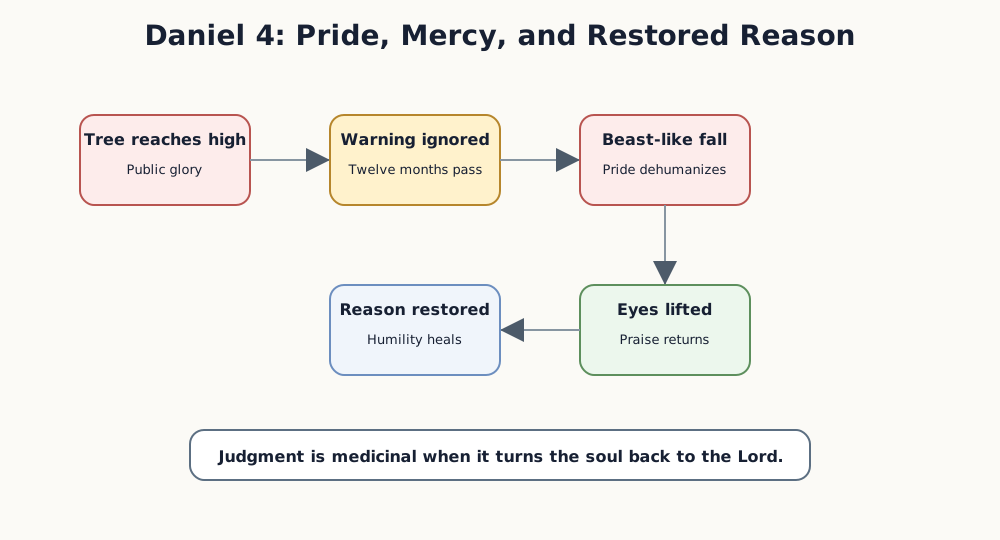 Source: Hermes, schematic of the king’s pride, abasement, and restored praise in Daniel 4.
Raised eyes and restored praise (Daniel 4:34-37)
34 And at the end of the time I Nabuchodonosor lifted up mine eyes to heaven, and my reason returned to me, and I blessed the Most High, and praised him that lives for ever, and gave him glory; for his dominion is an everlasting dominion, and his kingdom lasts to all generations: 35 and all the inhabitants of the earth are reputed as nothing: and he does according to his will in the army of heaven, and among the inhabitants of the earth: and there is none who shall withstand his power, and say to him, What hast thou done? 36 At the same time my reason returned to me, and I came to the honour of my kingdom; and my natural form returned to me, and my princes, and my nobles, sought me, and I was established in my kingdom, and more abundant majesty was added to me.
37 Now therefore I Nabuchodonosor praise and greatly exalt and glorify the King of heaven; for all his works are true, and his paths are judgment: and all that walk in pride he is able to abase.
The king’s recovery is told through an act of attention: he “lifted up mine eyes to heaven.” The direction of his gaze answers the earlier boast. He no longer looks upon Babylon as proof that everything begins and ends with himself. His reason returns, and the restored voice blesses the One who lives forever. Within this testimony, reason finds its proper setting in gratitude before the Creator.
That sequence is spiritual instruction, not a promise that a sick person can recover by making the correct gesture or praying hard enough. Someone who remains ill after prayer has not thereby failed at humility. The chapter gives us a particular act of divine restoration and a universal call to relinquish self-worship; it does not give us a universal timetable for healing.
The king’s confession that earth’s inhabitants are “reputed as nothing” is about their inability to resist God’s sovereignty. It does not mean that human lives have no value to Him. Nor does “he does according to his will” describe caprice. Jerome explicitly insists at this verse that God wills what is good. The king’s power to kill at pleasure is not the model for God’s kingship. God is the judge of that very misuse of power.
How complete was the king’s conversion? His praise is real within the story, and verse 37 ends with a truthful confession about pride. Yet Jerome reads a lingering worldliness in part of his language at verse 35. Ancient interpretation itself can therefore caution us against announcing more than the passage gives. We can rejoice in the mercy narrated here without claiming knowledge of the king’s final spiritual condition.
Christ reveals kingship free of the disease exposed in Babylon. He does not need correction for pride. He humbles Himself willingly and takes the form of a servant for our salvation (Philippians 2:5-11). The contrast is not simply between two routes to a restored throne. Nebuchadnezzar learns that he is a creature; the Son’s voluntary humility brings creatures back into communion with God. To belong to this King is to learn a greatness that can kneel and serve.
Spiritual Fruit 🍇
Begin with the king’s unfinished account of Babylon. Name one good thing you are tempted to describe as entirely your achievement: a child doing well, a successful ministry, a professional skill, a home. In prayer, give thanks for the people whose labor and patience helped sustain it. Then thank God for the breath and ability by which you could work at all. Gratitude does not deny labor; it rescues labor from self-worship.
Let Daniel’s counsel reach your possessions. Choose a concrete act of mercy this week through your parish or toward a person whose need you know. If someone has been underpaid, neglected, or burdened by your decisions, restitution and changed conduct are more truthful than a conspicuous donation elsewhere. Ask your confessor’s help where repentance requires an ongoing change rather than a single gift.
Practice Daniel’s compassion when another person’s public failure becomes conversation. Refuse to turn their humiliation into entertainment. This is especially important when illness is involved. Offer practical help to a struggling person or caregiver without asking what hidden sin caused the suffering.
Finally, lift your eyes before you are forced to stop. At the day’s end, bring one boast, one neglected person, and one received mercy before Christ. Ask Him to make your strength a shelter rather than a monument. The stump preserved in the earth is a reason not to despair of repentance, including the repentance you have postponed.
Teaching Notes
The tree and the watcher (Daniel 4:1-18)
- Ask: What good does the tree provide before it is cut down? How does that change our understanding of the king’s responsibility?
- Emphasize: The watcher serves the Most High; the dream does not describe competing heavenly authorities.
- Connect: Compare the birds sheltering in the tree with Matthew 13:31-32, distinguishing a Gospel comparison from a direct prediction.
Daniel’s counsel (Daniel 4:19-27)
- Ask: What would almsgiving have to change in a ruler’s actual administration?
- Watch for: Explain “atone” without erasing its force or making money a purchase price for pardon.
- Emphasize: Jerome’s proposed initial almsgiving is an interpretation, not an additional verse.
The boast and the affliction (Daniel 4:28-33)
- Ask: What does the king leave out of his account of Babylon’s greatness?
- Watch for: Read the in-body illness safeguard aloud. Never invite learners to diagnose a sick person’s sin or to replace medical care with a spiritual test.
Restored praise (Daniel 4:34-37)
- Ask: How do the king’s words in verse 30 differ from his words in verses 34-37?
- Emphasize: Jerome’s reservations about the king’s language counsel restraint about how completely his conversion can be described.
- Show: Follow the diagram from royal greatness through the ignored warning and fall to lifted eyes and restored reason. Discuss the preserved stump from the Scripture text itself.
Sources
Brenton, The Septuagint Version of the Old Testament, Daniel 4. Embedded wording is retained; Hebrew-based wording at 4:33 can be compared in NKJV Daniel 4:33.
St. Cyprian, On Works and Alms 1-5, especially 5 on Daniel 4:27.
Jerome, Commentary on Daniel, chapter 4, comments on 4:8, 13-14, 19, 27, 34-37. His verse labels sometimes place the present number in parentheses; the commentary is a historical exegetical witness, not an equally normative Coptic authority in every assertion.
Prayer of Nabonidus, 4Q242, a fragmentary comparative text, not proof of the event narrated in Daniel; Philip J. Long, “Daniel 4: Is Nebuchadnezzar’s Madness Historical?”, for the limits of the historical evidence. Their wider reconstruction is not adopted here as settled history.
Coptic lectionary: no verse-addressed appointment for Daniel 4 was found in the service data consulted. This does not establish absence from every prayer or hymn.
Footnotes
-
Jerome, Commentary on Daniel, chapter 4, on 4:13-14 (his vv. 10-11), trans. Gleason L. Archer, https://www.tertullian.org/fathers/jerome_daniel_02_text.htm. ↩
-
St. Cyprian, On Works and Alms 5, https://www.newadvent.org/fathers/050708.htm. ↩