


This narration is from a previous version of the study and may include a combined recording of multiple chapters.
Daniel 9 must be read as prayer before prediction. A promise in Jeremiah does not make Daniel calculate his escape from the suffering of his people. It sends him to prayer. He confesses, intercedes, and asks God to turn His face toward a desolate sanctuary. Only inside that movement does Gabriel speak of the seventy weeks, atonement, and the anointed one.
The chapter stands in the first year of Darius, after the Babylonian kingdom’s overthrow in the book’s narrative. Political change has not by itself restored Jerusalem. Daniel reads the word concerning the desolation and discovers that hope requires a response. The question is not simply when the ruins will be rebuilt, but how a sinful people can receive restoration from the covenant-keeping God.
The promise sends Daniel to prayer (Daniel 9:1-3)
1 In the first year of Darius the son of Assuerus, of the seed of the Medes, who reigned over the kingdom of the Chaldeans,
2 I Daniel understood by books the number of the years which was the word of the Lord to the prophet Jeremias, even seventy years for the accomplishment of the desolation of Jerusalem.
3 And I set my face toward the Lord God, to seek him diligently by prayer and supplications, with fastings and sackcloth.
Daniel understands “by books.” The prophet who has received visions still listens to an earlier prophetic word. Revelation does not make him independent of Scripture, and his knowledge does not remove his need to pray. Jeremiah’s seventy years identify a promised limit to desolation. Daniel’s response shows that a divine promise is not a reason to become passive. It is a reason to ask, repent, and prepare to receive.
His turning is bodily as well as intellectual: he sets his face toward the Lord, seeks diligently, fasts, and puts on sackcloth. These acts do not purchase the answer. They bring his attention and habits into agreement with the seriousness of his petition. A person can believe in restoration while arranging daily life as though no conversion were necessary. Daniel refuses that division.
Jerome notices that Jeremiah’s promise encouraged Daniel to pray rather than making him careless. His comment on verses 1-2 treats prayer as a faithful response to what God has graciously promised.1 The distinction is useful whenever we say that God already knows what is needed. Divine knowledge is not an argument against prayer. God invites us to desire His good consciously and to let that desire expose what in us resists it.
For a reader who struggles to begin praying, Daniel supplies a practical order. Read a small portion of Scripture attentively, name the hope or command it gives, and answer it. Prayer need not begin with a strong religious emotion. It can begin with the decision to turn toward the Lord whose word has already addressed us.
We plead compassion, not our righteousness (Daniel 9:4-19)
4 And I prayed to the Lord my God, and confessed, and said, O Lord, the great and wonderful God, keeping thy covenant and thy mercy to them that love thee, and to them that keep thy commandments; we have sinned,
5 we have done iniquity, we have transgressed, and we have departed and turned aside from thy commandments and from thy judgments:
6 and we have not hearkened to thy servants the prophets, who spoke in thy name to our kings, and our princes, and our fathers, and to all the people of the land.
7 To thee, O Lord, belongs righteousness, and to us confusion of face, as at this day; to the men of Juda, and to the dwellers in Jerusalem, and to all Israel, to them that are near, and to them that are far off in all the earth, wherever thou hast scattered them, for the sin which they committed.
8 In thee, O Lord, is our righteousness, and to us belongs confusion of face, and to our kings, and to our princes, and to our fathers, forasmuch as we have sinned.
9 To thee, the Lord our God, belong compassions and forgivenesses, whereas we have departed from thee;
10 neither have we hearkened to the voice of the Lord our God, to walk in his laws, which he set before us by the hands of his servants the prophets.
11 Moreover all Israel have transgressed thy law, and have refused to hearken to thy voice; so the curse has come upon us, and the oath that is written in the law of Moses the servant of God, because we have sinned against him.
12 And he has confirmed his words, which he spoke against us, and against our judges who judged us, by bringing upon us great evils, such as have not happened under the whole heaven, according to what has happened in Jerusalem.
13 As it is written in the law of Moses, all these evils have come upon us: yet we have not besought the Lord our God, that we might turn away from our iniquities, and have understanding in all thy truth.
14 The Lord also has watched, and brought the evils upon us: for the Lord our God is righteous in all his work which he has executed, but we have not hearkened to his voice.
15 And now, O Lord our God, who broughtest thy people out of the land of Egypt with a mighty hand, and madest to thyself a name, as at this day; we have sinned, we have transgressed.
16 O Lord, thy mercy is over all: let, I pray thee, thy wrath turn away, and thine anger from thy city Jerusalem, even thy holy mountain: for we have sinned, and because of our iniquities, and those of our fathers, Jerusalem and thy people are become a reproach among all that are round about us.
17 And now, O Lord our God, hearken to the prayer of thy servant, and his supplications, and cause thy face to shine on thy desolate sanctuary, for thine own sake, O Lord.
18 Incline thine ear, O my God, and hear; open thine eyes and behold our desolation, and that of thy city on which thy name is called: for we do not bring our pitiful case before thee on the ground of our righteousness, but on the ground of thy manifold compassions, O Lord.
19 Hearken, O Lord; be propitious, O Lord; attend, O Lord; delay not, O my God, for thine own sake: for thy name is called upon thy city and upon thy people.
Daniel begins with God before he begins with guilt. The Lord is great, wonderful, faithful to covenant, and merciful. The confession that follows is therefore not an attempt to discover whether God might possibly be persuaded to care. It is an appeal to the God whose character the covenant has already revealed. Repentance can be truthful because divine mercy is not imaginary.
Daniel says “we,” not “they.” Kings, princes, fathers, and people belong within the confession. He refuses the position of an observer whose own righteousness entitles him to explain everybody else’s ruin. The prayer names acts: iniquity, transgression, departure from commandments, and refusal to hear the prophets. It does not hide disobedience inside a vague declaration that life has become difficult.
Jerome explains this solidarity by saying that Daniel reviews the people’s sins as one who belongs to them, while verse 20 also explicitly names his own sins.2 The “we” need not imply that Daniel committed every offense he confesses. It means that intercession is not conducted from outside the people. Their wound concerns him, and he seeks their restoration before God.
Such solidarity must never be turned against a victim. No one is required to confess an abuser’s act as though it were their own, and a communal prayer must not conceal responsibility or prevent protection and justice. Daniel’s “we” is a refusal of self-righteous detachment, not a device for making everyone equally guilty. The same prayer distinguishes rulers, judges, fathers, and people; belonging together does not make their acts indistinguishable.
The contrast between God’s righteousness and human confusion of face is repeated. Shame here is an acknowledgment that our public self-defense has failed. But Daniel does not stop at shame. Verse 9 immediately names compassions and forgivenesses. The Judge is the One to whom he appeals for mercy. A confession that never reaches mercy can become another form of self-absorption; a claim to mercy that will not name sin becomes evasion. Daniel keeps truth and hope together.
Verses 11-14 place the catastrophe within the covenant’s warnings. Daniel recognizes a relation between the people’s disobedience and the desolation; he does not claim that the Lord has become unjust. Yet this confession is not a universal explanation of every sufferer’s pain. We cannot take its covenant judgment and diagnose a neighbor’s illness, bereavement, displacement, or assault as proof of that person’s sin. The Church hears this text as an invitation to examine herself, not as permission to accuse the afflicted.
Verse 13 sharpens the diagnosis. Suffering has occurred, but the people have not turned away from iniquity or sought understanding in God’s truth. Pain does not automatically make a person repentant. We can become resentful, numb, or eager for relief while defending the very habit that has damaged us. Daniel asks for a change deeper than the end of unpleasant consequences. Restoration must include the recovery of obedience.
The memory of Egypt in verse 15 changes the prayer’s scale. The God who brought His people out with a mighty hand has already acted when they could not free themselves. Daniel’s hope rests on that history of deliverance, not on an improved estimate of human deserving. The remembered divine name becomes the ground for a renewed plea: act again as the Lord who saves.
The final petitions turn toward the city, the holy mountain, and the desolate sanctuary. Daniel asks God to make His face shine. It is the language of restored favor and presence, not merely a request for successful building work. A repaired city without reconciliation would leave the deepest desolation untouched. Conversely, the prayer never treats material ruins and communal humiliation as irrelevant because inward spirituality is enough. Daniel brings the actual wounded place before God.
Verse 18 gives the prayer its center: the appeal rests not on “our righteousness” but on God’s “manifold compassions.” Need is brought without a fabricated claim to merit. The urgent verbs of verse 19 then pour out: hear, be propitious, attend, do not delay. Urgency is not manipulation when it is surrendered to God’s own name. The people belong to Him; their plea is that He make His mercy known among those who bear that name.
The Church’s Voice in Worship ⛪
The Bright Saturday service order lists Daniel 9:4-19 as the Prayer of Daniel in Midnight Praises, within the Praises of the Prophets. This is a prophetic-prayer placement in the vigil, not a claim that the passage is a Bright Saturday Eucharistic Liturgy reading. The Church receives Daniel’s own words of confession while awaiting the proclamation of the Resurrection.3
The liturgical setting deepens the appeal of verses 17-18. The desolate sanctuary asks for God’s shining face; sinners have no righteousness to present as a price. Beside Christ’s tomb, the Church does not demand life as wages. She waits for the mercy of the crucified Lord who conquers death. This is a Christian reading of the prayer in that vigil, not a claim that Daniel’s historical petition originally described every detail of Holy Saturday. The typological connection strengthens, rather than erases, the original plea for Jerusalem.
Beloved before the answer is complete (Daniel 9:20-23)
20 And while I was yet speaking, and praying, and confessing my sins and the sins of my people Israel, and bringing my pitiful case before the Lord my God concerning the holy mountain;
21 yea, while I was yet speaking in prayer, behold the man Gabriel, whom I had seen in the vision at the beginning, came flying, and he touched me about the hour of the evening sacrifice.
22 And he instructed me, and spoke with me, and said, O Daniel, I am now come forth to impart to thee understanding.
23 At the beginning of thy supplication the word came forth, and I am come to tell thee; for thou art a man much beloved: therefore consider the matter, understand the vision.
Gabriel comes while Daniel is still praying. The answer begins before he finishes arranging all his words. Verse 23 says the word went forth at the beginning of the supplication. Prayer is not a performance in which only a perfectly completed formula finally attracts God’s attention. Daniel has set his face toward the Lord, and the Lord is not inattentive to him.
The message also names him “much beloved.” He is confessing sin, not displaying innocence, when this assurance arrives. Repentance and belovedness are not opposites. The recognition of sin does not force us to imagine that God has ceased to desire our restoration. Nor does being loved exempt Daniel from understanding a hard word. Gabriel tells him to consider and understand, not simply to feel reassured.
The hour of the evening sacrifice remains part of Daniel’s memory even though the sanctuary is desolate. Prayer keeps time with the worship for whose restoration he asks. In Christian reading the hour also recalls the Gospel’s ninth-hour account of the Lord’s death (Matthew 27:45-50). The connection is a theological resonance: Daniel does not explicitly predict the hour of the Crucifixion here. The absent temple offering and the intercessor’s continuing prayer prepare us to contemplate the Lord whose self-offering gives sinners access to God.
The touching of Daniel recalls Gabriel’s strengthening presence in chapter 8, but the message now enters through confession and supplication. Understanding grows within dependence, not mastery. The right approach to what follows is therefore neither indifference nor the confidence of a calculator. It is the attention of a beloved servant who has asked mercy for his people.
Atonement, the anointed one, and the end of desolation (Daniel 9:24-27)
24 Seventy weeks have been determined upon thy people, and upon the holy city, for sin to be ended, and to seal up transgressions, and to blot out the iniquities, and to make atonement for iniquities, and to bring in everlasting righteousness, and to seal the vision and the prophet, and to anoint the Most Holy.
25 And thou shalt know and understand, that from the going forth of the command for the answer and for the building of Jerusalem until Christ the prince there shall be seven weeks, and sixty-two weeks: and then the time shall return, and the street shall be built, and the wall, and the times shall be exhausted.
26 And after the sixty-two weeks, the anointed one shall be destroyed, and there is no judgment in him: and he shall destroy the city and the sanctuary with the prince that is coming: they shall be cut off with a flood, and to the end of the war which is rapidly completed he shall appoint the city to desolations.
27 And one week shall establish the covenant with many: and in the midst of the week my sacrifice and drink-offering shall be taken away: and on the temple shall be the abomination of desolations; and at the end of the time an end shall be put to the desolation.
The answer enlarges Daniel’s question. He has been considering seventy years of desolation; Gabriel speaks of seventy weeks and a work that includes the ending of sin, atonement, everlasting righteousness, the sealing of vision and prophet, and the anointing of the Most Holy. Rebuilding matters, but the answer is not exhausted by the return of buildings and rulers. The wound of iniquity must be addressed.
The weeks are traditionally understood as periods of years. In the interpretations Jerome gathers, the seven weeks, sixty-two weeks, and final week receive differing historical explanations. They are not treated simply as a sequence of ordinary seven-day weeks. But agreement on that broad scale does not produce agreement on the starting decree, the division of the periods, or the placement of the final week. The passage names a divine determination; it does not remove the need for modesty in our reconstruction.
Brenton’s verse 25 explicitly says “Christ the prince.” The title draws attention to the anointed ruler, but the explanatory weight must come from the whole passage, not from treating an English capital letter as a complete argument. The answer moves through restoration, the suffering of the anointed one, the fate of city and sanctuary, covenant, sacrifice, and the ending of desolation. The Church reads this movement in the light of Jesus Christ, whose saving work brings forgiveness and righteousness rather than merely another turn in imperial succession.
Verse 26 is especially difficult. The anointed one is destroyed, with “no judgment in him,” and the verse then speaks of the city’s and sanctuary’s destruction. Its compressed sequence and pronouns do not give a simple picture in which every action can be assigned without explanation to the same actor. Christian reading hears the innocent suffering of Christ in the anointed one’s destruction and recognizes the later devastation of Jerusalem as part of the passage’s reception. It should not make Christ’s Passion a moral endorsement of armies destroying a city. Neither does it authorize contempt for Jewish people, whose history and Scriptures the Church is receiving here.
Gems from the Fathers 💎: Fulfillment without a manufactured consensus
Saint Athanasius quotes Daniel 9:24-25 in On the Incarnation 39.2. In sections 39-40 he argues that the expected Messiah has already come: the promise is not indefinitely postponed, and its language of holiness, righteousness, and the nations’ turning to the God of Israel is fulfilled in Christ. His emphasis is the identity and saving advent of the Word, not a worked calculation offered as the only Christian calendar.4 He asks in section 40.2: “For when He that was signified had come, what need was there any longer of any to signify Him?”5 The prophecy’s goal is the Savior Himself. Its continuing gift to the Church is to bear witness to Him, not to keep us permanently waiting for a different redeemer.
Athanasius writes in an ancient polemical setting. Receiving his Christological argument does not require us to repeat disparaging descriptions of Jewish people or treat the destruction of Jerusalem as a reason to rejoice. The apostles’ own Jewish identity and Daniel’s intercession forbid such spiritual self-congratulation. Christian confession should produce gratitude for mercy and prayer for all, not a caricature of those who do not share it.
Jerome’s introduction to his discussion of verses 24-27 makes a different, complementary contribution. After acknowledging the learning of earlier interpreters, he writes: “I shall simply repeat the view of each, and leave it to the reader’s judgment as to whose explanation ought to be followed.”6 He surveys Africanus, Eusebius, Hippolytus, Apollinarius, Clement, Origen, and Tertullian. The opening commitment does not mean he never criticizes a proposal; he does. It means that the diversity cannot honestly be replaced by a single computation attributed to all the Fathers. These are reported historical interpretations, not seven separately verified authorities quoted here.
The differences are substantial. In Jerome’s report, Africanus begins from the rebuilding decree associated with Nehemiah and Artaxerxes; Tertullian begins from Darius’s first year, when Daniel receives the revelation. Hippolytus reserves a final week for the end of the world. The survey thus includes explanations concentrated on Christ’s first advent and the destruction of the temple, as well as explanations that reserve a final period for the Antichrist. We can confess fulfillment in Christ without pretending that every commentator made the same chronological argument. The Lord’s own reference to Daniel’s “abomination of desolation” in Matthew 24:15 and Mark 13:14 keeps the warning about profanation serious; it does not instruct later generations to advertise a date for His return.
Verse 27 joins covenant with many, the removal of sacrifice, a desecrating abomination, and the eventual ending of desolation. Covenant and sacrilege are not the same action, and the sentence is not a command to violate worship. The end promised is not evil’s endless success. When the sequence remains difficult, the reader should retain what has been made clear: God answers the plea for mercy with a purpose that reaches atonement and righteousness, and He does not surrender the sanctuary or His people to an eternal desolation.
The Church’s Voice in Worship ⛪
A Coptic Reader-sourced order of the Myron preparation readings appoints Daniel 9:20-27.7 This is a specific preparation-service placement, not a claim that the whole chapter is read throughout every part of the consecration. Its range carries Gabriel’s arrival into the prophecy of atonement, everlasting righteousness, and the anointing of the Most Holy.
Myron is holy chrism, the oil used in the Church’s anointing. Hearing this promise while preparing it invites a Christological meditation: holiness is received from the Lord, not manufactured by the people who prepare the oil. Athanasius reads the Holy of Holies in this prophecy personally of Christ; the service placement does not by itself resolve every exegetical question about the expression. Nor does the reading order supply an official explanation of why the passage was chosen. Its spiritual resonance is nevertheless clear: repentance and anointing belong to God’s work of restoring a people, not to a technique for acquiring sacred power.
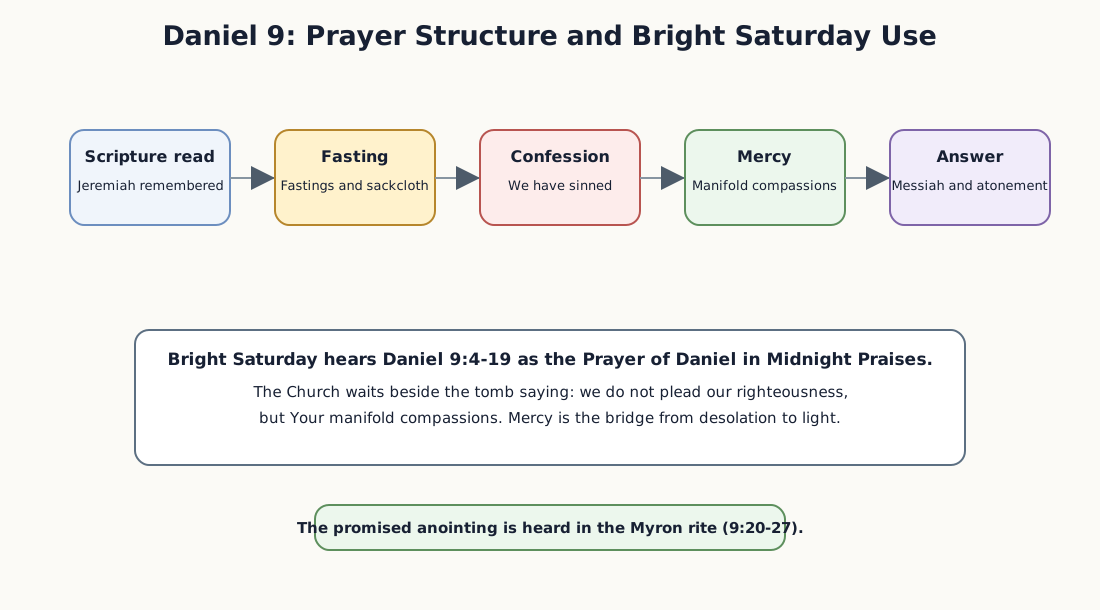 Daniel’s prayer moves from Scripture and bodily repentance through confession and mercy to the promise of restoration.
Spiritual Fruit 🍇
Pray Daniel 9:4-19 aloud for your parish or household. Say “we” deliberately. Do not use the prayer to list other people’s faults before God while leaving your own unnamed. After praying, identify one actual responsibility: a reconciliation you have avoided, an untrue account you have repeated, a neglected person, or an obligation you can now fulfill. Intercession becomes more truthful when it changes the intercessor.
If you carry shame, remain with verse 18. You are not required to produce a convincing history of righteousness before asking mercy. Come with the truth, including what you cannot repair by yourself, and ask on the ground of God’s compassions. Confession before a priest can give this turning a concrete form, without turning sorrow into endless self-accusation.
If a family or parish has been injured by wrongdoing, keep solidarity and responsibility together. Pray for all, protect those harmed, and do not call silence “forgiveness.” Daniel’s “we” opens a shared appeal to God; it does not forbid truthful testimony or wise boundaries.
When you meet a promise in Scripture, answer it in prayer before using it as an explanation for someone else’s life. Daniel reads, turns, confesses, and waits. The seventy weeks do not cancel that order. At the end of the chapter, the soul’s deepest question is not whether it can control the calendar, but whether it will trust the Christ who brings atonement and everlasting righteousness.
Lord, turn Your face toward what has become desolate in us. Teach us to confess without excuse, to hope without entitlement, and to receive the mercy we cannot earn.
Teaching Notes
The promise sends Daniel to prayer (Daniel 9:1-3)
- Ask: Why does a promise from God make Daniel pray more seriously rather than wait passively?
- Watch for: Brenton names fastings and sackcloth, not ashes.
We plead compassion, not our righteousness (Daniel 9:4-19)
- Emphasize: Follow the prayer’s order: God’s faithfulness, named disobedience, remembered deliverance, and mercy for the sanctuary.
- Ask: What is the difference between saying “we” in intercession and making an innocent person responsible for another’s wrong?
- Connect: Bright Saturday Midnight Praises, Praises of the Prophets, not the Eucharistic Liturgy readings.
Beloved before the answer is complete (Daniel 9:20-23)
- Ask: What changes when a penitent hears “much beloved” before the difficult explanation begins?
- Watch for: The evening sacrifice and Christ’s death provide a Christian resonance, not an explicit prediction of the Crucifixion’s hour.
Atonement, the anointed one, and the end of desolation (Daniel 9:24-27)
- Emphasize: Explain the purpose of the weeks before comparing chronological proposals.
- Watch for: Athanasius witnesses to fulfillment in Christ; Jerome witnesses to real interpretive differences. Neither warrants a timetable proclaimed as unanimous doctrine.
- Connect: The Myron preparation reading spans Daniel 9:20-27, including Gabriel’s arrival and the seventy-weeks prophecy. The resonance with anointing is interpretation, not an official rationale stated by the reading order.
- Ask: What would be lost if restoration meant only rebuilt walls and did not include atonement and righteousness?
Sources
Embedded Scripture is from Brenton’s English Septuagint (LXX).
Biblical connections: Matthew 24:15; Matthew 27:45-50; Mark 13:14.
Footnotes
-
Jerome, Commentary on Daniel, on Daniel 9:1-2, translated by Gleason L. Archer, primary text. Jerome is cited as a historical Christian exegete rather than as the measure of Coptic doctrinal reception. ↩
-
Jerome, Commentary on Daniel, on Daniel 9:5 and Daniel 9:20, primary text. ↩
-
Coptic Bright Saturday, Midnight Praises, Praises of the Prophets, “Prayer of Daniel,” Daniel 9:4-19. ↩
-
Saint Athanasius, On the Incarnation 39.2-5 and 40.1-5, primary text. ↩
-
Saint Athanasius, On the Incarnation 40.2, primary text. ↩
-
Jerome, Commentary on Daniel, opening discussion of Daniel 9:24-27 and the ensuing survey, primary text. ↩
-
Myron preparation readings, Daniel 9:20-27, sourced to Coptic Reader, Special / Consecrations / Oil / Myron / Preparation. ↩