


This narration is from a previous version of the study and may include a combined recording of multiple chapters.
The beasts devour, the horn boasts, and then the court sits. Daniel 7 does not deny the terror of violent power. It reveals the judgment that power cannot escape and the kingdom it cannot destroy. The temptation is to defeat beasts by becoming beastly. The Son of Man shows another way to be human, and another source of dominion.
The vision is dated to the first year of Baltasar, before the fall narrated in chapter 5. Daniel is no longer explaining another man’s dream; he must bear a revelation that troubles him. Chapter 2 viewed successive kingdoms through a magnificent statue. Chapter 7 shows their predatory character from another angle. Its center is not a more frightening beast but the heavenly court and the One who approaches it.
Kingdoms that forget how to be human (Daniel 7:1-8)
1 In the first year of Baltasar king of the Chaldeans Daniel had a dream, and visions of his head upon his bed: and he wrote his dream.
2 I Daniel beheld, and, lo, the four winds of heaven blew violently upon the great sea.
3 And there came up four great beasts out of the sea, differing from one another.
4 The first was as a lioness, and her wings as an eagle’s: I beheld until her wings were plucked, and she was lifted off from the earth, and she stood on human feet, and a man’s heart was given to her.
5 And, behold, a second beast like a bear, and it supported itself on one side, and there were three ribs in its mouth, between its teeth: and thus they said to it, Arise, devour much flesh.
6 After this one I looked, and behold another wild beast as a leopard, and it had four wings of a bird upon it: and the wild beast had four heads, and power was given to it.
7 After this one I looked, and behold a fourth beast, dreadful and terrible, and exceedingly strong, and its teeth were of iron; devouring and crushing to atoms, and it trampled the remainder with its feet: and it was altogether different from all the beasts that were before it; and it had ten horns.
8 I noticed his horns, and, behold, another little horn came up in the midst of them, and before it three of the former horns were rooted out: and, behold, there were eyes as the eyes of a man in this horn, and a mouth speaking great things.
The great sea is violently stirred before anything emerges from it. Kingdoms that appear solid from inside their palaces rise here amid turbulence. Each beast has its own shape, but appetite unites them: they devour, crush, trample, and exalt themselves. The image does not make animals morally wicked. It exposes human rule that has abandoned the human calling to exercise authority under God. A state may possess intelligence, administration, and beauty while treating persons as material to consume.
The lioness is an important exception within this grim procession. Her wings are plucked, she stands on human feet, and a human heart is given to her. The reversal recalls the humbled king of chapter 4: loss of imperial grandeur may become the recovery of creaturely sanity. Power is not healed merely by acquiring stronger wings. It must receive a different heart. The vision leaves room for a ruler’s humiliation to become mercy rather than simply destruction.
The bear’s command to devour much flesh, the leopard’s wings and heads, and the fourth beast’s iron teeth intensify the picture. Speed and reach are not virtues by themselves. Neither is organizational strength. What matters is what that strength does to the vulnerable. The fourth beast is so terrible that Daniel does not give it a familiar animal name. Its ten horns present multiplied royal power; the smaller horn rises by displacing others. What looks small at first can become spiritually monstrous.
Its human eyes and boastful mouth are especially searching. Intelligence and speech, gifts that should serve communion and truth, become instruments of self-exaltation. This is not mindless brutality. The horn can observe, plan, and persuade. The warning therefore reaches beyond obvious violence to the clever justification of violence. A Christian must test not only whether an argument succeeds, but whether it teaches us to despise the people we wish to defeat.
Gems from the Fathers 💎: A human heart after humiliation
Hippolytus reads chapters 2 and 7 together. In On Christ and Antichrist 23-25 he identifies Babylon, Persia, Greece, and Rome, understanding the lioness’s restored human heart through Nabuchodonosor’s repentance. His reading helps us see that the same vision can unmask an empire and still discern mercy toward a humbled person.1 These historical identifications belong to a particular ancient Christian exposition; they are not permission to identify today’s nations with the beasts. The heavenly interpreter will insist on the kingdoms’ temporary authority and God’s final judgment. Those are the controlling certainties.
The court sits and the Son of Man receives the kingdom (Daniel 7:9-14)
9 I beheld until the thrones were set, and the Ancient of days sat; and his raiment was white as snow, and the hair of his head as pure wool: his throne was a flame of fire, and his wheels burning fire.
10 A stream of fire rushed forth before him: thousand thousands ministered to him, and ten thousands of myriads attended upon him: the judgment sat, and the books were opened.
11 I beheld then because of the voice of the great words which that horn spoke, until the wild beast was slain and destroyed, and his body given to be burnt with fire.
12 And the dominion of the rest of the wild beasts was taken away; but a prolonging of life was given them for certain times.
13 I beheld in the night vision, and, lo, one coming with the clouds of heaven as the Son of man, and he came on to the Ancient of days, and was brought near to him.
14 And to him was given the dominion, and the honour, and the kingdom; and all nations, tribes, and languages, shall serve him: his dominion is an everlasting dominion, which shall not pass away, and his kingdom shall not be destroyed.
The scene changes without the beasts’ permission. Thrones are set, the Ancient of Days sits, and books are opened. The horn has a mouth full of claims; the court has a record. Its loudness cannot alter what has been done. For the persecuted, the opened books promise that hidden wrong has not disappeared into history. For the powerful, they announce accountability. For every reader, they make repentance more urgent than winning the argument about who was right.
White clothing and hair like pure wool signify a majesty untouched by the corruption of earthly rulers. The fire, wheels, and innumerable attendants disclose living holiness and sovereign judgment, not an elderly deity made subject to time. The God who judges is not another participant scrambling for a place among the empires. Even the prolonged life of the remaining beasts is measured and granted, not independently possessed. God’s patience must not be mistaken for their immortality.
Then one comes with the clouds of heaven as the Son of Man. Unlike the beasts that rise from the sea, this figure belongs to the heavenly scene and appears in human likeness. He approaches the Ancient of Days and receives dominion, honor, and a kingdom. His rule does not depend on devouring another people’s life. All nations, tribes, and languages serve Him, and the kingdom does not pass away. The universal claim is greater than any empire’s boast because it is joined to everlasting life rather than temporary force.
Christ applies this imagery to Himself before the high priest: the Son of Man will be seen at the right hand of power and coming with the clouds of heaven (Matthew 26:64; Mark 14:62). Matthew 24:30 also takes up the coming of the Son of Man on the clouds. The man placed under human judgment is not finally defined by His judges. His Cross is not a surrender of divine kingship, and His Resurrection is not the mere recovery of a defeated political cause. The crucified and risen Lord possesses the dominion that death cannot terminate.
The receiving of dominion must not be used to make the Son a creature promoted into divinity. Hippolytus, explaining this vision in section 26, joins the Father’s gift of authority to the eternal Word’s becoming man, His re-creation of Adam, and His victory over death.2 Christian reading holds together the Son’s eternal divine identity and the exaltation of the humanity He truly assumed. The vision gives us communion with the victorious Christ, not a second god competing for a throne.
Gems from the Fathers 💎: Glory without a bodily picture of God
Revelation 1:13-14 gives the risen Christ hair white like wool and snow. Daniel’s imagery thus helps the New Testament confess Christ’s divine glory. Yet this connection does not mean that every ancient interpreter assigned the figures in Daniel’s throne scene identically. Hippolytus reads the approach in terms of Father and Son; Revelation’s reuse of the white hair reveals that the Son shares divine majesty. Received confession is firm: Christ is truly divine, truly incarnate, and everlasting King. The allocation of every visionary detail is an exegetical question, not a test by which to manufacture patristic unanimity.
Saint John Chrysostom places Daniel’s vision beside Isaiah’s and Ezekiel’s when explaining John 1:18. His purpose is to distinguish God’s merciful self-disclosure from a direct sight of the divine essence: “It is to declare, that all these were instances of (His) condescension, not the vision of the Essence itself unveiled.”3 The whiteness, throne, and fire teach truly, but they do not make God’s incorporeal being into a body we can diagram. Reverence receives the revelation without pretending to possess God.
Saint Cyril of Jerusalem explicitly cites Daniel 7:13-14 against the claim that Christ’s kingdom will end. He joins Daniel to Gabriel’s promise in Luke 1:33 and urges his hearers: “These things rather hold fast, these things believe, and cast away from you the words of heresy; for you have heard most plainly of the endless kingdom of Christ.”4 The Church’s confession of an unending kingdom is not vague optimism. The Lord who died and rose does not expire when the present struggle is over.
The Church’s Voice in Worship ⛪
The St. Mary Ottawa printed Holy Pascha Katameros gives Daniel 7:9-15 at the Ninth Hour on Tuesday of Holy Week. This is a printed-book witness, not a claim that every current Coptic reading source appoints it. Within that witness the Passion setting is striking: the Lord stands before human judges while Daniel opens the court of heaven. The juxtaposition teaches us not to confuse Christ’s voluntary humiliation with the loss of His kingdom.
A Coptic prayer also brings Daniel’s innumerable attendants into the worshipper’s hearing. The Fraction in the Copt-Net English text of Saint Basil’s Liturgy addresses God: “Before whom stand thousands of thousands and ten thousand times ten thousands of holy angels and archangels, the Cherubim and the Seraphim and all the innumerable host of the heavenly powers.”5 The connection is theological rather than a chapter-reading appointment: the person approaching the Holy Mysteries stands before the same holy God whose court Daniel sees. Awe should produce repentance and attention, not anxiety about mastering invisible ranks.
The saints inherit what the horn cannot keep (Daniel 7:15-28)
15 As for me Daniel, my spirit in my body trembled, and the visions of my head troubled me.
16 And I drew near to one of them that stood by, and I sought to learn of him the truth of all these things: and he told me the truth, and made known to me the interpretation of the things.
17 These four beasts are four kingdoms that shall rise up on the earth:
18 which shall be taken away; and the saints of the Most High shall take the kingdom, and possess it for ever and ever.
19 Then I enquired carefully concerning the fourth beast; for it differed from every other beast, exceeding dreadful: its teeth were of iron, and its claws of brass, devouring, and utterly breaking to pieces, and it trampled the remainder with its feet:
20 and concerning its ten horns that were in its head, and the other that came up, and rooted up some of the former, which had eyes, and a mouth speaking great things, and his look was bolder than the rest.
21 I beheld, and that horn made war with the saints, and prevailed against them;
22 until the Ancient of days came, and he gave judgment to the saints of the Most High; and the time came on, and the saints possessed the kingdom.
23 And he said, The fourth beast shall be the fourth kingdom on the earth, which shall excel all other kingdoms, and shall devour the whole earth, and trample and destroy it.
24 And his ten horns are ten kings that shall arise: and after them shall arise another, who shall exceed all the former ones in wickedness, and he shall subdue three kings.
25 And he shall speak words against the Most High, and shall wear out the saints of the Most High, and shall think to change times and law: and power shall be given into his hand for a time and times and half a time.
26 And the judgment has sat, and they shall remove his dominion to abolish it, and to destroy it utterly.
27 And the kingdom and the power and the greatness of the kings that are under the whole heaven were given to the saints of the Most High; and his kingdom is an everlasting kingdom, and all powers shall serve and obey him.
28 Hitherto is the end of the matter. As for me Daniel, my thoughts greatly troubled me, and my countenance was changed: but I kept the matter in my heart.
Daniel trembles and asks for understanding. Revelation has not made him emotionally invulnerable. The interpreter’s first answer identifies four kingdoms and immediately turns to the saints’ inheritance. The Son of Man’s victory is not solitary magnificence. In verses 18, 22, and 27 the holy people receive the kingdom. Their life is bound to His rule; what He possesses becomes their inheritance by grace.
This corporate promise matters when faith has become an exclusively private struggle to feel safe. The vision sees a people, not merely isolated heroic individuals. Their destiny is not to watch a triumphant ruler from a distance while remaining abandoned. Nor do they become divine rivals of God. They share the life and vindication of His kingdom. Christ’s promise that His disciples will share His royal table and judgment in Luke 22:28-30 helps disclose this communion.
The intervening suffering remains real. The horn makes war on the saints and prevails against them. Daniel does not explain away defeat by saying that the persecuted only appeared to suffer. Neither does he conclude that visible victory proves righteousness. The enemy may imprison, exhaust, and kill, yet cannot turn his temporary ascendancy into everlasting dominion. Final judgment belongs to God. The saints are not instructed to acquire the horn’s weapons of boastfulness and cruelty in order to become heirs.
To “wear out” the saints describes a pressure that can work through duration as well as sudden catastrophe. Changing times and law suggests an ambition to reorder life under arrogant power, reaching into the patterns by which a people remembers and obeys God. Ordinary fidelity therefore matters. A prayer kept under pressure, a refusal to lie, and protection offered to someone threatened may appear small beside imperial decrees, but they preserve allegiance to another Lord.
Gems from the Fathers 💎: Evil measured, not enthroned forever
Saint Irenaeus reads the boastful horn as the Antichrist in Against Heresies 5.25.1-3. His explanation places Daniel beside 2 Thessalonians 2: the final enemy claims divine honor and tyrannically exalts himself, but Christ destroys his rule. Irenaeus interprets the “time and times and half a time” as three years and six months.6 This is a definite ancient Christian reading, not a starting date supplied to later readers. Revelation 12:14 reuses the time-language for a protected yet afflicted people. The force of the measure is that oppression has an appointed limit; it cannot enlarge itself into God’s eternity.
The historical and final horizons should not be collapsed into one scheme. The Antiochus pattern developed in chapter 8 helps us recognize sacrilegious persecution, while Irenaeus reads chapter 7 toward a final opponent. Neither reading licenses the identification of a contemporary person or ethnic community as the Antichrist. The spiritual warning concerns false worship and murderous pride wherever they recruit our consent.
The chapter ends not with Daniel announcing a timetable but with a changed countenance and a matter kept in the heart. There is a gentle resemblance to Mary’s keeping and pondering in Luke 2:19 and Luke 2:51, though the experiences are not identical. Some truth must be carried faithfully before it can be explained exhaustively. Daniel’s distress is allowed to remain inside obedience. The vision has supplied enough to endure: the horn loses its dominion, the saints receive the kingdom, and the Most High is not defeated.
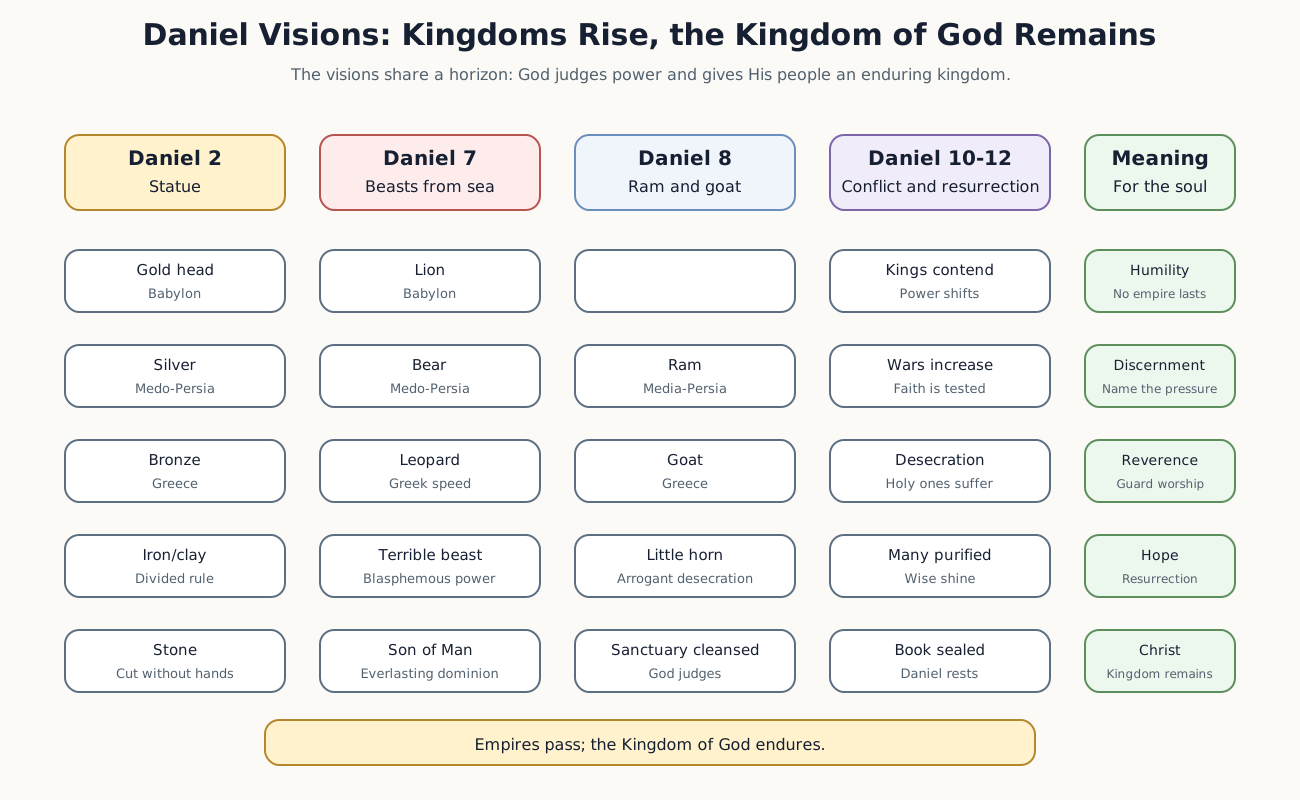 The visions contrast the apparent strength of successive kingdoms with the everlasting kingdom given by God.
Spiritual Fruit 🍇
When beastly power looks permanent, Daniel 7 teaches the soul to look again. The court is seated. The books are opened. Christ reigns. This does not require us to call cruelty harmless. It gives us a place to bring the cruelty we cannot presently stop, without pretending that God has forgotten its victims.
Name one place where the wish to defeat wrongdoing has begun to deform your own speech. It may be contempt in a family argument, delight in a rival’s humiliation, or the sharing of an accusation before its truth is known. Refuse that one participation today. Tell the truth without making another person less than human. Where someone needs protection, seek practical help and lawful accountability; meekness is not cooperation with abuse.
The opened books also interrupt self-justification. Before confession, remember one wrong you have minimized because the other person behaved worse. Bring your own act to Christ plainly. His judgment frees us from needing either to hide our sin or to avenge ourselves. The mercy we ask from the Judge must begin to change the way we judge our neighbor.
Finally, remember one exhausted member of the Church in prayer and in a concrete act of help. The promise is given to the saints together. A visit, a meal, help with transport, or patient listening can bear witness that a suffering person has not been excluded from the kingdom. We wait for the Son of Man not by imitating the beasts, but by letting His meekness govern our treatment of one another.
Teaching Notes
Kingdoms that forget how to be human (Daniel 7:1-8)
- Ask: What distinguishes the human heart given to the lioness from the human-looking eyes and mouth of the horn?
- Watch for: Ancient kingdom identifications are not a code for present nations.
The court sits and the Son of Man receives the kingdom (Daniel 7:9-14)
- Emphasize: Read the movement from boastful speech to opened books, then from judgment to the gift of the kingdom.
- Connect: Matthew 26:64, Mark 14:62, and Revelation 1:13-14. Distinguish the Church’s confession of Christ from diversity in explaining the visionary figures.
- Watch for: The Ottawa Pascha appointment is a printed witness; the quoted Coptic liturgical text is a Fraction, not the pre-Sanctus.
The saints inherit what the horn cannot keep (Daniel 7:15-28)
- Ask: How can the horn prevail against the saints without possessing the final victory?
- Emphasize: Give time to the three promises of the saints’ inheritance before discussing the horn’s measured period.
- Watch for: Do not tell an injured person that refusing cruelty means remaining accessible to abuse.
Sources
Embedded Scripture is from Brenton’s English Septuagint (LXX).
- St. Mary Ottawa, Holy Pascha Katameros, Tuesday, Ninth Hour, Daniel 7:9-15: printed liturgical witness.
- Biblical connections: Matthew 24:30; Matthew 26:64; Mark 14:62; Luke 22:28-30; Revelation 1:13-14; Revelation 12:14.
Footnotes
-
Hippolytus, On Christ and Antichrist 23-25, primary text. ↩
-
Hippolytus, On Christ and Antichrist 26, primary text. ↩
-
Saint John Chrysostom, Homilies on John, Homily 15.1 on John 1:18, primary text. ↩
-
Saint Cyril of Jerusalem, Catechetical Lecture 15.27-30, especially 15.27, primary text. ↩
-
The Coptic Liturgy of Saint Basil, “Fraction,” English text provided through St. Mary Coptic Orthodox Church, Seattle, in the Copt-Net archive. ↩
-
Saint Irenaeus, Against Heresies 5.25.1-3, primary text. ↩