


Genesis 1 proclaims that everything begins with God speaking. The world is not born from divine combat, accident, or need. It is called into being, ordered, blessed, and declared good. The chapter reaches its summit in humanity made in the image and likeness of God, entrusted with royal-priestly dominion that serves life rather than consuming it. From the Church’s perspective, the whole chapter already leans toward Christ, the eternal Logos and true Light in whom creation is both made and renewed.
Why this passage matters
Genesis 1 gives the Church her first theology of reality. It establishes one Creator, the goodness of matter, the dignity of the human person, and the difference between holy dominion and destructive domination. It also dismantles ancient and modern idolatries at once. The heavenly bodies are not gods, nature is not ultimate, technology is not savior, and humanity is not self-created.
This chapter also matters because the New Testament reads creation through the Logos. John 1, Colossians 1, Hebrews 1, and Romans 8 all assume the world first described here. To teach Genesis 1 well is already to teach the grammar of worship, ethics, sacramental life, and hope.
Historical and Scriptural Context
Genesis begins with one of Scripture’s boldest confessions: “In the beginning God made the heaven and the earth.” Israel’s story does not start with cosmic rivalry or divine genealogy, but with the one God creating all things. Sea, darkness, heavens, and earth are not rival powers. They are parts of a world that depends entirely on the Creator.
The structure of the chapter is itself theological. God speaks, separates, names, blesses, and evaluates. Light appears before the luminaries. Fruitfulness is gifted before it is managed. Humanity appears last not because man is least important, but because man is placed into an already prepared and hospitable world. The pattern moves toward Sabbath rest in the next chapter and prepares later biblical themes of temple, kingship, priesthood, and new creation.
Orthodox readers therefore do not approach Genesis 1 as either a disposable myth or a modern laboratory report. It is a liturgical and theological proclamation about who God is, what the world is, and what humanity is for. St. Basil the Great’s Hexaemeron models precisely this reverent reading: the six days become a school of wonder that leads the soul from creation to praise rather than from curiosity to pride. Basil gives the movement its own direct phrase: “by the beauty of visible things let us raise ourselves to Him who is above all beauty.”1
Creation begins with God speaking (Genesis 1:1-5)
1 In the beginning God made the heaven and the earth. 2 But the earth was unsightly and unfurnished, and darkness was over the deep, and the Spirit of God moved over the water. 3 And God said, Let there be light, and there was light. 4 And God saw the light that it was good, and God divided between the light and the darkness. 5 And God called the light Day, and the darkness he called Night, and there was evening and there was morning, the first day.
The text refuses to explain God because God is the One through whom explanation is possible. He is already there in the beginning. The earth is unsightly and unfurnished, darkness covers the deep, and the Spirit of God moves over the waters. Then creation advances by speech: “And God said.” The world begins as answer to the divine Word.
Light arrives before sun and moon. This order keeps the luminaries in their proper place: they serve a world whose first gift of light depends on God, not on their own divinity. Genesis does not specify the physical mechanism of that first light. The repeated “God said” directs attention to the Creator’s effective word, while John 1 later names the eternal Word through whom all things were made. That Christian reading joins the texts without confusing created light with the uncreated Son.
God orders a world fit for life (Genesis 1:6-13)
6 And God said, Let there be a firmament in the midst of the water, and let it be a division between water and water, and it was so. 7 And God made the firmament, and God divided between the water which was under the firmament and the water which was above the firmament. 8 And God called the firmament Heaven, and God saw that it was good, and there was evening and there was morning, the second day.
9 And God said, Let the water which is under the heaven be collected into one place, and let the dry land appear, and it was so. And the water which was under the heaven was collected into its places, and the dry land appeared. 10 And God called the dry land Earth, and the gatherings of the waters he called Seas, and God saw that it was good. 11 And God said, Let the earth bring forth the herb of grass bearing seed according to its kind and according to its likeness, and the fruit-tree bearing fruit whose seed is in it, according to its kind on the earth, and it was so. 12 And the earth brought forth the herb of grass bearing seed according to its kind and according to its likeness, and the fruit tree bearing fruit whose seed is in it, according to its kind on the earth, and God saw that it was good. 13 And there was evening and there was morning, the third day.
Days two and three show that creation is not only made but arranged. Waters are divided, firmament established, seas gathered, dry land named, and vegetation summoned forth. Distinction is not the enemy of harmony here. God’s ordering work creates a world that can be inhabited, cultivated, and received with thanksgiving.
The repeated phrase “according to its kind” gives the sense of intelligibility and faithfulness. Creation is stable enough to be known because it rests in the wisdom of God. St. Basil delights in this order and repeated goodness because it teaches Christians to reject both chaos and contempt. Matter is not evil stuff waiting to become spiritual; it is already created good and capable of blessing.
Light and the heavenly bodies serve the Creator’s purposes (Genesis 1:14-19)
14 And God said, Let there be lights in the firmament of the heaven to give light upon the earth, to divide between day and night, and let them be for signs and for seasons and for days and for years. 15 And let them be for light in the firmament of the heaven, so as to shine upon the earth, and it was so. 16 And God made the two great lights, the greater light for regulating the day and the lesser light for regulating the night, the stars also. 17 And God placed them in the firmament of the heaven, so as to shine upon the earth, 18 and to regulate day and night, and to divide between the light and the darkness. And God saw that it was good. 19 And there was evening and there was morning, the fourth day.
On the fourth day the heavenly lights are appointed for signs, seasons, days, and years. Their function is real and glorious, but their status is creaturely. Genesis even avoids magnifying them by name; it calls them the greater light and the lesser light. The chapter quietly strips the cosmos of false divinity.
This is as relevant now as it was in the ancient world. People still absolutize impersonal forces - nature, history, biology, systems, markets, even technology. Genesis 1 refuses that surrender. The heavenly bodies help order time, but they do not own time. Orthodox worship lives inside this truth whenever it sanctifies hours, feasts, and fasts as gifts of the Creator rather than prisons of fate.
Life fills the world under blessing (Genesis 1:20-25)
20 And God said, Let the waters bring forth reptiles having life, and winged creatures flying above the earth in the firmament of heaven, and it was so. 21 And God made great whales, and every living reptile, which the waters brought forth according to their kinds, and every creature that flies with wings according to its kind, and God saw that they were good. 22 And God blessed them, saying, Increase and multiply and fill the waters in the seas, and let the creatures that fly be multiplied on the earth. 23 And there was evening and there was morning, the fifth day.
24 And God said, Let the earth bring forth the living creature according to its kind, quadrupeds and reptiles and wild beasts of the earth according to their kind, and it was so. 25 And God made the wild beasts of the earth according to their kind, and cattle according to their kind, and all the reptiles of the earth according to their kind, and God saw that they were good.
The waters teem, the sky fills with winged creatures, and the earth brings forth living beings. The tone of the chapter is abundance, not scarcity. God is not a reluctant giver. He delights in a world crowded with life.
The blessing to increase and multiply is spoken to the creatures of sea and sky before it is spoken to humanity. Their life matters to God before it serves any human purpose. This makes gratitude for creation more demanding than admiring its beauty: the one entrusted with dominion in verse 28 must learn to make room for the living world God has already blessed.
Humanity is made in the image and likeness of God (Genesis 1:26-27)
26 And God said, Let us make man according to our image and likeness, and let them have dominion over the fish of the sea, and over the flying creatures of heaven, and over the cattle and all the earth, and over all the reptiles that creep on the earth. 27 And God made man, according to the image of God he made him, male and female he made them.
The chapter rises to its summit when God says, “Let us make man according to our image and likeness.” Humanity is not merely another specimen within the animal order. The human person is created for communion with God, capable of knowing Him, answering Him, and reflecting His rule within the world. The image is given to humanity as a divine gift, not achieved as a human project.
The text itself makes clear that male and female together bear this honor. The image is not the private possession of the strong, the male, the educated, or the useful. It belongs to every human life from the beginning. Later Christian reflection speaks of growth into likeness through communion with God, but the verse must first be allowed its own force: the dignity is given before anyone has done anything to earn it. To disregard a dependent or inconvenient person is to disregard an image-bearer.
Dominion is royal-priestly stewardship (Genesis 1:28-31)
28 And God blessed them, saying, Increase and multiply, and fill the earth and subdue it, and have dominion over the fish of the seas and flying creatures of heaven, and all the cattle and all the earth, and all the reptiles that creep on the earth. 29 And God said, Behold I have given to you every seed-bearing herb sowing seed which is upon all the earth, and every tree which has in itself the fruit of seed that is sown, to you it shall be for food. 30 And to all the wild beasts of the earth, and to all the flying creatures of heaven, and to every reptile creeping on the earth, which has in itself the breath of life, even every green plant for food; and it was so. 31 And God saw all the things that he had made, and, behold, they were very good. And there was evening and there was morning, the sixth day.
God blesses humanity and then gives the charge to fill, subdue, and have dominion. The sequence is decisive. Rule is given inside blessing and under God’s prior ownership. Dominion in Genesis 1 therefore cannot mean predatory exploitation. The ruler is an image-bearer of the God who gives light, food, order, and life. Human rule must resemble divine care.
For this reason Orthodox writers often speak of humanity here as royal-priestly. Humanity is royal because it is crowned to govern under God; humanity is priestly because it receives creation thankfully, tends it faithfully, and offers it back in praise. Fr. Tadros Yacoub Malaty frequently stresses this priestly vocation, and Pope Shenouda III’s pastoral teaching on human dignity points in the same direction: power severed from holiness no longer resembles God’s image. The chapter closes with the great verdict over the whole: “behold, they were very good.” The world is not raw material for appetite. It is a good creation entrusted to grateful stewards.
💎 Gems from the Fathers
St. Basil the Great’s Hexaemeron remains one of the Church’s great entrances into Genesis 1. He reads the six days as a revelation of beauty, proportion, intelligibility, and goodness. Creation does not compete with God. It manifests His wisdom and calls humanity to reverence. Basil’s closing movement is exactly the posture a reader should learn from Genesis: “by the beauty of visible things let us raise ourselves to Him who is above all beauty; by the grandeur of bodies, sensible and limited in their nature, let us conceive of the infinite Being whose immensity and omnipotence surpass all the efforts of the imagination.”1
St. Athanasius gives Genesis 1 its indispensable Christological depth by insisting that the same Word through whom all things came to be is the One who enters history to rescue creation from corruption. He says, “God is good, or rather is essentially the source of goodness,” and therefore “grudging existence to none, He has made all things out of nothing by His own Word, Jesus Christ our Lord.”2 Creation and Incarnation are not disconnected topics; the Maker Himself becomes Restorer.
St. Irenaeus protects the dignity and calling of humanity within this chapter. Man is not a mistake, not an imprisoned spark, and not a finished self-sufficient power. Humanity is created good, called to communion, and healed in Christ so that the image may move toward its intended likeness. Irenaeus gives the chapter its spiritual anthropology in one luminous line: “For the glory of God is a living man; and the life of man consists in beholding God.”3 Orthodox Coptic commentators such as Fr. Tadros gather these patristic lines and read Genesis 1 as the beginning of humanity’s priestly and eucharistic life before God.
The Trinity and the creation of man
Genesis 1 should not be reduced to a later doctrinal proof-text. Christians read God’s speech and the Spirit moving over the waters in light of John 1 and the Church’s confession of Father, Son, and Holy Spirit. The word translated “Spirit” in Genesis 1:2 can also be understood as wind or breath; the verse by itself does not set out the later doctrine of the Trinity. Yet Christian worship hears creation as the work of the one God, not of rival divine powers.
At verse 26, “Let us make man” has drawn Christian reflection toward the Trinity, but the plural alone does not demonstrate three divine persons. Verse 27 immediately returns to the singular: “God made man.” The Church confesses one divine work of creation. The image cannot be reduced to intelligence, power, or command over animals; the first mandate is shared by male and female and exercised under the Creator’s blessing.
St. Athanasius helps protect this reading from speculation by grounding it in worship: the Word who creates is the Word who saves. The doctrine of creation is therefore already Christian hope. The One through whom the world was made is not far from the world. He enters His creation to renew it.
The visual witnesses below should be read carefully. The Sinai Pantocrator icon is not an illustration of Genesis 1 as a scene; it is a confession of Christ as Lord and Creator, the eternal Logos through whom creation receives being. Rublev’s Trinity icon belongs directly to Genesis 18, but it helps the reader contemplate why the Church does not hear “Let us make man” as divine loneliness. The Monreale creation mosaic gives a narrative visual entry into the ordered creation of lights and time.
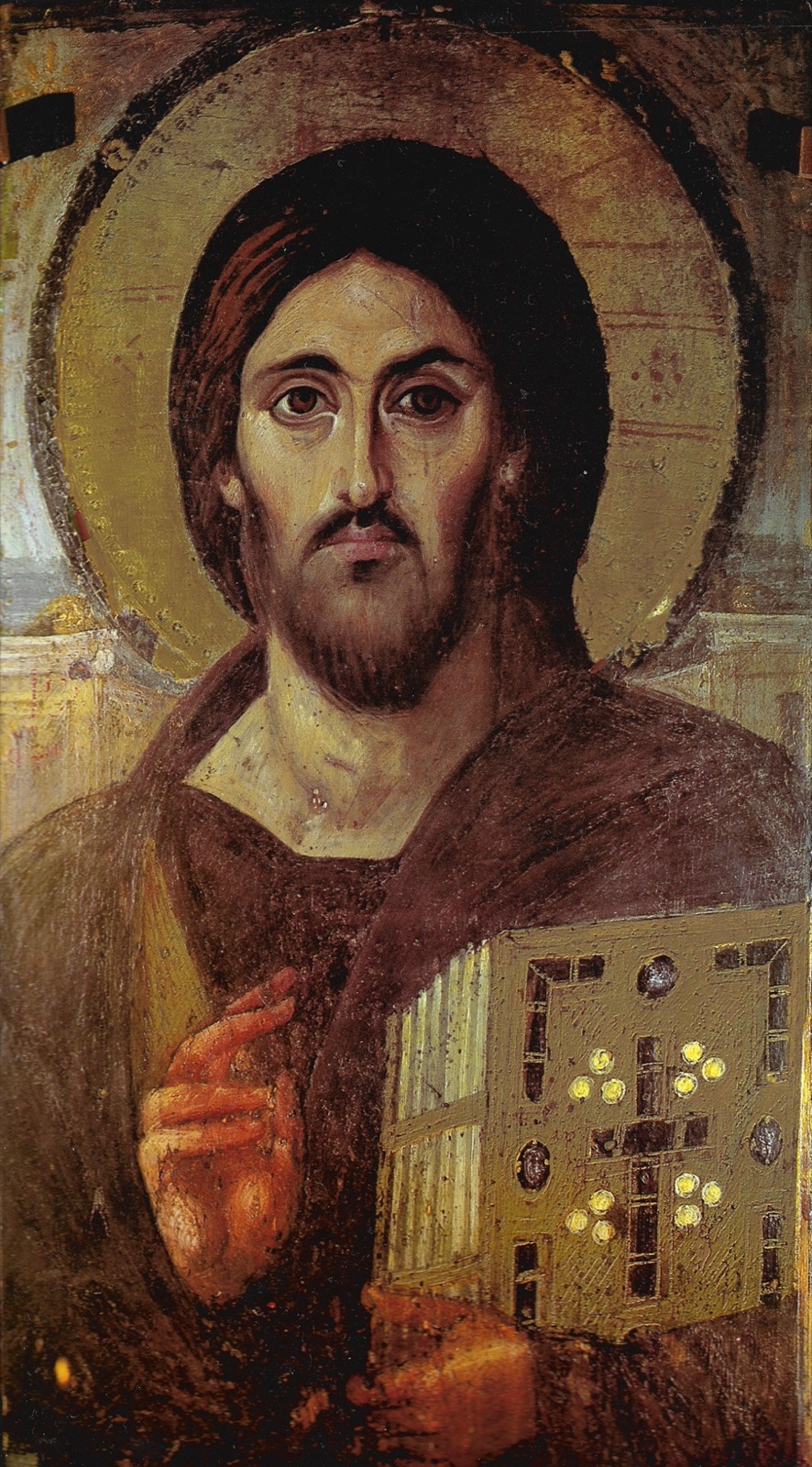 Source: Christ Pantocrator, sixth-century encaustic icon at St. Catherine’s Monastery, Wikimedia Commons, public domain, https://commons.wikimedia.org/wiki/File:CHRIST_PANTOCRATOR-SINAI(6th_Century).jpg
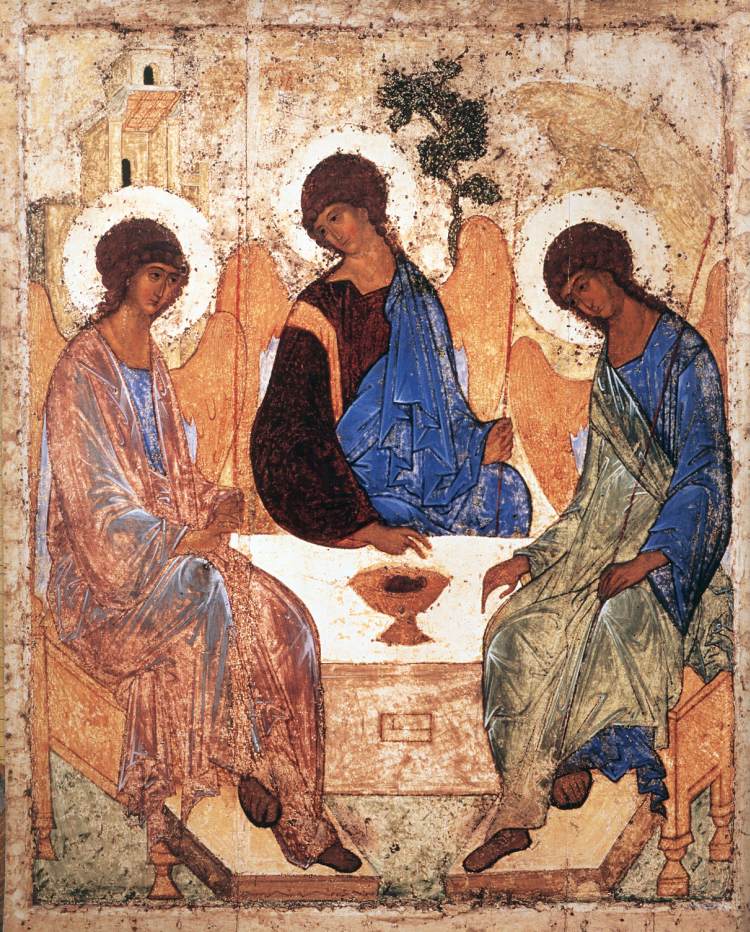 Source: Andrei Rublev, The Holy Trinity, Wikimedia Commons, public domain, https://commons.wikimedia.org/wiki/File:Andrej_Rubl%C3%ABv_-_Holy_Trinity_-_WGA20456.jpg
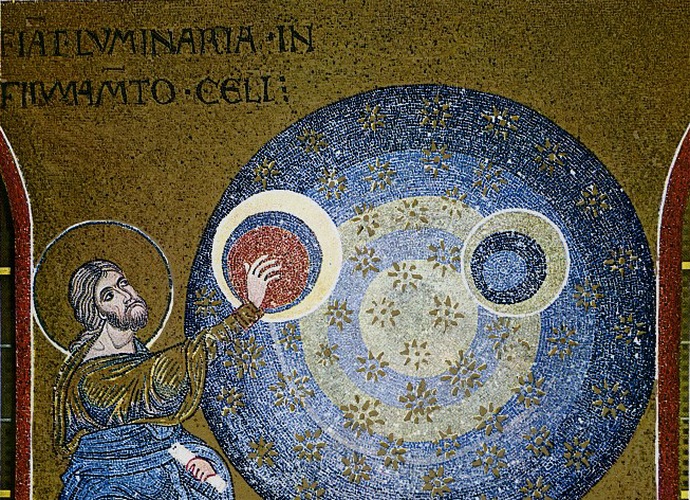 Source: Monreale Cathedral mosaic, Creation of the Sun and Moon, Wikimedia Commons, public domain, https://commons.wikimedia.org/wiki/File:Mosaici_Monreale,_creazione_del_Sole_e_della_Luna.png
Spiritual Fruit 🍇
- Begin with thanksgiving rather than possession. Before using a created thing today, notice that God calls it good before it becomes useful to you. Receive a meal or a patch of living earth as gift, then care for it accordingly.
- Honor the image where it costs you something. Verse 27 includes male and female in the same divine gift. In the next encounter with someone dependent, overlooked, or difficult, refuse to measure their dignity by productivity or agreement with you.
- Rule as a guest under God. The creatures receive blessing in verse 22 before humanity receives dominion in verse 28. Make one concrete choice that protects rather than exhausts what was entrusted to you.
- Keep the lights in their place. The sun and moon mark time but do not govern destiny. Notice what claims ultimate power over your schedule or fear; bring that fear into prayer before Christ, through whom all things were made.
Teaching Notes
Creation begins with God speaking (Genesis 1:1-5)
- Ask: What does Genesis teach first about God before it teaches anything about the mechanics of the world?
- Emphasize: God creates freely by His Word, gives order without rivalry, and calls the material world good.
- Watch for: Do not let the lesson collapse into a modern science debate or into contempt for the body and matter.
- Connect: John 1, Colossians 1, and Hebrews 1 let the Church read creation through Christ the Logos without flattening Genesis into a later proof-text.
- Show: Use the Monreale creation mosaic to help students see ordered creation as a summons to praise, not as a substitute for reading the text.
God orders a world fit for life (Genesis 1:6-13)
- Ask: What do God’s separating and naming make possible for the earth?
- Emphasize: The ordered world is received before it is cultivated; goodness is God’s verdict, not ours.
- Watch for: Do not make the firmament into a modern scientific diagram.
Light and the heavenly bodies serve the Creator’s purposes (Genesis 1:14-19)
- Ask: Why does the narrative introduce the sun and moon after light?
- Emphasize: The lights serve time and life; they are creatures, not rivals to God.
- Connect: The Church orders days and seasons for worship, not fatalism.
Life fills the world under blessing (Genesis 1:20-25)
- Ask: Who receives the command to multiply before humanity does?
- Emphasize: Creatures are blessed before they have human utility.
- Watch for: Avoid treating stewardship as a right to exhaust living things.
Humanity is made in the image and likeness of God (Genesis 1:26-27)
- Ask: How does being made in the image and likeness of God change the way we see every human person?
- Emphasize: Dominion is received under blessing and must resemble God’s life-giving care.
- Watch for: Avoid language that makes rule sound like exploitation or that ties dignity to usefulness, gender, strength, or achievement.
- Connect: The image wounded by sin is restored in Christ, the true Image of the invisible God.
- Show: Use the Sinai Pantocrator icon when teaching Christ as Creator and Restorer; keep Rublev’s Trinity as a contemplative aid for divine communion, not as a direct illustration of Genesis 1.
Dominion is royal-priestly stewardship (Genesis 1:28-31)
- Ask: What would dominion look like if it resembled the God who blesses and feeds?
- Emphasize: The mandate follows a blessing; it is accountable to the Creator’s “very good.”
- Watch for: Neither exploitation nor contempt for human work follows from this text.
Sources
Scripture and apostolic witnesses
Embedded Scripture is from Brenton’s English Septuagint (LXX).
- Public-domain Brenton edition: https://archive.org/details/septuagintversio00bren
- John 1:1-5, 9-14; Colossians 1:15-17; Hebrews 1:1-3; Romans 8:18-23.
Patristic and Orthodox sources
- St. Basil the Great, Hexaemeron, especially Homily I on Genesis 1:1: https://www.newadvent.org/fathers/32011.htm
- St. Athanasius, On the Incarnation, chapter 3 for creation through the Word and chapter 4 for restoration from corruption: https://www.ccel.org/ccel/schaff/npnf204.vii.ii.iii.html and https://www.ccel.org/ccel/schaff/npnf204.vii.ii.iv.html
- St. Athanasius, Councils of Ariminum and Seleucia, for the anti-Arian reception of Genesis 1:26: https://www.ccel.org/ccel/schaff/npnf204.xxii.ii.ii.html#xxii.ii.ii-p149
- St. Irenaeus, Against Heresies 4.20.7, for the dignity of humanity and growth toward likeness: https://www.ccel.org/ccel/schaff/anf01.ix.vi.xxi.html#ix.vi.xxi-p29
- St. Ephrem the Syrian, Commentary on Genesis, for contemplative and symbolic reading of creation: https://archive.org/details/selectedprosewor0000ephr
Secondary academic sources
- Gordon J. Wenham, Genesis 1-15.
- Victor P. Hamilton, The Book of Genesis: Chapters 1-17.
- Kenneth A. Mathews, Genesis 1-11:26.
- Claus Westermann, Genesis 1-11.
Coptic Orthodox / pastoral sources
- The Orthodox Study Bible, notes on Genesis 1, John 1, and Colossians 1.
- Fr. Tadros Yacoub Malaty, commentary on Genesis.
- Pope Shenouda III on human dignity, thanksgiving, and life with God.
- Fr. Bishoy Kamel on Eucharistic thanksgiving, holiness, and responsible life in God’s world.
Visual sources
Christ Pantocrator, sixth-century encaustic icon at St. Catherine’s Monastery, Wikimedia Commons, public domain: https://commons.wikimedia.org/wiki/File:CHRIST_PANTOCRATOR-SINAI(6th_Century).jpg
Andrei Rublev, The Holy Trinity, Wikimedia Commons, public domain: https://commons.wikimedia.org/wiki/File:Andrej_Rubl%C3%ABv_-_Holy_Trinity_-_WGA20456.jpg
Monreale Cathedral mosaic, Creation of the Sun and Moon, Wikimedia Commons, public domain: https://commons.wikimedia.org/wiki/File:Mosaici_Monreale,_creazione_del_Sole_e_della_Luna.png
Footnotes
-
St. Basil the Great, Hexaemeron, Homily I on Genesis 1:1, https://www.newadvent.org/fathers/32011.htm. ↩ ↩2
-
St. Athanasius, On the Incarnation, chapter 3, https://www.ccel.org/ccel/schaff/npnf204.vii.ii.iii.html. ↩
-
St. Irenaeus, Against Heresies 4.20.7, https://www.ccel.org/ccel/schaff/anf01.ix.vi.xxi.html#ix.vi.xxi-p29. ↩