
The Undivided Heart
Pure in heart
“Blessed are the pure in heart, For they shall see God.” Matthew 5:8
Main burden
Purity of heart is not a spotless religious image or a life without temptation. It is the healing of the divided self: when what we show, what we desire, what we worship, and what we do in secret are gathered toward one love. Christ alone is perfectly pure in heart because His whole life is communion with the Father. He does not merely inspect our hidden motives; He cleanses and reunites the heart through repentance, Scripture, prayer, and the mysteries of His Church. The promise “they shall see God” does not mean comprehending God’s essence or earning a vision through moral achievement. It is the restoration of humanity’s vocation to know, behold, and participate in God’s life, now by grace and finally face to face.
Opening: the two versions of me
Most of us know how to keep two versions of ourselves running.
There is the version people can see: patient parent, attentive spouse, competent leader, faithful servant, prayerful Christian. Then there is the version hidden behind the face: irritated by the interruption, hungry for recognition, rehearsing the argument, comparing, resenting, fantasizing, checking whether anyone noticed the sacrifice.
The visible action may even be good. We serve. We give. We pray. We tell the truth. Yet beneath the action another desire quietly asks, How did I look? Who noticed? Did I win? What does this get me?
The problem is not only that we sometimes do bad things. The deeper problem is that even our good things can be divided. One part of us reaches toward God while another reaches for applause. One part wants the truth while another wants the other person humiliated. One part loves our family while another wants to control them. One part says, “Your will be done,” while another negotiates the terms.
Then Christ says:
“Blessed are the pure in heart, For they shall see God.”
He does not say, “Blessed are those who successfully look pure.” He moves past the face, past the reputation, and past the visible act to the heart.
The central question is:
Where does my outward obedience conceal a divided motive?
1. The heart is the hidden center
In modern speech, “the heart” often means emotion. In Scripture it is larger. The heart is the interior center of the person: desire, thought, attention, intention, memory, decision, and love. It is the place from which the visible life proceeds.
That is why Jesus does not contrast heart with mind. He asks for the whole person. A pure heart is not merely sincere emotion, and it is not intellectual correctness without love. It is the person becoming true before God.
James names the opposite condition:
“Draw near to God and He will draw near to you. Cleanse your hands, you sinners; and purify your hearts, you double-minded.” James 4:8
The word “double-minded” exposes the disease. We want God and the protection of our favorite sin. We want communion and control. We want to forgive and to preserve the right to reopen the case. We want to serve and to be admired for serving. We want holiness, but not if holiness costs the secret arrangement by which we comfort ourselves.
Purity is therefore not first the absence of dirt. It is the end of doubleness. It is simplicity in the deepest sense: one heart before one God.
This does not mean a pure person never feels conflict or temptation. Christ was tempted without sin. A thought can arrive without our consent. Fear can rise before faith answers. Anger can flare before we decide what to do with it. Purity is not emotional flatness or instant perfection. It is the growing refusal to make peace with a second master.
A divided heart asks, “How much of myself must God have?” A pure heart begins to say, “There is no room in me that is not Yours.”
2. Gregory’s ascent: mercy turns inward toward the motive
Saint Gregory of Nyssa treats the Beatitudes as an ascent toward communion with God. The ascent is not self-salvation. Christ gives what He commands, and every step depends on grace. Yet each Beatitude exposes and heals a deeper layer of the person.
Poverty of spirit opened our empty hands. Mourning taught us to tell the truth about sin and suffering. Meekness surrendered the need to dominate. Hunger and thirst redirected desire toward righteousness. Mercy made God’s compassion visible toward the wounded neighbor.
Now Christ asks what is happening inside those acts of mercy.
I can give and still want to be seen. I can forgive and still enjoy being morally above the offender. I can correct injustice and still be secretly fed by anger. I can serve a ministry and slowly make the ministry a stage for my identity. Mercy must be purified from possession, superiority, and performance.
This is why purity follows mercy so naturally. The ascent moves from what I do for another person to what I am seeking while I do it. Christ is not dismissing the outward act. He is rescuing it from the divided heart.
Gregory begins his sixth oration almost dizzy before the promise. God is incomprehensible, yet Christ promises that the pure will see Him. Gregory refuses two errors. We may not imagine that a creature can grasp the divine essence. But neither may we empty the promise until it means nothing. The purified person truly knows and participates in God according to the capacity given by grace.1
The ascent has reached a breathtaking point. Mercy made us resemble the merciful God in action. Purity clears the interior eye to recognize the One whose likeness mercy was already forming in us.
3. Purity is broader than sexual chastity
Sexual purity matters. Christ speaks directly about lust, adultery, and the heart in the Sermon on the Mount. The body is not disposable, desire is not sovereign, and another human being must never be reduced to material for our imagination. Pornography, secret messages, emotional infidelity, fantasy cultivated for pleasure, and the use of another person’s body all divide the heart.
But if purity of heart is reduced to sexuality, many people will congratulate themselves too quickly, and others will hear only shame.
Saint John Chrysostom says the pure in heart may be understood as those who pursue the whole life of virtue or those who live in temperance. He does not make purity small. The heart is unclean wherever sin is welcomed within, even when the exterior remains respectable.2
Purity includes:
- sexual chastity, because love refuses to consume another person;
- truthfulness, because the pure heart does not need two stories;
- integrity, because the private and public selves are being reconciled;
- simplicity of intention, because service is offered to God rather than performed for an audience;
- freedom from manipulation, because love does not hide a hook inside a gift;
- clean use of power, because leadership seeks another’s good rather than personal control;
- purity of speech, because gossip and suggestive speech train the heart to enjoy what it claims to reject;
- purity of attention, because whatever repeatedly occupies the eyes and imagination slowly forms desire;
- freedom from contempt, because a person can be technically correct while inwardly delighted by another’s disgrace.
A sexually disciplined person can still have an unclean heart if money, praise, resentment, or control is the hidden master. A person struggling with sexual temptation can still be walking honestly toward purity if the struggle is brought into light, refused consent, and met with repentance rather than secrecy and surrender.
Temptation is not identity. Struggle is not hypocrisy. Hypocrisy begins when the image is protected more carefully than the soul.
4. The clean outside and the hidden tomb
Jesus’ strongest warnings about impurity are directed not only toward visibly disordered people, but toward religious people whose exterior conceals another life.
“Woe to you, scribes and Pharisees, hypocrites! For you cleanse the outside of the cup and dish, but inside they are full of extortion and self-indulgence.” Matthew 23:25
The outside is not irrelevant. Christ does not say that behavior does not matter. He says, “First cleanse the inside of the cup and dish, that the outside of them may be clean also” (Matthew 23:26). The goal is not to replace outward obedience with inward feelings. The goal is wholeness: the inside and outside becoming one truth.
Religious performance is dangerous because it uses holy things to hide from God.
A person can pray in order to avoid repentance. We repeat words while refusing the one apology the prayer is asking of us. We can serve in order to avoid being known. Everyone sees usefulness; no one sees loneliness, anger, addiction, or exhaustion. We can defend doctrine in order to avoid humility. We can expose another person’s error because indignation feels cleaner than grief.
In Matthew 6, immediately after the Beatitudes, Christ names the audience problem:
“Take heed that you do not do your charitable deeds before men, to be seen by them.” Matthew 6:1
He speaks similarly about prayer. The hypocrites love visible prayer “that they may be seen by men.” Christ sends the disciple into the secret place, “and your Father who sees in secret” receives the prayer.
The issue is not that all public prayer or visible service is wrong. The Lord Himself prays before others, teaches publicly, and commands visible good works that glorify the Father. The issue is the interior audience. Whose gaze has become the reward?
The pure heart can do something visible while standing inwardly before God alone. The divided heart can enter a locked room and still perform for an imaginary crowd.
5. Luke’s anti-ladder: the hunger to be well spoken of
Luke does not give a neat one-to-one woe opposite every Beatitude in Matthew. For purity of heart, however, one woe is an especially sharp counterpoint:
“Woe to you when all men speak well of you, For so did their fathers to the false prophets.” Luke 6:26
Being respected is not a sin. A good reputation can be the fruit of faithfulness, and Scripture values a good name. The danger is needing approval so deeply that it becomes the second god hidden inside every good action.
This is the anti-ladder. Instead of ascending from empty hands toward the vision of God, we build a polished self for the vision of other people. We ask not, “Is this true?” but, “How will this land?” Not, “Is this faithful?” but, “Will they still like me?” Not, “Does this serve?” but, “Will my contribution be recognized?”
The desire to be well spoken of can corrupt opposite personalities. The loud person performs competence, certainty, or spiritual authority. The quiet person performs humility, harmlessness, or being above conflict. One controls the room through presence; the other through withdrawal. Both may be watching themselves through other people’s eyes.
Social media makes the temptation measurable, but it did not create it. We can count likes, views, and comments, yet the same hunger lives in church halls, family gatherings, meetings, and private conversations. It appears when we tell a story so our sacrifice is accidentally discovered, when we ask a question that advertises what we know, or when disappointment grows because no one thanked us.
The pure heart is not indifferent to people. It is free enough to love them without needing them to function as mirrors.
6. The image beneath the rust
The Old Testament foundation of Gregory’s teaching is the creation of humanity in God’s image:
“Then God said, ‘Let Us make man in Our image, according to Our likeness.’” Genesis 1:26
Sin wounds and obscures that likeness, but it does not turn a human being into rubbish. Gregory pictures the heart like iron covered in rust. When the rust is scraped away, the iron that looked black begins to catch the sun and give off light. He also compares the purified heart to a mirror in which the sun is seen by reflection.
His point is not that the human soul becomes God by nature, or that we discover divinity by looking inward without Christ. God alone is God by nature. His essence remains beyond creaturely comprehension. His image in us is gift. Its restoration is grace.
But the image is real. Gregory writes that if the grime plastered over the heart is washed away through a diligent life, “the godlike beauty will shine forth for you.”3 Purification does not manufacture an alien identity. It removes what distorts the humanity God created.
This changes how repentance feels. Repentance is not God smashing the person until nothing remains. It is the Physician removing the disease so the person can become truly himself. Confession does not destroy identity. It separates identity from the lie that has attached itself to it.
A mirror does not create the sun. It must be turned toward the light and cleared of what prevents reflection. In the same way, purity is not self-generated brightness. It is a life turned toward Christ and made capable, by grace, of reflecting Him.
Paul describes this transformation:
“But we all, with unveiled face, beholding as in a mirror the glory of the Lord, are being transformed into the same image from glory to glory, just as by the Spirit of the Lord.” 2 Corinthians 3:18
We behold and are changed. We are changed and learn to behold. The promise and the purification grow together.
7. What does it mean to “see God”?
This promise needs reverence and precision.
Christ does not promise that the purified mind will comprehend God’s essence. God is not an object inside the universe that clearer thinking can master. Gregory carefully holds together the biblical statements that no one has seen or can see God in His incomprehensible nature with Christ’s promise that the pure will see God.
God is truly known in His self-revelation, His works, His grace, and His life shared with His creatures. Orthodox theology speaks of participation in God’s uncreated energies while His essence remains beyond comprehension. This is not a way of reducing the promise. It protects both truths: God remains truly God, and communion with Him is truly real.
Gregory makes the promise more intimate than collecting correct information. The blessedness is “not to know something about God, but to have God in oneself.”4 To see is to participate, to know by communion, to become capable of recognizing divine light because the heart is being made light-bearing.
The promise has a present beginning and a future fullness.
Now, the pure heart recognizes God’s action where the divided heart sees only interruption, threat, competition, or chance. It sees Christ in the vulnerable without using them. It sees the mercy hidden inside correction. It sees the altar not as religious routine but as the table of the Kingdom. It sees another person not as a tool, obstacle, or audience, but as an image of God.
Yet the promise is not exhausted now. Saint John writes:
“We know that when He is revealed, we shall be like Him, for we shall see Him as He is. And everyone who has this hope in Him purifies himself, just as He is pure.” 1 John 3:2–3
The future vision already purifies the present life. We become what we are preparing to behold.
8. Christ is the pure heart and the face of the Father
If this Beatitude becomes only an inspection of motives, it will make us anxious and self-absorbed. Every act has mixed motives. If we wait until our interior life is flawless before approaching God, we will never move.
The Beatitude is first fulfilled in Christ.
His heart is undivided. He does not perform for the crowd. He refuses the devil’s offer of spectacle in the wilderness. He withdraws when people want to make Him king on their terms. He speaks truth when it loses Him followers. He receives praise without becoming dependent on it and condemnation without becoming controlled by it.
His one desire is communion with and obedience to the Father. Even in Gethsemane, where His human will truly recoils from death, He does not divide Himself from the Father: “Nevertheless, not as I will, but as You will.” This is not emotional numbness. It is human freedom healed and offered in love.
And the God whom the pure will see is revealed in Him. Philip says, “Lord, show us the Father.” Jesus answers:
“He who has seen Me has seen the Father.” John 14:9
We do not purify ourselves toward an unknown spiritual brightness. We turn toward the face of Jesus Christ. In His compassion, holiness, truth, Cross, and Resurrection, the Father is made known.
Christ does not wait for us to purify ourselves before coming near. He gives Himself “that He might sanctify and cleanse” His Church (Ephesians 5:26). He enters the divided heart, exposes without humiliating, forgives without flattering, and begins to unite what sin scattered.
The command is real, but the grace comes first and remains active. Purity is cooperation with the One who alone can create a clean heart.
9. “Create in me”: the heart God reveals and renews
David does not say, “I will improve my heart.” After adultery, deception, and bloodshed, he prays:
“Create in me a clean heart, O God, And renew a steadfast spirit within me.” Psalm 51:10 (LXX Psalm 50)
The verb “create” returns us to Genesis. David needs more than reputation repair. He needs an act of God within him. Yet the prayer is not passive. The whole psalm tells the truth, takes responsibility, asks to be washed, and offers a broken and contrite heart.
“Create in me a clean heart” is better than a spiritual resolution built on self-confidence. A resolution says, “I will finally construct the right version of myself.” Repentance says, “Lord, expose what is divided, cleanse what I cannot heal alone, and make my life one offering.”
The appointed Gospel for September 20, 2026, gives this promise a direct Christological center. Jesus rejoices in the Holy Spirit and says that the Father has revealed His mysteries to babes rather than to the wise and prudent. Then He declares that no one knows who the Father is except the Son “and the one to whom the Son wills to reveal Him” (Luke 10:21–22). We do not force our way into the vision of God by cleverness or spiritual technique. The Son reveals the Father to the humble and receptive heart.
The lawyer then asks what he must do to inherit eternal life. Christ directs him to the undivided command: love God with all the heart, soul, strength, and mind, and love the neighbor as oneself (Luke 10:25–28). This is the opposite of double-mindedness. Purity of heart is not sterile inward inspection. It is the whole person gathered into love of God and neighbor.
The appointed Catholic Epistle, James 2:5–13, carries forward the previous lesson’s warning that “mercy triumphs over judgment.” That continuity is fitting. Mercy must be purified of partiality, performance, and superiority; purity must become merciful action. The lectionary therefore joins the two sessions rather than supplying a separate proof text for purity.
10. How the Church heals the divided heart
The Church does not purify us through image management. She brings us repeatedly into truth and communion.
Confession: one story before God
In confession, we stop maintaining two versions. We name what happened, what we chose, what we desired, and what we hid. A good confession does not curate an impression for the priest. It lets the wound be seen so Christ can heal it.
Do not wait for a pure motive before confessing an impure motive. Bring the mixture itself: “I served, but I wanted praise. I corrected, but I enjoyed the power. I forgave outwardly, but I kept collecting inwardly.” That honesty is already a movement toward singleness.
The Eucharist: one Lord, one hunger
At the altar, scattered people become one Body by receiving the one Christ. We do not receive separate Christs fitted to our private projects. The Eucharist confronts the divided heart because communion cannot remain merely vertical. We receive the Lord whose Body includes the person we envy, avoid, or use.
The Agpeya: returning attention
Matthew 5:1–16 is the Gospel of the Sixth Hour. At midday the Church interrupts competing loyalties and turns the heart toward the Crucified Christ. Attention wanders; the prayer returns it. This repeated return is not failure. It is training in purity.
Fasting: discovering the hidden master
Fasting reveals how quickly desire becomes command. The irritation, bargaining, and self-justification that appear when a comfort is limited expose the heart’s loyalties. The goal is not to become proud of restraint. It is to make room for one hunger.
Scripture: remaining under the word’s gaze
Read Scripture not only to collect meaning, but to remain under its gaze. The divided heart uses the Bible to inspect other people; the heart being purified lets the word expose its own hidden loyalties. Ask, “What does this reveal about the person I am becoming? What act of obedience keeps this word from remaining only an idea?”
Watchfulness: noticing the second motive
Watchfulness means attending to thoughts before they become agreements. When a second motive appears, do not panic and do not feed it. Name it, offer it to Christ, and return to the good action for the right reason.
Purification is often this quiet return, repeated hundreds of times.
A practice for this week: one act with no audience
For seven days, begin with David’s prayer:
“Create in me a clean heart, O God, And renew a steadfast spirit within me.”
Then practice three movements.
-
Ask the second question.
Before one significant action, ask not only, “Is this good?” but, “What am I seeking through it?” Do not overanalyze every minor choice. Look for the obvious second master: approval, control, revenge, comfort, or appearance. -
Do one good act in secret.
Give, encourage, clean, pray, serve, or repair something without arranging to be discovered. If it is discovered naturally, receive that without drama. The aim is not secrecy as another performance. It is freedom from the audience. -
Remove one source of interior pollution.
Choose one recurring input that divides attention or trains desire badly: an account you follow, a private conversation, suggestive media, grievance-driven content, gossip, or a fantasy you deliberately revisit. Remove access for one week and replace it with five quiet minutes before Christ.
At night, ask:
- Where was I one person today, the same before God and people?
- Where did I manage an image?
- What did I want someone else’s eyes to give me?
- What did I see differently when I sought God’s gaze first?
If a serious hidden pattern is controlling your life, do not make a private seven-day project your only response. Bring it to confession and seek appropriate pastoral or professional help. Light is not punishment. It is where healing begins.
Personal contemplation
Imagine a mirror darkened by years of smoke and rust.
The darkness is real, but it is not the mirror’s deepest truth. Beneath what has accumulated, the surface was made to receive light.
Now hear David pray, “Create in me a clean heart.”
Do not begin by inspecting everyone else’s impurity. Let the room become quiet. What second loyalty has been living beside your love for God? Whose approval? Which appetite? What resentment? Which hidden arrangement?
Bring it into the light without defending it and without calling yourself worthless.
Now look toward Christ on the mountain. The light is not produced by the disciples. It comes from Him. Peter, James, and John do not control the vision; they fall before it. The One they behold will descend the mountain and walk toward the Cross.
Ask Him:
Lord, what in me cannot yet look steadily toward You?
What would an undivided yes look like this week?
[Pause for 15–20 seconds.]
Conclusion
“Blessed are the pure in heart” is not praise for people who have hidden their mess successfully.
It is a promise to people who are letting Christ make them whole.
The pure heart is not merely sexually restrained, though chastity belongs to it. It is truthful without a second story, merciful without superiority, prayerful without performance, strong without domination, and obedient without bargaining for applause.
Purity does not mean never being tempted. It means refusing to build a home for the temptation. It does not mean every motive is already flawless. It means bringing the mixture into the light and asking Christ to unite the heart around one love.
The world says, “Be seen.” Christ says, “Your Father sees in secret.”
The world says, “Protect the image.” Christ says, “Clean the inside.”
The world says, “Build yourself.” David prays, “Create in me.”
And Christ promises more than improved behavior. He promises God.
The heart made for His image will behold its Archetype. The mirror turned toward Him will receive His light. The person who stops living before a thousand competing eyes will discover the one gaze that does not flatter, exploit, or abandon.
We will see Him because He first came where we could see Him: in the face of Jesus Christ. We will be like Him because His Spirit is already transforming us from glory to glory.
Closing prayer
Lord Jesus Christ, pure and undivided in Your love for the Father, have mercy on our scattered hearts. We confess the distance between the person others see and the life You see in secret. Cleanse us from lust, deceit, vainglory, resentment, manipulation, and every hidden loyalty that competes with You. Do not let us protect an image while the heart remains unhealed. Create in us a clean heart and renew a steadfast spirit within us. Through Your word, Your Cross, confession, and Your life-giving mysteries, restore in us the image You formed at the beginning. Turn the eyes of our souls toward Your light, and make us one in desire, word, and deed, until we behold You in the Kingdom and are transformed into Your likeness by grace. Amen.
Teaching Guide
30-minute teaching plan
Time Section Aim 0:00–3:00 The two versions of me Let the room recognize division without reducing purity to scandal. 3:00–6:00 The heart and double-mindedness Define the biblical heart and purity as the end of competing masters. 6:00–10:00 Gregory’s ascent Connect mercy to motive and place purity clearly on the series ladder. 10:00–14:00 Purity beyond sexuality Include chastity while broadening the Beatitude to integrity, speech, power, and attention. 14:00–18:00 Outside, inside, and Luke’s woe Expose religious performance and approval as the anti-ladder. 18:00–22:00 Image, mirror, and vision of God Teach Gregory’s restoration of the image and the essence/participation guardrail. 22:00–25:00 Christ the pure heart Keep the lesson Christological rather than introspective self-repair. 25:00–28:00 The day’s Gospel and the Church’s medicine Connect Psalm 51, Luke 10, James 2, confession, Eucharist, prayer, and fasting. 28:00–30:00 Weekly practice, contemplation, prayer Leave the room facing Christ’s light, not its own impurity.
- Ask: Invite recognition of divided motives without asking anyone to disclose sexual history, addiction, or private trauma publicly.
- Emphasize: Purity is wholeness under one Lord. It includes chastity but cannot be reduced to it.
- Watch for: Do not imply that temptation itself is impurity, that mental illness is spiritual uncleanness, or that humans can comprehend God’s essence.
- Connect: Keep Gregory’s ladder and Luke’s anti-ladder explicit: mercy is purified of self-display, while the need to be well spoken of divides the heart.
- Show: Display the Sinai Transfiguration icon when teaching the vision of God and during contemplation. Explain that Christ is the source of light; the disciples receive according to their capacity.
Ask
- Where is the gap widest between the person others see and the person you are before God?
- How can a genuinely good act become divided by the need for recognition, control, or superiority?
- What is the difference between experiencing temptation and making peace with a hidden loyalty?
- Why does Christ connect purity of heart with seeing God rather than merely with avoiding punishment?
- What one practice would help you become the same person in public, in private, and in prayer?
Emphasize
- In Scripture, the heart is the center of thought, desire, attention, intention, and decision, not merely emotion.
- James names the opposite of purity as double-mindedness. Purity gathers the self under one Lord.
- Gregory’s ascent moves from merciful action to the motive within it. Mercy itself must be cleansed of performance and superiority.
- Sexual chastity is essential but not exhaustive. Money, praise, resentment, control, speech, and attention also divide and pollute the heart.
- The clean heart is created and healed by God with our real cooperation. Grace does not erase ascetic struggle, and struggle does not manufacture grace.
- Seeing God means true communion and participation, not comprehension of the divine essence.
- Christ is both the perfectly pure heart and the visible revelation of the Father.
Watch for
- Do not identify intrusive thoughts, unwanted temptation, trauma responses, depression, anxiety, or other mental-health symptoms as proof of an impure heart.
- Do not turn the lesson into sexual shame. Speak clearly about chastity while preserving hope, privacy, and the path of confession and healing.
- Do not tell people to expose serious private struggles to the group. Direct them toward confession and appropriate professional care.
- Do not treat external conduct as irrelevant. Christ cleanses the inside so the outside becomes truly clean.
- Do not teach “seeing God” as ocular sight or comprehension of God’s essence. Preserve Gregory’s distinction between what is incomprehensible and real participation in God.
- Do not call the Transfiguration light a product of the disciples’ purity. The light belongs to Christ; purified sight receives what grace reveals.
- Do not claim Matthew 5:8 is the appointed Sunday Gospel. It is part of the confirmed Sixth Hour Gospel, Matthew 5:1–16. The appointed liturgy Gospel for September 20, 2026, is Luke 10:21–28.
Connect
- Connect mercy to purity: after crossing the road toward the wounded neighbor, ask whether love or self-display governs the act.
- Connect the prior Beatitudes: empty hands, truthful mourning, surrendered strength, holy hunger, and mercy prepare the heart to be gathered toward God.
- Connect Luke 6:26 to Matthew 6:1–6: the need to be seen and well spoken of becomes an interior audience competing with the Father who sees in secret.
- Connect Genesis 1 to Gregory’s mirror: purification restores the image; it does not invent human worth.
- Connect Psalm 51 to grace and cooperation: David asks God to create what repentance cannot manufacture, while bringing the truth into the light.
- Connect Luke 10:21–28 to the day’s Gospel: the Son reveals the Father to the humble, and the whole heart is gathered into love of God and neighbor.
- Connect James 2:5–13 to the previous session: mercy must be purified of partiality and superiority, while purity must remain merciful.
- Connect John 14:9 to the promise: God is seen in the incarnate Son, and the heart is purified by communion with Him.
- Connect 1 John 3:2–3 to the future: the hope of seeing Christ begins transforming the present life.
Show
Use the twelfth-century Transfiguration icon from Saint Catherine’s Monastery while explaining “they shall see God.” Christ stands as the luminous center, with Moses and Elijah beside Him and Peter, James, and John below. The disciples do not generate or control the revelation. They receive it, and their bodily responses show that divine glory is gift before it is achievement. Keep the icon visible during the contemplation. Ask the room to notice where every line of attention leads, then say slowly: Purity is not staring harder at ourselves. It is becoming able to look toward Christ with an undivided heart.
Iconography connection
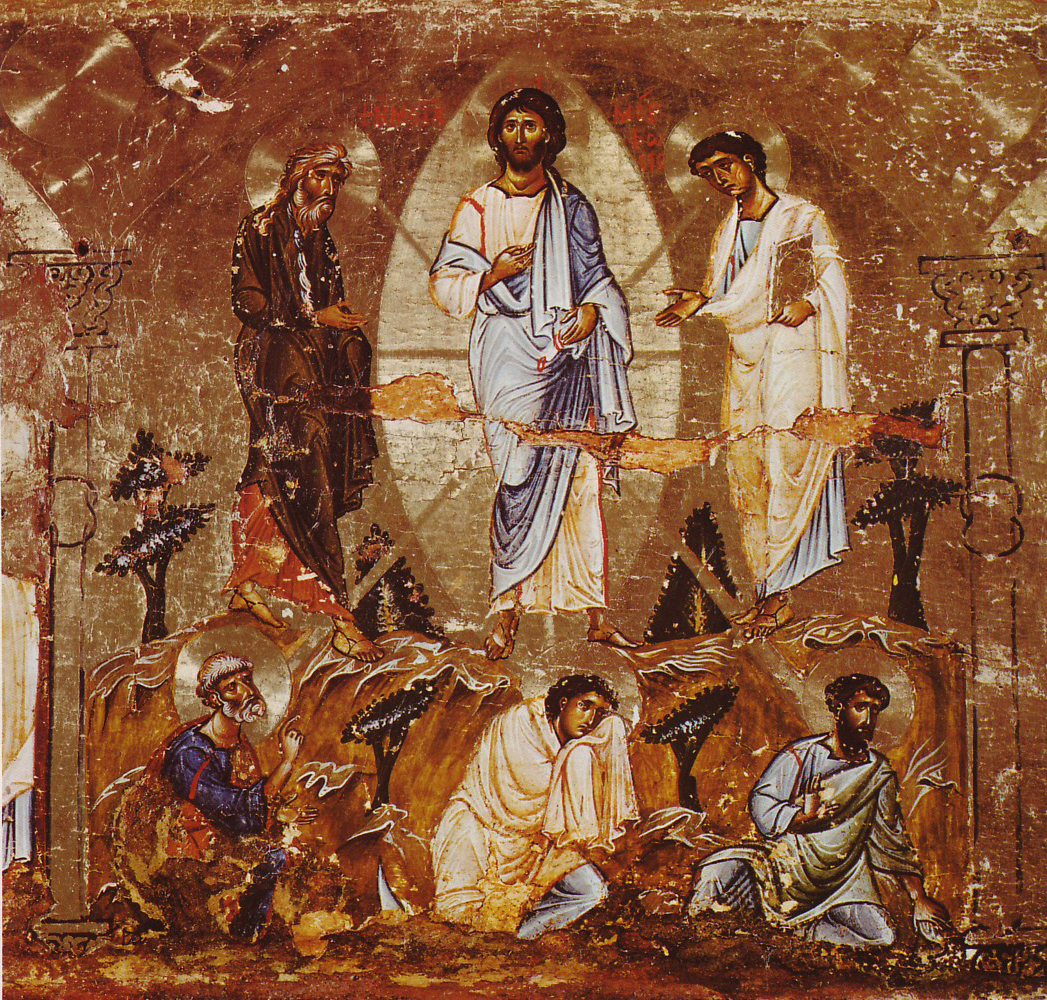
Source: The Transfiguration of Christ, mid-twelfth century, Saint Catherine’s Monastery, Sinai, public domain / Wikimedia Commons
The Transfiguration is not an illustration of Matthew 5:8 in a narrow sense, but it is the strongest iconographic companion to its promise. Christ is the source and center of light. Moses and Elijah stand in relation to Him, and the disciples below receive a revelation they did not manufacture. The icon therefore protects the lesson from turning purity into a technique for producing spiritual experiences.
The disciples see truly, but not comprehensively. They behold the glory Christ reveals according to their capacity, and even that gift brings them low. This corresponds to Gregory’s careful distinction: God remains incomprehensible in His essence, yet communion and vision are real because God genuinely gives Himself to be known.
The icon also corrects excessive introspection. The goal of cleansing a mirror is not to admire the mirror. It is to reflect light. Purity of heart does not end in fascination with our own interior condition. It turns the whole person toward Christ, then follows Him down the mountain toward the Cross, the neighbor, and ordinary faithfulness.
Glossary
- Beatitude: Christ’s declaration of who is blessed under God’s reign and what promise belongs to that life.
- Heart / kardia: In biblical usage, the interior center of thought, desire, intention, attention, decision, and love.
- Pure in heart / katharoi tē kardia: The actual Greek phrase in Matthew 5:8. It describes cleanness of the interior person; later terms such as katharsis, nous, and theoria may illuminate Orthodox reception but are not literal translations of the verse.
- Double-mindedness: A divided interior allegiance that tries to hold God together with a competing master.
- Vainglory: The passion that seeks human notice, praise, or reputation as the reward for virtue.
- Watchfulness: Attentive guarding of thoughts and desires so temptation is recognized before it becomes consent and habit.
- Theosis: Participation by grace in the life of God. It never means becoming God by essence.
- Divine essence and energies: God’s essence is incomprehensible and incommunicable; His uncreated energies are truly God as He acts, reveals Himself, and shares His life with creation.
Sources
Primary sources
- Scripture: Matthew 5:8; Matthew 6:1–6; Matthew 23:25–28; Luke 6:26; Luke 10:21–28; John 14:8–9; 1 John 3:2–3; James 2:5–13; James 4:8; 2 Corinthians 3:18; Genesis 1:26–27; Psalm 51:10 (LXX Psalm 50). Scripture is from NKJV.
- Saint Gregory of Nyssa, Oration 6 on the Beatitudes, on the incomprehensibility of the divine essence, true participation in God, and the purified heart as the restored image and mirror of divine light. Online-direct synchronized text: beginning of Oration 6, vision and participation, and image and mirror.
- Saint John Chrysostom, Homilies on Matthew, Homily XV, §6, on purity as whole virtue and temperance and on the spiritual promise of seeing God. New Advent; CCEL passage anchor.
- Saint John Chrysostom, Homilies on the Gospel of John, Homily XV on John 1:18, on the intellectual vision permitted to creatures while God’s essence remains beyond creaturely comprehension. CCEL deep link.
Secondary academic sources
- Hubertus R. Drobner and Albert Viciano, eds., Gregory of Nyssa: Homilies on the Beatitudes: An English Version with Commentary and Supporting Studies, Supplements to Vigiliae Christianae 52 (Brill, 2000).
- Michael Glerup, trans., Gregory of Nyssa: Sermons on the Beatitudes, Popular Patristics Series 52 (St Vladimir’s Seminary Press, 2012).
- Mark Allan Powell, “Matthew’s Beatitudes: Reversals and Rewards of the Kingdom,” The Catholic Biblical Quarterly 58, no. 3 (1996): 460–479. JSTOR.
- Jonathan T. Pennington, The Sermon on the Mount and Human Flourishing: A Theological Commentary (Baker Academic, 2017).
Coptic Orthodox and pastoral sources
- Coptic Agpeya, Sixth Hour Gospel: Matthew 5:1–16, confirmed in the local Coptic lectionary reference.
- Coptic lectionary for September 20, 2026, the second Sunday of Tout: Catholic Epistle James 2:5–13 and liturgy Gospel Luke 10:21–28. The lesson uses both as thematic liturgical connections and does not claim Matthew 5:8 as the appointed Sunday Gospel.
Iconography and image sources
The Transfiguration of Christ, mid-twelfth century, part of an iconostasis in Constantinopolitan style, Saint Catherine’s Monastery, Sinai. Wikimedia Commons, public-domain work and faithful reproduction.
Footnotes
-
Saint Gregory of Nyssa, Oration 6 on the Beatitudes, Catholic Library. Gregory distinguishes comprehension of God’s essence, which exceeds creatures, from true vision and participation granted to the purified heart. Online-direct mirror, not yet in the local corpus. ↩
-
Saint John Chrysostom, Homilies on Matthew, Homily XV, §6, trans. George Prevost and M. B. Riddle, New Advent §6 and CCEL passage anchor. Chrysostom’s treatment of Matthew 5:8 immediately follows his treatment of mercy in the same numbered section; he says the pure are those who pursue the whole of virtue or live in temperance and identifies the reward as spiritual. ↩
-
Saint Gregory of Nyssa, Oration 6 on the Beatitudes, Catholic Library. Gregory compares the heart to rusted iron that shines again when cleansed and to a mirror reflecting the sun. Online-direct mirror, not yet in the local corpus. ↩
-
Saint Gregory of Nyssa, Oration 6 on the Beatitudes, Catholic Library. In the synchronized English text, Gregory says the blessedness is “not to know something about God, but to have God in oneself.” Online-direct mirror, not yet in the local corpus. ↩