
“Blessed are the peacemakers, For they shall be called sons of God.” Matthew 5:9
Main burden
Peace is not the absence of tension, the suppression of truth, or the ability to keep everyone pleased. Biblical peace is the healing of communion broken by sin, and peacemaking is the costly work of joining truth, repentance, mercy, justice, protection, and reconciliation. Christ does not make peace by avoiding conflict. He enters the enmity, bears it in His flesh, exposes its violence, and puts it to death through the blood of His Cross. Those who belong to Him are called children of God because they begin to do the family work of their Father: not manufacturing pleasant appearances, but carrying Christ’s reconciling life into real divisions.
Opening: peace in the room, war in the heart
A family can sit at one table and not speak honestly for years.
A marriage can stop arguing because one person has stopped trying. A ministry team can look united because everyone knows which subject must never be raised. A workplace can call itself healthy while one person absorbs every difficult truth so the rest can remain comfortable. A church community can preserve politeness while gossip, rivalry, and suspicion move underneath it.
There is no shouting. There may even be smiles.
Is that peace?
Some of us are proud that we “do not like conflict.” But sometimes that means we do not like truth when truth may cost approval. Others are proud that we “say what needs to be said.” But sometimes that means we enjoy force, public correction, and the feeling of winning.
One person avoids the wound. Another presses it to prove that it exists. Neither necessarily heals it.
Then Christ says:
“Blessed are the peacemakers, For they shall be called sons of God.”
Not merely the peaceful. Not those who appear calm. Not those who win. The peacemakers.
The question for this week is:
Am I making peace, avoiding discomfort, or simply trying to win?
1. Peacemakers, not peace-lovers
The Greek word in Matthew 5:9 is eirēnopoioi. It joins peace with making or doing. Christ blesses people who actively make peace, not merely people who prefer peaceful surroundings.
That distinction matters. Almost everyone likes peace when peace means that other people stop disturbing us. The peacemaker is willing to enter the difficult space where communion has broken and bear some of the cost of repair.
Saint John Chrysostom makes the active force explicit. Christ, he says, does not only remove strife and hatred from us; He requires “something more,” that we “set at one again others, who are at strife.”1
Peacemaking may involve:
- beginning a conversation we would rather avoid;
- listening long enough to understand what we have already judged;
- naming a wrong privately before discussing it publicly;
- apologizing without attaching a defense;
- refusing gossip even when it would strengthen our side;
- protecting someone whose safety is threatened;
- asking a neutral person to help when direct conversation has failed;
- accepting a boundary when trust has been damaged;
- refusing retaliation while still pursuing truth and accountability;
- staying present after the emotional relief of an apology.
Peace is not made by pretending that there is no wound. It is made when the wound is treated without turning the wounded and the offender into permanent enemies.
2. Gregory’s ascent: the pure heart becomes a healing presence
Saint Gregory of Nyssa calls this Beatitude the “Holy of Holies” of the ascent. After the promise that the pure in heart will see God, Christ gives what Gregory considers an even more astonishing promise: the peacemakers will be called sons of God.2
The movement from the previous lesson is natural and demanding.
Poverty of spirit emptied our hands. Mourning taught us to grieve what sin destroys. Meekness surrendered the impulse to dominate. Hunger turned desire toward righteousness. Mercy crossed the road toward the wounded. Purity gathered the divided heart toward one love.
Now that purified heart must become useful to someone else.
Gregory says that a peacemaker first possesses peace and then gives it to those who lack it. He imagines peace like a fragrance filling the surrounding air, so that one person’s life becomes “a cure for another’s sickness.”3
This is not an argument for waiting until we are perfectly calm before helping anyone. It is a warning against trying to reconcile others while feeding our own envy, anger, or need for importance. A mediator who needs to be the hero can intensify the conflict. A parent who is terrified of tension can pressure the injured child to “just forgive.” A leader who wants quick harmony can silence the person telling the truth.
The pure heart sees God. The peacemaking heart carries something of God’s healing presence into a room where people can no longer see one another clearly.
3. Christ Himself is our peace
Peacemaking begins not with a technique but with a Person.
Paul does not say merely that Christ teaches peace. He says:
“For He Himself is our peace.” Ephesians 2:14
The conflict in Ephesians 2 is not a minor personality disagreement. Jew and Gentile had been separated by history, worship, law, identity, suspicion, and hostility. Paul does not imagine that one side simply becomes the other. He says Christ creates “one new man from the two,” reconciles both to God “in one body through the cross,” and puts the enmity to death.
This is more than a truce. A truce can leave two enemies untouched while they agree not to fire. Christ makes a new humanity in Himself.
Colossians gives the cost:
“Having made peace through the blood of His cross.” Colossians 1:20
Peace has blood in it.
That does not mean peacemaking glorifies violence or tells the vulnerable to absorb abuse. It means God did not heal enmity by standing safely outside its cost. In the Incarnation, the Son entered the human condition. On the Cross, He allowed our hostility to reveal itself fully against Him. He did not answer reviling with reviling. He entrusted judgment to the Father and bore our sins “in His own body on the tree” (1 Peter 2:23–24).
Saint Athanasius says that in the flesh the Word “reconciled the enmity which was against us,” creating one new humanity and reconciling both in one body to the Father.4
Christ’s peace therefore includes both vertical and horizontal reconciliation. We were enemies in our minds through wicked works, alienated from God, and He reconciled us. In Him, the walls by which we make other people untouchable are also judged and broken.
We cannot make Christian peace while leaving Christ outside the conflict. Without Him, peace easily becomes negotiation between competing egos. In Him, both sides are called to the same Cross, the same truth, the same repentance, the same mercy, and the same new life.
4. Why the Cross is the icon of peace
This lesson falls on September 27, Tout 17, the Feast of the Cross. The alignment is not decorative. The appointed Pauline Epistle declares, “We preach Christ crucified,” and calls Christ “the power of God and the wisdom of God” (1 Corinthians 1:23–24). The Matins Gospel records Christ saying, “If I am lifted up from the earth, I will draw all peoples to Myself” (John 12:32).
The world often makes peace by superior force: defeat the enemy, control the story, impose silence, and call the absence of resistance peace. The Cross reveals another power.
Christ does not overcome enemies by becoming a greater enemy. He defeats enmity itself. He speaks truth without deceit, absorbs violence without blessing violence, forgives without calling evil good, and rises without returning for revenge.
The Cross does not tell victims that suffering is holy simply because it is suffering. Christ’s Cross is voluntary, redemptive, and unique. No abuser may appoint himself as another person’s cross. No leader may use the feast to demand silence from the wounded.
But the Cross does judge our instinct to make another person’s defeat the condition of our peace. At Golgotha, victory does not look like the enemy’s humiliation. It looks like God opening His arms while exposing sin, bearing its cost, and creating a way home.
The Feast asks us: when conflict comes, which power do we trust? The power to shame, outmaneuver, exclude, and retaliate? Or the power of Christ crucified?
5. Peacemaking holds truth and love together
False peace usually sacrifices one of two things.
Some sacrifice truth to preserve warmth. They avoid the hard conversation, excuse repeated harm, and call the resulting quiet “grace.” Others sacrifice love to preserve truth. They expose, label, and punish, then call the resulting devastation “accountability.”
Christ separates neither.
Matthew 18 gives a sober path:
“If your brother sins against you, go and tell him his fault between you and him alone. If he hears you, you have gained your brother.” Matthew 18:15
The goal is not to win the case. It is to gain the brother.
The first movement is direct and private. This protects the other person from unnecessary humiliation and protects us from recruiting an audience before seeking repair. If the person will not hear, witnesses are added. If that fails, the Church is involved. If even the Church is refused, a real boundary follows.
This is not conflict avoidance. Neither is it uncontrolled confrontation. It is truth governed by the desire for communion.
Notice also what the passage does not promise. It does not promise that every attempt succeeds. Peace depends on more than one will. Paul therefore says, “If it is possible, as much as depends on you, live peaceably with all men” (Romans 12:18). We are responsible for faithfulness, not control over another person’s response.
A peacemaker can say:
- “What happened was wrong.”
- “I contributed to this, and I am sorry.”
- “I forgive you, but trust must be rebuilt.”
- “I want reconciliation, but this contact is not safe.”
- “We need help from someone with authority.”
- “I will not retaliate, but I will not conceal harm.”
These are not failures of peace. Sometimes they are its first truthful sentences.
6. Reconciliation is not the same as access
This distinction must be clear.
Forgiveness releases personal vengeance and entrusts final judgment to God. Reconciliation is the restoration of communion through truth, repentance, mercy, and changed life. Trust is confidence formed over time by consistent faithfulness. Access is the practical permission to enter another person’s space, relationship, role, or vulnerability.
They are related, but they are not identical.
A person may forgive while reconciliation remains incomplete because the offender denies the harm. Reconciliation may begin while trust is rebuilt slowly. A person may sincerely repent and still not return immediately to leadership. A victim may pray without hatred while maintaining permanent safeguards.
Peacemaking never requires a child, spouse, employee, parishioner, or vulnerable person to return to danger. Protecting the vulnerable is not hostility. Reporting abuse is not vengeance. Boundaries can be an act of truth toward the offender and mercy toward everyone affected.
The Cross does not erase justice. It reveals God’s judgment against sin and God’s mercy toward sinners. Christian peace seeks the offender’s repentance, the wounded person’s healing, and the community’s safety. Quick reunion that bypasses these goods is not reconciliation. It is image management.
7. The ancient brothers: Jacob and Esau
Genesis gives us a complicated picture of reconciliation in Jacob’s return to Esau.
Jacob had deceived his brother and fled. Years later, he hears that Esau is approaching with four hundred men. Jacob is afraid. He prays, prepares gifts, divides the camp, and finally goes forward himself. When the brothers meet, Esau runs, embraces him, falls on his neck, kisses him, and they weep (Genesis 33:4).
The scene is beautiful, but it is not sentimental. History is not denied. Jacob approaches humbly and takes concrete action. Esau relinquishes retaliation. Both cross a distance.
Yet they do not immediately merge households. They continue on separate paths. Scripture lets reconciliation be real without demanding that every former arrangement be restored.
This matters in adult life. Sometimes peace means renewed closeness. Sometimes it means an honest apology, forgiveness, and a safer distance. Sometimes it requires restitution. Sometimes it requires years. Sometimes one person offers peace and the other refuses it.
The peacemaker does not force a dramatic ending. He offers the next truthful act and leaves the outcome with God.
Jacob and Esau anticipate a greater reconciliation. Humanity fled from God and turned against its own brothers. In Christ, God comes toward us. But unlike Jacob, Christ is not the deceiver approaching the injured party. He is the innocent One who bears the cost of the guilty and opens His arms first.
8. The anti-ladder: approval that preserves false peace
Luke 6 does not provide a direct one-to-one woe for peacemaking. The closest recurring danger is:
“Woe to you when all men speak well of you.” Luke 6:26
A peacemaker will not always be praised. The person who names hidden harm may be called divisive. The person who refuses gossip may disappoint both camps. The person who will not join retaliation may be accused of betrayal. The person who insists on repentance before restored trust may be called unforgiving.
Approval becomes an anti-ladder when it makes the appearance of harmony more important than truth.
There is also an opposite counterfeit: grievance as identity. Some of us feel most alive when we have an enemy. We revisit the conflict, gather allies, and interpret every event through the wound. Peace begins to feel like surrender because anger has become a source of purpose.
Luke’s woe confronts both the pleaser and the combatant. One needs everyone’s praise. The other needs the right people’s praise for fighting the wrong people. Both can be governed by an audience.
The peacemaker is governed by the Father’s will. That freedom may make him harder to classify. He can confront without hatred, forgive without denial, protect without contempt, and refuse both the crowd’s false peace and its appetite for war.
9. “They shall be called sons of God”
Why is this promise attached to peacemaking?
In Scripture, sonship carries likeness, belonging, inheritance, and vocation. Christ is the Son by nature. We become children of God by grace through union with Him. Peacemaking does not purchase adoption. It reveals the family likeness of those being conformed to the Son.
Gregory is overwhelmed by the promise. Human nature, dishonored by sin, is received into the dignity of sonship. The gift is “beyond hope” and “beyond nature,” not because our humanity is erased, but because grace brings us into communion with what belongs to God.2
The Father is the One who seeks the lost. The Son is the One who makes peace through His blood. The Spirit is the bond of communion who gathers divided people into one Body. When Christians make peace, they act according to the life they have received from the Trinity.
This is why peacemaking is more than social usefulness. It is theosis in the field of conflict. The child begins to resemble the Father, not by possessing divinity by nature, but by participating in divine love by grace.
Saint John Chrysostom calls Christ the “King of Righteousness and of Peace” and asks, “What man is ‘King of Righteousness and of Peace’? None, save only our Lord Jesus Christ.”5
We are not the saviors of every conflict. There is only one King of Peace. Our task is to remain under His rule and carry His manner into the next room.
10. The Church as a school of reconciliation
The Church does not teach peace merely by discussing it. Her life trains us in reconciliation.
Baptism: one new humanity
In Baptism, identity is no longer finally secured by tribe, status, achievement, or grievance. We put on Christ. The old divisions do not become historically unreal, but they lose the right to define who can belong to God’s household.
Confession: disarmament begins with my sin
Confession breaks the instinct to arrive at every conflict as the innocent party. We name our own contempt, exaggeration, manipulation, silence, retaliation, and fear. This does not make all sides equally guilty. It makes us truthful about the part entrusted to us.
Eucharist: communion cannot be private
We approach one Cup as one Body. The Eucharist does not permit us to love Christ’s Head while despising His members. Before receiving, we exchange the holy kiss of peace. The gesture is not proof that every relationship is resolved. It is a declaration that enmity cannot be cherished as compatible with communion.
Prayer: the enemy becomes a person before God
Praying for an enemy does not make the wrong right. It refuses to let hatred reduce a person to the wrong. Pray first for truth, protection, repentance, and salvation if warmth is not yet possible.
The Cross: God’s pattern of power
On the Feast of the Cross, the Church lifts up the instrument of shame as the sign of victory. She teaches the body to bow before a King who conquers by self-giving love. Every attempt at peace must be measured against Him.
Matthew 5:1–16 is also the Gospel of the Sixth Hour, the hour of the Cross. The One who blesses peacemakers is the One stretched between heaven and earth, drawing all people to Himself.
A practice for this week: the next truthful step
Do not choose the largest conflict in your life simply because it is dramatic. Choose one relationship where a faithful next step is clear enough to take safely.
1. Name the kind of conflict
Ask:
- Is there an actual wrong, a misunderstanding, a difference, or a threat?
- Am I avoiding discomfort or protecting real safety?
- Do I want repair, vindication, control, or an audience?
2. Remove one weapon
For seven days, stop one practice that feeds the conflict: rehearsing the argument, checking allies, sending screenshots, sarcasm, indirect posts, withholding necessary information, or retelling the story for emotional reinforcement.
3. Take one ordered step
Choose one:
- speak privately and directly;
- apologize without defense;
- ask a clarifying question;
- request mediation;
- make restitution;
- establish a needed boundary;
- report harm to the proper authority;
- pray before speaking;
- remain silent instead of retaliating.
4. Release the outcome
Pray:
Lord Jesus Christ, You are our peace. Show me what belongs to me and what belongs to You. Give me courage for truth, freedom from revenge, and patience with the work of repair. Protect the vulnerable, bring repentance where it is needed, and do not let me call avoidance peace or domination justice. Amen.
If the situation involves abuse, threats, coercion, or serious misconduct, do not initiate private confrontation merely to complete this practice. Seek safe pastoral, professional, legal, or organizational help.
Personal contemplation
Stand before the Cross.
Look at the arms of Christ opened toward a world that has made itself His enemy.
He does not say that the nails are imaginary. He does not call betrayal loyalty or violence love. The truth is visible in His wounds.
Yet His wounds are not fists.
Bring one conflict into that scene. See the person, the facts, your fear, your anger, your contribution, and what must be protected. Do not rush to produce a warm feeling.
Ask instead:
What would truth look like under these open arms?
What weapon am I still holding?
What boundary protects healing rather than revenge?
What is the next act that resembles the Son?
[Pause for 15–20 seconds.]
Conclusion
“Blessed are the peacemakers” does not mean blessed are those who never disturb the room.
Christ disturbed many rooms. He named hypocrisy, overturned tables, protected the vulnerable, confronted sin, and refused false accusations. Yet He did none of it to feed hatred, defend an ego, or delight in humiliation.
He is our peace.
He made peace not by denying enmity but by putting it to death in His own flesh. He joined those far off and near into one new humanity. He forgave without surrendering truth. He bore violence without blessing it. He rose without revenge.
The world offers two easy roles: the appeaser who protects false harmony and the warrior who needs an enemy. Christ forms a third kind of person: truthful without cruelty, merciful without denial, courageous without domination, and patient without passivity.
Such people are called children of God because they bear the family likeness. They do what the Son does. They enter division carrying His Cross, not as saviors of every outcome, but as servants of the one King of Peace.
Peace is not whatever makes the room quiet. Peace is what happens when the life of Christ begins to put enmity to death.
Closing prayer
Lord Jesus Christ, King of Righteousness and King of Peace, You reconciled us to the Father and to one another through the blood of Your Cross. Forgive us for calling avoidance peace, control leadership, retaliation justice, and silence unity. Purify our motives before we enter another person’s conflict. Give us courage to tell the truth privately, humility to confess our part, wisdom to protect the vulnerable, patience to rebuild trust, and freedom to release outcomes we cannot control. Put to death the enmity within us. Make our homes, friendships, workplaces, and church service places where Your peace can take flesh. By Your Spirit, form in us the likeness of Your Father, that we may be called children of God and servants of the reconciliation You alone have accomplished. Amen.
Teaching Guide
30-minute teaching plan
Time Section Aim 0:00–3:00 Peace in the room, war in the heart Expose both avoidance and combativeness. 3:00–6:00 Peacemakers, not peace-lovers Establish the active force of eirēnopoioi. 6:00–9:00 Gregory’s ascent Move from purified motive to a life that heals another’s division. 9:00–15:00 Christ Himself is our peace Make Ephesians 2 and Colossians 1 the theological center. 15:00–19:00 Feast of the Cross Contrast Christ’s reconciling power with domination and false peace. 19:00–23:00 Truth, love, boundaries Use Matthew 18 and distinguish forgiveness, reconciliation, trust, and access. 23:00–26:00 Jacob and Esau; Luke’s woe Show truthful reconciliation and expose approval-driven harmony. 26:00–28:00 Sonship and Church life Connect Gregory’s promise to Baptism, confession, Eucharist, and prayer. 28:00–30:00 Practice, contemplation, prayer Leave the room before the Cross with one safe next step.
- Ask: Invite people to distinguish peacemaking from avoidance and winning without demanding disclosure of unsafe situations.
- Emphasize: Christ Himself is our peace; peacemaking participates in a reconciliation already accomplished through His Cross.
- Watch for: Never pressure a victim toward private confrontation, restored access, or quick reconciliation.
- Connect: Preserve Gregory’s ascent and Luke’s anti-ladder while letting the Feast of the Cross govern the lesson.
- Show: Keep the Sinai Crucifixion icon visible during Colossians 1, the feast section, and contemplation.
Ask
- What is the difference between a quiet room and a reconciled relationship?
- In conflict, which is your usual counterfeit: avoidance, control, retaliation, or recruiting an audience?
- Why does Matthew 18 define success as “gaining your brother” rather than proving your case?
- How can a boundary serve peace rather than revenge?
- What does the Cross reveal about the kind of power capable of ending enmity?
Emphasize
- Eirēnopoioi means peacemakers. Inner calm matters, but the Beatitude names active work.
- Gregory places this promise at the summit of the preceding ascent: the pure heart becomes a healing presence for others.
- Peace is not merely taught by Christ. “He Himself is our peace.”
- The Cross joins truth, judgment against sin, mercy toward sinners, and the creation of new communion.
- Christian peace does not require equal blame, immediate trust, or unsafe access.
- Sonship is grace and participation, not a wage earned through conflict-resolution skill.
Watch for
- Do not use “forgive” or “be a peacemaker” to keep abuse hidden.
- Do not assume direct private confrontation is safe in every case.
- Do not confuse neutrality with peace. Protecting someone from harm may require taking a clear position.
- Do not confuse anger with discernment or calmness with holiness.
- Do not promise that every faithful attempt will produce reconciliation.
- Do not turn the Feast of the Cross into praise of involuntary victimization.
- Do not claim Luke 6 contains a direct opposing woe for peacemakers; use Luke 6:26 as a relevant warning about approval and false harmony.
- Do not claim Matthew 5:9 is the appointed feast Gospel. It is part of the confirmed Sixth Hour Gospel. The appointed Feast of the Cross liturgy Gospel is John 10:22–38.
Connect
- Connect purity to peace: an undivided heart can enter conflict without needing applause, domination, or the role of savior.
- Connect Ephesians 2 to divisions that seem historically immovable: Christ creates one new humanity, not merely a ceasefire.
- Connect Colossians 1:20 to the feast: peace comes through the blood of the Cross.
- Connect Matthew 18 to ordered repair, privacy, witnesses, Church authority, and real boundaries.
- Connect Genesis 33 to reconciliation that is emotional and real without requiring merged lives.
- Connect Luke 6:26 to approval-driven peacekeeping and grievance-driven performance.
- Connect Baptism and Eucharist to one Body, confession to personal disarmament, and prayer to refusing dehumanization.
- Connect the appointed readings: 1 Corinthians 1 reveals the Cross as God’s power; 1 Peter 2 shows Christ refusing retaliation; John 12 shows the lifted-up Christ drawing all people.
Show
Display the late-twelfth-century Sinai Crucifixion icon when reading Colossians 1:20. Direct attention to Christ at the center, His body offered rather than weaponized, and the figures gathered around the Cross. The icon does not portray peace as pleasant atmosphere. It locates peace in the crucified Lord who exposes enmity and bears its cost. During contemplation, ask the room to look at His open arms and identify the weapon, lie, or false peace they are being asked to surrender.
Iconography connection
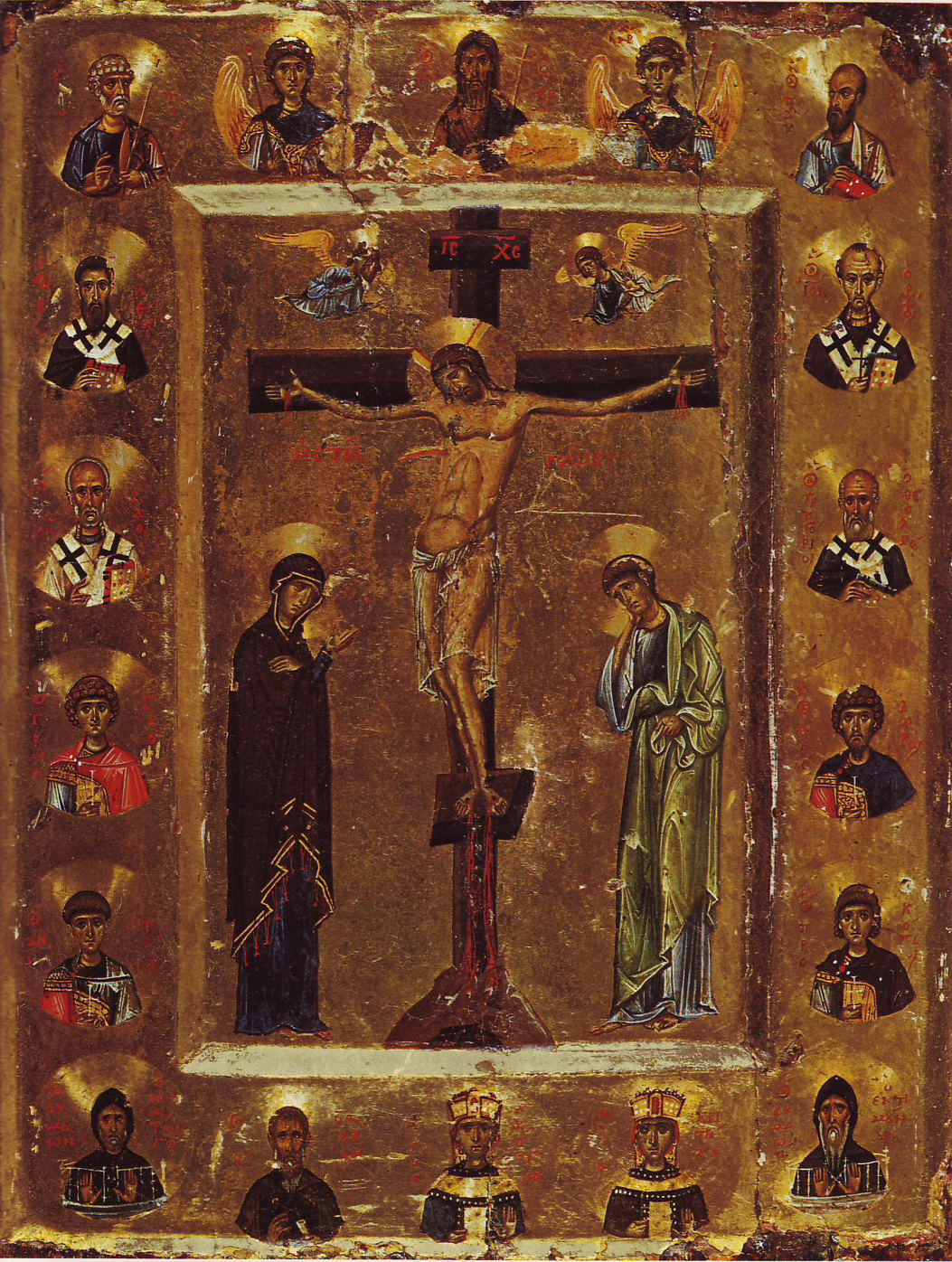
Source: The Crucifixion of Christ, second half of the twelfth century, Saint Catherine’s Monastery, Sinai, public domain / Wikimedia Commons
The Crucifixion is the iconographic center of this lesson because Paul defines Christ’s peacemaking through “the blood of His cross.” The icon does not sentimentalize peace. Christ’s wounds remain visible, Saint Mary and the beloved disciple stand within grief, and the Cross exposes the cost of human enmity.
Yet Christ occupies the center not as a defeated victim trapped by violence, but as the Lord who freely offers Himself. His arms are open. The vertical beam joins earth and heaven; the horizontal beam stretches toward divided humanity. This visual symbolism should be taught carefully as contemplation, not as a claim that the iconographer encoded a technical diagram.
On the Feast of the Cross, the Church venerates neither cruelty nor domination. She worships Christ, whose self-giving love turns an instrument of imperial terror into the sign of victory. The icon therefore corrects both counterfeits of peace. It refuses the appeaser’s denial because the wounds are real. It refuses the warrior’s revenge because the Crucified One answers hatred with saving love.
Glossary
- Beatitude: Christ’s declaration of who is blessed under God’s reign and what promise belongs to that life.
- Peacemakers / eirēnopoioi: Those who actively make peace. The word does not mean merely quiet, calm, or conflict-averse people.
- Peace / eirēnē: Wholeness and restored communion with God and neighbor, not simply the absence of visible conflict.
- Reconciliation: The restoration of communion through truth, repentance, mercy, and changed relationship.
- Forgiveness: Releasing personal vengeance and entrusting final judgment to God; it can begin before reconciliation is complete.
- Trust: Confidence built through demonstrated faithfulness over time.
- Access: Practical permission to enter another person’s space, role, or vulnerability; forgiveness does not automatically restore it.
- Sonship: Belonging to God and participation by grace in the life and likeness of the Son. Christ is Son by nature; we become children by adoption and grace.
- Theosis: Participation by grace in God’s life, here expressed as sharing the peacemaking family likeness of the Father.
- Feast of the Cross: The Coptic feast on Tout 17 celebrating the life-giving Cross of Christ and His victory through it.
Sources
Primary sources
- Scripture: Matthew 5:9; Matthew 18:15–20; Luke 6:26; John 12:26–36; John 14:27; Ephesians 2:13–18; Colossians 1:19–22; James 3:13–18; 1 Corinthians 1:17–31; 1 Peter 2:21–25; Genesis 33:1–11. Scripture is from NKJV.
- Saint Gregory of Nyssa, Oration 7 on the Beatitudes, on peacemaking as the Holy of Holies of the ascent, the gift of divine sonship, and a life full enough of peace to become a cure for another’s sickness. Online-direct synchronized text: beginning of Oration 7, sonship and peace, and peace as healing.
- Saint John Chrysostom, Homilies on Matthew, Homily XV, §7, on peacemakers removing their own strife and reconciling others. New Advent.
- Saint Athanasius of Alexandria, On Luke 10:22 (Matthew 11:27), §3, on the Word reconciling enmity in His flesh and making two into one new humanity. CCEL deep link.
- Saint John Chrysostom, Homilies on Hebrews, Homily XII on Hebrews 7:1–3, on Christ as King of Righteousness and King of Peace. CCEL deep link.
Secondary academic sources
- Hubertus R. Drobner and Albert Viciano, eds., Gregory of Nyssa: Homilies on the Beatitudes: An English Version with Commentary and Supporting Studies, Supplements to Vigiliae Christianae 52 (Brill, 2000).
- Michael Glerup, trans., Gregory of Nyssa: Sermons on the Beatitudes, Popular Patristics Series 52 (St Vladimir’s Seminary Press, 2012).
- Mark Allan Powell, “Matthew’s Beatitudes: Reversals and Rewards of the Kingdom,” The Catholic Biblical Quarterly 58, no. 3 (1996): 460–479. JSTOR.
- Jonathan T. Pennington, The Sermon on the Mount and Human Flourishing: A Theological Commentary (Baker Academic, 2017).
Coptic Orthodox and pastoral sources
- Coptic Agpeya, Sixth Hour Gospel: Matthew 5:1–16, confirmed in the local Coptic lectionary reference.
- Coptic lectionary for September 27, 2026, Tout 17, Feast of the Cross: Pauline Epistle 1 Corinthians 1:17–31; Catholic Epistle 1 Peter 2:1–25; Acts 10:34–43; liturgy Gospel John 10:22–38; Matins Gospel John 12:26–36; Vespers Gospel John 8:28–42. The lesson uses the feast readings as theological connections and does not claim Matthew 5:9 as the appointed liturgy Gospel.
Iconography and image sources
The Crucifixion of Christ, second half of the twelfth century, late Komnenian Byzantine icon, Saint Catherine’s Monastery, Sinai. Wikimedia Commons, public-domain work and faithful reproduction.
Footnotes
-
Saint John Chrysostom, Homilies on Matthew, Homily XV, §7, trans. George Prevost and M. B. Riddle, New Advent. Chrysostom says Christ requires more than the removal of personal hatred: peacemakers also restore those who are at strife. ↩
-
Saint Gregory of Nyssa, Oration 7 on the Beatitudes, Catholic Library and following section. Gregory calls this Beatitude the Holy of Holies of the ascent and describes sonship as a gift beyond natural human capacity. Online-direct mirror, not yet in the local corpus. ↩ ↩2
-
Saint Gregory of Nyssa, Oration 7 on the Beatitudes, Catholic Library. Gregory says the peacemaker first possesses peace, then gives it to others, so that one’s life becomes “a cure for another’s sickness.” Online-direct mirror, not yet in the local corpus. ↩
-
Saint Athanasius of Alexandria, On Luke 10:22 (Matthew 11:27), §3, trans. Archibald Robertson, CCEL. Local corpus segment 5696, quote-eligible, direct-online-verified NPNF text. ↩
-
Saint John Chrysostom, Homilies on Hebrews, Homily XII on Hebrews 7:1–3, trans. Philip Schaff and collaborators, CCEL. Local corpus segment 39826, quote-eligible, direct-online-verified NPNF text. ↩