
“Blessed are those who are persecuted for righteousness’ sake, For theirs is the kingdom of heaven.
Blessed are you when they revile and persecute you, and say all kinds of evil against you falsely for My sake. Rejoice and be exceedingly glad, for great is your reward in heaven, for so they persecuted the prophets who were before you.” Matthew 5:10–12
Main burden
The final Beatitude reveals whether the blessed life remains when obedience becomes costly. Christ does not bless pain for its own sake, every criticism we receive, or consequences created by our own pride. He blesses those who suffer because they remain faithful to righteousness and to Him. Their joy is not pleasure in pain or a grievance against the world. It is the deep freedom of belonging to a Kingdom that rejection cannot take away. Christ fulfills this Beatitude at the Cross: falsely accused, reviled, and rejected, He does not become false, retaliatory, or hateful. Joined to Him, the Church’s martyrs show that persecution may wound the body, reputation, livelihood, and relationships, but it cannot own the soul that remains open to Christ.
Opening: what changes when obedience has a price?
Many convictions feel strong while they are free.
It is easy to tell the truth when the truth costs nothing. It is easy to forgive when pride has already been satisfied. It is easy to call ourselves Christian when the name brings belonging, respect, or familiarity. It is easy to defend the vulnerable when our own place in the room is secure.
Then a price appears.
A friend may withdraw because we will not join the gossip. A promotion may depend on silence about something dishonest. A relationship may become colder because we set a faithful boundary. A family member may call obedience extremism. A social circle may tolerate Christianity as culture but not Christ as Lord. In some places, confessing His name may cost liberty, safety, or life.
The question changes from, “Do I believe this?” to, “Will I still live it when something I value is threatened?”
Christ does not hide that question at the end of the Sermon. He places it inside the Beatitudes:
“Blessed are those who are persecuted for righteousness’ sake.”
The central question for this week is:
Which part of the Beatitude life am I tempted to abandon when it costs comfort, approval, reputation, control, or belonging?
1. The Kingdom at both ends
The first and eighth Beatitudes carry the same promise:
“Theirs is the kingdom of heaven.”
The series began with the poor in spirit standing before God with empty hands. It ends with the persecuted still holding those hands open when the world tries to close them around fear, anger, compromise, or revenge.
This is the final test of the ascent.
- Will poverty of spirit remain when we are insulted, or will wounded pride demand vindication?
- Will mourning remain, or will we enjoy the downfall of those who oppose us?
- Will meekness remain, or will pressure release the domination we had only hidden?
- Will hunger for righteousness remain when righteousness costs opportunity?
- Will mercy remain when the other person has become an enemy?
- Will purity remain when compromise could protect our image?
- Will peacemaking remain when both sides punish anyone who refuses their hatred?
Persecution does not create these virtues. It reveals whether they have taken root.
The Kingdom appears at both ends because nothing essential has changed about the source. We enter with empty hands, and we endure with empty hands. We never graduate from dependence on Christ.
2. Gregory’s eighth step: persecution and resurrection
Saint Gregory of Nyssa calls this the eighth and highest step of the Beatitudes. He connects the number eight with the day beyond the seven-day cycle, the day of Resurrection. The final Beatitude therefore looks beyond the instability of earthly reward toward the unchanging Kingdom.1
Gregory also notices that the first and final Beatitudes receive the same promise. Poverty of spirit and persecution may appear unrelated, but all the Beatitudes converge toward one end. The person emptied of self-rule is prepared to remain faithful when tyrants, crowds, or private fear try to rule the soul.
The ascent does not end in spiritual invulnerability. It ends in resurrection hope.
This matters because suffering is not good in itself. Violence, slander, exclusion, and coercion are works of corruption. Christianity does not ask us to rename evil as blessing. The blessing lies in Christ’s promise that evil cannot determine the final meaning of a faithful life.
Gregory uses Joseph as an example. His brothers’ envy drives him away and sells him, yet their evil intention does not control the end of his story. God brings preservation through the road they meant for destruction. Gregory is not saying that betrayal becomes righteous. He is saying that the persecutor does not possess the future.2
The Resurrection is God’s final refusal to let the persecutor write the ending.
3. For righteousness’ sake, falsely, and for My sake
Three phrases guard this Beatitude from misuse.
“For righteousness’ sake”
Not all suffering is persecution. We may be opposed because we acted dishonestly, spoke harshly, ignored wisdom, violated trust, or confused stubbornness with conviction.
Being corrected is not the same as being persecuted. Losing influence after misconduct is not martyrdom. A conflict created by our contempt is not proof that the world hates Christ.
The Beatitude asks whether the suffering is connected to righteousness: truth, holiness, mercy, justice, faithfulness, and obedience to God.
“Falsely”
Jesus specifically names false accusation. If a charge is true, the Christian response is repentance, not the language of persecution.
This is especially important for leaders. Religious authority can become dangerous when every challenge is framed as an attack on the Church. The Church is not protected by denying truth. She is protected by holiness, repentance, and Christ.
“For My sake”
The center is not our cause, personality, politics, reputation, or need to feel courageous. The center is Christ.
A person can suffer for a foolish argument and call it boldness. We can seek controversy because opposition makes us feel significant. We can make Christianity needlessly offensive through arrogance, then claim the Cross when people react.
Saint Peter writes:
“But let none of you suffer as a murderer, a thief, an evildoer, or as a busybody in other people’s matters. Yet if anyone suffers as a Christian, let him not be ashamed.” 1 Peter 4:15–16
The question is not merely, “Am I suffering?” It is, “Whose likeness is visible in the way I am suffering?”
4. Christ is the persecuted Righteous One
The Beatitude is first a portrait of Christ.
He is falsely accused. Witnesses distort His words. Authorities protect power rather than truth. The crowd that welcomed Him turns toward crucifixion. Soldiers mock His kingship. Religious leaders use the language of fidelity to reject the One to whom the Scriptures bear witness.
Yet persecution does not make Him less Himself.
“Who, when He was reviled, did not revile in return; when He suffered, He did not threaten, but committed Himself to Him who judges righteously.” 1 Peter 2:23
His silence is not passivity. He has already spoken the truth. His refusal to threaten is not approval of injustice. It is the refusal to let injustice reproduce itself inside Him.
Hebrews tells us where to look:
“Looking unto Jesus, the author and finisher of our faith, who for the joy that was set before Him endured the cross, despising the shame.” Hebrews 12:2
Christ does not enjoy the pain. He endures the Cross for the joy set before Him: obedience to the Father, the salvation of the world, the destruction of death, and the gathering of His people.
Saint John Chrysostom says that when shame and danger must be borne, Scripture takes refuge in Christ, “who for the joy that was set before Him endured the Cross, despising the shame.”3
The Christian does not endure by staring at persecution. We endure by looking unto Jesus.
5. Stephen: pursued but not overtaken
Saint Stephen gives the clearest apostolic face to this Beatitude.
His hearers are enraged. They gnash their teeth, stop their ears, rush together, cast him out, and stone him. The scene is not sanitized. Religious certainty and mob violence join hands.
But Stephen sees another reality:
“Being full of the Holy Spirit, [he] gazed into heaven and saw the glory of God, and Jesus standing at the right hand of God.” Acts 7:55
Then, while stones fall, he prays:
“Lord Jesus, receive my spirit.”
“Lord, do not charge them with this sin.” Acts 7:59–60
Stephen’s witness is not merely that he dies without denying Christ. He dies without allowing hatred to become his final word. He follows the Crucified One in entrusting himself to God and interceding for his killers.
Gregory calls this the race of martyrdom: the faithful are pursued but not overtaken. The enemy may reach the body, but not the communion toward which the martyr runs. Gregory points to Stephen receiving the stones while returning blessing and prayer.4
One of the coats lies at Saul’s feet. Stephen does not see what God will do with that persecutor. His prayer enters a future hidden from him.
Faithfulness is not control over visible results. Stephen’s task is to remain Christ’s. God’s task is Resurrection.
6. The martyrs are witnesses, not grievance symbols
The Greek word martys means witness. A martyr is not simply someone who dies tragically or belongs to a persecuted group. The martyr bears witness to Christ through costly fidelity.
Coptic history contains deep and repeated suffering. That memory matters. The martyrs are not abstractions to us. Their names live in the Synaxarium, the calendar, the hymns, the churches, and family memory.
But martyrdom can be mishandled.
We can use the martyrs to nourish tribal grievance, to imagine ourselves morally superior, or to treat every social discomfort as a continuation of their blood. That does not honor them. It recruits their witness into our resentment.
The martyrs testify that Christ is worth more than life without Him. Their courage is not hatred of the persecutor. Their victory is not the enemy’s humiliation. Their crown is communion with the slain and risen Lamb.
The Twenty-One Coptic Martyrs of Libya provide a contemporary witness. They were migrant workers, not people seeking a dramatic death. They were killed because they belonged to Christ. The Church remembers them not because violence is holy, but because coercion could not separate them from His name. Their witness should lead us to prayer, fidelity, forgiveness, and care for persecuted people, not fascination with the machinery of their murder.
Do not show execution footage in a lesson. Do not make trauma into spectacle. If their icon is used in a future deck, obtain permission from its contemporary iconographer or use an authorized church source with attribution. Their witness is enough; the killers’ propaganda does not deserve another audience.
7. Joy without denial
“Rejoice and be exceedingly glad” can sound cruel if taught carelessly.
Christ is not commanding victims to enjoy pain, suppress grief, or pretend fear is unbelief. In Gethsemane He is sorrowful. On the Cross He cries out. The martyrs are not less faithful because the body trembles or the heart grieves.
Joy is not the absence of sorrow. It is the presence of a greater belonging.
Paul describes being burdened “beyond measure, above strength,” even despairing of life. Then he says the sentence of death taught him not to trust in himself but “in God who raises the dead” (2 Corinthians 1:8–9).
The appointed Pauline Epistle for October 4 begins with “the Father of mercies and God of all comfort.” God does not always prevent affliction. He meets His people in it and gives comfort that can later be shared.
Chrysostom comments that Paul does not say God kept him from affliction, but that God “comforteth in affliction.” He compares this to the Three Holy Children: God did not prevent the furnace or immediately extinguish it; He gave them freedom within it.5
Christian joy can therefore weep, seek help, leave danger, report evil, receive treatment, and lament injustice. Its deepest confession remains: this suffering is not my lord. Christ is.
8. Luke’s blessing and woe: excluded for Christ, praised into falsehood
Here Luke gives a direct parallel:
“Blessed are you when men hate you, and when they exclude you, and revile you, and cast out your name as evil, for the Son of Man’s sake. Rejoice in that day and leap for joy! For indeed your reward is great in heaven.” Luke 6:22–23
The corresponding woe sharpens the danger:
“Woe to you when all men speak well of you, for so did their fathers to the false prophets.” Luke 6:26
The anti-ladder is universal approval purchased by unfaithfulness.
This does not mean criticism proves we are right or praise proves we are false. Faithful people may be honored, and foolish people may be opposed. The test is whether approval has become our master.
We may compromise quietly:
- laugh at what degrades another person because silence would expose us;
- hide our faith because we fear appearing strange;
- soften a truthful report to protect a leader;
- join contempt because our group rewards it;
- conceal wrongdoing because the institution’s reputation feels sacred;
- refuse to apologize because our supporters expect us to remain innocent;
- turn Christian teaching into whatever will keep an audience.
The final Beatitude asks whether our identity can survive being misunderstood. Luke’s woe asks whether our integrity can survive being praised.
9. The surprising lectionary: love, forgiveness, and works that reveal the child
This lesson does not fall on the Feast of the Cross. The canceled September 13 meeting shifted it to October 4, the fourth Sunday of Tout. We should not pretend otherwise.
Yet the appointed readings deepen the Beatitude in a less obvious way.
The Catholic Epistle contrasts the children of God with Cain, who killed his brother because his brother’s works were righteous (1 John 3:8–12). This is persecution at its first biblical root: righteousness exposes evil, and envy answers with violence.
The Gospel presents the sinful woman in the Pharisee’s house (Luke 7:36–50). She is watched, classified, and despised. Simon thinks her past disqualifies her touch. Christ tells the truth about her many sins and the greater truth of forgiveness. She leaves with His words, “Your faith has saved you. Go in peace.”
Faithfulness under accusation must retain this Christlike vision. The persecuted can become tempted to classify every opponent as permanently wicked. But Christ sees the self-righteous persecutor and the repentant sinner truthfully. He does not confuse them, and He does not reduce either to a slogan.
The Pauline Epistle teaches comfort in tribulation so that comfort becomes ministry. Persecution must not curve the Christian inward until suffering becomes the only story we tell. The comfort received from God becomes comfort offered to others.
The readings therefore ask a hard question: If suffering makes us less loving, less truthful, less merciful, and more fascinated with enemies, what part of Christ’s witness have we lost?
10. The ordinary costs of fidelity
Most people in the room are not facing execution. The Beatitude must not be trivialized, but neither should it remain remote.
At work
Faithfulness may mean refusing to alter data, conceal a defect, mistreat an employee, or agree publicly with what conscience cannot affirm. It does not require announcing every conviction in every meeting. Wisdom chooses time and manner. Integrity refuses the lie.
In family life
A family may punish the person who names addiction, abuse, manipulation, or a long-protected secret. Honoring family does not mean protecting what destroys family. Seek wise counsel and safety; do not carry serious danger alone.
In friendships and social life
Sometimes fidelity costs access to a group. Refusing gossip, cruelty, sexualized entertainment, or contempt may make us inconvenient. Do not become theatrical. A quiet no can be a real confession.
In church service
A servant may suffer for telling the truth, but a servant may also call accountability persecution. Ask whether the issue is fidelity to Christ or resistance to correction. Involve appropriate authority rather than spiritualizing a personal power struggle.
In public witness
We are called to give a reason for our hope “with meekness and fear,” keeping a good conscience (1 Peter 3:15–16). Christian witness is neither cowardice nor aggression. If our defense of truth abandons meekness, the manner contradicts the message.
In hidden obedience
Some costs are invisible: ending a secret relationship, returning dishonest gain, confessing a sin before it is discovered, refusing an addictive comfort, or remaining faithful when nobody applauds. No crowd may persecute us, but the old self resists losing its throne.
The Beatitude belongs here too, without equating inconvenience with martyrdom. Every small fidelity trains the soul for the day when the price is larger.
11. How the Church prepares us to endure
Baptism: death and Resurrection before the crisis
In Baptism we are united to Christ’s death and Resurrection. Martyrdom does not invent that union; it reveals its depth. The baptized life already says that death no longer has final ownership.
Eucharist: the life that cannot be taken
The martyrs do not survive by willpower alone. The Church receives the Body and Blood of the One who passed through death. At the altar, eternal life is not an idea about the future. It is communion with Christ now.
Confession: learning not to defend a false self
The person who cannot admit wrongdoing will interpret every challenge as persecution. Confession teaches us to distinguish shame for Christ from embarrassment over our own sin. It frees us to repent when correction is true and endure when accusation is false.
The Agpeya: the Beatitudes beneath the Cross
Matthew 5:1–16 is read at the Sixth Hour. The final Beatitude is prayed beneath the Cross, where Christ is reviled and remains faithful. The hour teaches endurance by returning attention to Him.
The Synaxarium: memory without grievance
The Church remembers martyrs by name so courage does not become an abstraction. Their stories tell us that ordinary Christians, sustained by grace, can remain faithful. Their memory should produce worship and imitation, not a permanent appetite for enemies.
The community: no solitary heroics
Hebrews surrounds the runner with “a great cloud of witnesses.” Paul asks churches to help through prayer. People under pressure need the Church’s presence, material support, advocacy, and intercession. Do not praise endurance while abandoning the person who must endure.
A practice for this week: identify the price before it arrives
1. Name one vulnerable Beatitude
Which quality disappears first when pressure rises: humility, mourning, meekness, righteousness, mercy, purity, or peacemaking?
2. Name the price you fear
Be specific: disapproval, embarrassment, lost income, conflict, loneliness, reduced influence, or exposure of your own sin.
3. Prepare one faithful sentence
Examples:
- “I cannot say that because it is not true.”
- “I need to correct what I reported.”
- “I will not discuss that person without them present.”
- “What happened was wrong, and I need help.”
- “You are right about my part; I need to repent.”
- “I forgive you, but this boundary remains.”
- “I belong to Christ.”
4. Pray for the person, not merely against the pressure
Use Stephen’s prayer carefully: “Lord, do not charge them with this sin.” If the wound is too fresh for those words, begin with: “Lord, keep hatred from owning me. Bring truth, protection, repentance, and salvation.”
5. Ask for support
Tell a father of confession or trustworthy mature Christian where fidelity is becoming costly. If there is danger, coercion, abuse, or retaliation, involve appropriate professional, legal, or organizational support.
Personal contemplation
Stand outside the city with Stephen.
The crowd is loud. His name has been cast out as evil. The stones are real.
But heaven is open.
Stephen sees Jesus standing. Before he sees the crowd correctly, he sees Christ. Before he answers the hatred, he entrusts his spirit. Before the story closes, he prays for those killing him.
Bring one feared cost into that scene.
What are you afraid obedience will take from you?
Whose approval feels necessary for your identity?
Where might correction, not persecution, be the truth you need to receive?
If the accusation is false, can you remain truthful without becoming cruel?
Hear Christ say: “Theirs is the kingdom of heaven.”
The Kingdom was not granted by the crowd. The crowd cannot revoke it.
[Pause for 15–20 seconds.]
Conclusion
The Beatitudes begin with empty hands and end with those hands still open under pressure.
The persecuted are not blessed because pain is holy, opposition proves correctness, or victimhood creates virtue. They are blessed because they remain joined to Christ when righteousness costs them something.
The final Beatitude does not abandon the earlier ones. It crowns them. The faithful do not become proud when insulted, cruel when opposed, impure when compromise is offered, or vengeful when wounded. They remain poor in spirit, mourning, meek, hungry for righteousness, merciful, pure, and peacemaking.
That life is possible because Christ has already lived it.
He was falsely accused and did not become false. He was reviled and did not revile. He was threatened and did not surrender to fear. He was crucified and did not stop loving. He entered death and rose beyond its reach.
The world may take comfort, reputation, position, belonging, liberty, or life. It cannot take the Kingdom from those whose life is hidden with Christ.
Rejoicing is not pretending the stone does not hurt. It is seeing heaven open while the stone falls.
Closing prayer
Lord Jesus Christ, faithful Witness and risen King, You were rejected, falsely accused, reviled, and crucified, yet no hatred entered Your heart. Forgive us when we call correction persecution, when pride seeks controversy, or when fear purchases approval through compromise. Strengthen those who suffer for Your name and protect all who face coercion, violence, exclusion, or loss. Give us truth without aggression, meekness without cowardice, endurance without denial, and forgiveness without concealment of evil. When faithfulness costs us, keep every Beatitude alive within us. Let the witness of Your martyrs lead us not into grievance but into courage, prayer, mercy, and love. Fix our eyes on You, the Author and Finisher of our faith, and make us faithful unto the Kingdom that cannot be taken away. Amen.
Teaching Guide
30-minute teaching plan
Time Section Aim 0:00–3:00 What changes when obedience has a price? Move from abstract conviction to costly fidelity. 3:00–6:00 The Kingdom at both ends Show the inclusio and test every prior Beatitude under pressure. 6:00–10:00 Gregory’s eighth step Connect persecution to Resurrection and deny evil the final word. 10:00–14:00 Three textual guardrails Distinguish righteousness, false accusation, and suffering for Christ from misconduct. 14:00–19:00 Christ and Stephen Make Christ the center and Stephen the apostolic witness. 19:00–22:00 Martyrdom and joy Reject grievance, spectacle, romanticized suffering, and emotional denial. 22:00–25:00 Luke and the day’s readings Contrast costly fidelity with purchased approval and connect comfort, Cain, and forgiveness. 25:00–28:00 Ordinary costs and Church life Bring the Beatitude into work, family, service, confession, and Eucharist. 28:00–30:00 Practice, contemplation, prayer Leave the room seeing Christ rather than staring at opposition.
- Ask: Let people name feared costs without comparing ordinary pressure to violent martyrdom.
- Emphasize: The blessing belongs to faithfulness in Christ, not suffering by itself.
- Watch for: Correct any move toward grievance, self-righteousness, victim blaming, or calling accountability persecution.
- Connect: Keep Gregory’s ascent and Luke’s direct blessing/woe pair explicit; let Resurrection govern the ending.
- Show: Use the Sinai Crucifixion icon while teaching Christ as the persecuted Righteous One and during contemplation.
Ask
- Which earlier Beatitude becomes hardest for you to keep when you feel attacked?
- What distinguishes persecution for righteousness from consequences caused by our own behavior?
- Why does Stephen’s prayer for his killers belong to his witness rather than merely to private kindness?
- Where are you tempted to purchase approval through a small compromise?
- How does Resurrection change the meaning of a faithful life that appears to lose?
Emphasize
- The first and eighth Beatitudes promise the same Kingdom: dependence on Christ is both entrance and endurance.
- Gregory reads the eighth step through Resurrection. Persecution is not good; God’s unchangeable Kingdom defeats its claim to finality.
- “For righteousness’ sake,” “falsely,” and “for My sake” prevent self-serving uses of the Beatitude.
- Christ is not merely an example beside the lesson. He is the persecuted Righteous One whose life sustains the Church.
- Stephen is pursued but not overtaken: stones reach his body while his spirit remains directed toward Christ.
- Martyrs are witnesses to Christ, not symbols for tribal grievance.
- Joy can coexist with grief, fear, trauma, lament, and the need for protection.
Watch for
- Do not imply that criticism validates a person’s position.
- Do not describe consequences for misconduct as persecution.
- Do not romanticize poverty, abuse, coercion, imprisonment, or death.
- Do not pressure victims to remain in danger or forgive on another person’s timetable.
- Do not show violent execution footage or reproduce persecutors’ propaganda.
- Do not turn the Twenty-One Martyrs of Libya into anti-Muslim or nationalist grievance. Their witness is Christ, fidelity, and prayer.
- Do not claim this session lands on the Feast of the Cross. It occurs October 4, the fourth Sunday of Tout.
- Do not claim Matthew 5:10–12 is the appointed Sunday Gospel. It is part of the confirmed Sixth Hour Gospel. The appointed liturgy Gospel is Luke 7:36–50.
Connect
- Connect poverty of spirit to endurance: we begin and finish with empty hands.
- Connect Gregory’s eighth day to Resurrection, while presenting it as patristic interpretation rather than the lexical meaning of Matthew’s verse.
- Connect Joseph to providence without calling betrayal good.
- Connect Christ’s non-retaliation in 1 Peter 2 to Stephen’s prayer in Acts 7.
- Connect Luke 6:22–23 directly to Matthew 5:10–12 and Luke 6:26 to approval purchased through compromise.
- Connect 2 Corinthians 1 to the day’s Pauline Epistle: God comforts in affliction and turns received comfort outward.
- Connect 1 John 3 to Cain’s persecution of righteous Abel.
- Connect Luke 7 to Christ’s refusal to reduce the sinful woman to the contempt of the room.
- Connect Baptism, Eucharist, confession, the Sixth Hour, Synaxarium, and community support to endurance in Christ.
Show
Display the late-twelfth-century Sinai Crucifixion icon while reading 1 Peter 2:21–24 and Hebrews 12:1–3. Christ is visibly wounded, so the icon does not deny suffering. Yet He remains the compositional center, and His open arms do not imitate the violence directed against Him. During contemplation, ask the room to distinguish the real wounds from the response of the Righteous One. The image should direct attention away from fascination with persecutors and toward Christ’s faithful, non-retaliatory love.
Iconography connection
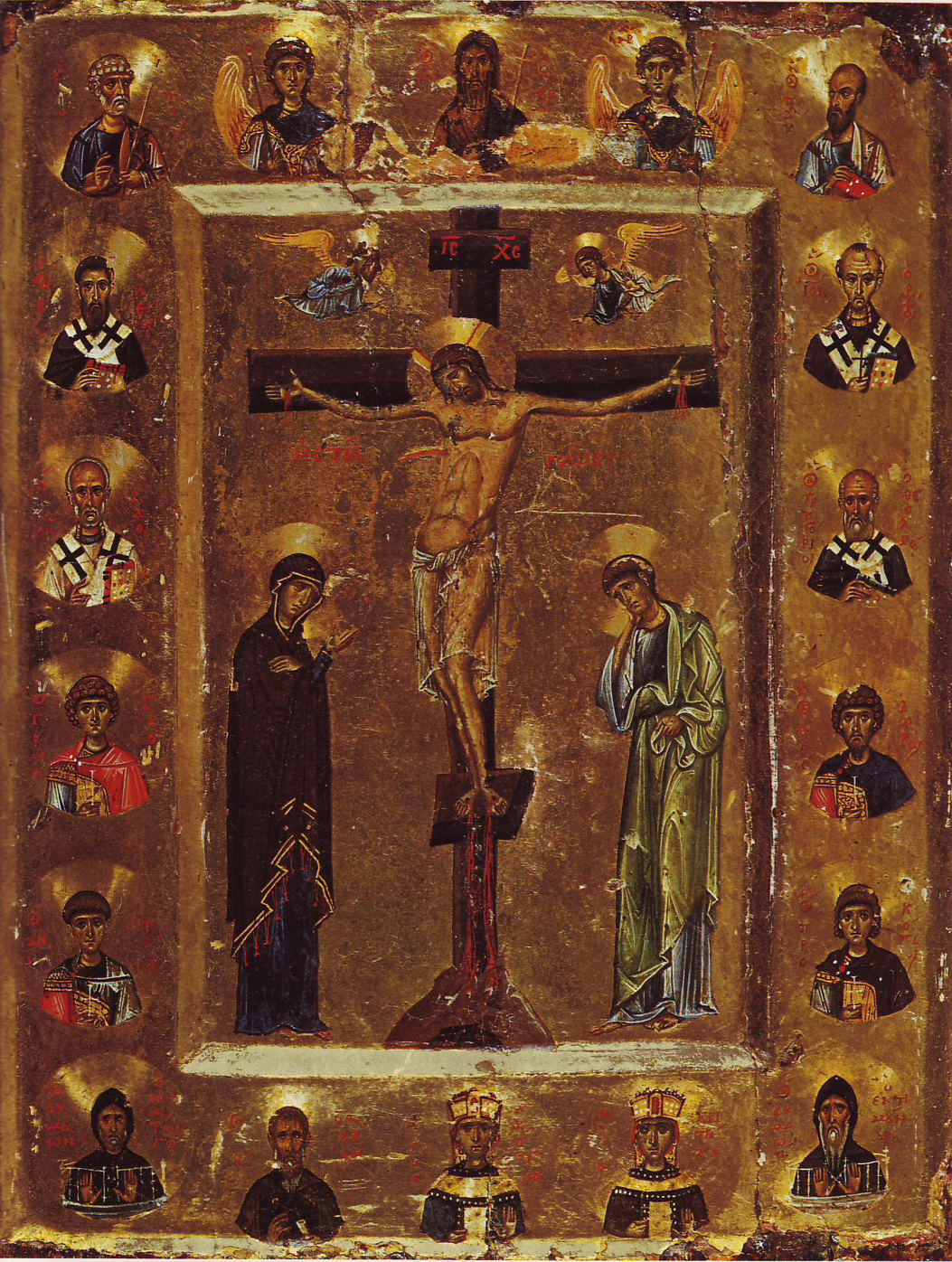
Source: The Crucifixion of Christ, second half of the twelfth century, Saint Catherine’s Monastery, Sinai, public domain / Wikimedia Commons
The Crucifixion remains the central iconographic scene for this Beatitude even though the meeting falls one week after the Feast of the Cross. Christ is the One reviled falsely for righteousness’ sake and for the salvation of the world. His wounds prevent us from making suffering abstract. His open posture prevents us from defining victory as retaliation.
Saint Stephen’s martyrdom is also a natural visual connection because Acts 7 joins persecution, the open heaven, the vision of Christ, the offering of the spirit, and prayer for persecutors. A verified reusable Orthodox icon of Stephen’s martyrdom was not embedded in this lesson. Contemporary Coptic icons of the Twenty-One Martyrs of Libya should not be copied into a published lesson without clear permission from the iconographer or authorized publisher.
The lesson therefore uses the provenance-verified Sinai Crucifixion icon already embedded in the series. This continuity is intentional: peacemaking and endurance both receive their form from the same Cross. Do not use execution imagery as a substitute for iconography. The Church directs the gaze toward the victorious Christ and the crowned witness, not toward the persecutor’s spectacle.
Glossary
- Beatitude: Christ’s declaration of who is blessed under God’s reign and what promise belongs to that life.
- Persecution: Hostility, exclusion, coercion, punishment, or violence directed against someone because of righteousness or fidelity to Christ.
- Martyr / martys: A witness. In Christian usage, one who bears faithful witness to Christ, especially unto death.
- Confessor: A Christian who suffers for the faith and remains faithful without being killed.
- Eighth day: Patristic symbolism for the Resurrection and the life of the age beyond the present seven-day cycle.
- Inclusio: A literary framing device in which matching language at the beginning and end encloses a unit. Matthew 5:3 and 5:10 both promise the Kingdom of Heaven.
- Providence: God’s wise and loving governance, by which evil is never made good but is prevented from controlling the final purpose of creation.
- Synaxarium: The Church’s liturgical collection of commemorations and lives of saints and martyrs.
- Fourth Sunday of Tout: The verified Coptic calendar placement of October 4, 2026.
Sources
Primary sources
- Scripture: Matthew 5:10–12; Luke 6:22–26; John 15:18–21; Acts 7:54–60; Romans 12:14–21; 1 Peter 2:21–25; 1 Peter 3:13–17; 1 Peter 4:12–16; Hebrews 12:1–3; 2 Corinthians 1:3–10; 1 John 3:8–12; Luke 7:36–50; Genesis 37:18–28; Genesis 45:4–8. Scripture is from NKJV.
- Saint Gregory of Nyssa, Oration 8 on the Beatitudes, on the eighth step, Resurrection, the Kingdom promised at both ends, Joseph, the martyrs’ race, and Saint Stephen. Online-direct synchronized text: beginning of Oration 8 and persecution, Joseph, and Stephen.
- Saint John Chrysostom, Homilies on the Gospel of John, on John 15:24–16:4, regarding Christ’s comfort to those who suffer for His sake. CCEL deep link.
- Saint John Chrysostom, Homilies on Romans, Homily XXI on Romans 12:14, on blessing persecutors as a sign of love for Christ. CCEL.
- Saint John Chrysostom, Homilies on Second Corinthians, Homily I, on God comforting His people within affliction. CCEL.
Secondary academic sources
- Hubertus R. Drobner and Albert Viciano, eds., Gregory of Nyssa: Homilies on the Beatitudes: An English Version with Commentary and Supporting Studies, Supplements to Vigiliae Christianae 52 (Brill, 2000).
- Michael Glerup, trans., Gregory of Nyssa: Sermons on the Beatitudes, Popular Patristics Series 52 (St Vladimir’s Seminary Press, 2012).
- Mark Allan Powell, “Matthew’s Beatitudes: Reversals and Rewards of the Kingdom,” The Catholic Biblical Quarterly 58, no. 3 (1996): 460–479. JSTOR.
- Candida R. Moss, The Myth of Persecution: How Early Christians Invented a Story of Martyrdom (HarperOne, 2013). Useful as a critical modern challenge requiring careful distinction between historical persecution, later memory, and sweeping narratives; it does not govern the Church’s theology of martyrdom.
Coptic Orthodox and pastoral sources
- Coptic Agpeya, Sixth Hour Gospel: Matthew 5:1–16, confirmed in the local Coptic lectionary reference.
- Coptic lectionary for October 4, 2026, the fourth Sunday of Tout: Pauline Epistle 2 Corinthians 1:1–14; Catholic Epistle 1 John 3:8–12; Acts 9:36–42; liturgy Gospel Luke 7:36–50. The lesson uses these as thematic connections and does not claim Matthew 5:10–12 as the appointed Sunday Gospel.
- Coptic Orthodox Diocese of Los Angeles, “The New Martyrs of Libya Added to the Coptic Synaxarium,” confirming their reception and commemoration on 8 Amshir. https://www.lacopts.org/news/the-new-martyrs-of-libya-added-to-the-coptic-synaxarium/.
Iconography and image sources
The Crucifixion of Christ, second half of the twelfth century, late Komnenian Byzantine icon, Saint Catherine’s Monastery, Sinai. Wikimedia Commons, public-domain work and faithful reproduction.
Tony Rezk’s contemporary Coptic icon of the Twenty-One Martyrs of Libya is identified by the Coptic Orthodox Diocese of Los Angeles but is not embedded because reusable publication rights were not confirmed.
Footnotes
-
Saint Gregory of Nyssa, Oration 8 on the Beatitudes, Catholic Library. Gregory calls this the eighth and highest step, connects the eighth day with Resurrection, and notes that the first and eighth Beatitudes share the promise of the Kingdom. Online-direct mirror, not yet in the local corpus. ↩
-
Saint Gregory of Nyssa, Oration 8 on the Beatitudes, Catholic Library. Gregory uses Joseph to show that an evil plot can become, under providence, the road to an end the persecutors did not intend. Online-direct mirror, not yet in the local corpus. ↩
-
Saint John Chrysostom, Homilies on Romans, Homily XXVII on Romans 14:25–27, trans. J. B. Morris and W. H. Simcox, CCEL deep link. Local corpus segment 15499, quote-eligible, direct-online-verified NPNF text. ↩
-
Saint Gregory of Nyssa, Oration 8 on the Beatitudes, Catholic Library. Gregory describes the martyrs as pursued but not overtaken and points to Stephen blessing and praying for his killers. Online-direct mirror, not yet in the local corpus. ↩
-
Saint John Chrysostom, Homilies on Second Corinthians, Homily I, trans. Talbot W. Chambers and revisers, CCEL. Local corpus segment 52734, quote-eligible, direct-online-verified NPNF text. ↩