
“You are the salt of the earth…”
“You are the light of the world. A city that is set on a hill cannot be hidden.”
“Let your light so shine before men, that they may see your good works and glorify your Father in heaven.” Matthew 5:13–16
Main burden
The Beatitudes are not eight religious personality types, eight independent achievements, or eight ways to prove ourselves worthy of God. They are one life, the life of Jesus Christ, shared by grace with His Body. The saints make that life visible because Christ lived in them, not because they mastered a spiritual checklist. The final call to salt and light is therefore not a demand for Christian visibility without Christian character. Christ forms the hidden heart through poverty of spirit, mourning, meekness, holy hunger, mercy, purity, peacemaking, and costly faithfulness. Then that life becomes nourishment, healing, truth, beauty, and light for the world, so that the Father rather than the servant receives the glory.
Opening: can anyone see what we have studied?
For nine sessions we have heard Christ pronounce a different verdict on the good life.
The world says blessed are the self-sufficient. Christ says blessed are the poor in spirit.
The world says avoid sorrow. Christ blesses those who mourn.
The world rewards domination. Christ promises the earth to the meek.
The world trains desire toward comfort, consumption, and victory. Christ blesses those who hunger and thirst for righteousness.
The world turns another person’s weakness into distance or superiority. Christ blesses the merciful.
The world perfects the image. Christ cleanses the heart.
The world calls avoidance peace and conquest victory. Christ calls peacemakers His Father’s children.
The world treats rejection as failure and applause as proof. Christ blesses those who remain faithful when righteousness costs them.
Now the series reaches a final question:
Can anyone see this life taking flesh in us?
Not, “Can people see that we attend church?”
Not, “Can people hear us defend Christian positions?”
Not, “Can people recognize our ministry, knowledge, fasting, or service?”
Can a spouse, child, coworker, wounded neighbor, difficult relative, or fellow servant encounter more humility, truth, mercy, purity, peace, and courage because we have sat at Christ’s feet?
The Beatitudes do not end with private admiration. Jesus turns to the same disciples and says, “You are the salt of the earth… You are the light of the world.”
1. One face before many faces
Before looking at the saints, we look at Christ.
If we begin with the saints as impressive moral examples, the lesson becomes discouraging. Saint Mary seems impossibly pure. Saint Moses seems impossibly repentant. Saint Basil seems impossibly generous. Saint Athanasius seems impossibly steadfast. The martyrs seem impossibly courageous.
But none of them is the source of the life we admire.
Christ is not merely the best example of the Beatitudes. He is their fulfillment and giver.
- He is poor in spirit, not because the eternal Son lacks anything in His divinity, but because He freely humbles Himself, receives all from the Father in love, and takes the form of a servant.
- He mourns over Jerusalem, weeps at Lazarus’s tomb, and carries the grief of our fallen condition without surrendering to despair.
- He is meek and lowly in heart, yet His meekness never becomes cowardice before falsehood or neglect of the vulnerable.
- His food is to do the Father’s will. His whole earthly life hungers for righteousness and completes the work entrusted to Him.
- He is mercy in the flesh, drawing near to sinners, touching the unclean, feeding the hungry, forgiving enemies, and offering Himself for the life of the world.
- His heart is perfectly undivided. There is no gap between His hidden love, His spoken word, and His deed.
- He makes peace through the blood of His Cross, not by pretending sin is harmless but by bearing and defeating its power.
- He is the Righteous One who is rejected, falsely accused, crucified, and raised beyond the reach of death.
Saint Paul gives the mystery its personal form:
“I have been crucified with Christ; it is no longer I who live, but Christ lives in me.” Galatians 2:20
This does not erase Paul’s person. Grace does not replace a human being with a religious copy. Christ heals and transfigures the person so deeply that a distinct human life begins to reveal His life.
That is what a saint is: not an independent spiritual success, but a human face made transparent to Christ.
2. The ascent is one living movement
Saint Gregory of Nyssa preached eight orations because he saw an ordered ascent in the Beatitudes. Saint John Chrysostom describes the same movement as a “golden chain.”1
The links belong together:
- Poverty of spirit stops bargaining with God from imagined wealth.
- Mourning tells the truth about sin, loss, and the world’s wounds.
- Meekness releases strength from domination and revenge.
- Hunger for righteousness turns desire toward God’s will.
- Mercy carries remembered need into another person’s need.
- Purity of heart gathers divided motives toward one love.
- Peacemaking carries that healed love into broken relationships.
- Faithfulness under persecution keeps the whole life intact when obedience becomes costly.
This is not a ladder on which successful people climb above weaker people. Every step makes superiority less possible. The higher the ascent goes, the more the person depends on grace, serves the neighbor, and resembles the crucified Christ.
Nor is the sequence mechanical. A mourner may need mercy on the same day. A peacemaker must remain poor in spirit. A person suffering for righteousness still needs purity of motive. The virtues interpenetrate because they belong to one Christ.
Chrysostom says that Christ placed them in this order because each prepares the next. Humility gives birth to mourning; mourning forms meekness and righteousness; mercy and contrition purify the heart; purity opens into peacemaking; and the person formed by all these can withstand danger without surrendering the life of the Kingdom.1
The point of the ascent is not, “Look how high I climbed.” It is, “Look how completely Christ has become my life.”
3. The anti-ladder: a life that looks full and becomes empty
Luke’s woes have followed this series as an anti-ladder:
“Woe to you who are rich…”
“Woe to you who are full…”
“Woe to you who laugh now…”
“Woe to you when all men speak well of you…” Luke 6:24–26
The woes are not a declaration that money, food, laughter, or a good reputation are automatically evil. They uncover false fullness.
- Riches can tell us we need nothing.
- Fullness can silence holy hunger.
- Laughter can become refusal to mourn what should break the heart.
- Approval can purchase our silence or reshape the truth we are willing to live.
The anti-ladder does not always look wicked. It can look efficient, admired, comfortable, respectable, and religious. It may produce a polished Christian exterior while the heart becomes less merciful, less teachable, less truthful, and less willing to bear a cost.
The Beatitudes empty us of false abundance so Christ can fill us with real life. Luke’s woes warn that we can gain the appearance of blessing while losing the capacity to receive it.
The final test is not whether our life looks enviable. It is whether it has become available to God and neighbor.
4. Saint Mary: the blessed life receives Christ
Saint Mary is not included as a decorative example of feminine gentleness. She reveals the deepest posture of the Beatitudes: a human life wholly receptive to God.
At the Annunciation she says:
“Behold the maidservant of the Lord! Let it be to me according to your word.” Luke 1:38
This is poverty of spirit without self-hatred. She does not claim control over God’s gift, yet she gives a real and free answer.
Her purity is not sterile withdrawal. It becomes astonishing fruitfulness. The undivided heart receives the Word and gives Him to the world.
Her humility does not make her passive. She rises and travels to Elizabeth in service. Her Magnificat is both worship and hunger for righteousness: God scatters the proud, lifts the lowly, fills the hungry, and remembers His mercy.
At Cana she notices a family’s need before it becomes public humiliation. Beneath the Cross she remains present when disciples flee. In the apostolic Church she prays among those awaiting the Spirit.
The Coptic Church calls her blessed because Christ filled her life, not because she drew attention away from Him. Her entire witness says, “Whatever He says to you, do it.”
Saint Mary shows that the first movement of salt and light is not self-expression. It is receiving Christ so fully that He can be carried to another person.
5. Saint Moses the Strong: the face changed by mercy
Saint Moses does not fit neatly inside one Beatitude.
His earlier life was marked by violence. Grace did not merely teach a violent man to behave politely. Repentance reordered his strength. The man once feared for force became known for humility, hospitality, tears, mercy, and peace.
The famous basket story gathers several Beatitudes at once. When monks assembled to judge a brother who had sinned, Moses came carrying a leaking basket of sand. He said:
“My sins … are running down behind me and I cannot see them, and I … have come this day to judge shortcomings which are not mine.”2
He does not call the brother’s sin good. He exposes condemnation as a way of forgetting our own need for mercy.
Poverty of spirit remembers its empty hands. Mourning grieves over sin without enjoying the sinner’s shame. Meekness refuses to use spiritual strength to dominate. Mercy seeks healing rather than distance. Purity examines the motive beneath correction. Peacemaking interrupts a community’s movement toward condemnation.
Saint Moses’s life tells anyone with a destructive past: holiness is not the reward of people who began well. It is Christ’s transfiguration of people who keep repenting.
The saint’s face does not hide what grace overcame. It reveals that the past is not sovereign.
6. Saint Basil: holy hunger builds a table
Saint Basil’s life refuses the division between correct theology and concrete mercy.
He defended the divinity of the Holy Spirit, shaped communal monastic life, resisted imperial pressure, preached against hoarding during famine, and established the charitable complex later called the Basileias. The same life guarded the Creed and made room for the hungry, sick, stranger, orphan, traveler, and socially rejected.
Basil’s hunger for righteousness did not remain an opinion about what society should do. Mercy gave it buildings, beds, food, medical care, hospitality, worship, and human touch.
The lesson is not that every Christian must build an institution. It is that love must eventually become concrete.
- If we pray for the hungry, what food can move from our table?
- If we defend human dignity, whose name do we learn?
- If we speak about mercy, what inconvenience do we accept?
- If we believe the Church is one Body, whose burden becomes partly ours?
Saint Basil shows that salt does not merely criticize decay. It preserves life. Light does not merely expose darkness. It helps someone find a road, a bed, a table, a church, and a human face.
His witness also guards the series from private spirituality. A pure heart that never opens the hand has not yet become whole.
7. Saint Athanasius: vision becomes endurance
Saint Athanasius is often remembered through conflict, councils, and exile. But courage was the fruit. Vision was the root.
Before his long struggle against Arianism, the young deacon contemplated the Incarnation. He saw that if the Son is a creature, humanity has not been united to God and salvation collapses. Only the true Word of the Father can renew the creation He made.
Athanasius writes:
“For He was made man that we might be made God.”3
The sentence names theosis: by grace we participate in divine life because the eternal Son truly became human. It does not mean that creatures become God by nature or cease to be human.
This gives the whole Beatitudes series its deepest foundation. Christ does not stand at a distance and demand eight impossible qualities. He assumes our humanity, defeats corruption and death, gives us His Spirit, and forms His own life in us.
Athanasius’s five exiles then become spiritually intelligible. He did not endure because opposition itself made him holy. He endured because he had seen Christ clearly enough that compromise would have meant losing the Savior he loved.
His life joins purity of vision, hunger for righteousness, peacemaking that refuses false peace, and faithfulness under persecution. It also gives a guardrail: costly fidelity is not delight in conflict. Athanasius repeatedly returned to pastor his people. His endurance served communion.
8. The martyrs: the whole chain under pressure
The martyrs reveal what happens when the entire Beatitude life passes through fire.
They are not blessed because violence is good, death is desirable, or victimhood automatically makes a person holy. They are witnesses because coercion cannot make Christ cease to be their life.
Saint Stephen sees the Son of Man standing in glory while stones fall. He entrusts his spirit to Jesus and prays for his killers. His witness holds together purity of vision, faithful endurance, mercy, and peacemaking.
The Twenty-One Coptic Martyrs of Libya confess Christ under mortal threat. Their witness does not invite fascination with violence or hatred toward a people. It invites the Church to value communion with Christ above fear and to pray for every person trapped in hatred, coercion, or persecution.
The martyrs must never become symbols used to feed tribal grievance. If their memory makes us more contemptuous, we have remembered their suffering while forgetting their Lord.
Their crowns belong to the Lamb who was slain and rose. Their courage tells us that the Beatitudes are not fragile ideals for safe conditions. Christ’s life can remain alive in His people even when the world tries to extinguish it.
9. The saints are not eight labels
We should resist turning the conclusion into a chart where one saint represents one Beatitude.
Saint Mary is not only humility. Her humility is pure, merciful, courageous, and hungry for God’s will.
Saint Moses is not only repentance. His repentance becomes meekness, mercy, peacemaking, and finally martyrdom.
Saint Basil is not only almsgiving. His mercy is inseparable from doctrinal truth, ascetic freedom, courage, worship, and the communion of the Church.
Saint Athanasius is not only resistance. His endurance grows from contemplation, love for Christ, pastoral care, and hope in incorruption.
The martyrs are not only persecution. Their witness includes poverty of spirit, forgiveness, purity, peace, and joy.
A saint is not a virtue with a biography attached. A saint is a member of Christ in whom the one life of Christ becomes personally visible.
This protects us from imitation without communion. We are not asked to copy another person’s temperament, historical circumstances, ascetic measure, or public ministry. We are called to the same Christ through the concrete obedience given to us.
Saint Athanasius closes On the Incarnation by saying that a person approaches the saints “by imitating their works,” becoming associated with them “in the conduct of a common life.”4 We understand the saints most deeply not by collecting facts about them, but by entering the same life of repentance and love.
10. Salt: the life of Christ preserving life
After the final Beatitude, Jesus says:
“You are the salt of the earth.”
He does not say, “Try to become salt after you finish the Beatitudes.” The people formed by this life are salt.
Saint John Chrysostom makes the connection explicit. The meek, merciful, righteous, pure, peacemaking, and faithful do not keep their good works enclosed within themselves. These “good fountains” overflow for the benefit of others.5
Salt works by contact. It cannot preserve food from a sealed container across the room.
Christian witness therefore requires presence:
- remaining near a grieving person without rushing the grief;
- telling the truth at work without humiliating anyone;
- protecting someone vulnerable without cultivating hatred;
- giving money, time, food, attention, or access to practical help;
- apologizing in front of children so repentance becomes imaginable;
- interrupting gossip without turning the correction into another performance;
- bringing a divided relationship toward truthful peace;
- keeping fidelity when compromise would be rewarded.
Salt also warns us. A Christian identity can remain visible while its savor disappears. We may retain language, rituals, opinions, and affiliations while losing humility, mercy, purity, and courage.
The answer is not louder branding. It is renewed communion with Christ.
Chrysostom insists that Christ alone first frees humanity from corruption. The disciples preserve what they have received from the Lord.5 We are not the Savior of the world. We carry the life of the Savior into the places He has given us.
11. Light: visible works that transfer glory
Jesus then says:
“You are the light of the world.”
Only Christ is Light by nature. He says, “I am the light of the world” (John 8:12). The Church shines by participation, like a lamp kindled from another flame.
Matthew 5:16 and Matthew 6:1 must be held together.
Matthew 5 tells us to let people see good works.
Matthew 6 warns us not to practice righteousness in order to be seen by people.
The difference is not secrecy versus visibility. The difference is the direction of glory.
A work becomes performance when the neighbor’s need becomes a stage for the self. A work becomes witness when it truly serves the neighbor and directs gratitude beyond the servant toward the Father.
This requires an undivided heart. We can do something genuinely helpful and still notice a desire for praise. The answer is not to stop serving. It is to bring the divided motive into prayer and continue the fitting work without feeding the appetite for recognition.
The goal is not that people say, “What an impressive Christian.”
The goal is that someone begins to suspect that the Father is merciful, truthful, beautiful, and near.
Chrysostom says Christ’s calling is “not for your own life apart … but for the whole world.”5 The Beatitudes are deeply personal, but never private.
12. The first Sunday of Baba: four friends, living stones, and a letter written by the Spirit
The appointed readings for October 11 do not repeat Matthew 5. They show what Beatitude-shaped community looks like.
Four people carry one wounded person
In Mark 2:1–12, four people carry a paralytic to Jesus. The crowd blocks the door, so they uncover the roof and lower him before Christ.
Jesus “saw their faith.”
The story does not tell us which carrier was most humble, merciful, pure, or courageous. Their faith becomes visible together because a wounded person reaches Christ.
This is the parish as salt and light.
- Poverty of spirit admits, “We cannot heal him.”
- Holy hunger refuses to accept distance from Christ as the final answer.
- Mercy carries weight.
- Meekness serves without needing the center.
- Purity keeps the wounded person’s need above the carriers’ recognition.
- Peacemaking overcomes obstacles without creating another enemy.
- Faithfulness keeps carrying when the doorway is closed.
They do not become the healer. They bring the man to the One who forgives and heals.
A church may have excellent teaching, beautiful worship, and full rooms, yet still become the crowd at the door. The lectionary asks whether our life together makes a path for the wounded or becomes another obstacle they must survive.
Living stones become a spiritual house
The Catholic Epistle says:
“Coming to Him as to a living stone, rejected indeed by men, but chosen by God and precious, you also, as living stones, are being built up a spiritual house.” 1 Peter 2:4–5
The stones live because they come to Christ, the Living Stone. They are built together, not displayed as individual spiritual trophies.
This is the ecclesial answer to the ascent. Gregory’s ladder does not end with a solitary person standing above others. It ends in the Kingdom, in communion, in a house made of living people whose lives support one another around Christ.
The Church becomes a letter of Christ
The Pauline Epistle says:
“You are our epistle written in our hearts, known and read by all men; clearly you are an epistle of Christ … written not with ink but by the Spirit of the living God … on tablets of flesh, that is, of the heart.” 2 Corinthians 3:2–3
People read the Church before they read her books.
A parish can confess correct words while its relationships communicate rivalry, indifference, secrecy, or contempt. It can also become a living letter in which forgiveness, truth, hospitality, chastity, courage, and care make Christ legible.
The Spirit writes on hearts. Salt, light, living stones, and a living letter all say the same thing: grace becomes embodied communion.
13. A Beatitudes rule of life
A rule of life is not a scorecard and not a promise to fix ourselves. It is a modest structure that keeps returning us to the places where Christ meets and changes us.
For the next season, choose four continuing responses.
1. One prayer of poverty
Pray daily:
Lord Jesus Christ, Son of God, have mercy on me, a sinner.
Do not rush past the need. Let the prayer release you from performance and return you to received mercy.
2. One concrete work of mercy
Choose a work that costs something measurable: a recurring gift, a meal, a visit, transportation, advocacy, patient listening, or practical service. Give wisely. Mercy is not careless enabling, and it does not require unsafe access.
3. One truthful step toward peace
Name one relationship where love requires an apology, a conversation, patient listening, a boundary, restitution, intercession, or the help of a priest or qualified professional. Reconciliation requires truth and willing participation. If contact is unsafe, the faithful step may be protection and prayer rather than restored access.
4. One area of visible fidelity
Identify where approval or fear most tempts you to hide or compromise: work, money, sexuality, speech, family expectations, public witness, or church service. Prepare one concrete act of obedience and ask another mature Christian to pray with you.
Keep the rule small enough to live and serious enough to expose the heart.
Review it in confession, not as a performance report but as a place to notice grace, resistance, wounds, and the next act of faithfulness.
Personal contemplation: stand before the face of Christ
Look at the icon of Christ Pantocrator.
His right hand blesses. His left holds the Gospel. He is not one virtue among many. He is the Lord who speaks every Beatitude and gives the life He names.
Bring each part of your life before His gaze.
Where are you pretending to be rich before Him?
What grief have you refused to mourn?
Where has strength become control?
What appetite organizes your days?
Whose weakness awakens superiority instead of mercy?
Where is your heart divided?
Which conflict are you avoiding, inflaming, or trying to win?
What faithfulness are you tempted to surrender for approval?
Do not answer by promising Him a better version of yourself.
Hear Him say, “Blessed.”
Hear Him call you near.
Receive the Kingdom with empty hands.
Then ask:
Lord, whose weight are You asking me to help carry toward You?
[Pause for 20–30 seconds.]
Conclusion: from the mountain into the world
The series began with disciples coming near to Jesus on a mountain.
It ends with those disciples sent toward the world.
They do not leave the mountain carrying eight slogans. They carry a life received from Christ.
Saint Mary shows what it means to receive Him.
Saint Moses shows that mercy can remake a violent past.
Saint Basil shows that holy hunger and mercy can build a city for the poor.
Saint Athanasius shows that vision of Christ can hold through exile.
The martyrs show that the whole life can remain faithful under the final pressure.
But Christ remains the center. The saints do not form a hall of independent lights around Him. They shine because His life has entered theirs.
The Beatitudes are not finished because the series is finished.
They now move into kitchens, marriages, offices, schools, ministry meetings, bank accounts, hospital rooms, difficult conversations, hidden temptations, and wounds that need carrying.
The world does not need Christians who merely know the Beatitudes. It needs a Church in whom the Beatitudes have faces.
Salt must touch what it preserves.
Light must leave the basket.
Living stones must become a house.
Friends must carry the wounded to Christ.
And when people encounter the good, the glory must pass through us to the Father.
Closing prayer
Lord Jesus Christ, true Light of the world and living image of the Father, You spoke the blessed life because it is Your own life. We come to You with empty hands. Heal what pride has inflated, what grief has hardened, what anger has ruled, what appetite has disordered, what judgment has made cruel, what desire has divided, what conflict has broken, and what fear has hidden. Through Your Holy Spirit, write Your life upon our hearts. Form us together as living stones in Your Church. Teach us to carry the wounded to You without imagining that we are their savior. Through the prayers of Saint Mary, Saint Moses the Strong, Saint Basil the Great, Saint Athanasius the Apostolic, and all Your saints and martyrs, make us salt that preserves life and light that reveals Your Father’s goodness. Let our homes, work, service, possessions, speech, and suffering bear the family likeness of Your Kingdom. May people see the fitting works of grace and glorify Your Father in heaven. Amen.
Iconography connection
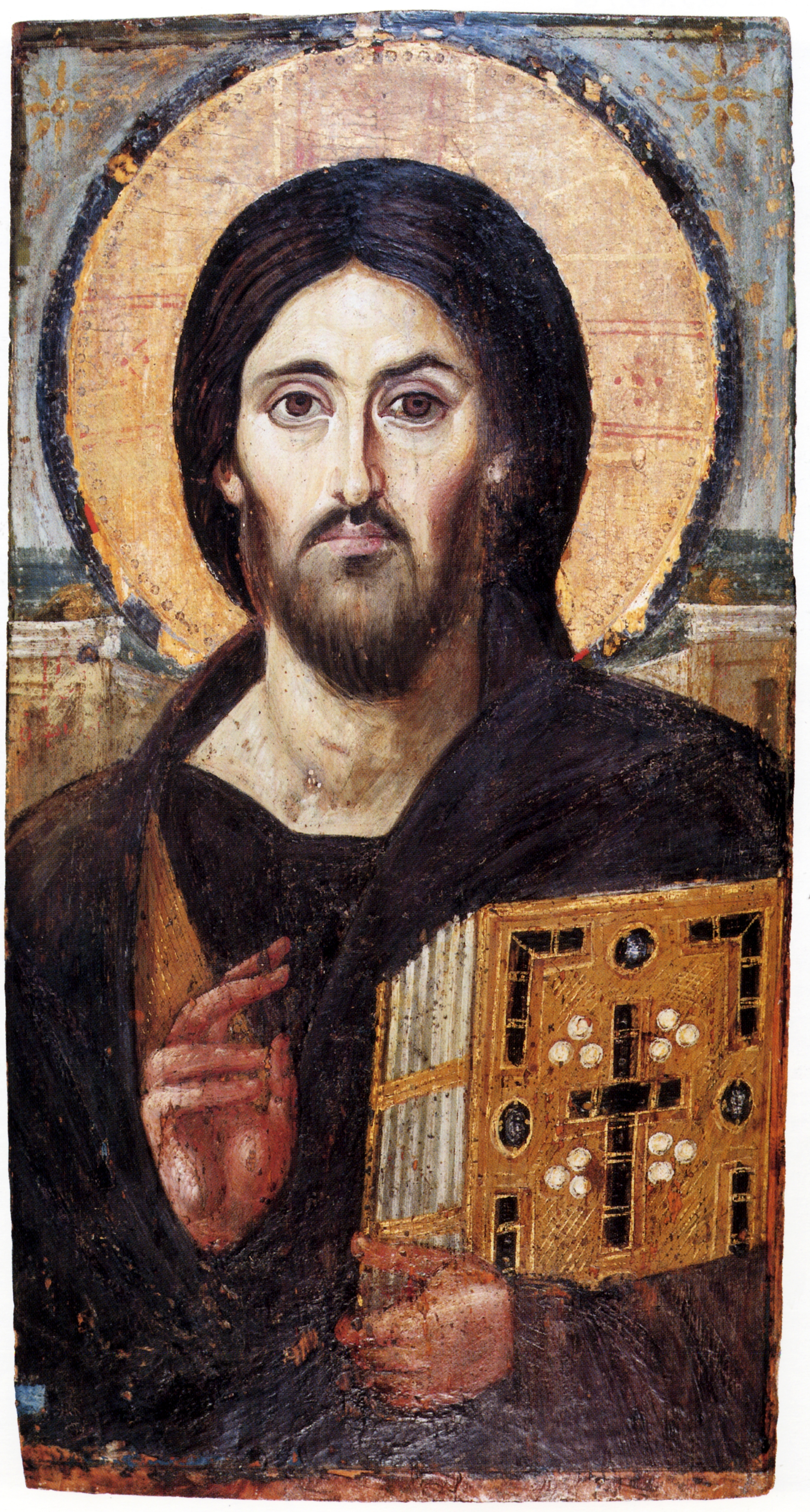
Source: Christ Pantocrator, sixth century, Saint Catherine’s Monastery, Sinai, public domain / Wikimedia Commons
The conclusion uses Christ Pantocrator rather than a collage of saints because the theological order matters. Christ is the source, unity, fulfillment, and judge of the blessed life. He blesses and teaches with His right hand and holds the Gospel with His left. The saints do not surround a vacant ideal; they participate in the life of this living Lord.
The face is visibly asymmetrical in light and expression. Modern viewers sometimes label the two sides “mercy and judgment” or “humanity and divinity.” Those can function as devotional reflections, but they are not proven explanations from the icon’s original setting and should not be taught as historical fact. The icon confesses one undivided Christ, perfect God and perfect man.
His direct gaze supports the contemplation. We do not complete the series by inspecting saints from a safe distance. We stand before Christ and allow His word to inspect us. The Gospel book joins hearing to seeing: the face before us is the One whose Beatitudes we have heard.
Commemoration and the cloud of witnesses
This session is not tied to the feast of any one saint. It falls on the first Sunday of Baba, and its appointed readings shape the lesson through the paralytic carried by four friends, the living stones built into a spiritual house, and the Church as a letter written by the Spirit.
The selected saints belong to the Church’s living memory throughout the year. Saint Mary is celebrated in multiple Coptic feasts rather than reduced to one commemoration. The Twenty-One Coptic Martyrs of Libya are confirmed in the Coptic Synaxarium on 8 Amshir, corresponding to February 15.6
The exact commemorations of Saint Moses, Saint Basil, and Saint Athanasius are not needed to create an artificial October 11 connection. They are included because their lives illuminate the completed series. The Church’s calendar keeps telling us what Hebrews teaches: we run surrounded by witnesses, with our eyes fixed on Jesus.
Fruit to carry from the series
-
Let Christ, not self-improvement, hold the series together. When one Beatitude exposes failure, do not abandon the whole path. Return to the One who gives what He commands. The Jesus Prayer is a daily way to stand poor in spirit and receive mercy again.
-
Refuse to separate inward holiness from your neighbor’s good. Purity, prayer, fasting, and doctrinal fidelity are not private achievements. Ask where the life of Christ in you becomes food, safety, truth, comfort, repair, or courage for someone else.
-
Choose communion over spiritual individualism. The October 11 readings show four carriers, living stones, and a letter written on hearts. Let another Christian carry you where you are weak, and accept one concrete share of another person’s burden.
-
Make visible works transparent to the Father. Do not hide obedience from fear, and do not display it for identity. Serve the real need, examine the hunger for praise, and let gratitude pass beyond you toward God.
-
Adopt the four-part rule of life as a response to grace. Keep one prayer of poverty, one work of mercy, one truthful step toward peace, and one area of visible fidelity. Review it with humility and guidance rather than turning it into another system for self-accusation or comparison.
-
Carry someone to Christ without trying to become Christ for them. You may offer presence, practical help, advocacy, prayer, transportation, or accompaniment to care. You cannot control healing. The four friends open the roof; Jesus forgives and raises the man.
Teaching Guide
30-minute teaching plan
Time Section Aim 0:00–3:00 Can anyone see what we studied? Move from knowledge of the Beatitudes to embodied witness. 3:00–7:00 One face before many faces Establish Christ as fulfillment, source, and giver of the whole life. 7:00–10:00 Ascent and anti-ladder Review Gregory and Chrysostom’s ordered movement alongside Luke’s false fullness. 10:00–17:00 The saints as transparent faces Use Saint Mary, Moses, Basil, Athanasius, and the martyrs without reducing any saint to one label. 17:00–21:00 Salt and light Connect hidden formation to public vocation and the Father’s glory. 21:00–25:00 The October 11 readings Show a parish carrying the wounded, becoming living stones, and embodying a letter of Christ. 25:00–28:00 Rule of life Invite four sustainable responses to grace. 28:00–30:00 Icon, contemplation, prayer End before Christ’s face, not with admiration of human heroes.
- Ask: Invite the room to name the Beatitude that most changed its understanding of blessedness and the one that remains hardest to embody.
- Emphasize: Christ is the source and unity of the whole life; the saints shine by participation in Him, and the Church becomes salt and light together.
- Watch for: Stop one-to-one saint labeling, moral heroism, unsafe reconciliation, martyr grievance, or visible service aimed at the servant’s glory.
- Connect: Join Gregory and Chrysostom’s ascent to Luke’s anti-ladder, then move through the October 11 readings from four carriers to living stones and Christ’s living letter.
- Show: Keep the Sinai Pantocrator visible while moving from Christ, through the saints, to the Church’s shared vocation.
Ask
- Which Beatitude has most challenged your definition of a good life?
- Which one disappears first when you are tired, threatened, or overlooked?
- What is the difference between imitating a saint and copying that saint’s personality or circumstances?
- Where could your parish, family, or friend group be the four carriers in Mark 2?
- What makes a visible work point toward the Father instead of toward the servant?
- Which of the four rule-of-life responses is most necessary now?
Emphasize
- Christ is not merely one face in the lesson. He is the one life visible in all holy faces.
- The Beatitudes are gift and vocation. Grace speaks “Blessed” before the disciple bears fruit.
- Gregory’s ascent and Chrysostom’s golden chain join the virtues without creating spiritual rank.
- Luke’s woes expose false fullness rather than condemning every possession, meal, laugh, or good reputation.
- Saints are not independent moral champions. Holiness is personal participation in Christ by the Holy Spirit.
- Salt and light follow the Beatitudes. Public witness without Beatitude character becomes noise, performance, or harm.
- The four friends in Mark 2 offer an ecclesial image: the Church carries the wounded to Christ; Christ heals.
- The rule of life is a trellis for grace, not a ladder of self-worth.
Watch for
- Do not imply that Christ is “poor in spirit” through deficiency in His divine nature. Speak of His voluntary humility and self-emptying in the Incarnation.
- Do not divide saints into one-to-one Beatitude categories. Name the interwoven virtues in each life.
- Do not present hagiographic stories as if every detail has equal historical certainty. Let Scripture and verified primary sources carry the main claims.
- Do not make sainthood sound like temperament, exceptional productivity, or self-generated moral strength.
- Do not confuse veneration with worship. The Church honors the saints as living members of Christ; worship belongs to God.
- Do not turn salt and light into Christian branding, influence, or political dominance.
- Do not shame people whose faith is presently hidden by fear, trauma, illness, or danger. Safety and patient healing may be the current form of faithfulness.
- Do not pressure unsafe reconciliation. Mercy and peace remain compatible with boundaries, accountability, and protection.
- Do not claim Matthew 5:1–16 is the appointed October 11 liturgy Gospel. It is the confirmed Sixth Hour Gospel. The appointed liturgy Gospel is Mark 2:1–12.
- Do not teach a fixed meaning for the asymmetrical sides of the Sinai Pantocrator’s face.
Connect
- Connect Galatians 2:20 to theosis without confusing participation by grace with identity by nature.
- Connect Chrysostom’s golden chain to the explicit eight-session ascent already taught.
- Connect Saint Mary’s “Let it be” to poverty of spirit, purity, service, and her Magnificat’s holy hunger.
- Connect Saint Moses’s basket to mercy without denial of sin.
- Connect Basil’s Basileias to hunger, mercy, and salt preserving life.
- Connect Athanasius’s Incarnation theology to Christ giving the life the Beatitudes describe.
- Connect Stephen and the Coptic martyrs to a whole Beatitude life kept under pressure, not to grievance.
- Connect Matthew 5:16 with Matthew 6:1 so visibility serves the Father’s glory rather than self-display.
- Connect Mark 2, 1 Peter 2, and 2 Corinthians 3 as three images of a visible Church: carriers, living stones, and Christ’s letter.
- Connect the Sixth Hour Gospel to Christ on the Cross, where every Beatitude finds its costly form.
Show
Display the sixth-century Sinai Pantocrator icon during the opening Christological synthesis and return to it for contemplation. Point first to Christ’s blessing hand and Gospel book. Do not begin with theories about the facial asymmetry. The pedagogical movement should be from Christ’s face, to His life in the saints, to His life being formed in the gathered Church.
For a board or slide, draw three simple lines:
- Christ: the source and fulfillment.
- Saints: distinct lives made transparent to Him.
- Church: a shared life becoming salt and light for the world.
Glossary
- Beatitude: Christ’s declaration of who is blessed under God’s reign and the promise belonging to that life.
- Theosis: Participation by grace in God’s life through union with Christ and the work of the Holy Spirit. It does not mean becoming God by nature.
- Saint: A holy member of Christ whose distinct human life has been transfigured by grace and bears witness to Him.
- Veneration: Honor given to the saints as God’s holy ones. It differs essentially from worship, which belongs to God alone.
- Pantocrator: “Ruler of all” or “Almighty,” a title of Christ emphasizing His divine authority and kingship.
- Rule of life: A modest, sustainable pattern of prayer and obedience that supports attention to grace. It is not a measure of personal worth.
- Golden chain: Chrysostom’s image for the ordered connection among the Beatitudes, each preparing the disciple for what follows.
- Living stones: First Peter’s image for Christians joined to Christ and built together into a spiritual house.
- First Sunday of Baba: The verified Coptic calendar placement of October 11, 2026.
Sources
Primary sources
- Scripture: Matthew 5:1–16; Luke 6:20–26; Hebrews 12:1–3; Galatians 2:20; Philippians 2:5–11; Luke 1:38–55; Mark 2:1–12; 1 Peter 1:22–2:5; 2 Corinthians 2:12–3:6; Acts 7:54–60. Scripture is from NKJV.
- Saint John Chrysostom, Homilies on the Gospel of Matthew, Homily XV on Matthew 5:1–16, especially the “golden chain” and salt-and-light sections. CCEL direct text.
- Saint Athanasius of Alexandria, On the Incarnation of the Word, §§54 and 57, on the Word becoming human for our participation in divine life and approaching the saints by imitating their works. New Advent.
- Paradise of the Holy Fathers, vol. 2, Saying 542, on Saint Moses’s leaking basket of sand; compare Benedicta Ward, trans., The Sayings of the Desert Fathers, Moses 2, where the object is a leaking jug of water.
- Saint Basil the Great, Homily 6, “I Will Tear Down My Barns,” on Luke 12, and Saint Gregory the Theologian, Oration 43, on Basil and the charitable complex called the Basileias.
Secondary and Coptic Orthodox sources
- Coptic Orthodox Diocese of Los Angeles, “Our All-Holy, Immaculate, Most Blessed and Glorified Lady, the Theotokos and Ever-Virgin Saint Mary,” on Saint Mary as a model of obedience, purity, holiness, and humility. https://www.lacopts.org/orthodoxy/our-faith/the-holy-virgin-mary/.
- Coptic Orthodox Diocese of Los Angeles, “The New Martyrs of Libya Added to the Coptic Synaxarium,” confirming their annual commemoration on 8 Amshir. https://www.lacopts.org/news/the-new-martyrs-of-libya-added-to-the-coptic-synaxarium/.
- Mark Allan Powell, “Matthew’s Beatitudes: Reversals and Rewards of the Kingdom,” The Catholic Biblical Quarterly 58, no. 3 (1996): 460–479. JSTOR.
- Coptic Agpeya, Sixth Hour Gospel: Matthew 5:1–16.
- Coptic lectionary for October 11, 2026, the first Sunday of Baba: Pauline Epistle 2 Corinthians 2:12–3:6; Catholic Epistle 1 Peter 1:22–2:5; Acts 13:36–43; liturgy Gospel Mark 2:1–12. These readings shape section 12; the lesson does not claim Matthew 5:1–16 as the appointed Sunday Gospel.
Iconography and image source
Christ Pantocrator, sixth century, encaustic icon from Saint Catherine’s Monastery, Sinai. Wikimedia Commons, public domain.
Footnotes
-
Saint John Chrysostom, Homilies on the Gospel of Matthew, Homily XV on Matthew 5:3–12. After describing how one Beatitude prepares for the next, he says Christ has “woven a sort of golden chain for us.” CCEL deep link. ↩ ↩2
-
Paradise of the Holy Fathers, vol. 2, Saying 542. Compare Benedicta Ward, trans., The Sayings of the Desert Fathers, Moses 2, where the object is a leaking jug filled with water. ↩
-
Saint Athanasius of Alexandria, On the Incarnation of the Word §54.3, trans. Archibald Robertson: “For He was made man that we might be made God.” New Advent. ↩
-
Saint Athanasius of Alexandria, On the Incarnation of the Word §57.3, on cleansing the soul and approaching the saints by imitating their works so as to share “the conduct of a common life.” New Advent. ↩
-
Saint John Chrysostom, Homilies on the Gospel of Matthew, Homily XV on Matthew 5:13–16. Chrysostom says the disciples’ calling is “not for your own life apart … but for the whole world” and connects salt explicitly to the virtues just named in the Beatitudes. CCEL deep link. ↩ ↩2 ↩3
-
Coptic Orthodox Diocese of Los Angeles, “The New Martyrs of Libya Added to the Coptic Synaxarium,” February 21, 2015. https://www.lacopts.org/news/the-new-martyrs-of-libya-added-to-the-coptic-synaxarium/. ↩