
“Blessed are the merciful, For they shall obtain mercy.” Matthew 5:7
Main burden
Mercy is not a virtue practiced by strong people toward inferior people. It is the family likeness of those who have discovered that they themselves live entirely by the mercy of God. Christ does not merely command us to be merciful. He comes to us as the true Good Samaritan, enters the road where sin left humanity wounded, carries what cannot carry itself, and brings us into the healing life of His Church. The person who receives that mercy cannot keep another human being pinned beneath a debt, a failure, a label, or a need. Mercy forgives, feeds, protects, corrects, restores, and bears cost, without calling evil good or reopening unsafe access.
Opening: the file we keep open
Most of us have a file on someone.
It may not be written down, but we know what is in it. The sentence they said. The apology they never gave. The money they failed to repay. The way they embarrassed us, disappointed us, or made our life harder. When their name comes up, we reopen the file. When they fail again, we add another page. Even when we behave politely, some part of us keeps saying, You still owe me.
Sometimes the file is about a stranger. We decide who deserves help before we have looked closely at the wound. Sometimes it is about a family member. We forgive in public but collect the debt in tone, silence, sarcasm, or distance. Sometimes it is about someone who truly did serious harm, and the word mercy sounds like a demand to pretend it did not happen.
Into all of that, Christ says:
“Blessed are the merciful, For they shall obtain mercy.”
This is not sentimental. The Beatitude takes us into the courtroom, the roadside, the family argument, the bank account, the confessional, and finally beneath the Cross.
The question for this week is:
Whose weakness am I using to feel superior rather than to become merciful?
1. Mercy is first the name of God
Before mercy becomes our action, it is God’s self-revelation.
When Moses stands before the Lord after Israel’s sin with the golden calf, God proclaims His own name:
“The Lord, the Lord God, merciful and gracious, longsuffering, and abounding in goodness and truth.” Exodus 34:6
God does not say that He is indifferent to evil. The same passage speaks of truth, justice, and the terrible reach of sin. Yet when He names Himself to a sinful people, mercy stands at the front. His holiness is not cold distance. His justice is not cruelty. His mercy is His holy love moving toward the guilty and the wounded in order to forgive, heal, and restore.
Jesus brings that revelation directly into the life of His disciples:
“Therefore be merciful, just as your Father also is merciful.” Luke 6:36
We are not merciful because we are naturally nicer than other people. We become merciful because mercy is the life of our Father, and the children are meant to bear the Father’s likeness.
Saint Gregory of Nyssa makes this the center of his fifth sermon on the Beatitudes. Scripture repeatedly calls God merciful. Therefore, Gregory says, when a human being becomes merciful, that person is being formed according to a quality by which God Himself is named. Mercy is not merely respectable behavior. It is participation in the divine life. Gregory describes it as a loving willingness to share another person’s pain, then presses the point into one brief phrase: “Mercy is an intensification of love.”1
This protects us from condescension. The merciful Christian does not stand above the wounded person as the successful one above the failure. He recognizes the Father’s image in the other person and the Father’s mercy beneath his own feet.
If I help someone so that I can feel superior, I may have given money without giving mercy. If I forgive so that I can advertise my maturity, I have turned another person’s failure into my stage. If I serve only when the recipient is grateful, teachable, clean, familiar, or likely to improve, I am still placing myself in the judge’s chair.
Mercy begins when I remember: I am not the source. I am a debtor who has been shown mercy.
2. The holy appetite becomes a merciful life
Last week Christ blessed those who hunger and thirst for righteousness. This week He blesses the merciful. The movement matters.
Saint Gregory of Nyssa imagines the Beatitudes as Jacob’s ladder, each blessing lifting the soul toward communion with the blessed God. Poverty of spirit emptied our hands; mourning taught us to grieve sin and suffering; meekness surrendered the power to dominate; hunger and thirst turned desire toward righteousness. Now that holy desire bends toward the wounded neighbor. On Gregory’s ascent, mercy is not an optional kindness added after personal holiness. It is the point at which a soul being drawn toward God begins to resemble the God who is merciful.
Righteousness that never becomes mercy has been misunderstood. We can hunger to be correct, to be vindicated, to see consequences fall on the right people, or to live among people who do not inconvenience us. That hunger may borrow the language of righteousness while remaining centered on ourselves.
Saint John Chrysostom links the two Beatitudes. He warns that mercy must not be funded by injustice or covetousness. Then, commenting directly on Matthew 5:7, he refuses to reduce mercy to money: “The way of showing mercy is manifold, and this commandment is broad.”2
Mercy includes almsgiving, but it cannot be contained there. It includes:
- forgiving a real offense without continuing to use it as leverage;
- feeding, clothing, housing, visiting, or materially supporting someone in need;
- listening without turning another person’s pain into gossip;
- correcting someone for the sake of healing rather than humiliation;
- protecting the vulnerable when silence would be easier;
- making room for repentance after consequences have done their work;
- carrying inconvenience that love has placed directly in our path;
- praying for someone whose failure has made us angry;
- refusing to reduce a person to the worst thing he has done.
Chrysostom then compares the promise with the action. We show mercy as human beings with small resources and mixed motives; we receive mercy from the God of all. The exchange is not equal. We do not buy divine forgiveness with a few acts of kindness. God’s mercy is immeasurably greater than ours. Yet the mercy we receive is meant to open a passage through us.
Luke 6 does not give mercy a neat one-to-one opposing woe. We should not force one. Instead, the whole cluster of woes exposes the conditions that can make a heart unmerciful: wealth that insulates us from need, fullness that makes another person’s hunger invisible, laughter that refuses to enter another’s sorrow, and public approval that makes us protect our image instead of crossing the road. The anti-ladder is not simply “cruelty.” It is the self-satisfied life that has enough comfort, distraction, and admiration to avoid sharing anyone else’s burden. Matthew blesses those in whom received mercy has broken that insulation.
A blocked passage is the crisis in the parable of the unforgiving servant.
3. The servant who wanted grace for himself and accounting for everyone else
Peter asks Jesus how many times he must forgive a brother who sins against him. He proposes seven, a number that already sounds generous. Jesus answers with a number that destroys the ledger: “up to seventy times seven.” Then He tells a story about two debts.
A servant owes a king ten thousand talents. The amount is deliberately overwhelming. It is not a difficult payment plan. It is a debt beyond his power to repay. The servant asks for patience and promises the impossible: “I will pay you all.” The king does more than delay collection. He is moved with compassion, releases the servant, and forgives the debt.
Then the forgiven man goes out and finds a fellow servant who owes him one hundred denarii. The second debt is not imaginary. A real wrong has occurred. Mercy does not require us to say that nothing is owed. But the scale of the story is meant to expose the horror of what happens next.
The first servant seizes the second by the throat and says, “Pay me what you owe!” The second man uses almost the same plea the first servant had used before the king: “Have patience with me, and I will pay you all.” The words should have sounded familiar. But received mercy has not entered the first servant’s memory. He sends the man to prison.
The most frightening sentence in the parable is not the king’s judgment. It is the transition: “But that servant went out.”
He left the room of mercy unchanged.
He received cancellation without communion. He wanted relief from consequences but not the heart of the king. He could narrate what had been done for him, yet he still approached his brother with hands around a throat.
That is possible in religious life. We can say “Lord, have mercy” dozens of times and still preserve one person as the exception. We can confess our sins using careful spiritual language, then go home and punish a spouse with silence. We can receive absolution and still refuse an apology because it did not sound painful enough. We can speak beautifully about grace and delight when someone we dislike is publicly exposed.
Christ’s warning is severe because the danger is real. Mercy is not the price that forces God to forgive us. His initiative comes first. The king cancels the impossible debt before the servant has done anything merciful. But a heart that finally refuses mercy refuses the life of the King. It closes itself around the very debt from which it asked to be released.
James says it without softening it:
“For judgment is without mercy to the one who has shown no mercy. Mercy triumphs over judgment.” James 2:13
“Mercy triumphs over judgment” does not mean that truth disappears or evil becomes harmless. It means God’s purpose is not satisfied by merely proving us guilty. His mercy enters judgment to expose evil, forgive the repentant, repair what sin has broken, and form a people who no longer need another person’s condemnation to feel righteous.
The question is not whether someone truly owes us. The question is whether we want the debt handled by Christ, or whether keeping our hands around the person’s throat has become part of our identity.
4. Christ crosses the road toward us
The unforgiving servant shows mercy refused. The Good Samaritan shows mercy moving.
A lawyer asks Jesus, “Who is my neighbor?” The question seeks a boundary. Whom must I love, and where may I stop? Jesus answers with a wounded man whose identity has been stripped from him. Robbers have taken his clothing, beaten him, and left him half dead. A priest sees him and passes by. A Levite comes close enough to look and passes by.
Then comes the Samaritan, the person from whom Jesus’ hearers would least expect faithful love.
“And when he saw him, he had compassion. So he went to him and bandaged his wounds, pouring on oil and wine; and he set him on his own animal, brought him to an inn, and took care of him.” Luke 10:33–34
Notice the verbs. He sees. He has compassion. He goes to him. He binds. He pours. He lifts. He brings. He cares. He pays. He promises to return.
Mercy is not a feeling admired from the safe side of the road. It moves the body. It spends time. It touches what is unpleasant. It uses personal resources. It accepts interruption. It stays after the first emotional moment has passed.
Chrysostom draws a sharp conclusion from the parable. When a person is afflicted, we should not begin by investigating whether he is worthy enough to receive our care. “His being in affliction,” Chrysostom says, “involves a just claim on thy aid.”3 This does not mean every request must be granted in the form requested. Wise mercy can say no to manipulation, seek help, set limits, or offer a different kind of care. It does mean we may not use the investigation of worthiness as camouflage for a heart that simply does not want to be interrupted.
Saint Clement of Alexandria takes the parable further. The Samaritan is not only a model placed in front of us. He is an image of the Savior who has pitied us. Humanity lies wounded by fears, lusts, passions, pains, deceits, and pleasures. Christ is the Physician who comes near, pours healing upon our souls, binds us with faith, hope, and love, and bears us toward life.4
We can show mercy because Christ first crossed the road toward us.
He did not love humanity from a distance. The Son took our flesh. He entered our mortality. He touched lepers, ate with sinners, wept beside a tomb, forgave from the Cross, descended into death, and rose carrying human nature into life. The Good Samaritan spends oil and wine; Christ spends Himself.
At the Cross, mercy is not God pretending sin does not matter. The wounds reveal exactly what sin does. Mercy is God refusing to let our violence have the final word. Christ receives it, judges it by exposing its full horror, forgives His enemies, and breaks death through the Resurrection.
The Beatitude is therefore first a portrait of Christ: Blessed is the Merciful One, for He gives the mercy by which the world is saved. In Him, those who were wounded become people who can bind wounds.
5. What mercy is not
Because mercy is holy, counterfeits can cause real harm.
Mercy is not denial
Forgiveness does not require the sentence, “It was nothing.” If it were nothing, there would be nothing to forgive. Mercy tells the truth about the debt and refuses to make vengeance its future.
Mercy is not the removal of every consequence
A person can be forgiven and still need to repay money, step away from leadership, receive treatment, face legal consequences, or rebuild trust over time. Consequences can protect people and serve repentance. The test is whether we seek healing and truth, or whether we are making suffering itself the goal.
Mercy is not compulsory reconciliation
Forgiveness and reconciliation are related, but they are not identical. Forgiveness can be offered by one person before the other repents. Reconciliation requires truth, repentance, safety, and the rebuilding of trust by both. No victim should be pressured to restore private access to an abusive or dangerous person in the name of mercy.
Mercy is not enabling
Giving cash that will likely feed an addiction may be less merciful than offering food, transportation, treatment support, or the presence needed to reach appropriate help. Saying yes to every demand can protect a destructive pattern instead of the person.
Mercy is not avoiding correction
Sometimes the merciful sentence is the hard sentence. A parent who refuses every boundary is not merciful to the child. A servant who hides misconduct to protect the ministry’s image is not merciful to the wounded or to the offender’s soul. Truth can cut like wine on a wound, but the hand applying it must still be a healing hand.
Mercy is not superiority in religious clothing
“I feel sorry for them” can preserve distance. Gregory’s definition is stronger. Mercy shares the burden. It becomes, in his words, a loving shared disposition toward the suffering person. The merciful do not simply look down and distribute. They come near.
6. Joseph: mercy with memory, truth, and power
The Old Testament gives us a demanding image of mercy in Joseph.
His brothers hated him, stripped him, cast him into a pit, sold him, and allowed their father to live for years beneath a lie. When famine later brings the brothers before Joseph in Egypt, the balance of power has completely reversed. They need grain; he has authority. They do not recognize him, but he recognizes them.
Joseph does not pretend the past never happened. When he finally reveals himself, he says plainly, “I am Joseph, your brother, whom you sold into Egypt” (Genesis 45:4). Mercy does not edit evil into innocence.
Nor does Joseph rush immediately into untested familiarity. The chapters before Genesis 45 include questions, pressure, and the testing of his brothers’ character. Judah’s willingness to offer himself for Benjamin reveals that something has changed. The story therefore does not teach that trust must be restored without evidence.
Yet when the moment comes, Joseph refuses to use his power to make his brothers feel what he felt. He weeps. He draws them near. He sees that God’s providence has brought life out of their evil without calling the evil good. Then he uses the position they once tried to prevent him from having in order to preserve them and their children through the famine.
“But now, do not therefore be grieved or angry with yourselves because you sold me here; for God sent me before you to preserve life.” Genesis 45:5
Joseph does not say, “You did not sell me.” He says, in effect, Your sin is not sovereign. God is.
This is mercy with memory, truth, boundaries, tears, and power offered for another’s life. It prepares us to see Christ, rejected by His own and handed over to death, rise not to destroy His brothers but to speak peace, feed them with His life, and make their betrayal the place where salvation is revealed.
When we gain power over someone who once wounded us, mercy asks what we will do with it. Will we recreate the pit? Will we demand humiliation as proof of repentance? Or can the power that might have punished become power that protects, tells the truth, and preserves life?
7. The Church is an inn for people still being healed
The Good Samaritan does not leave the man where He found him. He brings him to an inn and entrusts him to ongoing care.
The Fathers often saw in this scene the mystery of salvation. Christ is the Samaritan who comes to wounded humanity; the inn is the Church, where healing continues. This reading does not replace Jesus’ direct command to serve the neighbor. It tells us where the power and pattern for that service come from.
The Church is not a showroom for people who have never been wounded. She is the inn into which Christ carries people who cannot heal themselves.
In Baptism, we are joined to His death and Resurrection and receive the washing of new life. In confession, the wound is named without being made our final name. The priest does not invent mercy; he serves the reconciliation Christ entrusted to His Church. In the Eucharist, the One who spent Himself for us becomes our food, teaching us that Christian life is received before it is given.
The words “Lord, have mercy” are therefore not filler between more important prayers. They are the breathing of the wounded in the inn. We ask for pardon, healing, protection, help, and the presence of God. Then the liturgy sends us back onto the road carrying what we asked to receive.
Matthew 5:1–16 is read in the Coptic Agpeya at the Sixth Hour, the hour in which the Church remembers the Cross. That placement keeps mercy from becoming vague kindness. At midday we hear, “Blessed are the merciful,” while standing before the Crucified One who prayed for His enemies and opened Paradise to a thief.
If the Eucharist does not slowly loosen our grip on another person’s throat, we are resisting the medicine. If confession makes us more aware of other people’s sins than our own need, we have used the sacrament as another mirror for pride. If “Lord, have mercy” never becomes “How can I become neighbor to the person before me?” the prayer has not yet reached our hands.
8. Mercy in ordinary adult life
Mercy usually arrives without a dramatic soundtrack. It looks like the next faithful act.
At home
Mercy listens to the whole sentence before preparing a defense. It does not bring six old failures into today’s disagreement. It disciplines a child without making the child feel disposable. It cares for an aging parent without pretending the burden is easy. It apologizes without explaining why the other person made the sin understandable.
At work
Mercy gives truthful feedback without public humiliation. It does not enjoy a colleague’s failure because that failure improves our standing. It shares credit. It protects someone being scapegoated. It can remove responsibility from a person who is harming the team while still refusing contempt.
With money and possessions
Mercy leaves room in the budget for someone else’s need. It pays fairly and promptly. It gives useful things with dignity, not only unwanted leftovers. It asks whether our comfort is being subsidized by another person’s exhaustion, underpayment, or invisibility.
In church service
Mercy does not confuse standards with coldness. It corrects errors without reducing the servant to the error. It notices the newcomer standing alone. It refuses gossip disguised as a prayer request. It remembers that ministries exist for people, not people for ministries.
In conflict
Mercy releases the fantasy of making the other person suffer enough to understand. It may still name the wrong, request repair, involve authority, or establish a boundary. But it does not feed on humiliation. It wants repentance more than defeat.
Toward visible need
Mercy does not have to solve every problem to become neighbor. The Samaritan did not eliminate robbery from the road between Jerusalem and Jericho that day. He cared for the person placed before him. We can become paralyzed by the size of suffering, or protected by the thought that our small act will not fix the system. Christ asks a smaller and harder question: Will you cross the road?
A practice for this week: one debt, one wound, one interruption
For seven days, pray Luke 6:36 each morning:
“Be merciful, just as your Father also is merciful.”
Then choose one action in each of these three areas.
-
One debt to release
Name one offense you repeatedly collect in memory. Forgiveness may be a process, especially after serious harm. Begin by saying before Christ: “This debt is real, but vengeance is not my calling. Judge truthfully, protect what must be protected, and free my heart from hatred.” If reconciliation is unsafe, do not force contact. -
One wound to bind
Notice one concrete need within reach: a meal, a ride, a phone call, a hospital visit, help with a bill, childcare, advocacy, or quiet companionship. Offer something that actually serves the person’s good. -
One interruption to accept
Leave enough space in one day to be inconvenienced by love. Put the phone down. Let the conversation take longer. Cross the room, the office, the church hall, or the street.
At night, ask:
- Where did I receive mercy today?
- Where did I pass by?
- Did I seek the person’s healing, or the feeling of being a good person?
- What debt am I still using to hold someone below me?
Bring the answers to confession when needed. Do not turn the exercise into self-condemnation. The point is to return to the Innkeeper with the wound uncovered.
Personal contemplation
See the wounded man on the road.
His clothing is gone. You cannot identify his rank, his politics, his usefulness, his gratitude, or whether he would have helped you. You can only see that he is wounded.
Now notice how quickly the mind begins its investigation. What happened? Was it his fault? Is this a trap? Why was he traveling alone? Will helping become a long-term obligation?
Some of those questions may eventually matter. None of them binds the first wound.
Now look again, and see yourself in the road.
See Christ come near without disgust. He does not ask whether you can repay the oil, the wine, the animal, the night at the inn, or the promise of His return. He lifts you with hands already moving toward the Cross.
What changes when the person beside the road is no longer “one of those people,” but someone Christ identifies with, and someone whose place you have occupied?
Whose face appears?
What would it mean to cross the road this week?
[Pause for 15–20 seconds.]
Conclusion
“Blessed are the merciful” is not a compliment for soft personalities.
It is Christ’s promise that the life of God is taking flesh in people who have stopped treating mercy as a private possession.
The merciful tell the truth, because lies do not heal. They forgive, because they have been released from an impossible debt. They give, because what they possess was first received. They correct without cruelty, protect without hatred, and set boundaries without turning another human being into a monster. They cross the road because Christ crossed the greater distance toward them.
The world asks, “Does this person deserve my mercy?” Christ asks, “Do you remember the room in which your debt was cancelled?”
The world asks, “Who qualifies as my neighbor?” Christ asks, “To whom will you become neighbor?”
The world keeps the file open. Christ opens His hands on the Cross.
We do not earn His mercy by imitating it. We discover that His mercy, truly received, refuses to remain still. It moves from the altar to the road, from confession to forgiveness, from “Lord, have mercy” to “Go and do likewise.”
Closing prayer
Lord Jesus Christ, true Good Samaritan and Physician of our souls, You found us wounded and did not pass by. You carried what could not carry itself, forgave the debt we could never repay, and brought us into the healing life of Your Church. Tear from our hands the ledgers we use against one another. Give us truth without cruelty, forgiveness without denial, generosity without superiority, and boundaries without hatred. Open our eyes to the person beside the road. Make our prayer, “Lord, have mercy,” pass from our lips into our time, money, attention, courage, and care. As You have shown mercy to us, form in us the likeness of Your merciful Father, until mercy triumphs and every wound is healed in Your Kingdom. Amen.
Teaching Guide
30-minute teaching plan
Time Section Aim 0:00–3:00 Opening: the file we keep open Let the room recognize debt-keeping in ordinary relationships. 3:00–7:00 Mercy is first the name of God Root mercy in Exodus 34, Luke 6:36, and participation in the Father’s likeness. 7:00–10:00 Righteousness becomes mercy Connect Session 5 to Session 6 and broaden mercy beyond money. 10:00–16:00 The unforgiving servant Expose the tragedy of receiving cancellation without receiving the King’s heart. 16:00–21:00 Christ the Good Samaritan Make Christ’s saving mercy the center, then move to “Go and do likewise.” 21:00–24:00 What mercy is not Protect truth, consequences, boundaries, and vulnerable people. 24:00–26:00 Joseph and the power to preserve Show mercy naming evil without recreating the pit. 26:00–28:00 Church and ordinary life Connect confession, Eucharist, the Agpeya, and recognizable adult situations. 28:00–30:00 Practice, contemplation, and prayer Leave the room with one debt, one wound, and one interruption.
- Ask: Begin with the internal “file,” but do not require anyone to disclose trauma or an unsafe relationship.
- Emphasize: Mercy begins in God, reaches us in Christ, and then becomes concrete through us.
- Watch for: Do not imply that forgiveness erases consequences, requires immediate reconciliation, or restores unsafe access.
- Connect: Keep Matthew 18 and Luke 10 together. The forgiven debtor must become the neighbor who crosses the road.
- Show: Display the Aldegrever Good Samaritan engraving during Luke 10 and the contemplation. Identify it honestly as a sixteenth-century Western engraving, not an Orthodox icon.
Ask
- What is the difference between releasing a debt and pretending no debt existed?
- Why is the sentence “But that servant went out” so spiritually dangerous?
- Where do you see the difference between compassion as a feeling and mercy as a costly action?
- How can accountability serve healing rather than vengeance?
- Who becomes easier to judge when you forget how much mercy you have received?
Emphasize
- God’s mercy is the source. Human mercy is response and participation, not payment for grace.
- Gregory’s ascent moves from empty hands and healed desire toward resemblance to the merciful God; mercy is personal holiness becoming love for the wounded neighbor.
- Luke supplies no single woe directly opposite Matthew 5:7. Use the whole woe cluster to expose the comfort and self-satisfaction that insulate us from another person’s burden.
- The unmerciful servant’s smaller debt is real. The parable does not deny harm; it exposes the heart that wants grace for itself and strict accounting for everyone else.
- Chrysostom’s “broad commandment” includes money, action, forgiveness, attention, advocacy, correction, and care.
- The Samaritan’s mercy has verbs. He sees, approaches, binds, lifts, brings, pays, and returns.
- Christ is not merely the One who says “Go.” He is the Samaritan who first came to us.
- The Church is the inn of continuing healing, not a showroom for the unwounded.
Watch for
- Do not describe abuse as a minor debt or pressure a victim to contact an offender.
- Do not equate forgiveness with restored trust. Reconciliation requires truth, repentance, safety, and mutual work.
- Do not turn material mercy into careless giving. Wise help seeks the person’s actual good.
- Do not make the priest and Levite into a license for contempt toward clergy or worship. Jesus exposes religious identity that does not become love.
- Do not claim this Beatitude makes divine mercy a commercial exchange. The king’s mercy comes first and exceeds the servant’s capacity.
- Do not claim Matthew 5:7 is the appointed Gospel for September 6, 2026. Matthew 5:1–16 is the confirmed Sixth Hour Gospel in the Agpeya. The appointed liturgy Gospel for the first Sunday of Nasie is Matthew 24:3–35.
Connect
- Connect hunger for righteousness to mercy: holy desire must become the healing of the neighbor, not pleasure in being correct.
- Connect Gregory’s ladder to the preceding sessions: poverty empties, mourning grieves, meekness surrenders domination, holy hunger desires what God loves, and mercy begins to bear God’s likeness toward the neighbor.
- Connect Luke 6:24–26 as a cluster, not a fabricated one-to-one pairing: wealth, fullness, laughter, and approval can become insulation against costly mercy.
- Connect Exodus 34:6 to Luke 6:36: the Father forms His children in the mercy by which He names Himself.
- Connect Matthew 18 to confession: we enter with an unpayable debt and must not leave with our hands around another person’s throat.
- Connect Luke 10 to the Incarnation and Cross: Christ comes near, bears the wounded, pays the cost, and promises to return.
- Connect Genesis 45 to truthful mercy: Joseph names the betrayal, tests whether change is real, relinquishes vengeance, and uses power to preserve life.
- Connect the inn to the Church’s sacramental life while preserving the parable’s direct command to serve anyone in need.
- Connect James 2:13 to judgment transformed by mercy, not truth abolished by sentiment.
Show
Use Heinrich Aldegrever’s 1554 engraving when reading Luke 10:33–35. The wounded traveler lies stripped in the foreground, while the Samaritan kneels close enough to touch and treat him. The priest and Levite continue in the middle distance. Ask the room to notice the difference between seeing from a distance and mercy that closes the distance. During the contemplation, leave the image visible and invite people first to see the wounded neighbor, then to recognize themselves as the person Christ has lifted. State that this is a Western narrative engraving used for its clear contrast, not a canonical Orthodox icon.
Iconography connection
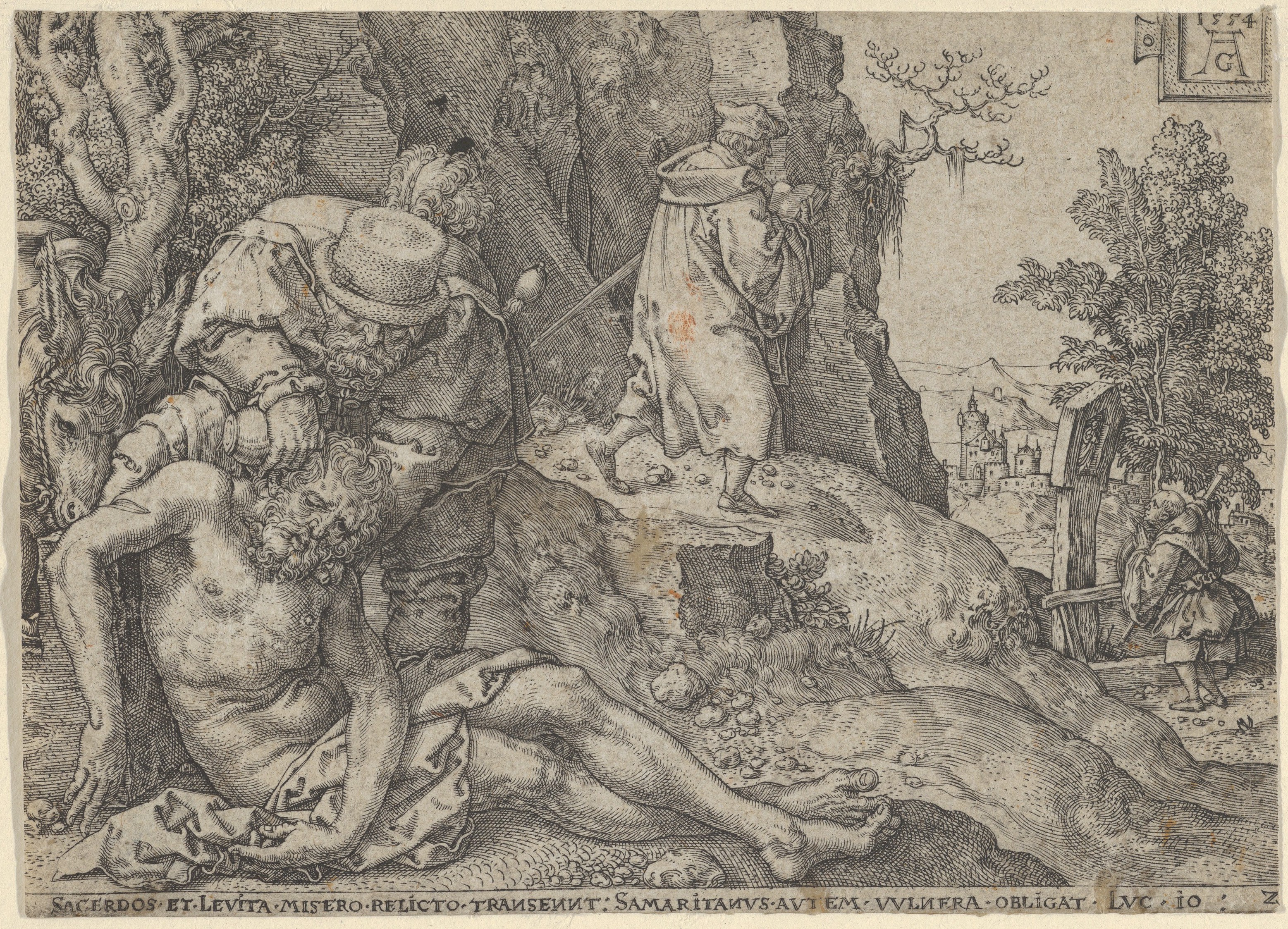
Source: Heinrich Aldegrever, The Good Samaritan Tending the Traveller’s Wounds with Oil and Wine; The Priest and the Levite Passing, 1554, The Metropolitan Museum of Art, CC0 / Wikimedia Commons
No single fixed Orthodox feast icon is central to Matthew 5:7. The Good Samaritan, however, is a natural narrative scene for the lesson because it makes mercy’s movement visible. In this engraving, the wounded man’s exposed body occupies the foreground. He cannot advertise his worthiness or group identity. The Samaritan bends toward him while the priest and Levite recede along the road. The composition asks a spiritual question before a doctrinal one: Which direction is my body moving when suffering enters my sight?
Orthodox patristic interpretation deepens the scene beyond moral example. Christ is the One who comes to humanity wounded by sin and death. He binds, carries, and entrusts the wounded to the Church’s healing. That interpretation should not make the actual sufferer disappear into symbolism. It makes the command more demanding. If Christ has identified Himself with the wounded and has occupied the place of the merciful Stranger, then the person before us is neither an interruption nor an object. The person is the place where received mercy is asked to become visible.
The visual is a sixteenth-century Western engraving rather than an Orthodox icon. Use it as a clear narrative aid, not as the definitive iconographic interpretation of the parable.
Glossary
- Beatitude: Christ’s declaration of who is blessed under God’s reign and what promise belongs to that life.
- Mercy / eleos: Compassionate love moving toward guilt, suffering, or need in order to forgive, heal, protect, or restore.
- Merciful / eleēmones: The Greek word in Matthew 5:7 for people characterized by mercy. It shares its root with eleos but should not be reduced to a merely emotional feeling.
- Almsgiving: Material mercy offered to someone in need. In Orthodox life it belongs with prayer and fasting as a basic work of repentance and love.
- Forgiveness: Releasing personal vengeance and entrusting judgment to God. It does not require denying harm or immediately restoring trust.
- Reconciliation: The rebuilding of communion through truth, repentance, forgiveness, safety, and restored trust. It ordinarily requires participation from both sides.
- Theosis: Participation by grace in the life of God. Gregory reads mercy as a way the human person is formed in the likeness of the merciful God.
- Nasie: The short intercalary period at the end of the Coptic year before Nairouz.
Sources
Primary sources
- Scripture: Matthew 5:7; Matthew 18:21–35; Luke 10:25–37; Luke 6:24–26, 36; James 2:13; Exodus 34:5–7; Genesis 45:1–15. Scripture is from NKJV.
- Saint John Chrysostom, Homilies on Matthew, Homily XV, §6, on the breadth of mercy and the greater gift of divine mercy. New Advent; CCEL.
- Saint John Chrysostom, Homilies on Hebrews, Homily X on Hebrews 6:7–8, §8, on the Good Samaritan and helping the afflicted without first investigating worthiness. CCEL deep link.
- Saint Gregory of Nyssa, Oration 5 on the Beatitudes, on mercy as participation in a divine quality and as love sharing another’s pain. Online-direct synchronized text: Catholic Library, beginning of Oration 5 and discussion of mercy.
- Saint Clement of Alexandria, Who Is the Rich Man That Shall Be Saved?, §§28–29, on the Samaritan’s concrete care and Christ as the Physician of wounded souls. New Advent.
Secondary academic sources
- Mark Allan Powell, “Matthew’s Beatitudes: Reversals and Rewards of the Kingdom,” The Catholic Biblical Quarterly 58, no. 3 (1996): 460–479. JSTOR.
- Hubertus R. Drobner and Albert Viciano, eds., Gregory of Nyssa: Homilies on the Beatitudes: An English Version with Commentary and Supporting Studies, Supplements to Vigiliae Christianae 52 (Brill, 2000).
- Jonathan T. Pennington, The Sermon on the Mount and Human Flourishing: A Theological Commentary (Baker Academic, 2017).
Coptic Orthodox and pastoral sources
- Coptic Agpeya, Sixth Hour Gospel: Matthew 5:1–16, confirmed in the local Coptic lectionary reference.
- Coptic lectionary for September 6, 2026, the first Sunday of Nasie. The appointed liturgy Gospel is Matthew 24:3–35. The lesson does not claim Matthew 5:7 as the appointed Sunday Gospel.
Iconography and image sources
Heinrich Aldegrever, The Good Samaritan Tending the Traveller’s Wounds with Oil and Wine; The Priest and the Levite Passing, 1554, engraving, The Metropolitan Museum of Art, object 57.658.71(2). Wikimedia Commons, CC0.
Footnotes
-
Saint Gregory of Nyssa, Oration 5 on the Beatitudes, synchronized English text, Catholic Library. Gregory defines mercy as a loving shared disposition toward those suffering grievous things and calls it “an intensification of love.” Online-direct mirror, not yet in the local corpus. ↩
-
Saint John Chrysostom, Homilies on Matthew, Homily XV, §6, trans. George Prevost and M. B. Riddle, New Advent. Local corpus segment 43318, quote-eligible, direct-online-verified NPNF text. ↩
-
Saint John Chrysostom, Homilies on Hebrews, Homily X on Hebrews 6:7–8, §8, trans. Philip Schaff and collaborators, CCEL deep link. Local corpus segment 39745, quote-eligible, direct-online-verified NPNF text. ↩
-
Saint Clement of Alexandria, Who Is the Rich Man That Shall Be Saved?, §§28–29, trans. William Wilson, New Advent. Clement first insists on the Samaritan’s concrete supplies and care, then identifies Christ as the Savior who pities and heals wounded humanity. ↩