
Start here: Do I read them all at once?
No. You do not have to read all the listed readings at once. The Daily Readings page groups passages by the church services in which they are appointed: Vespers is evening worship, Matins is morning worship, and the Divine Liturgy is the Eucharistic service, centered on Holy Communion. These headings describe the Church’s worship, not a mandatory personal checklist.
At home, begin with the Gospel under Liturgy, read it slowly, and pause to pray. You may read more in one sitting or spread the passages through the day. Parish schedules vary, and services may be celebrated one after another.
One detail explains the apparent date puzzle: in the liturgical tradition, a new day begins with evening prayer. Saturday evening Vespers therefore belongs to Sunday’s worship. This website’s date picker uses a civil calendar date, however, not an automatic sunset change: select Sunday to find its Vespers readings for Saturday evening.
Whether you are Catholic, Protestant, exploring Christianity, or visiting an Orthodox church for the first time, you are welcome to begin with one passage.
Source: Original generated artwork for Orthodox Bible Study. An illustration, not a photograph of a particular church.
What is a lectionary?
A lectionary is an ordered calendar of Bible readings for worship. Katameros is the name commonly used for the Coptic Church’s lectionary books, which arrange readings according to the Church’s calendar and services.
Instead of always reading straight through one biblical book, the Church hears Scripture through the life of Christ: His birth, ministry, Passion, Resurrection, and the gift of the Holy Spirit. Feasts, seasons of fasting, Sundays, and commemorations help shape the appointed selections.
That does not replace reading whole biblical books. It gives us another way of listening: with the Church, returning to the same saving events as the year unfolds.
This guide describes Coptic Orthodox practice. Other Orthodox traditions also have lectionaries, but their daily selections and service arrangements are not identical.
Why does the Church’s day begin in the evening?
Genesis repeatedly describes creation’s days with evening followed by morning, beginning in Genesis 1:5. The Church’s evening-to-morning rhythm recalls this biblical pattern. Sunday worship does not appear suddenly when we wake up: the preceding evening already opens toward it.
Coptic Reader’s official documentation gives the practical example of Saturday evening Vespers using Sunday’s readings.1 That explains the liturgical relationship, not a universal clock time for every parish.
Keep two things separate:
- The liturgical day joins the preceding evening with the following day’s worship.
- The website’s selected date identifies the day whose readings are displayed. It should not be assumed to advance at sunset.
For a particular parish service, follow the parish calendar and the priest’s guidance, especially around feasts and fasts. The date on your phone is not, by itself, a service rubric.
What happens at the three services?
In Coptic usage, Vespers and Matins are also called the Evening Raising of Incense and Morning Raising of Incense. They include prayers, hymns, incense, and the proclamation of Scripture. They prepare the Church for the Divine Liturgy, but they are not simply alternative names for it.2
The Divine Liturgy includes the proclamation of the Word and the celebration of the Eucharist. The readings belong within that worship, not to an unrelated lecture before the service begins.
Reading groups at a glance
| Service | Usual setting | Readings in the ordinary pattern | A gentle home practice |
|---|---|---|---|
| Vespers | Previous evening | Psalm and Gospel | Read the Gospel as you prepare for the next day’s worship. |
| Matins | Morning, often before Liturgy | Psalm and Gospel | Read a passage before the day’s demands gather. |
| Divine Liturgy | Following the morning preparation, where served | Pauline Epistle, Catholic Epistle, Praxis, Synaxarium when appointed, Psalm and Gospel | Begin with its Gospel; add another reading as you are able. |
This is the usual outline, not an exhaustive rule for every date. Seasons and feasts can change the pattern or add readings.3
Here is what the unfamiliar labels mean:
- Psalm: a selection from the Bible’s book of prayer and praise, ordinarily proclaimed before the Gospel.
- Gospel: a passage from Matthew, Mark, Luke, or John, proclaiming the life and teaching of Jesus Christ.
- Pauline Epistle: a reading from the letters received in the Church’s Pauline collection. An epistle is a letter.
- Catholic Epistle: a reading from the general letters of James, Peter, John, or Jude. Here catholic means general or universal. It does not mean a passage reserved for Roman Catholics.
- Praxis (Acts): a reading from the Acts of the Apostles, telling of the risen Christ’s work through His apostles and the Holy Spirit.
- Synaxarium: the Church’s calendar collection of commemorations, including accounts of saints and martyrs. It is not a book of the Bible. Its place in the usual Liturgy follows Acts, but its liturgical reading is subject to seasonal practice.3
The website may display commemorations even when the Synaxarium is not read aloud in the service. A calendar display is not a command to insert every item into worship.
A simple day in the life
Imagine preparing for a Sunday Liturgy. The following times are illustrative, not prescribed:
- Saturday, 6 p.m.: Vespers. The parish gathers for evening worship. Its Psalm and Gospel belong to Sunday’s liturgical day.
- Sunday, 8 a.m.: Matins. Morning prayer prepares the congregation for the Liturgy, with its own Psalm and Gospel.
- Sunday, 9 a.m.: Divine Liturgy. The Church hears the appointed readings and continues into the Eucharistic celebration.
Your parish might begin earlier or later. Matins and Liturgy may follow without a long break. A feast’s Liturgy may have an evening or nighttime schedule. Not every parish serves the Divine Liturgy daily, even though the calendar supplies readings for the day.
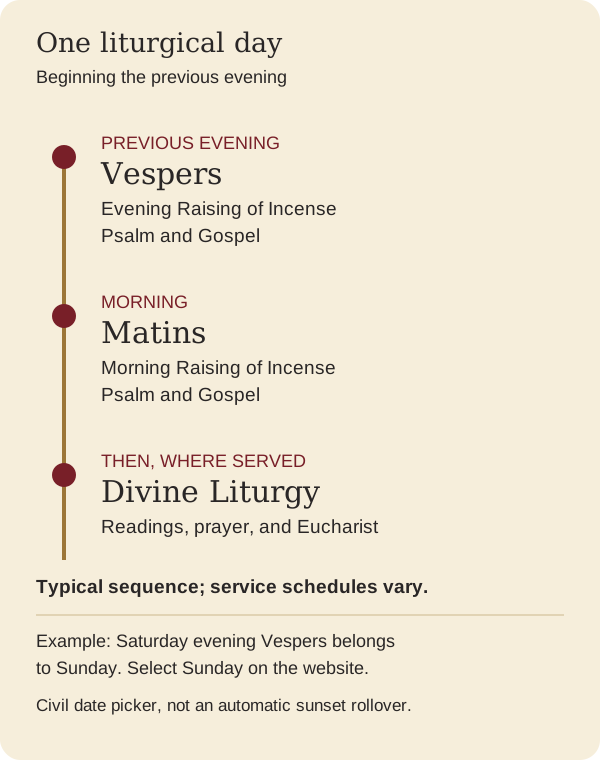
Source: Original Orthodox Bible Study diagram with editable text. Typical sequence; service schedules vary.
At home, you do not need to recreate this timetable. It explains where the readings belong, not when your household must finish them.
How to use the Daily Readings page at home
Open Daily Readings and take one step at a time:
- Check the displayed date. Use the previous-day and next-day arrows, or open Choose date, select a date, and press Show readings. Today returns to the current civil date.
- Find the service heading. On an ordinary day, look for Vespers, Matins, and Liturgy. Special days may present different groups.
- Choose one passage. The Gospel under Liturgy is a good starting point. Use the displayed reference to read the appointed verses in your Bible. Some references link to a study rather than to a full Bible-text display.
- Pause before moving on. Notice what Christ says or does, what calls for thanksgiving or repentance, and what you need to bring before Him in prayer.
- Explore further if helpful. Read the Synaxarium commemoration titles shown on the page. Where available, the Study these readings section offers related studies. A study may cover a longer passage than the day’s selection.
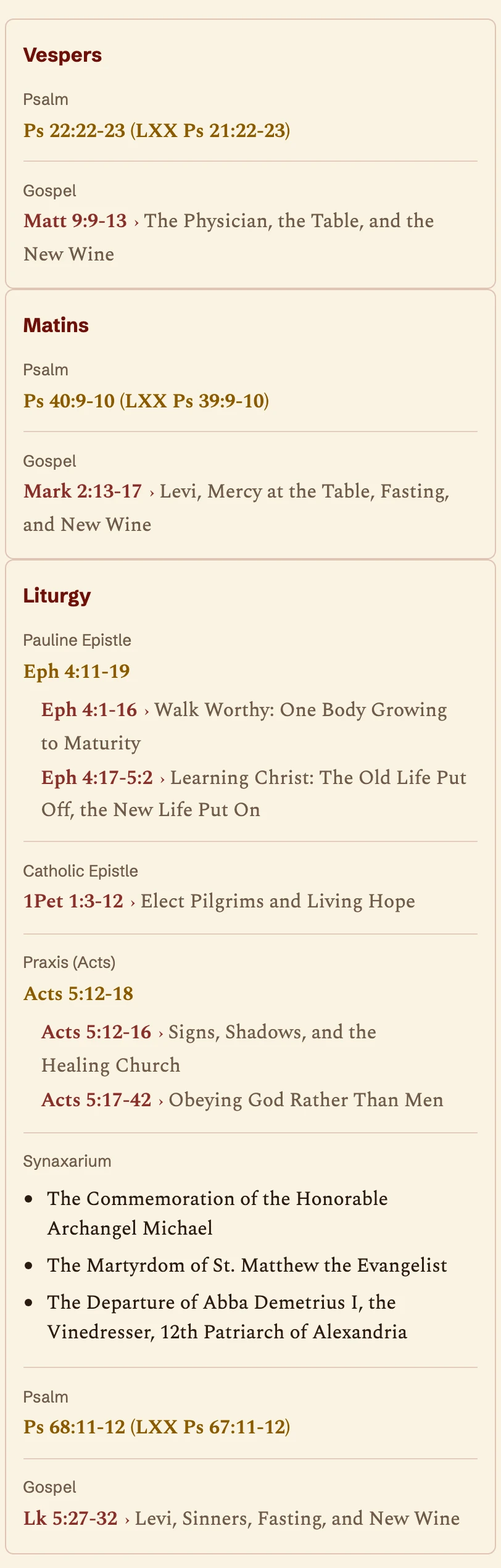
Source: OrthodoxBibleStudy.com, actual mobile-width screenshot captured October 22, 2026. Cropped to the service groups; readings vary by selected date.
If a Psalm number looks unfamiliar, the page gives common English numbering and an LXX reference where they differ. LXX means the Septuagint, the ancient Greek Old Testament used in Orthodox worship. Verse divisions can differ too; do not assume a different number means a different prayer.
Three gentle ways to begin
These are suggested home practices, not official liturgical obligations. The time estimates are flexible; a longer Gospel may take longer.
About five minutes: one Gospel
Read the Liturgy Gospel slowly. Keep one sentence in mind and respond to God in your own words. Let that sentence accompany you into your work, your family responsibilities, or a difficult conversation.
About fifteen minutes: a little more context
Read the Gospel and one epistle or Psalm. If helpful, look at the day’s Synaxarium titles and seek a reliable account of a commemorated saint. Do not force a connection between every saint and every reading.
A fuller rhythm: follow the services
When feasible, read the coming day’s Vespers selection in the evening, its Matins selection in the morning, and the Liturgy readings together or at another quiet time. If one sitting is what your circumstances allow, that is a reasonable beginning too.
Let this reading lead toward parish worship rather than replace it. A priest can help you develop a sustainable rhythm without turning prayer into anxious accounting.
What is the Agpeya, and is it the same thing?
The Agpeya is the Coptic Book of Hours, containing prayers for different parts of the day and night. Its hours include Psalms, a Gospel passage, and other prayers, with themes connected to Christ’s saving work.4
The distinction is simple:
- The Katameros tells us the readings appointed for the Church’s services according to the calendar.
- The Agpeya gives us an established pattern of prayer through the hours.
The Agpeya also has a prayer called Vespers. That hour is not identical to the parish’s Evening Raising of Incense, and its Gospel should not be confused with the changing Vespers Gospel on the Daily Readings page.
You can use both: pray an Agpeya hour, then read a daily lectionary passage. Begin modestly and seek guidance rather than assuming you must immediately pray every hour and read every selection.
See the services for yourself
The following recordings are examples, not rules for every parish. You can sample a few minutes rather than watch an entire service.
- Vespers: “HE Metropolitan Youssef: Vespers & Bible Study @ St Macarius, Tampa FL ~ 12/20/2024”, on His Eminence Metropolitan Youssef. Listen for the evening prayers in English. This recording also includes Bible study.
- Matins: “From the Abbey: Midnight Praises / Matins Prayers w HG Bishop Basil (English) ~ April 7, 2020”, on Coptic Orthodox Diocese of the Southern US. Hear the morning prayers in their wider setting at St. Mary and St. Moses Abbey. Midnight Praises come first, so the opening is not Matins.
- Divine Liturgy: “Divine Liturgy (English) - 2nd Sunday of Lent (01 Mar 2026)”, on St. Mark’s Coptic Orthodox Church London. Notice how Scripture is heard within the congregation’s prayer, rather than as a separate reading exercise.
More than finishing a list
The Church places Scripture inside prayer because listening to God is more than collecting information. The same Christ whom the Gospel proclaims calls us into communion with Himself and into a changed life.
On the road to Emmaus, the risen Lord opened the Scriptures to His disciples; afterward they remembered how their hearts burned while He spoke to them (Luke 24:27-32). Understanding the readings is meant to become that kind of attentive encounter, not merely recognition of a label on a page.
St. John Cassian, describing ancient Egyptian monks, says that their work was joined to meditation on the Psalms and Scripture, so that such meditation was “never entirely omitted.”5 He is describing an ancient monastic practice, not prescribing today’s Coptic parish timetable or a beginner’s reading quota. His witness points toward something we can learn: the words heard in prayer need not be left behind when ordinary work begins.
If today’s Gospel calls you to forgive, carry it into the relationship where forgiveness is hardest. If it reveals Christ’s mercy, return to Him rather than hiding in shame. One passage received attentively can remain with you long after the screen is closed.
Short questions, simple answers
Why is tomorrow’s reading associated with tonight?
Because evening worship opens the next liturgical day. For Saturday evening Vespers, look at Sunday’s Vespers group. That relationship does not mean this website automatically advances its date at sunset.
Must I attend church before I can read these passages?
No. You may begin reading at home now. A visit to a Coptic parish will help you hear how the passages live within worship. If you are visiting from another tradition, ask the priest about participation and Communion rather than assuming every practice is the same.
What if I miss a day?
Begin again with today’s passage. There is no need to turn a missed reading into a growing burden of catch-up work. If you have an agreed prayer rule, discuss difficulties with your priest.
Do Greek and Coptic Orthodox churches use identical readings?
No. They share a deep reverence for Scripture in worship, but their calendars, lectionaries, and service arrangements differ. This page follows the Coptic tradition.
What about feast days and Holy Week?
Follow the appointed material for the date and your parish’s service guidance. Great Lent may add prophetic readings; Holy Week has its own day-and-hour pattern centered on Christ’s Passion. Do not force those services into an ordinary Vespers–Matins–Liturgy template.
Begin with one Gospel
Open today’s readings, find the Liturgy Gospel, and read the appointed passage in your Bible. Give it a little silence. Bring what you have heard into prayer and into the next person you meet.
You do not need to master the whole calendar before you begin listening to Christ.
Sources
Footnotes
-
Coptic Orthodox Diocese of the Southern United States, Coptic Reader documentation, “Dates”, including its Saturday-evening/Sunday example. Coptic Reader’s app-specific transition setting is not a description of this website’s date picker. ↩
-
Coptic Orthodox Diocese of the Southern United States, Coptic Rites (1): Raising of Incense, “The Liturgy Prayers” and the outline of the Raising of Incense. ↩
-
Coptic Orthodox Diocese of the Southern United States, RIT 101: Liturgy, Agpeya and Praises, sections 2, “The Ritual of the Raising of Incense,” and 6, “Liturgy of the Word,” including “The Synaxarium.” The ordinary outline is distinguished here from seasonal and feast-day variations. ↩ ↩2
-
Coptic Orthodox Diocese of the Southern United States, RIT 101: Liturgy, Agpeya and Praises, section 3, “The Agpeya”; see also “The Agpeya” for pastoral reflection on a sustainable prayer life. ↩
-
St. John Cassian, Institutes, Book III, chapter 2, translated by C. S. Gibson, Nicene and Post-Nicene Fathers, Second Series, volume 11. The quotation concerns ancient Egyptian monastic practice; its application to a beginner’s reading is a pastoral reflection, not a claim of identical present-day service rules. ↩