


The first words of Genesis 5 recall the image and blessing of creation. Then each generation has children, lives many years, and dies. The repeated ending refuses to let longevity masquerade as victory over the sentence of Genesis 3. But one name interrupts the rhythm: Enoch is “well-pleasing to God” and “was not found, because God translated him.” The genealogy carries both the cost of the fall and a sign that life with God has not ended east of Eden.
Why this passage matters
Many readers rush past genealogies, but the Church reads Genesis 5 as theology. It teaches the persistence of the divine image, the inheritance of mortality, the seriousness of sin, the possibility of holiness, and the longing for rest that will only be fulfilled in Christ. The repeated “and he died” confirms that God’s warning to Adam was true. Enoch interrupts that rhythm and shows that communion with God remains possible. Noah’s naming gathers up the human cry for relief from labor, curse, and grief.
Genealogy visual: Adam to Noah in the Septuagint line
The genealogy below is not decorative. It makes the chapter’s theology visible: the image of God is remembered, Adam’s line continues, death repeats, Enoch interrupts the rhythm by being well-pleasing to God, and Noah appears as the hope-bearing hinge before the flood. The ages follow Brenton’s English Septuagint in Genesis 5, so they should not be silently harmonized with Hebrew-based charts.
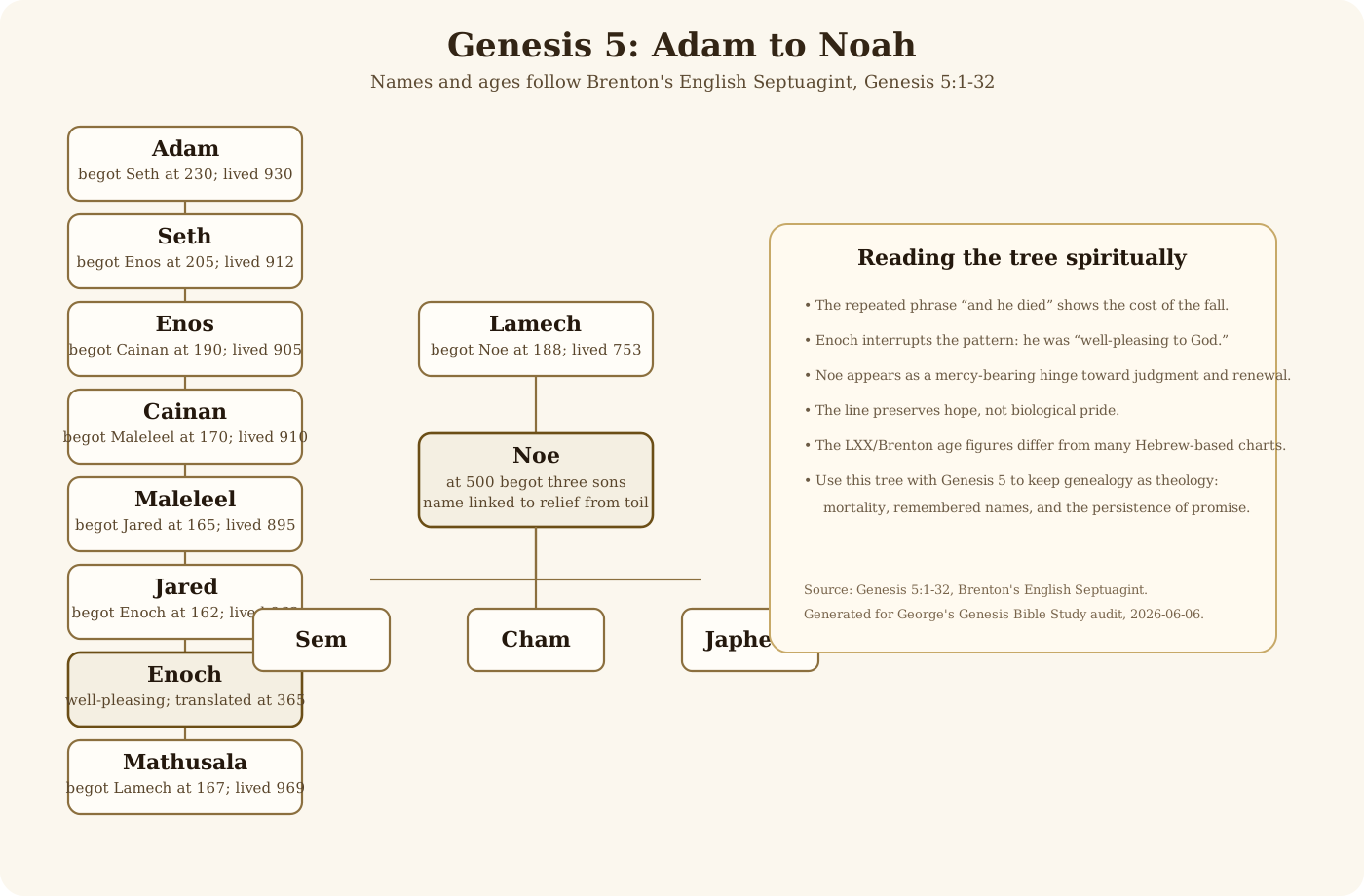 Source: generated for this Genesis audit from Genesis 5:1-32 in Brenton’s English Septuagint, 2026-06-06.
Historical and Scriptural Context
Genesis 5 stands between Cain’s line in Genesis 4 and the flood in Genesis 6. It is therefore a bridge chapter. It shows that the line through Seth preserves hope without escaping the human condition.
The chapter begins by echoing creation: “in the image of God he made him.” Then verse 3 says that Seth is begotten in Adam’s form and image. The later wording does not cancel God’s image in Seth or claim that a baby has inherited personal guilt for Adam’s act. It holds two truths together: human dignity persists, and the generations now live and die outside Eden.
The long life spans should not distract from the main burden. The Septuagint and Hebrew textual traditions differ in some ages and totals; this guide prints Brenton’s Septuagint figures rather than harmonizing them with a Hebrew-based chronology. Neither column of numbers should be used to calculate a date for creation or to evade the chapter’s repeated ending. Human life is fruitful and dignified, yet it is not exempt from death.
Creation is remembered inside fallen history (Genesis 5:1-2)
1 This is the genealogy of men in the day in which God made Adam; in the image of God he made him: 2 male and female he made them, and blessed them; and he called his name Adam, in the day in which he made them.
The chapter opens with blessing before it opens with death. Humanity is male and female, blessed by God, and collectively named Adam. That means the genealogy is about more than one branch of one family. It is about the human race under God.
This opening keeps the chapter from fatalism. Death will be repeated, but death is not the first word spoken over man. The Church therefore reads human life through creation before she reads it through corruption.
Seth is born in Adam’s image (Genesis 5:3-5)
3 And Adam lived two hundred and thirty years, and begot a son after his own form, and after his own image, and he called his name Seth. 4 And the days of Adam, which he lived after his begetting Seth, were seven hundred years; and he begot sons and daughters. 5 And all the days of Adam which he lived were nine hundred and thirty years, and he died.
Adam begets Seth “after his own form, and after his own image.” Seth is truly human and still within God’s good creation, but he inherits life as it now exists outside Eden. The child of Adam receives not only existence, but also Adam’s mortal condition.
That is why Adam’s own death matters so much. The first father of the race cannot preserve even his own life. The line continues, but paradise has not been regained.
The refrain “and he died” teaches the cost of the fall (Genesis 5:6-20; 25-27)
6 Now Seth lived two hundred and five years, and begot Enos. 7 And Seth lived after his begetting Enos, seven hundred and seven years, and he begot sons and daughters. 8 And all the days of Seth were nine hundred and twelve years, and he died. 9 And Enos lived an hundred and ninety years, and begot Cainan. 10 And Enos lived after his begetting Cainan, seven hundred and fifteen years, and he begot sons and daughters. 11 And all the days of Enos were nine hundred and five years, and he died. 12 And Cainan lived an hundred and seventy years, and he begot Maleleel. 13 And Cainan lived after his begetting Maleleel, seven hundred and forty years, and he begot sons and daughters. 14 And all the days of Cainan were nine hundred and ten years, and he died.
15 And Maleleel lived an hundred and sixty and five years, and he begot Jared. 16 And Maleleel lived after his begetting Jared, seven hundred and thirty years, and he begot sons and daughters. 17 And all the days of Maleleel were eight hundred and ninety and five years, and he died. 18 And Jared lived an hundred and sixty and two years, and begot Enoch: 19 and Jared lived after his begetting Enoch, eight hundred years, and he begot sons and daughters. 20 And all the days of Jared were nine hundred and sixty and two years, and he died.
25 And Mathusala lived an hundred and sixty and seven years, and begot Lamech. 26 And Mathusala lived after his begetting Lamech eight hundred and two years, and begot sons and daughters. 27 And all the days of Mathusala which he lived, were nine hundred and sixty and nine years, and he died.
Seth dies. Enos dies. Cainan dies. Maleleel dies. Jared and Mathusala die too. Lamech’s death comes in verses 28–31. The repeated formula lets us hear what no impressive age can change: a long life remains a mortal one. Notice also the names and children between the deaths. The text neither erases ordinary lives nor grants any household power to save itself from death.
This also keeps the faithful line humble. Seth’s descendants are not saved by bloodline or longevity. They too stand under the common human sentence. Election is not an escape from need. The righteous still need salvation.
Enoch is well-pleasing to God (Genesis 5:21-24)
21 And Enoch lived an hundred and sixty and five years, and begat Mathusala. 22 And Enoch was well-pleasing to God after his begetting Mathusala, two hundred years, and he begot sons and daughters. 23 And all the days of Enoch were three hundred and sixty and five years. 24 And Enoch was well-pleasing to God, and was not found, because God translated him.
At the center of the recurring deaths, Enoch appears. Brenton’s Septuagint says twice that he was “well-pleasing to God,” whereas many Hebrew-based English versions say he “walked with God.” These are not two competing biographies. The Septuagint’s phrasing makes his Godward life explicit, and Hebrews 11:5 receives it as the testimony of faith. Enoch’s distinction is first spiritual, not spectacular.
He is not outside ordinary life. He fathers Mathusala and lives within the genealogy. Yet his entry lacks the expected “and he died.” Hebrews 11:5–6 receives his translation as a witness to faith that pleases God. Chrysostom presses the point for hearers who see no immediate reward: Enoch trusted God before he could see what would become of him.1
This should be handled carefully. Enoch is a sign, not a loophole that solves death before Christ. Scripture does not satisfy curiosity about the mechanics of translation. It directs attention to faith, repentance, and a life pleasing to God.
Noah’s name gathers the hope of the weary (Genesis 5:28-32)
28 And Lamech lived an hundred and eighty and eight years, and begot a son. 29 And he called his name Noe, saying, This one will cause us to cease from our works, and from the toils of our hands, and from the earth, which the Lord God has cursed. 30 And Lamech lived after his begetting Noe, five hundred and sixty and five years, and begot sons and daughters. 31 And all the days of Lamech were seven hundred and fifty-three years, and he died. 32 And Noe was five hundred years old, and he begot three sons, Sem, Cham, and Japheth.
Lamech names his son Noe with words tied directly to Genesis 3: “This one will cause us to cease from our works, and from the toils of our hands, and from the earth, which the Lord God has cursed.” This is a father’s hope, not a narrator’s declaration that Noah has already removed the curse. His name carries the exhaustion of hands that work resistant ground. Genesis will show preservation through Noah, but it will also show a world still needing a deeper rest.
Noah will bring a real measure of relief in the coming chapters, yet not the final answer. The naming teaches readers to expect rest, then to learn that every partial rest points beyond itself to a greater one.
Gems from the Fathers 💎
The Fathers do not treat Genesis 5 as dead archive. St. John Chrysostom uses the genealogies of Genesis to show the reliability of God’s word and the seriousness of sin. The repeated deaths are part of the lesson, not accidental detail.
St. Ephrem the Syrian helps readers see Enoch as a consolation. Before the flood, before Sinai, and far from Eden, a man can still live in a way well-pleasing to God. That does not erase the curse, but it shows that communion with God is not shut.
St. John Chrysostom makes Enoch’s witness concrete in his homily on Hebrews. Enoch’s translation is not treated as curiosity, but as faith receiving hope before the resurrection is fully revealed. Chrysostom says, “This same thing then made [Enoch] well-pleasing [to God], namely, that he received nothing. For he knew that [God] ‘is a rewarder.’”1 He then turns this into a word for the reader: even if visible reward does not appear here, the believer should not be troubled. Enoch walks with God before visible reward, and his life trains the Church to trust God’s recompense.
St. Augustine’s reading of the two cities also helps here. Cain’s line and Seth’s line display two different orientations within history, one bent toward earthly self-assertion, the other preserving life before God within mortality. Augustine’s phrase is concise but the full contrast is stronger: “two cities have been formed by two loves: the earthly by the love of self, even to the contempt of God; the heavenly by the love of God, even to the contempt of self. The former, in a word, glories in itself, the latter in the Lord.”2 The Fathers do not use Enoch mainly to feed sensational curiosity. They use him to call the hearer to holiness.
Spiritual Fruit 🍇
- Let the refrain make you truthful, not afraid. “And he died” can teach a sober reckoning with time. Make the conversation or reconciliation you have postponed rather than assuming there will always be another year.
- Seek Enoch’s testimony in ordinary days. The chapter places his pleasing God alongside fatherhood and years of life. Pray and act faithfully in the duties already entrusted to you instead of waiting for a spectacular calling.
- Honor the unnamed lives. The text repeatedly says “sons and daughters” without listing them. Do not measure a person’s worth by whether a record preserves their achievements; attend to someone whose faithful work is usually unseen.
- Bring weary hands before Christ. Lamech longs for relief from toil. Rest in Christ does not mean that every labor disappears now; it allows us to ask for help, share burdens, and keep hope beyond the curse.
Teaching Notes
Creation is remembered inside fallen history (Genesis 5:1-2)
- Ask: Why repeat the creation blessing at the beginning of a death-marked genealogy?
- Emphasize: The image and blessing precede the mortality refrain; fallen people retain human dignity.
Seth is born in Adam’s image (Genesis 5:3-5)
- Ask: What can Adam pass on to Seth, and what can he not give him?
- Emphasize: Seth receives a real human life under mortality, not personal blame for Adam’s individual act.
The refrain “and he died” teaches the cost of the fall (Genesis 5:6-20; 25-27)
- Ask: Why does Scripture make us listen to repeated names and deaths instead of rushing to the flood narrative?
- Emphasize: The refrain “and he died” teaches the cost of the fall, while the line of Seth preserves hope.
- Watch for: Do not turn the genealogy into trivia or chronology alone.
- Connect: The names carry the story from Adam toward Noah, showing that God remembers persons across generations.
- Show: Use the Adam-to-Noah genealogy to make the Septuagint line readable, not to distract from the spiritual weight of mortality.
Enoch is well-pleasing to God (Genesis 5:21-24)
- Ask: What does Enoch’s being well-pleasing to God teach in a chapter dominated by death?
- Emphasize: Holiness is possible inside fallen history, and communion with God is stronger than the chapter’s rhythm of death.
- Watch for: Do not overbuild speculation about Enoch beyond the scriptural witness.
- Connect: Hebrews 11 lets the Church read Enoch as a witness that faith walks with God before visible completion.
- Show: Let Noah’s naming point forward to comfort and new beginning without pretending Genesis 5 has resolved the human wound.
Noah’s name gathers the hope of the weary (Genesis 5:28-32)
- Ask: Is Lamech describing accomplished salvation or hoping for relief?
- Emphasize: The named longing rises from cursed toil; Noah’s preservation is real but not final victory over death.
- Connect: The hope for rest reaches beyond Noah to Christ.
Sources
Scripture and apostolic witnesses
Embedded Scripture is from Brenton’s English Septuagint (LXX).
- Public-domain Brenton edition: https://archive.org/details/septuagintversio00bren
- Hebrews 11:5-6; Luke 3:23-38; Romans 5:12-21; 1 Corinthians 15:21-22, 45-49.
Patristic and Orthodox sources
- St. Ephrem the Syrian, Commentary on Genesis: https://archive.org/details/selectedprosewor0000ephr
- St. John Chrysostom, Homilies on Hebrews, Homily XXII, for Enoch as well-pleasing and translated: https://www.ccel.org/ccel/schaff/npnf114.v.xxvi.html#v.xxvi-p50
- St. John Chrysostom, Homilies on Genesis: https://www2.iath.virginia.edu/anderson/commentaries/ChrGen.html
- St. Augustine, The City of God, Book XIV.28, for the two loves that form the two cities: https://www.newadvent.org/fathers/120114.htm
- St. Augustine, The City of God, Book XV, for Cain, Seth, and the two cities from Genesis: https://www.newadvent.org/fathers/120115.htm
Secondary academic sources
- Gordon J. Wenham, Genesis 1-15.
- Victor P. Hamilton, The Book of Genesis: Chapters 1-17.
- Kenneth A. Mathews, Genesis 1-11:26.
- Claus Westermann, Genesis 1-11.
Coptic Orthodox / pastoral sources
- The Orthodox Study Bible, notes on Genesis 5, Hebrews 11, and Luke 3.
- Fr. Tadros Yacoub Malaty, commentary on Genesis and the patristic reading of Enoch and Noah.
- Pope Shenouda III on repentance, death, vigilance, and hope in eternal life.
- Fr. Bishoy Kamel on holy living, spiritual wakefulness, and endurance in hope.
Visual sources
Genesis 5 genealogy from Adam to Noah diagram, created for this guide from Genesis 5 in Brenton’s English Septuagint. No external visual-source URL exists for this schematic.
Footnotes
-
St. John Chrysostom, Homily XXII on Hebrews 11:5, https://www.ccel.org/ccel/schaff/npnf114.v.xxvi.html#v.xxvi-p50. ↩ ↩2
-
St. Augustine, The City of God, Book XIV.28, https://www.newadvent.org/fathers/120114.htm. ↩