


Jacob leaves home with a blessing, but also with the consequences of having obtained an earlier blessing through deception. His father now knows whom he is blessing; his brother’s anger has not disappeared. Between that troubled household and the unknown household ahead, Jacob lies down with a stone at his head. There God speaks before Jacob has learned how to answer faithfully. Genesis 28 holds together truths we often separate: sin has consequences, grace comes before we deserve it, and the Lord’s nearness begins to change the person who receives it. The vision will find its fullest meaning in Christ, who speaks of heaven opened and angels ascending and descending upon the Son of Man.
Isaac knowingly gives the blessing of Abraham (Genesis 28:1-5)
1 And Isaac having called for Jacob, blessed him, and charged him, saying, Thou shalt not take a wife of the daughters of the Chananites. 2 Rise and depart quickly into Mesopotamia, to the house of Bathuel the father of thy mother, and take to thyself thence a wife of the daughters of Laban thy mother’s brother. 3 And may my God bless thee, and increase thee, and multiply thee, and thou shalt become gatherings of nations. 4 And may he give thee the blessing of my father Abraam, even to thee and to thy seed after thee, to inherit the land of thy sojourning, which God gave to Abraam. 5 So Isaac sent away Jacob, and he went into Mesopotamia to Laban the son of Bethuel the Syrian, the brother of Rebecca the mother of Jacob and Esau.
The opening is quieter than Genesis 27, yet the difference is decisive. Isaac calls Jacob by his own identity and blesses him deliberately. Jacob no longer has to pretend to be Esau to receive his father’s words. The blessing names Abraham and the land God gave him; its purpose reaches beyond household advantage to the continuation of the covenant. God’s covenant is His faithful commitment to a people, carrying a promise that will become blessing for others. Jacob receives a future larger than the rivalry through which he tried to secure it.
This does not retrospectively make the deception righteous. The household is still fractured, and Jacob must leave. Yet Isaac’s conscious blessing shows that the promise is not trapped inside the falsehood by which Jacob previously sought it. God can carry His purpose forward while also healing the people who have wounded one another. A sinner’s history need not become the prison of his future. The path out begins when he stops defending the lie and receives what can now be given in truth.
Marriage belongs to that future. Isaac directs Jacob toward Rebekah’s family, as Abraham had sought a wife for Isaac from his own kin in Genesis 24. The concern is the continuity of the promised household and its allegiance to God. Laban is Jacob’s maternal uncle; Bethuel is his mother’s father. Kinship will give Jacob a place to go, but the later account will expose how difficult life in Laban’s household can be. A familiar family name is no guarantee of a truthful or holy home.
Christian readers should hear the seriousness of choosing a spouse with whom faith can be lived. They should not turn this patriarchal direction into a mandate for racial purity, ethnic superiority, or marrying a relative. Verse 3 already opens the horizon toward nations, and verse 14 will speak of blessing for all the tribes of the earth. A Christian household serves that blessing when its common life teaches prayer, fidelity, hospitality, and mercy.
Language insight: “gatherings of nations”
The Septuagint has συναγωγὰς ἐθνῶν (synagōgas ethnōn), “gatherings” or “assemblies of nations,” in verse 3.1 The first word describes gathering together; here it should not be narrowed to the later sense of a synagogue building. Brenton’s unusual plural helps us hear that Jacob’s promised increase reaches beyond a private household. The phrase belongs first to the patriarchal promise, whose international scope becomes explicit in verse 14.
Galatians 3:8-9 reads God’s promise to Abraham as the Gospel announced beforehand: the Gentiles, meaning the nations, will receive blessing through faith. When Jacob returns to Bethel, God Himself will repeat the father’s prayer as a promise: “nations and gatherings of nations shall be of thee” (Genesis 35:11).2 The gift spoken at departure awaits him again at the place of return. Paul reads this widening promise through its fulfillment in Christ. The connection gives Isaac’s blessing a spiritual breadth: God’s gifts to a family are meant to make it a servant of blessing, not the proprietor of God.
Esau sees the blessing and adds another marriage (Genesis 28:6-9)
6 And Esau saw that Isaac blessed Jacob, and sent him away to Mesopotamia of Syria as he blessed him, to take to himself a wife thence, and that he charged him, saying, Thou shalt not take a wife of the daughters of the Chananites; 7 and that Jacob hearkened to his father and his mother, and went to Mesopotamia of Syria. 8 And Esau also having seen that the daughters of Chanaan were evil before his father Isaac, 9 Esau went to Ismael, and took Maeleth the daughter of Ismael, the son of Abraam, the sister of Nabeoth, a wife in addition to his other wives.
Esau observes what Jacob receives and what his parents require. The narrator repeatedly tells us what he sees: the blessing, the departure, the marriage instruction, and his father’s displeasure with the daughters of Canaan. Esau then marries into Ishmael’s family, another branch of Abraham’s household. Scripture records an action in response to something he has recognized. It does not open his heart and tell us whether he acts from repentance, rivalry, a desire for approval, or a mixture of motives.
The final phrase deserves close attention: this wife is “in addition to his other wives.” The new marriage does not erase the existing marriages or the grief already associated with them in Genesis 26:34-35. The chapter places Esau’s visible adjustment beside Jacob’s departure, then turns from what Esau sees to what Jacob is shown. The traveler will receive a vision of heaven opened; in John 1, Jesus will invite Nathanael to expect greater sight centered on the Son of Man. The reader is being led beyond human approval toward the Lord who makes Himself known.
That restraint also teaches repentance. When a person has hurt a household, an additional good-looking gesture may leave the original wound untouched. Bringing a gift does not answer a refusal to tell the truth; appearing at worship does not itself reconcile a person with someone he continues to mistreat. The deeper question is whether we are willing to address the wrong itself. Equally, we should receive another person’s first attempt at change with humility: God sees the whole heart, including what remains hidden in us.
A given ladder and the Son of Man (Genesis 28:10-12)
10 And Jacob went forth from the well of the oath, and departed into Charrhan. 11 And came to a certain place and slept there, for the sun had gone down; and he took one of the stones of the place, and put it at his head, and lay down to sleep in that place, 12 and dreamed, and behold a ladder fixed on the earth, whose top reached to heaven, and the angels of God ascended and descended on it.
The “well of the oath” is Beersheba, Brenton’s Bersabee. Charrhan is Haran, Jacob’s destination in Mesopotamia. The stopping place will be named the House of God, Bethel, in verse 19. Jacob leaves the well of the oath, and this night will end with a vow of his own. Bethel is on the road, before he reaches the family to whom Isaac has sent him. Its first description is simply “a certain place.” Sunset, a stone, and the need for sleep are enough to explain why Jacob stops there.
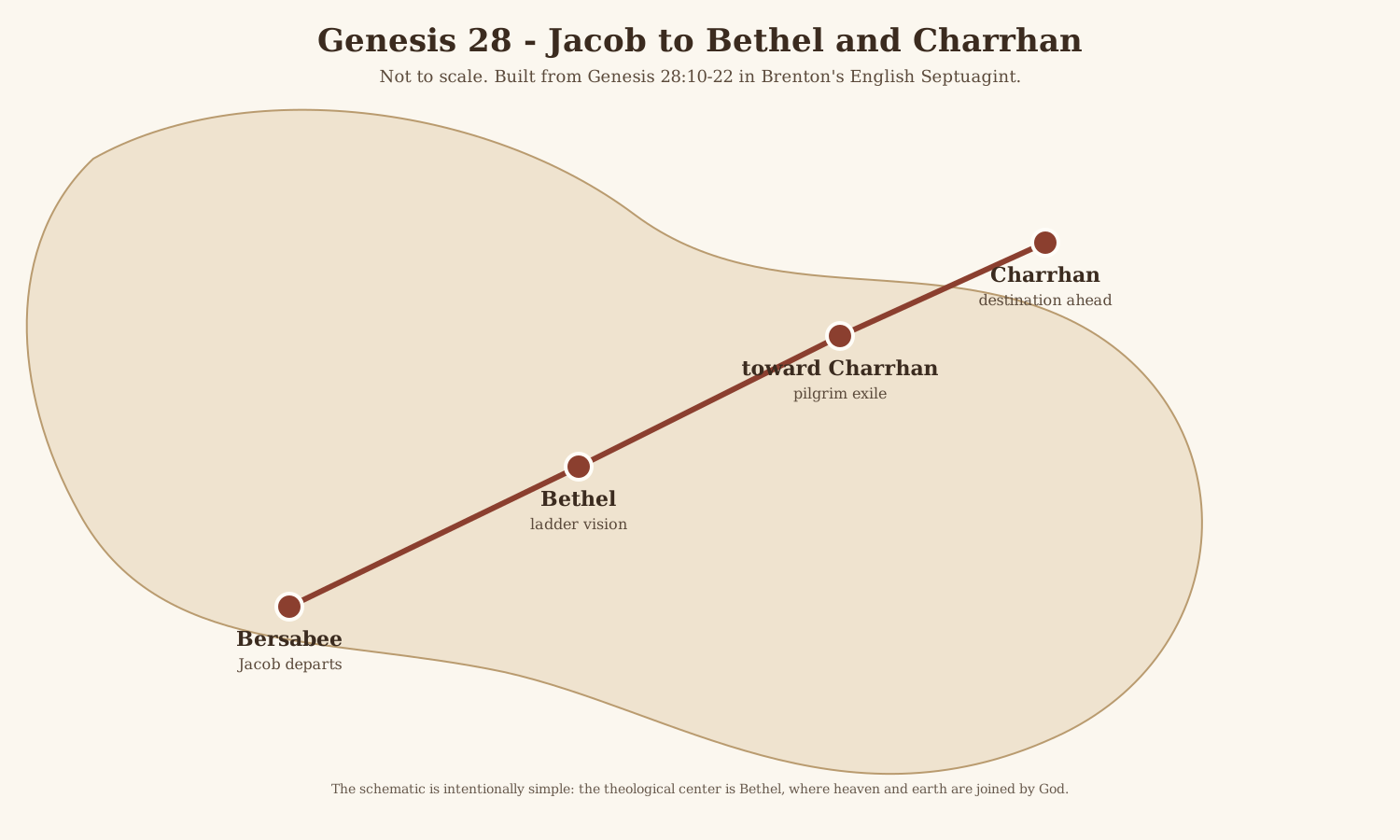 Source: guide schematic from Genesis 28; not to scale.
Jacob dreams of a ladder “fixed on the earth,” with its top reaching heaven. Angels ascend and descend upon it. He has neither built it nor climbed it. The image discloses a relation between heaven and the earth on which he is lying, before he can make any offering or vow. His vulnerability is the setting of an unbidden gift. God chooses to reveal Himself before Jacob has learned how to answer.
The contrast with Babel in Genesis 11 is illuminating. There people plan a tower “whose top shall be to heaven” (Genesis 11:4), to secure a name and resist scattering. Jacob is shown a ladder “whose top reached to heaven.” Here a displaced man receives the vision of a connection he did not construct. Babel’s project is governed by human self-securing; Bethel begins in God’s disclosure and leads toward worship. Christian prayer, fasting, and repentance require real effort, but their purpose is to answer grace. Our effort cannot construct a passage into God’s life independent of Him.
Heaven opened in John 1:43-51
Jesus’ meeting with Nathanael gives the strongest biblical light on the vision. Philip announces the One of whom Moses and the prophets wrote. Jesus then recognizes Nathanael as an Israelite in whom there is “no deceit” (John 1:47). Read beside Jacob’s story, that description is striking: Jacob, who will be named Israel, has just emerged from deception, while Nathanael is welcomed in the truth of his own heart.
Nathanael confesses Jesus as Son of God and King of Israel. Jesus promises greater things, saying: “hereafter you shall see heaven open, and the angels of God ascending and descending upon the Son of Man” (John 1:51). The ascent and descent echo Jacob’s dream, but the focus is now the Son of Man Himself. Jesus does not literally say, “I am the ladder.” His words give the Church the ground for reading the vision as fulfilled in Him: the communion disclosed at Bethel has its living center in the incarnate Son.
The ladder is fixed on earth and reaches heaven. Its fulfillment is the Incarnation: the eternal Word truly became man. The One who meets us is fully divine and fully human: the one incarnate Word, whose divinity and humanity are united without mingling, confusion, or alteration, and never parted. His humanity is real, capable of suffering and death; His divinity remains truly divine. We come to God through Him because He has made our human life His own, healed it through His saving work, and raised it in His Resurrection. Salvation is communion with the living Christ, and every ascent in prayer and virtue is made in Him and by His grace. Ephesians 2:4-6 joins His mercy to our being made alive and raised with Him, seated in heavenly places in Christ Jesus. Prayer, fasting, and repentance are our real cooperation with the One who lifts us up, not a rival path built apart from Him.
This also changes how a guilty person prays. Jacob’s deceit does not make truth inaccessible to him forever. The Son who knows Nathanael’s heart also knows ours. Cyril explains that this knowledge gives Nathanael a pledge that Christ “knoweth the hearts, as God.”3 Being known by Him becomes the beginning of faith. We need not arrange a convincing appearance before coming to Him. We come in confession, asking to become truthful. Christ’s mercy gives us courage to expose the very sin that would make us hide.
Gems from the Fathers 💎: The angels serve the incarnate Son
St. Cyril of Alexandria, commenting directly on John 1:51, explains the angels’ ascent and descent as their ministry under Christ’s command for the salvation of believers. He sees their service as testimony that the Son of Man is also Son of God by nature. The same Person who stands among men possesses the divine dignity before which the heavenly powers minister.
Cyril writes: “For it is not one another that the rational powers serve but surely God.”4 By “rational powers” he means the intelligent heavenly beings, the angels. He acknowledges order among them, but his point concerns the Lord they serve. The angels direct our attention toward Christ rather than becoming an alternative way to reach God. Their service strengthens the confession that the Savior is truly divine; His coming among us is God’s own saving nearness.
The Church’s Voice in Worship ⛪
The Coptic Church reads Genesis 28:10-22 among the Matins prophecies on Tuesday of the fourth week of Great Lent.5 The reading accompanies a season of repentance and disciplined dependence on God. Jacob receives the promise before his life has become settled, then begins to answer with worship and a vow. In Lent we likewise seek a changed life through the mercy already offered in Christ. Fasting becomes truthful when it loosens our self-sufficiency and makes room for prayer, generosity, and reconciliation.
The Coptic Tuesday Theotokia, a hymn praising the Mother of God in the annual Psalmody, makes the ladder connection explicit in its second part: “You have found grace, and the Lord is with you, you are the ladder, which Jacob saw.”6 The next stanza describes the ladder fixed on earth and reaching heaven. The hymn then turns to the unconsumed burning bush and the Son of God dwelling in Mary’s womb: a succession of biblical figures gives voice to thanksgiving for the Incarnation. The hymn’s first part has already confessed that God the Word became man for our salvation and remains God after becoming man.
That context gives Marian language its meaning. The Virgin is called ladder because through her the Word truly received our humanity. Her title “Theotokos,” Mother of God, confesses that the One she bore is the eternal Word Himself, truly come in our humanity. The hymn honors her real participation in the Incarnation while directing our praise toward the Savior who came to save us. Jacob’s vision becomes a song of thanksgiving that God has come near in our flesh.
The promise reaches from Jacob to the nations (Genesis 28:13-15)
13 And the Lord stood upon it, and said, I am the God of thy father Abraam, and the God of Isaac; fear not, the land on which thou liest, to thee will I give it, and to thy seed. 14 And thy seed shall be as the sand of the earth; and it shall spread abroad to the sea, and the south, and the north, and to the east; and in thee and in thy seed shall all the tribes of the earth be blessed. 15 And behold I am with thee to preserve thee continually in all the way wherein thou shalt go; and I will bring thee back to this land; for I will not desert thee, until I have done all that I have said to thee.
Isaac’s blessing is now confirmed by the Lord Himself. The speaker identifies Himself as the God of Abraham and Isaac, joining this night to the promise Jacob has inherited. The land beneath Jacob’s sleeping body belongs to the future God announces. Jacob possesses very little at this stopping place, but his present resources are not the measure of the Lord’s faithfulness.
The promise expands in every direction and reaches “all the tribes of the earth.” Election, God’s choosing for His purpose, is ordered toward blessing. Jacob is not chosen so that other peoples may become spiritually irrelevant. In the fullness of the Gospel, Abraham’s blessing comes to the nations through Christ, as Galatians 3 explains. A parish that receives this inheritance should find its heart enlarged toward strangers, including people whose language, circumstances, or troubled history make them difficult to welcome.
Then the Lord addresses the vulnerability of the traveler: “I am with thee.” He promises preservation, return, and fidelity to what He has spoken. The assurance is personal and particular. Jacob will still have to live through the long difficulties of the following chapters. God’s presence does not mean that consequences, conflict, or the need for repentance have been canceled. It means that these will not place Jacob beyond the Lord’s faithful care.
The phrase “until I have done all that I have said” assures the completion of God’s word; it does not announce a withdrawal of love afterward. Christ’s promise in Matthew 28:20 likewise joins His presence to the disciples’ mission through the end of the age. Hebrews 13:5-6 receives the scriptural assurance of God’s non-abandonment and applies it to contentment and courage. The Lord’s faithfulness frees a person from making money his final security.
The promised return belongs to Jacob’s actual story. In Genesis 31:13 God recalls the pillar and vow and commands him to leave Laban’s country. In Genesis 35:1-7 Jacob returns to Bethel, leads his household to put away strange gods, and builds an altar. The night of mercy has a future in concrete obedience. For Christians, this gives hope in God’s faithfulness, not a guarantee that every traveler or refugee will regain an earlier home or escape bodily harm. In Christ we receive the presence of the Savior who carries us through suffering toward resurrection and life with Him.
Gems from the Fathers 💎: The Lord who spoke at Bethel
Eusebius of Caesarea, the early Church historian, reads Genesis 28 together with Genesis 31 in Proof of the Gospel V.10. The later speaker recalls the place where Jacob anointed the pillar; Eusebius takes that connection as a witness to the Word of God’s appearing to the patriarch. His focus is the identity of the Lord who speaks, rather than a detailed allegory of every feature of the ladder.
He writes: “So the same Being is clearly called the Angel of the Lord, and God and Lord in this place.”7 In this argument “Angel” concerns the One who conveys God’s word, not a claim that the Son is a created angel. In the same passage, however, Eusebius calls Him “the Second to” the Father and distinguishes Him from “the Almighty.” This subordinating account is not the Church’s confession: the Creed names the Son true God of true God, of one essence with the Father. His witness is valuable here for the continuity it perceives between God’s self-disclosure to Jacob and the revelation of the Word in the Gospel. The Christian reading belongs to that unfolding history of promise.
Awakening to the house of God (Genesis 28:16-17)
16 And Jacob awaked out of his sleep, and said, The Lord is in this place, and I knew it not. 17 And he was afraid, and said, How fearful is this place! this is none other than the house of God, and this is the gate of heaven.
Jacob’s first response is to recognize the poverty of his previous awareness. The place has not become holy because he has found the right feeling. The Lord has revealed Himself there, and Jacob now knows what he did not know before. The difference between God’s presence and our perception of it is an important school of humility. A distracted heart may be inattentive to a gift without having the power to make the Giver absent.
Fear follows the discovery. Here it takes the form of reverence before holy nearness. The words “house of God” and “gate of heaven” gather the meaning of the vision: the God of his fathers has addressed him on earth, and heaven has been disclosed to him. Holy fear allows a person to receive the promise with wonder. It need not become panic that God is waiting to reject him. The same Lord who awakens awe has just told him not to fear and promised not to desert him.
In the Church, this recognition matures through Christ. Ephesians 2:18-22 speaks of access to the Father through Him in one Spirit. Those who were strangers become members of God’s household, built together as a holy temple, with Christ as the chief cornerstone. Bethel’s meaning is therefore larger than an intensely private religious moment. The Lord gathers people into a dwelling place for His presence. Communion with Him joins us to one another.
Our church buildings and consecrated altars serve this embodied worship. We gather, listen to the Gospel, offer prayer, and approach the Eucharist, receiving the true Body and Blood of the incarnate Lord. Reverence is fitting because Christ gives Himself, not because architecture confines God to an address. The place is holy through its dedication to Him and the worship offered there; the assembly’s life must answer that holiness in truth and love.
A person can stand near the altar while mentally arguing with someone, measuring another parishioner’s clothing, or rehearsing what to say after the service. Jacob’s awakening gives us a gentle but searching prayer: help me recognize the gift before me. Arriving with time to quiet the heart, listening without preparing a reply, and praying for the person we resent are small acts of attention. Such reverence should leave the church with us. The worshipper who has learned to honor Christ must also learn to receive the stranger who belongs to His household.
The stone becomes a memorial of mercy (Genesis 28:18-19)
18 And Jacob rose up in the morning, and took the stone he had laid there by his head, and he set it up as a pillar, and poured oil on the top of it. 19 And he called the name of that place, the House of God; and the name of the city before was Ulam-luz.
Morning brings a bodily response. Jacob takes the very stone that lay at his head, stands it as a pillar, and pours oil upon it. The object associated with his night’s vulnerability becomes a visible memorial of the mercy he has received. Anointing means applying oil; here it marks the pillar as dedicated to God. The place receives a name that tells what has been revealed there: the House of God, commonly called Bethel. The old name, Ulam-luz, gives way to a name that remembers God’s presence.
Memory now has a form that can outlast the intensity of the dream. Jacob will continue traveling, but he has marked the place to which God’s later command will return him. Faithfulness often needs this kind of embodied remembrance. The sign of the cross, a place set aside for prayer, and the parish’s rhythm of worship can help us remember whom we have encountered when daily pressures make us forget. Their purpose is fulfilled when remembrance leads to renewed obedience.
The oil gives this stone a further meaning for Christians. “Christ” means the Anointed One: Acts 10:38 speaks of God anointing Jesus of Nazareth with the Holy Spirit and power. First Peter 2:4-5 calls Him a living stone and describes believers as living stones being built into a spiritual house; Ephesians 2:20-22 names Him the chief cornerstone. Jacob marks the place where God has met him. In the incarnate Son, God comes to dwell among us and gathers us into His own life. We answer by dedicating our bodies, homes, work, and possessions to the One who has given Himself.
Gems from the Fathers 💎: The anointing points toward Christ
St. Augustine explicitly connects Jacob’s oil with the name of Christ in The City of God XVI.38. He distinguishes the pillar’s dedication from worship of a stone, then writes: “But since the name of Christ comes from the chrism or anointing, something pertaining to the great mystery was certainly represented in this.”8 “Chrism” means anointing; the name draws our attention to the Savior. Augustine then turns to the same John 1 sayings about Nathanael and angels upon the Son of Man. The anointed memorial and the opened heaven belong together in the Church’s confession of Christ.
Bread, clothing, and the unfinished vow (Genesis 28:20-22)
20 And Jacob vowed a vow, saying, If the Lord God will be with me, and guard me throughout on this journey, on which I am going, and give me bread to eat, and raiment to put on, 21 and bring me back in safety to the house of my father, then shall the Lord be for a God to me. 22 And this stone, which I have set up for a pillar, shall be to me a house of God; and of all whatsoever thou shalt give me, I will tithe a tenth for thee.
God’s speech was confident: He will be with Jacob, preserve him, and bring him back. Jacob answers with “If” and “then.” Those words should remain audible. His vow can sound like a bargain, especially after the unconditional generosity of the promise. Yet it also takes up what the Lord has said and binds Jacob’s future to worship and offering. The text lets us hear a real, still-unfinished response without requiring us to pronounce every part of it either perfect faith or sheer unbelief.
Jacob asks for bread and clothing. The vast promise of descendants and blessing for the world meets the ordinary needs of a man on the road. Dependence on God does not require pretending that food, shelter, and bodily safety are beneath spiritual concern. We may ask plainly for what sustains life. At the same time, the modest language can loosen our habit of treating a constantly increasing standard of comfort as a necessity. Receiving enough with thanksgiving is a form of freedom.
A vow is a solemn commitment made to God. Jacob’s includes allegiance to the Lord, the pillar as a house of God for him, and a tenth of whatever God gives. The sequence protects the meaning of the offering: the Lord has already spoken, and the vision has already been given. Jacob cannot purchase either with his future tithe. Giving becomes an answer to generosity already received.
The word “tithe” means a tenth. Abraham had already offered a tenth to Melchizedek (Genesis 14:20); Jacob’s vow continues this family history of answering blessing with an offering, before Israel receives its later laws. This individual vow does not by itself establish a universal Christian legal rate or promise increased investment returns to someone who pays it. Its searching claim is simpler: Jacob acknowledges a Giver and commits part of what he receives to God. A grateful Christian can translate that acknowledgment into regular support for the Church and concrete mercy toward people in need. The gift should become honest and sustained, not a substitute for repentance or a means of making God indebted to us.
The vow’s fulfillment belongs to a longer life. Genesis 35 will connect return to Bethel with putting away strange gods and building an altar. Jacob has more to relinquish than money. So do we. A remembered encounter becomes fruitful when it changes the loyalties we carry into our homes: the resentment we protect, the dishonesty we excuse, the appetite we will not govern. The Lord who came near before Jacob was mature continues to call him into a life worthy of that mercy.
Spiritual Fruit 🍇
Receive mercy without defending the wrong. Jacob receives the promise while still living with the consequences of deceit. If shame makes you postpone confession until you can appear improved, reverse that order. Bring the concrete falsehood, manipulation, or injury before Christ and speak honestly with your confessor. Where possible, repair what you have damaged without demanding immediate trust from the person you hurt. Mercy gives the courage to begin; it does not require a favorable account of the past.
Answer holy nearness with attention. Jacob wakes to the Lord’s presence and rises to mark the place. Before the next Liturgy, set aside one distraction you ordinarily carry through the door. Listen to the Gospel as a word addressed to the Church, and prepare for Communion through repentance and reconciliation. If you feel little, let reverence rest on Christ’s gift rather than on the intensity of your mood. His presence is more substantial than your ability to feel it.
Ask for enough and make room for another. Jacob names bread and clothing after hearing a promise of nations. Pray plainly for your household’s needs; then examine one purchase, status anxiety, or comparison that has begun to govern your peace. A simpler choice may free both attention and money for mercy. Hebrews 13 joins contentment to God’s non-abandonment: the heart can become less grasping because the Lord is faithful. Offer practical help to someone whose displacement or insecurity is real.
Give as someone who has already received. Jacob’s tenth follows the vision and promise. Choose a regular, sustainable offering for the Church and for a person or ministry serving the needy. Give without using the amount to excuse hardness toward a dependent, employee, or family member. Let generosity include time, hospitality, and patient listening. The gift becomes an acknowledgment that life is received from God and is meant to carry His blessing beyond ourselves.
Return to obedience when the first fervor has faded. Bethel will require a return, and that return will include the removal of strange gods. Recover one commitment you have allowed to become a pleasant memory: a daily prayer, an apology, an abandoned responsibility, or a needed act of reconciliation. Begin again quietly, with counsel when needed, rather than promising an impressive transformation. The Lord’s faithfulness is received through the next truthful act as well as through moments of wonder.
The stone at Jacob’s head becomes a pillar in the morning. The road still lies ahead, but he will walk it having heard that he is not deserted. Christ has come among us more intimately than Jacob could yet see, taking our humanity and opening our life toward the Father. Lord, awaken us to Your gift, make us truthful in Your presence, and teach us to answer Your mercy with our whole life.
Teaching Notes
Orientation: Brenton’s “well of the oath,” Charrhan, and “House of God” are familiar as Beersheba, Haran, and Bethel. The non-abandonment language in Hebrews 13:5 belongs to a wider scriptural promise tradition, not exclusively Genesis 28.
Isaac knowingly gives the blessing of Abraham (Genesis 28:1-5)
- Ask: How does Isaac’s conscious blessing change the way we understand Jacob’s future after Genesis 27?
- Watch for: Covenant continuity concerns faith and God’s promise; it is no Christian command for racial purity or close-kin marriage.
Esau sees the blessing and adds another marriage (Genesis 28:6-9)
- Ask: What can an outward adjustment accomplish, and what harm might still need to be addressed directly?
- Watch for: The narrator describes Esau’s observations and action, not a definitive account of his inward motives.
A given ladder and the Son of Man (Genesis 28:10-12)
- Ask: What changes when the angels’ ascent and descent are centered on the Son of Man in John 1:51?
- Watch for: The given vision and Christ’s gracious descent make real ascetical cooperation possible. Marian ladder language serves the Incarnation.
- Show: Use the route schematic once to locate Bethel between departure and destination, then turn to the words of the vision.
The promise reaches from Jacob to the nations (Genesis 28:13-15)
- Ask: How does God’s particular care for Jacob become blessing for people beyond his household?
- Watch for: Jacob’s promised geographical return is not a universal guarantee of safe travel or recovering an earlier home.
Awakening to the house of God (Genesis 28:16-17)
- Ask: What practical act of attention would help us receive the Gospel and Eucharist with reverence?
- Watch for: God’s presence exceeds our feelings and buildings; holy fear should deepen worship, not cultivate terror of rejection.
The stone becomes a memorial of mercy (Genesis 28:18-19)
- Ask: Which embodied practices help remembrance of God become obedience rather than nostalgia?
- Watch for: The pillar is a real patriarchal memorial; later Christological and ecclesial connections do not erase its original meaning.
Bread, clothing, and the unfinished vow (Genesis 28:20-22)
- Ask: What would giving look like if it answered a gift already received instead of trying to secure God’s favor?
- Watch for: Preserve the vow’s conditional wording; neither condemn every motive nor turn Jacob’s tenth into a prosperity formula.
Sources
Embedded Scripture is from Brenton’s English Septuagint (LXX). New Testament quotations are from NKJV.
Genesis 11:4; 14:20; 24; 26:34-35; 27-28; 31:13; 35:1-11, for family context, the vow, and the return to Bethel.
John 1:43-51; Galatians 3:8-9; Ephesians 2:4-6, 18-22; Acts 10:38; 1 Peter 2:4-5; Matthew 28:20; Hebrews 13:5-6, for fulfillment in Christ, blessing for the nations, God’s household, abiding presence, and contentment.
St. Cyril of Alexandria, Commentary on John, Book II, exposition of John 1:47-51, pp. 153-155; translated by P. E. Pusey, Library of the Fathers 43 (1874). 🔗
Eusebius of Caesarea, Proof of the Gospel V.10, vol. I, pp. 254-255; translated by W. J. Ferrar (1920). 🔗
Coptic annual Psalmody, Tuesday Theotokia, parts one and two. 🔗
Coptic Katameros, Tuesday of the fourth week of Great Lent, Matins prophecy, Genesis 28:10-22. 🔗
Greek Septuagint, Genesis 28, for “gatherings of nations.” 🔗
St. Augustine, The City of God XVI.38, Marcus Dods translation, on the anointed stone, Christ, and John 1:47, 51. 🔗
Footnotes
-
Genesis 35:11 repeats the Septuagint “gatherings of nations” phrase from Isaac’s prayer in 28:3: συναγωγαὶ ἐθνῶν. 🔗 ↩
-
St. Cyril of Alexandria, Commentary on John, Book II, chapter I, on John 1:47-49, p. 153; P. E. Pusey, trans., Library of the Fathers 43 (1874). 🔗 ↩
-
St. Cyril of Alexandria, Commentary on John, Book II, chapter I, on John 1:51, p. 154; P. E. Pusey, trans., Library of the Fathers 43 (1874). 🔗 ↩
-
Coptic Katameros, Tuesday of the fourth week of Great Lent, Matins prophecies, Genesis 28:10-22; the date-resolved reading for 10 March 2026 gives the same range. 🔗 ↩
-
Coptic annual Psalmody, Tuesday Theotokia (Adam), part two, ladder stanza; part one supplies the explicit confession that the Word became man and remains God. 🔗 ↩
-
Eusebius of Caesarea, Proof of the Gospel V.10, vol. I, p. 255; W. J. Ferrar, trans. (1920). The quoted identification of the appearing Word is used as a historical witness; his adjacent subordinating account of the Son is expressly distinguished from the Nicene confession. 🔗 ↩
-
St. Augustine, The City of God XVI.38, NPNF1, vol. 2, p. 333, Marcus Dods translation; the passage connects the anointing of Jacob’s pillar to Christ and John 1:47, 51. 🔗 ↩