
The marked remnant has been distinguished, and now the glory rises from the house. The cherubim and wheels of the first vision carry it to the gate and beyond the city. Yet, while the departure is still unfolding, the Lord promises the scattered a sanctuary and a living heart. Holiness will not bless the old betrayal, and mercy will not leave the humbled without a future.
Previous: Ezekiel 8-9 · Next: Ezekiel 12-13
Historical and Scriptural Context
This is the second half of the temple vision begun in Ezekiel 8-9. The same glory revealed beside Chobar now withdraws from the defiled house. The Lord has shown why: hidden idolatry, denial of His sight, and violence that turns sacred nearness into a shield for evil. The departure does not mean that Babylon has defeated Him.
Geographical Significance ⛰️
The movement is from the house to the east-facing gate, then to the mountain before the city. The eastern mountain is the Mount of Olives. Luke 19:37-41 places the Lord’s approach and tears on that side of Jerusalem, and Acts 1:12 names the Mount of Olives after His Ascension, within Acts 1:1-14 read at the Ascension Liturgy.1 The mountain of departure stands within a larger biblical movement: glory returns from the east in Ezekiel 43. The place of warning will not have the last word.
The Characters 👥
- The Lord of glory: He reveals, judges, marks, scatters, gathers, and gives the new heart. His holiness refuses to bless death as worship.
- Ezekiel: Priest, prophet, seer, and intercessor. He does not watch judgment coldly; he falls on his face and cries for the remnant.
- Jechonias and Phaltias: Brenton names leaders at the east gate who devise vanities and give evil counsel. Phaltias dies while Ezekiel prophesies, and Ezekiel intercedes again.
- The scattered brethren: Jerusalem despises them as far from the Lord, but God promises to be a little sanctuary for them and to give another heart and a new spirit.
- The cherubim and wheels: The same living creature from Ezekiel 1 now carries the departing glory, proving that God’s throne is living, free, and not bound to a defiled building.
Coals, cherubim, and the glory departing from the house (Ezekiel 10:1-22)
Text note: Brenton has no 10:14; the Hebrew text and the NKJV include a description of the four faces: cherub, man, lion, and eagle. Brenton also has eight wings in 10:21 where the NKJV has four. Both differences belong to the textual form before us; no missing verse has been supplied inside the Scripture block.
1 Then I looked, and, behold, over the firmament that was above the head of the cherubs there was a likeness of a throne over them, as a sapphire stone. 2 And he said to the man clothed with the long robe, Go in between the wheels that are under the cherubs, and fill thine hands with coals of fire from between the cherubs, and scatter them over the city. And he went in in my sight. 3 And the cherubs stood on the right hand of the house, as the man went in; and the cloud filled the inner court. 4 Then the glory of the Lord departed from the cherubs to the porch of the house; and the cloud filled the house, and the court was filled with the brightness of the glory of the Lord. 5 And the sound of the cherubs’ wings was heard as far as the outer court, as the voice of the Almighty God speaking. 6 And it came to pass, when he gave a charge to the man clothed with the sacred robe, saying, Take fire from between the wheels from between the cherubs, that he went in, and stood near the wheels. 7 And he stretched forth his hand into the midst of the fire that was between the cherubs, and took thereof, and put it into the hands of the man clothed with the sacred robe: and he took it, and went out. 8 And I saw the cherubs having the likeness of men’s hands under their wings. 9 And I saw, and behold, four wheels stood by the cherubs, one wheel by each cherub: and the appearance of the wheels was as the appearance of a carbuncle stone. 10 And as for their appearance, there was one likeness to the four, as if there should be a wheel in the midst of a wheel. 11 When they went, they went on their four sides; they turned not when they went, for whichever way the first head looked, they went; and they turned not as they went. 12 And their backs, and their hands, and their wings, and the wheels, were full of eyes round about the four wheels. 13 And these wheels were called Gelgel in my hearing. 15 And the cherubs were the same living creature which I saw by the river of Chobar. 16 And when the cherubs went, the wheels went, and they were close to them: and when the cherubs lifted up their wings to mount up from the earth, their wheels turned not. 17 When they stood, the wheels stood; and when they mounted up, the wheels mounted up with them: because the spirit of life was in them. 18 Then the glory of the Lord departed from the house, and went up on the cherubs. 19 And the cherubs lifted up their wings, and mounted up from the earth in my sight: when they went forth, the wheels were also beside them, and they stood at the entrance of the front gate of the house of the Lord; and the glory of the God of Israel was upon them above. 20 This is the living creature which I saw under the God of Israel by the river of Chobar; and I knew that they were cherubs. 21 Each one had four faces, and each one had eight wings; and under their wings was the likeness of men’s hands. 22 And as for the likeness of their faces, these are the same faces which I saw under the glory of the God of Israel by the river of Chobar: and they went each straight forward.
The throne vision from Ezekiel 1 returns inside Jerusalem’s judgment. The firmament, sapphire likeness, cherubim, wheels, eyes, and spirit of life show that the glory leaving the temple is the same glory Ezekiel saw by Chobar. The Lord who meets the prophet in exile is the Lord who departs from the defiled house.
The coals from between the cherubim are scattered over the city. Fire near the throne can purify, illumine, or judge. Here it declares that worship and violence cannot live together. The court is filled with brightness even as judgment is commanded, because Ezekiel will not divide God’s beauty from His holiness.
In 10:20 Ezekiel recognizes the living creatures as cherubim, remembered on Hatour 8. Recognition comes within obedience, not through solving the wheels as a mechanism. The eyes, wings, and movement all lead back to the freedom of the Lord whose glory they bear.
Leaders, violence, false security, and Ezekiel’s cry (Ezekiel 11:1-13)
Text note: Brenton has no 11:11-12. The Hebrew-based text makes explicit that the city will not be their caldron or they its meat, and that judgment comes because they followed the surrounding nations rather than the Lord’s ordinances. Brenton 11:7-10 already reverses their boast and announces their removal. In 11:7 the words “this city” are printed separately.
1 Moreover the Spirit took me up, and brought me to the front gate of the house of the Lord, that looks eastward: and behold at the entrance of the gate were about five and twenty men; and I saw in the midst of them Jechonias the son of Ezer, and Phaltias the son of Banæas, the leaders of the people. 2 And the Lord said to me, Son of man, these are the men that devise vanities, and take evil counsel in this city: 3 who say, Have not the houses been newly built? This is the caldron, and we are the flesh. 4 Therefore prophesy against them, prophesy, son of man. 5 And the Spirit of the Lord fell upon me, and said to me, say; Thus saith the Lord; Thus have ye said, O house of Israel: and I know the devices of your spirit. 6 Ye have multiplied your dead in this city, and ye have filled your ways with slain men. 7 Therefore thus saith the Lord; Your dead whom ye have smitten in the midst of it, these are the flesh, and this city is the caldron: but I will bring you forth out of the midst of it. 8 Ye fear the sword; and I will bring a sword upon you, saith the Lord. 9 And I will bring you forth out of the midst of it, and will deliver you into the hands of strangers, and will execute judgments among you. 10 Ye shall fall by the sword; I will judge you on the mountains of Israel; and ye shall know that I am the Lord. 13 And it came to pass, while I was prophesying, that Phaltias the son of Banæas died. And I fell upon my face, and cried with a loud voice, and said, Alas, alas, O Lord! wilt thou utterly destroy the remnant of Israel?
At the east-facing gate, leaders counsel the city into false confidence. They say, “This is the caldron, and we are the flesh,” meaning that Jerusalem protects them. The Lord reverses the image. The slain whom they multiplied are the flesh, and the city is the caldron. Their violence exposes the lie of their security.
This is a direct word about leaders corrupting public life. They devise vanities and fill the city with dead. Ezekiel refuses to separate liturgical corruption from civic violence. A city that worships falsely will eventually treat human beings falsely. When God is treated as absent, the weak become disposable.
Phaltias dies while Ezekiel prophesies, and the prophet again cries out for the remnant. Prophetic courage without tears becomes cruelty. Compassion without truth becomes sentimentality. Christ’s lament in Matthew 23 belongs beside this scene: He does not rejoice that the house is left desolate. He weeps over the city that refuses to be gathered.
A little sanctuary, another heart, and the final departure (Ezekiel 11:14-25)
14 And the word of the Lord came to me, saying, 15 Son of man, thy brethren, and the men of thy captivity, and all the house of Israel are come to the full, to whom the inhabitants of Jerusalem said, Keep ye far away from the Lord: the land is given to us for an inheritance. 16 Therefore say thou, Thus saith the Lord; I will cast them off among the nations, and will disperse them into every land, yet will I be to them for a little sanctuary in the countries which they shall enter. 17 Therefore say thou, Thus saith the Lord; I will also take them from the heathen, and gather them out of the lands wherein I have scattered them, and will give them the land of Israel. 18 And they shall enter in there, and shall remove all the abominations of it, and all its iniquities from it. 19 And I will give them another heart, and will put a new spirit within them; and will extract the heart of stone from their flesh, and give them a heart of flesh: 20 that they may walk in my commandments, and keep mine ordinances, and do them: and they shall be to me a people, and I will be to them a God. 21 And as for the heart set upon their abominations and their iniquities, as their heart went after them, I have recompensed their ways on their heads, saith the Lord. 22 Then the cherubs lifted up their wings, and the wheels beside them; and the glory of the God of Israel was over them above. 23 And the glory of the Lord went up from the midst of the city, and stood on the mountain which was in front of the city. 24 And the Spirit took me up, and brought me to the land of the Chaldeans, to the captivity, in a vision by the Spirit of God: and I went up after the vision which I saw. 25 And I spoke to the captivity all the words of the Lord which he had shewed me.
The Lord now speaks of the exiles whom Jerusalem has despised. The inhabitants of Jerusalem say, “Keep ye far away from the Lord: the land is given to us for an inheritance.” They assume that distance from the city means distance from God. The Lord overturns them: He will be a little sanctuary for the scattered in the countries where they enter.
This promise judges the false use of temple holiness without denying the temple’s holiness. The Lord who leaves a defiled sanctuary can become sanctuary for the humbled. Exile is not automatically abandonment, and visible nearness is not automatically communion.
Restoration begins with God’s gift: “I will give them another heart, and will put a new spirit within them.” This promise appears before the vision ends, while the glory is still departing. It returns in Ezekiel 36:26, proclaimed over the water at Theophany and Great Thursday; the later study unfolds those Lakkan readings.2 John 1:14 and John 2:19-21 show the fulfillment in Christ, the incarnate Word and true temple. 2 Corinthians 3 and Romans 8 show the inner form of that fulfillment: unveiled transformation and life governed by the Spirit.
The heart of flesh is not a more easily frightened heart. It is a living heart, able to receive a command as the word of the God who loves it. Verse 20 states the purpose of the gift: to walk, keep, and do. Grace does not leave the person unchanged, and obedience does not create grace. The Lord gives the new heart from which the new walk becomes possible.
Gems from the Fathers 💎
Eusebius reads the “little sanctuary” of Ezekiel 11:16 as the faithful people preserved through scattering.3 His reading brings a personal dimension to the promise: the Lord does not merely save a building from damage. He preserves a people in whom His saving purpose continues.
The Church’s Voice in Worship ⛪
At Matins on the Sixth Sunday of Great Lent, the Church reads Matthew 23:1-39; at the Liturgy on the Saturday of the fifth week, she hears Matthew 23:14-39.4 Christ’s lament over the house left desolate belongs beside Ezekiel’s departing glory. The One speaking has desired to gather the city’s children. The Church hears this first as a summons to receive Him, never as permission to despise Jewish people.
The Divine Liturgy stands under Ezekiel’s warning. We gather because God has had mercy, not because a beautiful house can compel His presence. The promise of the new heart leads onward to Ezekiel 36:16-38, whose cleansing and Spirit the Church proclaims in the Lakkans of Theophany and Great Thursday.2 The Lord does not merely empty the false sanctuary. He makes a people capable of communion.
Iconography Connection 🖼️
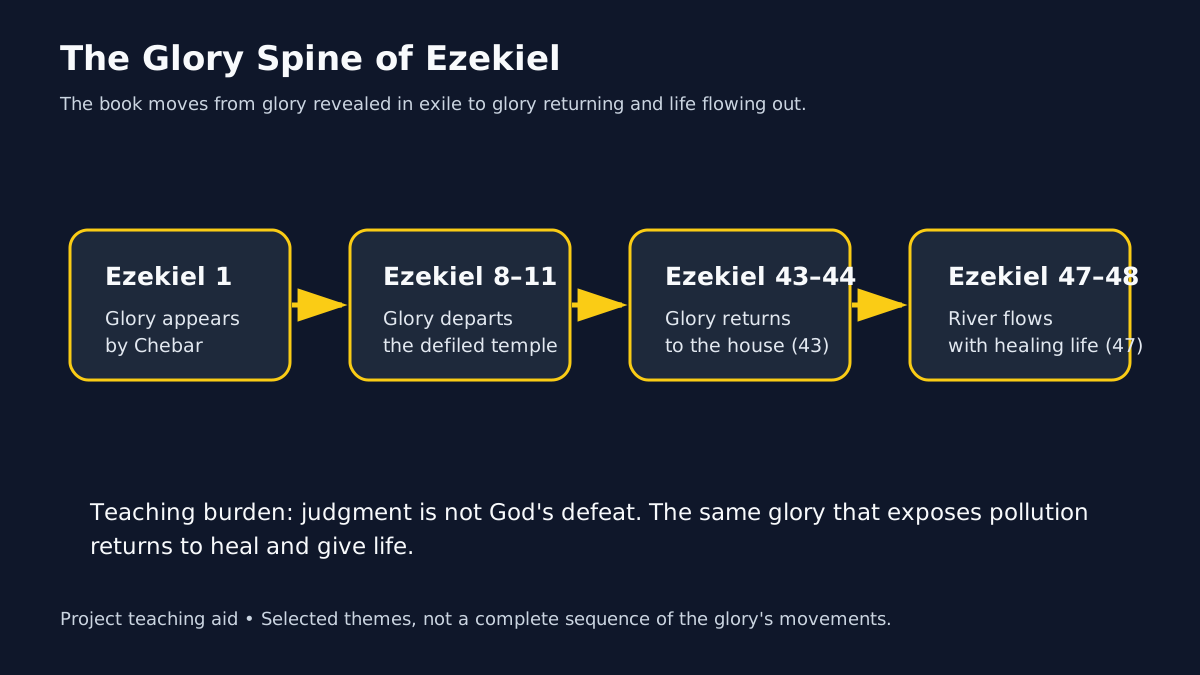 Source: Teaching, 2026-06-19.
The glory leaves by stages and returns in Ezekiel 43. Departure is judgment on polluted worship, not a defeat of the Lord.
The cherubim are the living creatures first seen by Chobar. The image joins chapters 1 and 10: God is neither confined to the temple nor separated from the people in exile.
The departing glory warns that icons, church buildings, and sacred vessels are not magic protection if the heart worships idols. Their beauty calls for truthful worship, not for confidence that sacred surroundings can replace repentance.
The temple remains a holy gift. Its desecration is terrible because worship matters, not because holy places never mattered.
Spiritual Fruit 🍇
-
Receive the little sanctuary. The exiles were told they were far from the Lord, yet God promised to be sanctuary for them. A person who feels displaced, ashamed, or cut off should not conclude that God is absent. The humbled heart can meet Him in a hospital room, prison cell, small apartment, commute, or quiet corner of repentance.
-
Ask for the new heart, not only better habits. Ezekiel does not end with advice. God says He will give another heart and a new spirit. Christian discipline matters, but it must be prayer for God to change the heart. A simple prayer from this unit is: “Lord, remove the stony heart that loves its idols. Give me a heart that can receive Your Spirit.”
Teaching Notes
Ezekiel 10:1-22 - Coals, cherubim, and the glory departing from the house
- Ask: Why is the same glory from Chobar the one that departs?
- Emphasize: The departure is gradual, visible, and morally explained by the previous chapter.
- Watch for: Turning the cherubim and wheels into a code puzzle. Their force here is the free, seeing, living movement of God’s glory.
- Connect: The Lord who meets the prophet in exile is the Lord who departs from the defiled house.
- Practice: Make the sign of the Cross attentively before prayer, remembering that your life belongs to the Lord, not to your idols.
Ezekiel 11:1-13 - Leaders, violence, false security, and Ezekiel’s cry
- Ask: Why does corrupt leadership belong inside the temple judgment vision?
- Emphasize: Corrupt leadership and violence belong inside the temple-judgment vision. Worship and justice cannot be separated.
- Watch for: Politicizing the passage into a simple attack on other groups. Let it search the leaders, servants, and worshippers in the room first.
- Connect: Prophetic courage without tears becomes cruelty; compassion without truth becomes sentimentality.
- Practice: Name one decision this week where worship should change how you treat a person under your influence.
Ezekiel 11:14-25 - A little sanctuary, another heart, and the final departure
- Ask: How can God be a little sanctuary for the scattered while the glory departs the city?
- Emphasize: Restoration begins with God’s gift of a renewed heart and spirit. It is not self-improvement with religious language.
- Watch for: Rushing past the final departure. Hope is spoken from inside judgment, not as denial of judgment.
- Connect: The new heart and new spirit point to life in the Spirit in Christ.
- Practice: Pray daily: “Lord, remove the stony heart that loves its idols. Give me a heart that can receive Your Spirit.”
Glossary
- Abomination: A practice that defiles worship and covenant relationship, especially idolatry and violence in holy places.
- Glory of the Lord: The visible manifestation of God’s presence and holiness, seen in the throne-chariot and departing from the temple.
- Cherubim: Heavenly beings associated with God’s throne; in Ezekiel 10 identified with the living creatures of chapter 1.
- Mark on the forehead: The sign of those who groan and grieve over abominations; a sign of mercy distinguishing the repentant remnant.
- Little sanctuary: God’s promise to be present with the scattered exiles even when the temple is defiled and the glory departs.
- New heart and new spirit: God’s gift of inner renewal that enables obedience; a key new-covenant promise.
Translation and Source Notes
Embedded Scripture is from Brenton’s English Septuagint (LXX).
The absence of 10:14 and 11:11-12, and the different wing count at 10:21, are explained before their passages. The heart is “another heart” in Brenton 11:19; it is the Lord’s gift for an obedient life, not a heart the exile must manufacture alone.
Sources
Coptic Katameros, Sixth Sunday of Great Lent Matins, Matthew 23:1-39, readings; Saturday of the fifth week of Great Lent Liturgy, Matthew 23:14-39, readings.
Coptic Reader, Special / Lakkan / Theophany, Ezekiel 36:24-29; Great Thursday Lakkan, Ezekiel 36:25-29, Lakkan prayers.
Coptic Katameros, Feast of the Ascension Liturgy, Acts 1:1-14; published reading tables.
Eusebius, Proof of the Gospel II.3, item 57, trans. W. J. Ferrar: tertullian.org.
Brenton, Ezekiel 10-11: ebible.org and ebible.org.
Matthew 23:37-39; Luke 19:37-44; Acts 1:1-12; John 1:14 and 2:19-21; 2 Corinthians 3; Romans 8.
Footnotes
-
Coptic Katameros, Feast of the Ascension Liturgy, Acts 1:1-14; published reading tables. ↩
-
Coptic Reader, Special / Lakkan / Theophany, Ezekiel 36:24-29; Great Thursday Lakkan, Ezekiel 36:25-29, Lakkan prayers. ↩ ↩2
-
Eusebius, Proof of the Gospel II.3, item 57, trans. W. J. Ferrar, tertullian.org. ↩
-
Coptic Katameros, Sixth Sunday of Great Lent Matins, Matthew 23:1-39, readings; Saturday of the fifth week of Great Lent Liturgy, Matthew 23:14-39, readings. ↩